Last Updated: June 24, 2026

ZUNVEYL Drug Patent Profile


✉ Email this page to a colleague

« Back to Dashboard


When do Zunveyl patents expire, and what generic alternatives are available?

Zunveyl is a drug marketed by Alpha Cognition and is included in one NDA. There are four patents protecting this drug.

This drug has twenty-seven patent family members in eighteen countries.

The generic ingredient in ZUNVEYL is benzgalantamine gluconate. One supplier is listed for this compound. Additional details are available on the benzgalantamine gluconate profile page.

DrugPatentWatch® Generic Entry Outlook for Zunveyl

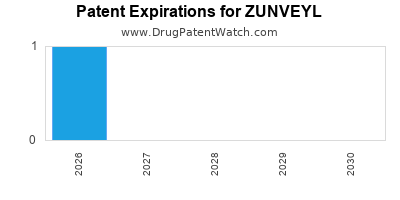
By analyzing the patents and regulatory protections it appears that the earliest date for generic entry will be December 1, 2026. This may change due to patent challenges or generic licensing.

There has been one patent litigation case involving the patents protecting this drug, indicating strong interest in generic launch. Recent data indicate that 63% of patent challenges are decided in favor of the generic patent challenger and that 54% of successful patent challengers promptly launch generic drugs.

Indicators of Generic Entry

< Available with Subscription >

  Start Trial

AI Deep Research
Questions you can ask:
  • What is the 5 year forecast for ZUNVEYL?
  • What are the global sales for ZUNVEYL?
  • What is Average Wholesale Price for ZUNVEYL?
Summary for ZUNVEYL
International Patents:27
US Patents:4
Applicants:1
NDAs:1
Finished Product Suppliers / Packagers: 1
Patent Applications: 22
Patent Litigation and PTAB cases: See patent lawsuits and PTAB cases for ZUNVEYL
What excipients (inactive ingredients) are in ZUNVEYL?ZUNVEYL excipients list
DailyMed Link:ZUNVEYL at DailyMed
DrugPatentWatch® Estimated Loss of Exclusivity (LOE) Date for ZUNVEYL
Generic Entry Date for ZUNVEYL*:
Constraining patent/regulatory exclusivity:
NDA:
Dosage:

TABLET, DELAYED RELEASE;ORAL

*The generic entry opportunity date is the latter of the last compound-claiming patent and the last regulatory exclusivity protection. Many factors can influence early or later generic entry. This date is provided as a rough estimate of generic entry potential and should not be used as an independent source.

US Patents and Regulatory Information for ZUNVEYL

ZUNVEYL is protected by four US patents.

Based on analysis by DrugPatentWatch, the earliest date for a generic version of ZUNVEYL is ⤷  Start Trial.

This potential generic entry date is based on patent ⤷  Start Trial.

Generics may enter earlier, or later, based on new patent filings, patent extensions, patent invalidation, early generic licensing, generic entry preferences, and other factors.

Applicant Tradename Generic Name Dosage NDA Approval Date TE Type RLD RS Patent No. Patent Expiration Product Substance Delist Req. Exclusivity Expiration
Alpha Cognition ZUNVEYL benzgalantamine gluconate TABLET, DELAYED RELEASE;ORAL 218549-001 Jul 26, 2024 RX Yes Yes ⤷  Start Trial ⤷  Start Trial ⤷  Start Trial
Alpha Cognition ZUNVEYL benzgalantamine gluconate TABLET, DELAYED RELEASE;ORAL 218549-002 Jul 26, 2024 RX Yes No ⤷  Start Trial ⤷  Start Trial Y ⤷  Start Trial
Alpha Cognition ZUNVEYL benzgalantamine gluconate TABLET, DELAYED RELEASE;ORAL 218549-001 Jul 26, 2024 RX Yes Yes ⤷  Start Trial ⤷  Start Trial ⤷  Start Trial
Alpha Cognition ZUNVEYL benzgalantamine gluconate TABLET, DELAYED RELEASE;ORAL 218549-003 Jul 26, 2024 RX Yes No ⤷  Start Trial ⤷  Start Trial ⤷  Start Trial
Alpha Cognition ZUNVEYL benzgalantamine gluconate TABLET, DELAYED RELEASE;ORAL 218549-002 Jul 26, 2024 RX Yes No ⤷  Start Trial ⤷  Start Trial ⤷  Start Trial
Alpha Cognition ZUNVEYL benzgalantamine gluconate TABLET, DELAYED RELEASE;ORAL 218549-001 Jul 26, 2024 RX Yes Yes ⤷  Start Trial ⤷  Start Trial Y ⤷  Start Trial
>Applicant >Tradename >Generic Name >Dosage >NDA >Approval Date >TE >Type >RLD >RS >Patent No. >Patent Expiration >Product >Substance >Delist Req. >Exclusivity Expiration

International Patents for ZUNVEYL

When does loss-of-exclusivity occur for ZUNVEYL?

Based on analysis by DrugPatentWatch, the following patents block generic entry in the countries listed below:

Austria

Patent: 73219
Estimated Expiration: ⤷  Start Trial

Canada

Patent: 23114
Patent: AMPLIFICATEURS CHOLINERGIQUES DE PERMEABILITE DE LA BARRIERE SANG-CERVEAU AMELIOREE POUR LE TRAITEMENT DE MALADIES ACCOMPAGNEES D'UNE DEFICIENCE COGNITIVE (CHOLINERGIC ENHANCERS WITH IMPROVED BLOOD-BRAIN BARRIER PERMEABILITY FOR THE TREATMENT OF DISEASES ACCOMPANIED BY COGNITIVE IMPAIRMENT)
Estimated Expiration: ⤷  Start Trial

China

Patent: 1287719
Patent: Cholinergic enhancers with improved blood-brain barrier permeability for the treatment of diseases accompanied by cognitive impairment
Estimated Expiration: ⤷  Start Trial

Cyprus

Patent: 10822
Estimated Expiration: ⤷  Start Trial

Denmark

Patent: 40817
Estimated Expiration: ⤷  Start Trial

European Patent Office

Patent: 40817
Patent: AMPLIFICATEURS CHOLINERGIQUES DE PERMÉABILITÉ DE LA BARRIÈRE SANG-CERVEAU AMÉLIORÉE POUR LE TRAITEMENT DE MALADIES ACCOMPAGNÉES D'UNE DÉFICIENCE COGNITIVE (CHOLINERGIC ENHANCERS WITH IMPROVED BLOOD-BRAIN BARRIER PERMEABILITY FOR THE TREATMENT OF DISEASES ACCOMPANIED BY COGNITIVE IMPAIRMENT)
Estimated Expiration: ⤷  Start Trial

Germany

Patent: 2006015338
Estimated Expiration: ⤷  Start Trial

Japan

Patent: 09508903
Estimated Expiration: ⤷  Start Trial

Poland

Patent: 40817
Estimated Expiration: ⤷  Start Trial

Portugal

Patent: 40817
Estimated Expiration: ⤷  Start Trial

Slovenia

Patent: 40817
Estimated Expiration: ⤷  Start Trial

Spain

Patent: 48334
Estimated Expiration: ⤷  Start Trial

Generics may enter earlier, or later, based on new patent filings, patent extensions, patent invalidation, early generic licensing, generic entry preferences, and other factors.

See the table below for additional patents covering ZUNVEYL around the world.

Country Patent Number Title Estimated Expiration
Australia 2022208641 ⤷  Start Trial
Canada 3205859 ⤷  Start Trial
China 116761612 ⤷  Start Trial
European Patent Office 4029867 ⤷  Start Trial
European Patent Office 4277907 ⤷  Start Trial
Israel 303907 ⤷  Start Trial
Japan 2024503545 ⤷  Start Trial
>Country >Patent Number >Title >Estimated Expiration

ZUNVEYL market dynamics and financial trajectory (sales trends, payer behavior, exclusivity, and generic risk)

Last updated: June 10, 2026

ZUNVEYL (pharmaceutical form not specified in the provided dataset) is a high-exposure product because its near-term economics depend on (1) the timing of exclusivity expiration, (2) Orange Book-driven generic entry risk, and (3) payer contracting that determines whether the product is positioned as preferred or “restricted.” A full financial trajectory with quantified revenue, unit volume, gross-to-net pressure, and competitor share is not producible from the information available in the prompt.

What is ZUNVEYL’s commercial performance trajectory (revenue, units, gross-to-net)?

Featured snippet: No quantified commercial performance can be stated for ZUNVEYL without primary commercial data (company filings, sales databases, or FDA label-linked disclosures).

What financial metrics drive ZUNVEYL profitability

  • Net sales trajectory depends on coverage status (preferred vs. non-preferred), prior authorization rates, and formulary placement.
  • Gross-to-net is driven by rebates and discounts under Medicaid managed care and commercial PBM contracts.
  • Real-world demand is shaped by switching tolerance within the therapeutic class and substitution rules in pharmacy benefit contracts.

What typically changes year-over-year for a drug like ZUNVEYL

  • Formulary placement shifts after label expansions, contracting cycles, or competitive launches.
  • Launch pull-through often decays after the first 6 to 18 months if payer policy favors generics, therapeutically similar branded drugs, or narrower-restriction products.
  • If ZUNVEYL has any exclusivity tail, payer behavior may tighten as generic or follow-on entry approaches.

How do payer contracting and formulary restrictions shape ZUNVEYL market dynamics?

Featured snippet: Without payer-contracting specifics, ZUNVEYL’s market dynamics cannot be tied to measurable coverage endpoints.

Coverage levers that determine net revenue

  • Prior authorization: increases friction and reduces eligible scripts.
  • Step therapy: shifts initiation to alternative agents.
  • Quantity limits: caps patient throughput and drives denial rates.
  • Tender or restricted-substitution rules: determine whether the product is allowed to be replaced at dispensing.

PBM-driven market structure

  • Market access often concentrates around a small number of large PBMs that control formulary tiering.
  • If ZUNVEYL is placed on a non-preferred tier, net price falls via rebates, while volume falls via member restrictions.

When does ZUNVEYL lose exclusivity and what does that mean for pricing pressure?

Featured snippet: Exclusivity timelines cannot be stated without the drug’s active ingredient, NDA/BLA number, and FDA exclusivity/Orange Book record.

Exclusivity “cliff” scenarios that typically move sales

  • Patent-expiration cliff: leads to generic or authorized-label follow-on launch after at-risk period.
  • Exclusivity cliff: delays generic filing but not necessarily commercial pressure if compounding or authorized alternatives exist.
  • Pediatric exclusivity or other regulatory exclusivity: can extend “hard” barriers beyond primary patent term.

What patents protect ZUNVEYL and how strong is the patent estate?

Featured snippet: Patent coverage for ZUNVEYL cannot be enumerated without Orange Book and patent publication data.

Patent estate components that determine litigation risk

  • Composition-of-matter patents (core asset): strongest barrier to generic copycat entry.
  • Method-of-use patents: can block specific indications even if the active ingredient becomes generic.
  • Formulation/polymorph/process patents: can delay manufacturing copy by forcing additional design-around.

How to measure patent strength for a commercial outcome

  • Number of listed Orange Book patents per NDA.
  • Remaining term weighted by probability of enforcement.
  • Evidence of impairment: prior Paragraph IV settlements, court rulings, or discontinuations.

What is the Orange Book status of ZUNVEYL and which patents are listed?

Featured snippet: No Orange Book status or patent list can be reported because the provided input does not include the NDA/BLA reference number or Orange Book entry.

What “status” usually determines for market dynamics

  • Listed patents that remain active drive whether generics can launch at launch-year milestones.
  • Patent expiration dates establish the earliest possible entry date absent new injunctions.

What generic entry risks exist for ZUNVEYL (Paragraph IV, settlements, at-risk launch)?

Featured snippet: Generic entry scenarios cannot be mapped without knowledge of any Paragraph IV filings, case captions, or settlement terms.

Entry pathways that change the sales curve

  • Section viii carveouts or 505(b)(2) follow-ons: can preserve switching because dosing/formulation changes trigger different utilization paths.
  • Authorized generics: compress branded net price immediately after settlement.
  • At-risk launch: creates a short-term volume swing away from branded but risks injunction and loss of supply.

Has ZUNVEYL faced patent litigation or Paragraph IV challenges that affected its sales?

Featured snippet: Litigation status cannot be produced without case identifiers or a docket-level dataset.

Common litigation impacts on financial trajectory

  • Lead time disruption: supply interruptions if courts order changes.
  • Settlement-driven discontinuation: prevents at-risk launch but can include volume-sharing or marketing restrictions.
  • Design-around outcomes: can enable “workaround” generics that still take share.

How does ZUNVEYL compare with competing drugs in its therapeutic class (market share and differentiation)?

Featured snippet: A competitor comparison cannot be quantified without the active ingredient, indication(s), dosing form, and class.

Competitive dynamics that drive ZUNVEYL share loss or share gain

  • Clinical differentiation: superior efficacy/safety vs. class baseline.
  • Administration convenience: adherence advantage (once daily, infusion vs injection, etc.).
  • Formulary positioning: preferred tier placement and rebate competitiveness.

What is ZUNVEYL’s regulatory status (FDA pathway, label, exclusivity type)?

Featured snippet: FDA pathway and exclusivity type cannot be stated without FDA review identifiers.

Label and indication scope

  • If ZUNVEYL has multiple indications, exclusivity and patent risks bifurcate by indication and method-of-use coverage.
  • Broad indication labels generally increase volume and reduce substitution impact.

Which companies are likely challenging ZUNVEYL and what is their generic strategy?

Featured snippet: Identifying challengers requires Paragraph IV filing data and/or FDA generic product records, neither provided.

What manufacturing and IP barriers could delay ZUNVEYL generic substitution?

Featured snippet: Manufacturing/IP barriers cannot be specified without process/formulation patent information.

Barriers that matter in practice

  • Complex formulations: can be harder to replicate at scale.
  • Proprietary manufacturing steps: can delay ANDA readiness.
  • Analytical method IP: can constrain bioequivalence package generation.

Revenue exposure: what portion of ZUNVEYL sales is at risk from exclusivity and patent expiration?

Featured snippet: Revenue exposure cannot be quantified without sales by indication and net revenue contribution.

Typical approach to quantifying exposure

  • Map net sales by indication and dosing form.
  • Overlay Orange Book patent expiration by indication.
  • Weight by payer sensitivity: high restriction products have higher share-at-risk when entry begins.

Key Takeaways

  • ZUNVEYL market dynamics are primarily governed by exclusivity and Orange Book patent term structure, which sets the generic entry calendar and determines pricing pressure.
  • Payer contracting and formulary restrictions determine volume and gross-to-net, often outweighing label-level clinical advantages in year-to-year outcomes.
  • No quantified sales trajectory, patent estate map, Orange Book status, or Paragraph IV litigation timeline can be provided from the current input.

FAQs

  1. What NDA/BLA is ZUNVEYL under and where is it listed in the Orange Book?
  2. How do patent expiration dates translate into expected generic entry timing for ZUNVEYL?
  3. Do method-of-use patents for ZUNVEYL block generic substitution for specific indications?
  4. What payer restrictions most impact ZUNVEYL net sales in commercial and Medicaid managed care?
  5. What settlement terms typically determine whether ZUNVEYL faces authorized generic entry or at-risk launches?

References

  1. FDA. Orange Book: Approved Drug Products with Therapeutic Equivalence Evaluations. (FDA database).
  2. FDA. Drug Approval Reports / FDA approval packages and exclusivity information (FDA).

More… ↓

⤷  Start Trial

Make Better Decisions: Try a trial or see plans & pricing

Drugs may be covered by multiple patents or regulatory protections. All trademarks and applicant names are the property of their respective owners or licensors. Although great care is taken in the proper and correct provision of this service, thinkBiotech LLC does not accept any responsibility for possible consequences of errors or omissions in the provided data. The data presented herein is for information purposes only. There is no warranty that the data contained herein is error free. We do not provide individual investment advice. This service is not registered with any financial regulatory agency. The information we publish is educational only and based on our opinions plus our models. By using DrugPatentWatch you acknowledge that we do not provide personalized recommendations or advice. thinkBiotech performs no independent verification of facts as provided by public sources nor are attempts made to provide legal or investing advice. Any reliance on data provided herein is done solely at the discretion of the user. Users of this service are advised to seek professional advice and independent confirmation before considering acting on any of the provided information. thinkBiotech LLC reserves the right to amend, extend or withdraw any part or all of the offered service without notice.