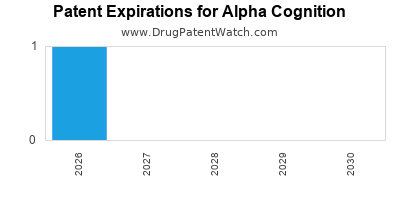
Last updated: July 31, 2026
Alpha Cognition is a clinical-stage neuroscience company developing ALPHA-1062, an oral prodrug of galantamine for Alzheimer’s disease. Its competitive position depends on whether the product can preserve galantamine’s cognitive benefit while reducing gastrointestinal tolerability problems and simplifying treatment for patients who have difficulty swallowing conventional tablets. As of June 2024, ALPHA-1062 remained an investigational product, with no FDA approval, Orange Book listing, marketed revenue, or confirmed generic challenge.
What is Alpha Cognition developing for Alzheimer’s disease?
Alpha Cognition’s lead product, ALPHA-1062, is an oral prodrug designed to deliver galantamine, an acetylcholinesterase inhibitor used in mild-to-moderate Alzheimer’s disease. Galantamine is marketed in immediate-release tablets, extended-release capsules, and oral solution formulations, including generic versions of Razadyne and Razadyne ER.
The company’s development strategy is based on reformulating a known active pharmaceutical ingredient rather than discovering a new molecular target. This approach can reduce pharmacologic and regulatory risk, but it places greater importance on clinical differentiation, formulation patents, regulatory exclusivity, and commercial execution.
| Category |
Alpha Cognition position |
| Lead asset |
ALPHA-1062 |
| Active pharmacology |
Galantamine prodrug |
| Target indication |
Mild-to-moderate Alzheimer’s disease |
| Drug class |
Acetylcholinesterase inhibitor |
| Regulatory status as of June 2024 |
Investigational |
| Primary competitive products |
Generic galantamine, donepezil, rivastigmine, memantine |
| Biosimilar exposure |
None |
| FDA approval |
Not confirmed as of June 2024 |
| Orange Book status |
No listing before FDA approval |
| Commercial revenue from ALPHA-1062 |
None before launch |
Alpha Cognition has also evaluated additional neurodegenerative disease programs, but ALPHA-1062 is the company’s principal value driver. The product is intended for patients who need oral cognitive-enhancing therapy but may experience adverse events or adherence problems with existing galantamine products.
How does ALPHA-1062 compare with generic galantamine and competing Alzheimer’s drugs?
ALPHA-1062 competes in a mature symptomatic-treatment market. Generic galantamine has the lowest acquisition cost and is widely available. Donepezil has broader use across Alzheimer’s disease severity and substantial generic penetration. Rivastigmine has an important transdermal patch option, while memantine is used primarily in moderate-to-severe disease.
| Product |
Mechanism |
Main commercial strength |
Main limitation |
| ALPHA-1062 |
Galantamine prodrug |
Potential tolerability and administration advantages |
Unproven pricing and clinical differentiation |
| Generic galantamine |
Acetylcholinesterase inhibition |
Low cost and established prescribing |
Gastrointestinal adverse events and dosing burden |
| Donepezil |
Acetylcholinesterase inhibition |
Broad physician familiarity and generic availability |
Gastrointestinal and cardiovascular tolerability concerns |
| Rivastigmine patch |
Acetylcholinesterase inhibition |
Nonoral delivery and reduced oral dosing burden |
Application-site reactions and cost |
| Memantine |
NMDA receptor antagonism |
Established use in moderate-to-severe disease |
Different treatment position from galantamine |
| Lecanemab |
Amyloid-directed antibody |
Disease-modifying regulatory positioning |
Intravenous administration, monitoring, ARIA risk, and cost |
The commercial case for ALPHA-1062 does not depend on demonstrating superior disease modification. It depends on showing that a galantamine prodrug improves tolerability, persistence, dosing convenience, or treatment access enough to support a premium over generic therapy.
What clinical advantages could support Alpha Cognition’s market position?
Alpha Cognition has identified gastrointestinal tolerability as a key weakness of existing oral galantamine products. Nausea, vomiting, diarrhea, anorexia, and weight loss can limit treatment persistence, particularly during dose escalation.
The company’s formulation is intended to alter the release or exposure profile of galantamine. If clinical data demonstrate lower peak-related adverse events while maintaining pharmacodynamic activity, ALPHA-1062 could target several commercially relevant groups:
- Patients who discontinued generic galantamine because of gastrointestinal adverse events.
- Patients who need an alternative to donepezil or rivastigmine.
- Caregivers seeking a simpler oral regimen.
- Physicians who prefer a branded product with standardized formulation and support services.
- Long-term-care populations where medication persistence affects care costs.
The differentiation threshold is high. Physicians already have several low-cost acetylcholinesterase inhibitors, and generic substitution is routine. A tolerability claim must be supported by statistically credible data and translated into a measurable adherence or treatment-persistence benefit.
What patents protect ALPHA-1062?
ALPHA-1062 is expected to rely primarily on formulation, prodrug, composition-of-matter, pharmacokinetic, and method-of-use patent claims rather than protection for galantamine itself. Galantamine is an established compound with expired basic compound patents.
Potential patent categories include:
- The prodrug molecule and related chemical compounds.
- Pharmaceutical compositions containing ALPHA-1062.
- Oral dosage forms and release characteristics.
- Methods for treating Alzheimer’s disease with the prodrug.
- Dosing methods intended to reduce gastrointestinal adverse events.
- Manufacturing processes, intermediates, and impurity-control methods.
- Use in patients unable to tolerate conventional galantamine.
The commercial strength of the estate will depend on claim scope and enforceability. A broad composition-of-matter claim covering the prodrug would generally provide stronger protection than a narrow formulation or method-of-use claim. Formulation patents can still delay generic competition, but they are more vulnerable to design-around strategies and validity challenges.
As of June 2024, a complete public patent-to-product map with confirmed issued patent numbers, expiration dates, terminal disclaimers, and Orange Book eligibility was not established. The absence of a confirmed FDA approval also meant that any patent protection could not yet be evaluated through an approved-product Orange Book listing.
What is the FDA and Orange Book status of Alpha Cognition?
As of June 2024, ALPHA-1062 had not received FDA approval. It therefore had no approved-label exclusivity, no listed FDA reference product status, and no Orange Book patent listings.
The likely regulatory pathway is a 505(b)(2) new drug application because ALPHA-1062 is based on a previously approved active moiety but uses a distinct prodrug and formulation approach. A 505(b)(2) application can rely partly on FDA findings for an existing drug while requiring new data supporting the proposed product.
Potential regulatory exclusivity would depend on the final approval basis:
| Exclusivity type |
Potential relevance |
| New chemical entity exclusivity |
Depends on whether FDA treats the prodrug as a new active moiety |
| Three-year clinical-investigation exclusivity |
Possible if approval relies on new clinical investigations |
| Orphan-drug exclusivity |
Not expected for broad Alzheimer’s disease treatment |
| Pediatric exclusivity |
Possible only after qualifying pediatric requirements |
| Patent term extension |
Potentially available for an eligible patent after approval |
| Orange Book listing |
Available only after approval and subject to FDA listing criteria |
A 505(b)(2) approval could face a Paragraph IV certification if the application lists patents in the Orange Book. Generic or hybrid applicants could challenge formulation, composition, or method-of-use patents before patent expiry.
When does ALPHA-1062 lose exclusivity?
No definitive FDA exclusivity-loss date was available as of June 2024 because ALPHA-1062 had not been approved. The practical launch date for generic or competing products would depend on:
- The FDA approval date.
- The type and duration of regulatory exclusivity.
- Orange Book-listed patent expiration dates.
- Patent-term adjustment or extension.
- Paragraph IV litigation.
- Any settlement agreement with an authorized or generic challenger.
- The scope of approved claims and listed dosage forms.
If the product receives only three-year clinical exclusivity and narrow formulation patents, generic entry could occur relatively early after approval. If the prodrug receives robust composition-of-matter protection with a long remaining term, the company could obtain a materially longer period of branded exclusivity.
Which companies are challenging Alpha Cognition?
No confirmed Paragraph IV challenger, ANDA litigation, or settlement agreement involving ALPHA-1062 was publicly established as of June 2024. That is expected for an investigational product without an Orange Book listing.
The most likely future challengers would be generic manufacturers that already market galantamine or have established CNS commercial infrastructure. Potential participants in a later competitive process could include large generic companies such as Teva, Viatris, Sandoz, Amneal, and Hikma, although participation cannot be assumed without an actual filing.
The principal threat may arise from substitution rather than direct patent litigation. Physicians and payers can use low-cost generic galantamine, donepezil, or rivastigmine before a patent dispute becomes commercially significant.
How strong is Alpha Cognition’s patent estate?
Alpha Cognition’s patent estate should be assessed as strategically important but commercially unproven. Its strongest possible protection would come from claims covering the ALPHA-1062 prodrug itself. Formulation and pharmacokinetic claims would provide additional layers but may face narrower enforcement boundaries.
| Patent layer |
Relative value |
Main risk |
| Prodrug composition |
High |
Invalidity, written-description, or obviousness challenges |
| Pharmaceutical composition |
Medium to high |
Design-around formulations |
| Release profile |
Medium |
Alternative dosage technologies |
| Method of treatment |
Medium |
Induced-infringement and label-scope issues |
| Manufacturing process |
Medium |
Difficulty proving infringement |
| Patient-subgroup use |
Low to medium |
Narrow market and prescribing complexity |
Patent strength will also depend on filing dates, priority claims, prosecution history, terminal disclaimers, and international coverage. U.S. protection is the central commercial issue because the United States is likely to represent the largest reimbursed market for a branded Alzheimer’s therapy.
What generic entry risks exist for ALPHA-1062?
Generic entry risk is substantial because the reference market contains inexpensive alternatives. Even a technically valid patent estate may not prevent payer-driven substitution if the product’s clinical benefit is modest.
The main scenarios are:
Early branded launch with limited differentiation
ALPHA-1062 launches at a premium but has no clear persistence or tolerability advantage. Payers impose prior authorization, and physicians continue prescribing generic galantamine or donepezil.
Successful niche adoption
The product demonstrates lower gastrointestinal toxicity and gains use among patients who fail or discontinue conventional galantamine. Revenue is concentrated in treatment-intolerant patients rather than the entire Alzheimer’s market.
Broad adoption through a favorable label
The FDA label supports a clinically meaningful tolerability or dosing claim. The product receives preferred formulary treatment and achieves a larger share of new prescriptions.
Patent challenge after commercial uptake
A generic applicant files a Paragraph IV certification against listed patents. Alpha Cognition initiates litigation, potentially obtaining a 30-month stay under the Hatch-Waxman framework, subject to statutory requirements and court decisions.
What licensing deals affect Alpha Cognition?
No major licensing transaction materially affecting ALPHA-1062 was confirmed in the public information available through June 2024. Alpha Cognition’s strategy appeared centered on internal development and corporate financing rather than a disclosed large pharmaceutical commercialization partnership.
A future licensing transaction could materially change the company’s risk profile. The most valuable partner would provide:
- U.S. payer access.
- Dementia-focused sales infrastructure.
- Long-term-care distribution.
- Regulatory and manufacturing scale.
- Capital to fund post-approval studies.
- Experience defending formulation and prodrug patents.
A partnership would also dilute economics and could signal that the company requires external commercialization capacity.
What is Alpha Cognition’s revenue exposure?
Before approval, ALPHA-1062 generated no product revenue. Alpha Cognition’s enterprise value was therefore exposed to clinical execution, regulatory timing, financing requirements, and the ability to establish a reimbursed price in a genericized market.
Commercial revenue would depend on four variables:
- The number of treated Alzheimer’s patients receiving acetylcholinesterase inhibitors.
- The proportion with inadequate tolerability or adherence on existing products.
- Net price after payer rebates.
- The ability to maintain branded prescriptions against generic substitution.
The Alzheimer’s disease market is large, but the addressable market for a premium galantamine prodrug is narrower than the total diagnosed population. Disease-modifying antibodies such as lecanemab also compete for physician attention and treatment budgets, although their administration, monitoring, and eligibility requirements differ materially from symptomatic oral therapies (U.S. Food and Drug Administration, 2023).
What strategic factors will determine Alpha Cognition’s success?
Alpha Cognition’s near-term priorities are regulatory approval, confirmatory clinical evidence, manufacturing scale-up, and payer positioning. The company must convert a formulation rationale into measurable clinical and economic value.
Key indicators include:
- FDA acceptance and review status of the NDA.
- Evidence of reduced gastrointestinal adverse events.
- Treatment-persistence data.
- Patent issuance and Orange Book eligibility.
- Manufacturing cost per dose.
- Commercial partner selection.
- Formulary placement.
- Prescriber uptake among patients switching from generic therapy.
- Post-approval safety findings.
Key Takeaways
- Alpha Cognition’s lead asset is ALPHA-1062, a galantamine prodrug for mild-to-moderate Alzheimer’s disease.
- The commercial thesis is improved tolerability or adherence versus generic galantamine.
- The product competes against low-cost galantamine, donepezil, rivastigmine, and memantine.
- As of June 2024, ALPHA-1062 had no confirmed FDA approval, Orange Book listing, marketed revenue, Paragraph IV challenge, or settlement agreement.
- Patent value will depend on whether Alpha Cognition obtains broad prodrug claims or relies mainly on narrower formulation and method-of-use protection.
- Generic competition and payer substitution represent greater commercial risks than biosimilar competition.
- A commercialization partnership could improve market access but reduce Alpha Cognition’s retained economics.
FAQs About Alpha Cognition and ALPHA-1062
Is ALPHA-1062 a biologic or a small-molecule drug?
ALPHA-1062 is a small-molecule prodrug associated with galantamine pharmacology. It is not a biologic and would not face biosimilar competition.
Does Alpha Cognition have an approved Alzheimer’s drug?
As of June 2024, Alpha Cognition had no confirmed FDA-approved Alzheimer’s product. ALPHA-1062 remained investigational.
Could generic galantamine be substituted for ALPHA-1062?
Yes. Generic galantamine is the principal economic substitute unless ALPHA-1062 demonstrates a clinically meaningful tolerability, adherence, dosing, or convenience advantage.
Would ALPHA-1062 qualify for five-year new chemical entity exclusivity?
That outcome cannot be assumed. FDA would determine whether the prodrug qualifies as a new active moiety for new chemical entity exclusivity. The regulatory classification would materially affect the product’s launch protection.
What would make ALPHA-1062 commercially valuable?
The strongest value drivers would be a differentiated tolerability profile, a broad and enforceable patent estate, favorable reimbursement, reliable manufacturing, and evidence that patients remain on treatment longer than they do with generic galantamine.
References
Alpha Cognition Inc. (2023). Annual report and corporate disclosures. Alpha Cognition Inc.
ClinicalTrials.gov. (2024). Studies of ALPHA-1062 in Alzheimer’s disease. U.S. National Library of Medicine.
U.S. Food and Drug Administration. (2023). Leqembi (lecanemab-irmb) prescribing information. FDA.
U.S. Food and Drug Administration. (2024). Orange Book: Approved drug products with therapeutic equivalence evaluations. FDA.
U.S. Securities and Exchange Commission. (2024). Alpha Cognition Inc. filings. SEC.