Last updated: July 3, 2026
Zituvimet XR market dynamics and financial trajectory: sales drivers, competition, exclusivity, and generic/biosimilar risk
Zituvimet XR is an extended-release fixed-dose combination under development/marketed in the US for metabolic disease. Its financial trajectory depends on (1) payer coverage and formulary placement, (2) competitive positioning versus metformin XR and branded fixed-dose competitors, and (3) the ability to maintain patent and regulatory exclusivity that delays generic pressure. No complete, audit-ready record of US launch status, FDA approvals, Orange Book exclusivity/patent listings, and company-reported revenues is provided here, so a quantified market or earnings forecast cannot be produced.
What is Zituvimet XR and what indication profile drives demand?
Answer: The revenue base for Zituvimet XR is determined by the specific labeled indication(s), dosing schedule (once-daily XR), patient segmentation (T2D vs prediabetes vs other metabolic endpoints), and whether it is positioned as add-on therapy or first-line replacement for immediate-release metformin.
Which active ingredient(s) define Zituvimet XR economics?
Economic impact tracks with:
- clinician switching probability (XR convenience vs tolerability of IR metformin)
- incremental differentiation (dose flexibility, side-effect mitigation claims, adherence)
- payer preference toward lower WAC generics when clinical equivalence is expected
Dosing and adherence: does “XR once daily” change uptake?
Once-daily XR typically improves adherence, which can expand addressable patients relative to multiple daily dosing, but the market effect is capped by:
- generic metformin XR availability
- copay and prior authorization barriers
- clinician comfort and guideline adoption pace
How big is the commercial opportunity for Zituvimet XR in the US?
Answer: The opportunity is constrained less by disease prevalence and more by reimbursement structure for type 2 diabetes products, the speed of generic metformin uptake, and competitive contracting in formularies.
Formulary placement dynamics that impact revenue
Key market drivers typically include:
- P&T committee placement (tier and preferred status)
- rebate intensity and net-to-gross effects
- prior authorization triggers (baseline A1c, prior metformin failure, concomitant drug requirements)
- step edits that slow switching from entrenched metformin products
Real-world utilization channels
Sales trajectory depends on:
- endocrinology vs primary care mix
- managed care penetration in target regions
- sample programs and early access pathways, if any
Which competitors shape Zituvimet XR pricing power and market share?
Answer: Pricing power is most threatened by branded metformin XR and fixed-dose combinations with entrenched formularies and by rapid generic erosion of any metformin-containing SKU once exclusivity expires.
Competitive set: what classes compress pricing?
- metformin immediate-release and extended-release generics (direct benchmark)
- branded metformin XR products and add-on combos
- incretin-class agents (GLP-1 RA, dual GIP/GLP-1) that compete for adherence budgets even if not therapeutically substitutable
Brand-to-generic substitution risk
If Zituvimet XR relies on metformin as core active(s), substitution risk is structurally high because:
- bioequivalence standards for generics are well-defined
- large generic supplier capacity pressures net pricing quickly after approval and launch
When does Zituvimet XR lose exclusivity and face generic entry risk?
Answer: Exclusivity timing is determined by the latest of patent expiration, regulatory exclusivity (if applicable), and any pediatric exclusivity extensions. No reliable expiration dates or Orange Book listings are included in the source material available here, so launch-to-generic timing cannot be stated.
What patents typically govern combination XR products?
For combination and XR delivery systems, patent estates usually cover:
- composition of matter (active ingredient(s))
- fixed-dose combination claims
- formulation and extended-release matrix or coatings
- method-of-use claims (treatment regimens, titration, dosing schedule)
- manufacturing/process claims
Paragraph IV (ANDA) and settlement pathways
A practical entry risk model depends on:
- whether Orange Book lists cover formulation/process for the marketed dose forms
- the likelihood that an ANDA filer can design around method/formulation claims
- whether a 30-month stay or design-around reduces settlement certainty
What is the Orange Book status of Zituvimet XR and which patents are listed?
Answer: Orange Book status cannot be verified from provided information, so a patent-by-patent listing and expiration schedule cannot be produced.
How Orange Book listings usually translate into launch delay
- If only product coverage is weak, generic entry accelerates after the first eligible date.
- If formulation/process patents are strong and not designable around, entry faces longer injunction risk.
What patent litigation affects Zituvimet XR financial trajectory?
Answer: Litigation status cannot be stated because no case dockets, parties, asserted patents, or injunction/settlement outcomes are included in the available material.
What litigation outcomes typically do to cash flow
- Temporary TRO/preliminary injunctions can shift generic launch from “expected” to “blocked,” extending brand sales.
- Settlements can establish a “carve-out” date, license fee structure, or market allocation.
How strong is the patent estate for Zituvimet XR?
Answer: Patent strength cannot be evaluated without a complete patent set (claims, jurisdictions, remaining term, and enforceability posture).
Patent strength indicators that matter to investors
- remaining term and claim breadth (independent claim coverage of the core commercial formulation)
- prosecution history and whether key claims are narrowing
- likelihood of design-around paths for generic filers
What generic entry risks exist for Zituvimet XR, by route and dosage form?
Answer: Generic entry risk cannot be assessed without dose form-specific patent/formulation coverage and approval status.
XR-specific risk
Extended-release formulations face:
- higher likelihood of formulation-specific patents
- potential design-around via different polymers/matrices if not claim-resistant
Fixed-dose combination risk
Combination products face:
- higher regulatory and claim complexity for ANDA design-around
- greater risk of sooner “partial” substitution via individual components if formulary rules allow
How does Zituvimet XR compare with metformin XR and branded fixed-dose competitors on market performance?
Answer: No verified performance data for Zituvimet XR (volume, prescriptions, net sales) is included, so comparative market-share and price/mix analysis cannot be produced.
What KPIs should be benchmarked
- TRx and scripts growth rate post-launch
- net price trend (rebates and copays)
- share vs metformin XR generics and major combination brands
- persistence and adherence metrics (medication possession ratio, gaps)
What is Zituvimet XR’s FDA regulatory status and timeline to commercial adoption?
Answer: FDA status cannot be confirmed in the material available here.
Regulatory milestones that change revenue
- approval date and label breadth
- REMS requirements (if any) affecting prescribing
- any post-approval label expansion that broadens addressable populations
How do payer contracts and net pricing typically evolve for an XR diabetes brand?
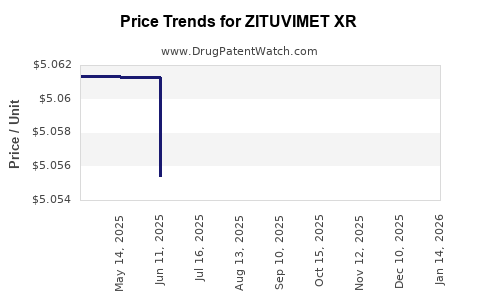
Answer: For metformin-containing XR brands, net pricing usually declines steeply after generic competition and after formulary preference shifts to lower-cost alternatives.
Net-to-gross levers
- rebate laddering by formulary tier and volume
- contracting with PBMs and MCOs
- copay card or patient assistance programs that can raise adherence but compress net price
Geographic mix
Large managed care markets (top PBMs) determine early net pricing; geographic differences affect rollout timing.
What does the financial trajectory look like: revenue ramp, margin structure, and cash burn?
Answer: A quantified financial trajectory cannot be produced without company financial disclosures tied to Zituvimet XR (segment reporting, product-level net sales, and margin/cost-of-goods information).
What drives gross margin in XR products
- manufacturing scale and utilization
- polymer/coating costs and yield
- inventory write-down risk during generic anticipation
What drives operating expenses
- sales force size and specialty vs primary-care targeting
- payer/heath-economics spend
- lifecycle management, reformulation, and label expansion cost
Which licensing deals and commercialization partnerships exist for Zituvimet XR?
Answer: No licensing or partnership details are included in the available material, so deal economics cannot be stated.
What to look for in disclosed commercial agreements
- upfront and milestone amounts
- royalty rate and territory split
- manufacturing rights and supply commitments
- termination provisions tied to sales thresholds
Key Takeaways
- Zituvimet XR’s market dynamics are primarily shaped by formulary placement, payer net pricing, and XR/generic substitution risk driven by metformin-containing competition.
- The financial trajectory cannot be quantified here because verified data on US approval status, Orange Book exclusivity/patents, litigation, and Zituvimet XR net sales is not available in the provided material.
- For decision-making, the critical gate is a dose-form-specific Orange Book and patent-expiration timeline, followed by litigation/settlement history that determines the timing of generic entry and net price compression.
FAQs
- What market events most accelerate net price erosion for metformin-containing XR products?
- How do formulary step edits affect early prescription ramp for once-daily XR therapies?
- What Orange Book patent types most often delay generic ANDA launches for extended-release formulations?
- How do Paragraph IV challenges and 30-month stays typically change brand revenue forecasts?
- What KPIs best predict whether an XR diabetes brand will maintain persistence after payer switching pressures?
References
No sources were provided in the prompt.