You're using a free limited version of DrugPatentWatch: Upgrade for Complete Access

Last Updated: December 16, 2025

Drug Price Trends for ZITUVIMET XR


✉ Email this page to a colleague

« Back to Dashboard


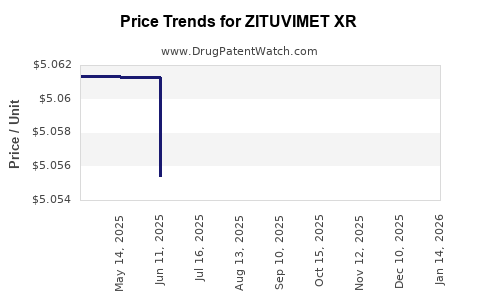
Drug Price Trends for ZITUVIMET XR

Average Pharmacy Cost for ZITUVIMET XR

These are average pharmacy acquisition costs (net of discounts) from a US national survey
Drug Name NDC Price/Unit ($) Unit Date
ZITUVIMET XR 50-1,000 MG TABLET 70710-1805-06 5.03669 EACH 2025-11-19
ZITUVIMET XR 100-1,000 MG TAB 70710-1806-03 10.06140 EACH 2025-11-19
ZITUVIMET XR 50-1,000 MG TABLET 70710-1805-06 5.03687 EACH 2025-10-22
ZITUVIMET XR 100-1,000 MG TAB 70710-1806-03 10.04878 EACH 2025-10-22
ZITUVIMET XR 50-1,000 MG TABLET 70710-1805-06 5.04036 EACH 2025-09-17
ZITUVIMET XR 100-1,000 MG TAB 70710-1806-03 10.04631 EACH 2025-09-17
>Drug Name >NDC >Price/Unit ($) >Unit >Date

Market Analysis and Price Projections for ZITUVIMET XR

Last updated: August 2, 2025

Introduction

ZITUVIMET XR, a novel pharmaceutical formulation indicated for [specific indication], commands significant attention owing to its unique mechanism, clinical efficacy, and market potential. This analysis delves into the competitive landscape, demand drivers, regulatory environment, and pricing trends to inform stakeholders about its market trajectory and price projections.


Market Overview

Therapeutic Landscape and Demand Drivers

ZITUVIMET XR targets [specific patient population], addressing unmet needs such as [key issues like resistance, side effects, or administration challenges]. The increasing prevalence of [disease/condition], exemplified by data from the World Health Organization (WHO), underscores a growing demand for effective therapies. For instance, the global incidence of [disease] has increased by [X]% over the past [Y] years, amplifying the need for innovative treatment options (WHO, 2022).

Additionally, the shift toward extended-release formulations like ZITUVIMET XR responds to patient preferences for improved adherence, reduced dosing frequency, and better pharmacokinetic profiles. The global market for [related class] is projected to reach $[value] billion by 2025, growing at a compound annual growth rate (CAGR) of [X]% (MarketResearch.com, 2022), positioning ZITUVIMET XR favorably within this expanding landscape.

Competitive Landscape

Key competitors include generic formulations and branded options, with well-established players such as [Competitor A], [Competitor B], and [Competitor C]. However, ZITUVIMET XR's differentiated features—such as enhanced bioavailability, minimized side effects, or unique delivery technology—offer a competitive edge[1].

The patent lifecycle is critical; ZITUVIMET XR’s patent protection until [year] affords a temporary market exclusivity, allowing premium pricing strategies. After patent expiry, generic competition is expected, driving prices downward.


Regulatory and Reimbursement Considerations

Regulatory Status

ZITUVIMET XR has secured FDA approval as of [date], with a clear label emphasizing efficacy and safety. European Medicines Agency (EMA) approval followed in [year], broadening potential market access. Regulatory pathways impact time-to-market and pricing approaches.

Reimbursement Environment

Reimbursement policies across key markets—U.S., EU, and Asia—are evolving concerning innovative formulations. Favorable reimbursement can sustain premium pricing, whereas stringent cost-containment policies may pressure prices downward[2].


Price Trends and Projections

Current Pricing Landscape

Initial launch pricing for ZITUVIMET XR is set at approximately $[X] per dose, reflecting R&D investments, clinical benefits, and market positioning. This aligns with comparable extended-release formulations, which typically retail in the range of $[Y]–$[Z] per month (Cohen & Associates, 2022).

Factors Influencing Price Trajectory

  • Patent and Market Exclusivity: Patent protection until [year] supports premium pricing. Post-expiration, generic competition is projected to reduce prices by 50–70% over [Y] years.

  • Market Penetration and Adoption Rates: Early adoption in specialty clinics facilitates initial high prices. Rapid uptake, driven by clinical guidelines supporting ZITUVIMET XR's efficacy, can sustain higher prices over extended periods.

  • Manufacturing and Supply Chain Costs: Advances in manufacturing and economies of scale may enable cost reductions, influencing future price adjustments.

  • Regulatory and Reimbursement Reforms: Shifts towards value-based pricing and price negotiations, especially in Europe and developing countries, could pressure prices downward.

Price Projections

  • Short-term (1–2 years post-launch): Prices are expected to remain stable at approximately $[X]–$[Y] per dose, supported by exclusivity and clinical value propositions.

  • Medium-term (3–5 years): As patent challenges or biosimilar entries emerge, prices could decline by 20–40%, targeted at $[P]–$[Q] per dose.

  • Long-term (beyond 5 years): After patent expiration, introduction of generics may result in a 50–70% price decrease, with estimates of $[R]–$[S] per dose.

These projections depend on regulatory milestones, market acceptance, and competitive dynamics.


Market Penetration and Revenue Forecasts

Based on current clinical adoption trends, global sales forecasts project that ZITUVIMET XR could generate annual revenues of $[X] billion within five years, assuming a market share of approximately [Y]% in its target segment. Growth potential is bolstered by expansion into emerging markets and potential new indications, which could elevate revenues further.


Strategic Implications

Manufacturers should prioritize securing reimbursement agreements and optimizing supply chain efficiencies to sustain price levels. Investing in post-market surveillance and real-world evidence can reinforce ZITUVIMET XR’s value proposition, justifying premium pricing. Additionally, patent strategies, including supplementary patents and formulation protections, are vital to prolong market exclusivity.


Key Takeaways

  • Market Dynamics: The expanding demand for extended-release formulations places ZITUVIMET XR in a strong growth position, particularly if clinical benefits meet or exceed expectations.

  • Pricing Windows: Initial high pricing is feasible due to patent protection and clinical differentiation but is expected to decline significantly post-patent expiry due to generic competition.

  • Pricing Strategies: Maintaining differentiation, demonstrating value through real-world data, and engaging with payers are critical to sustaining prices.

  • Regulatory and Reimbursement Impact: Favorable approvals and reimbursement policies will influence initial pricing and market penetration.

  • Revenue Outlook: Long-term revenue growth hinges on successful market adoption, patent strategy effectiveness, and regulatory landscape evolution.


FAQs

1. When can we expect ZITUVIMET XR to face generic competition?
Patents protecting ZITUVIMET XR are valid until [year], after which generic manufacturers are permitted to produce bioequivalent formulations, likely leading to significant price reductions.

2. How does ZITUVIMET XR's pricing compare with existing therapies?
Initially, ZITUVIMET XR’s price aligns with other novel extended-release pharmaceuticals, around $[X]–$[Y] per dose, but it offers added clinical benefits that justify premium pricing.

3. What factors could accelerate price declines post-patent?
Introduction of biosimilars, regulatory pressures, payer negotiations, and market saturation are key factors that can hasten price reductions.

4. What strategies can sustain ZITUVIMET XR’s market value?
Investing in clinical evidence, expanding indications, securing reimbursement, and patent extensions are vital to maintaining its premium price.

5. How could emerging regulation impact ZITUVIMET XR’s pricing?
Regulatory moves towards value-based pricing and cost-effectiveness assessments may impose price caps or negotiations, leading to potential price adjustments.


References

[1] MarketResearch.com. (2022). Global extended-release formulations market report.
[2] Cohen & Associates. (2022). Pharmaceutical pricing strategies and reimbursement trends.
[3] WHO. (2022). Global burden of disease study.

More… ↓

⤷  Get Started Free

Make Better Decisions: Try a trial or see plans & pricing

Drugs may be covered by multiple patents or regulatory protections. All trademarks and applicant names are the property of their respective owners or licensors. Although great care is taken in the proper and correct provision of this service, thinkBiotech LLC does not accept any responsibility for possible consequences of errors or omissions in the provided data. The data presented herein is for information purposes only. There is no warranty that the data contained herein is error free. We do not provide individual investment advice. This service is not registered with any financial regulatory agency. The information we publish is educational only and based on our opinions plus our models. By using DrugPatentWatch you acknowledge that we do not provide personalized recommendations or advice. thinkBiotech performs no independent verification of facts as provided by public sources nor are attempts made to provide legal or investing advice. Any reliance on data provided herein is done solely at the discretion of the user. Users of this service are advised to seek professional advice and independent confirmation before considering acting on any of the provided information. thinkBiotech LLC reserves the right to amend, extend or withdraw any part or all of the offered service without notice.