Share This Page
ZIRGAN Drug Patent Profile
✉ Email this page to a colleague
When do Zirgan patents expire, and when can generic versions of Zirgan launch?
Zirgan is a drug marketed by Bausch And Lomb and is included in one NDA.
The generic ingredient in ZIRGAN is ganciclovir. There is one drug master file entry for this compound. One supplier is listed for this compound. Additional details are available on the ganciclovir profile page.
AI Deep Research
Questions you can ask:
- What is the 5 year forecast for ZIRGAN?
- What are the global sales for ZIRGAN?
- What is Average Wholesale Price for ZIRGAN?
Summary for ZIRGAN
| US Patents: | 0 |
| Applicants: | 1 |
| NDAs: | 1 |
| Finished Product Suppliers / Packagers: | 1 |
| Raw Ingredient (Bulk) Api Vendors: | 1 |
| Clinical Trials: | 2 |
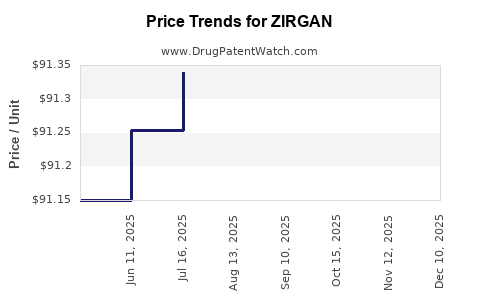
| Drug Prices: | Drug price information for ZIRGAN |
| What excipients (inactive ingredients) are in ZIRGAN? | ZIRGAN excipients list |
| DailyMed Link: | ZIRGAN at DailyMed |
Recent Clinical Trials for ZIRGAN
Identify potential brand extensions & 505(b)(2) entrants
| Sponsor | Phase |
|---|---|
| Bausch & Lomb Incorporated | Phase 2 |
| Northwestern University | Phase 2 |
| Lifelong Vision Foundation | Phase 4 |
Pharmacology for ZIRGAN
| Drug Class | Cytomegalovirus Nucleoside Analog DNA Polymerase Inhibitor Nucleoside Analog Antiviral |
| Mechanism of Action | DNA Polymerase Inhibitors |
US Patents and Regulatory Information for ZIRGAN
| Applicant | Tradename | Generic Name | Dosage | NDA | Approval Date | TE | Type | RLD | RS | Patent No. | Patent Expiration | Product | Substance | Delist Req. | Exclusivity Expiration |
|---|---|---|---|---|---|---|---|---|---|---|---|---|---|---|---|
| Bausch And Lomb | ZIRGAN | ganciclovir | GEL;OPHTHALMIC | 022211-001 | Sep 15, 2009 | RX | Yes | Yes | ⤷ Start Trial | ⤷ Start Trial | ⤷ Start Trial | ||||
| >Applicant | >Tradename | >Generic Name | >Dosage | >NDA | >Approval Date | >TE | >Type | >RLD | >RS | >Patent No. | >Patent Expiration | >Product | >Substance | >Delist Req. | >Exclusivity Expiration |
EU/EMA Drug Approvals for ZIRGAN
| Company | Drugname | Inn | Product Number / Indication | Status | Generic | Biosimilar | Orphan | Marketing Authorisation | Marketing Refusal |
|---|---|---|---|---|---|---|---|---|---|
| Dr. Gerhard Mann, Chem.-Pharm. Fabrik GmbH.. | Vitrasert Implant | ganciclovir | EMEA/H/C/000120The Vitrasert implant is indicated for the local treatment of cytomegalovirus (CMV) retinitis in patients with acquired immunodeficiency syndrome (AIDS) (See 4.4. Special warnings and special precautions for use). | Withdrawn | no | no | no | 1997-03-18 | |
| >Company | >Drugname | >Inn | >Product Number / Indication | >Status | >Generic | >Biosimilar | >Orphan | >Marketing Authorisation | >Marketing Refusal |
ZIRGAN Market Dynamics and Financial Trajectory: Ganciclovir Ophthalmic Gel
ZIRGAN is a mature, niche ophthalmic antiviral marketed by Bausch + Lomb for acute herpetic keratitis caused by herpes simplex virus. Its commercial profile is defined by a small addressable patient population, established clinical substitutes, generic substitution pressure, and limited publicly disclosed product-level financial data. ZIRGAN is unlikely to be a material growth driver for Bausch + Lomb, but it can remain a durable specialty product if prescriber familiarity, formulary access, and supply reliability persist.
What is ZIRGAN and which market does it serve?
ZIRGAN is ganciclovir ophthalmic gel 0.15%. The FDA-approved indication is the treatment of acute herpetic keratitis, also known as dendritic corneal ulcer, in immunocompetent adults and children aged 2 years and older.[1]
| Product attribute | ZIRGAN detail |
|---|---|
| Active ingredient | Ganciclovir |
| Dosage form | Ophthalmic gel |
| Strength | 0.15% |
| Administration | Initially five times daily until the ulcer heals, followed by three times daily for seven days |
| Therapeutic area | Ophthalmology, ocular antivirals |
| Primary condition | Acute herpetic keratitis |
| FDA approval | 2009 |
| Regulatory pathway | New Drug Application 022211 |
| Current commercial owner | Bausch + Lomb |
| Drug class | Small-molecule antiviral |
| Biosimilar exposure | None |
The product occupies a narrow segment of the ophthalmic anti-infective market. Its primary clinical competitors are topical trifluridine and oral acyclovir or valacyclovir used in selected treatment strategies. The relevant market is not the entire ophthalmic anti-infective category; it is the treatment of epithelial herpes simplex keratitis.
How large is the ZIRGAN market?
The ZIRGAN market is limited by disease prevalence, treatment duration, and the availability of alternative antivirals. Herpes simplex keratitis is clinically important but does not generate the prescription volume associated with chronic glaucoma, dry eye disease, allergic conjunctivitis, or cataract-related products.
Demand is concentrated among:
- Cornea specialists
- General ophthalmologists
- Emergency departments and urgent eye-care clinics
- Academic medical centers
- Pediatric ophthalmologists treating eligible children
Treatment is generally episodic rather than chronic. That limits refill frequency and reduces lifetime revenue per patient. The initial dosing schedule is intensive, but most courses are short and tied to an acute episode.
What drives demand for ZIRGAN?
The principal demand drivers are:
- Diagnosis of epithelial herpes simplex keratitis.
- Physician preference for ganciclovir gel over older topical antivirals.
- Availability through retail and specialty pharmacies.
- Insurance coverage and patient copay levels.
- Product supply and generic substitution rules.
- Clinical familiarity with the approved dosing regimen.
The product can retain demand even in a mature market because treatment decisions are often made by specialists and are influenced by formulation preference, tolerability, and local prescribing habits.
What is the financial trajectory for ZIRGAN?
Bausch + Lomb does not publicly report ZIRGAN revenue as a separate line item in its public financial statements. The product is included within broader pharmaceutical or prescription-product reporting. As a result, standalone sales, gross margin, prescription volume, and geographic revenue cannot be calculated from company filings.
| Financial indicator | Publicly available position |
|---|---|
| Standalone annual revenue | Not separately disclosed |
| Unit volume | Not separately disclosed |
| Product gross margin | Not separately disclosed |
| Product-specific marketing expense | Not separately disclosed |
| Product-specific sales growth | Not separately disclosed |
| Reported segment | Included in broader Bausch + Lomb pharmaceutical reporting |
| Revenue maturity | Mature branded product |
| Growth profile | Likely limited by narrow indication and generic competition |
The commercial trajectory is best characterized as mature and defensive rather than growth-oriented.
Early commercial phase
Following FDA approval in 2009, ZIRGAN offered an alternative to trifluridine, with a gel formulation and a dosing regimen intended for treatment of epithelial herpetic keratitis. Early commercial value came from product differentiation, physician adoption, and branded pricing.
Mature branded phase
As clinical familiarity increased, the product entered a maintenance phase. Revenue became dependent on recurring diagnosis volume, specialist prescribing, insurance coverage, and continued brand recognition. New indication expansion has not materially broadened the market.
Generic and post-exclusivity phase
The principal financial pressure is price competition from ganciclovir ophthalmic gel products and therapeutic substitution. Once generic versions are available and accepted by payers, branded net pricing typically declines. ZIRGAN may retain a branded segment among physicians or patients who prefer the originator product, but the volume opportunity is constrained.
The likely financial profile is therefore:
- Stable or declining nominal revenue.
- Declining average selling price where generic substitution is active.
- Lower promotional requirements than during launch.
- Continued value from manufacturing scale and established distribution.
- Limited opportunity for major revenue expansion without a new indication or reformulation.
When does ZIRGAN lose exclusivity?
ZIRGAN’s meaningful market exclusivity has expired. The product was approved in 2009, and its original regulatory exclusivity period for a new drug has long ended. Any patent protection associated with the original ophthalmic formulation would also be expected to have expired or reached the end of its enforceable term by the current commercial period.
FDA approval is not the same as continuing market exclusivity. The controlling records are:
- FDA Drugs@FDA for NDA 022211.
- FDA’s Approved Drug Products with Therapeutic Equivalence Evaluations, commonly called the Orange Book.
- Applicable U.S. patents listed for the product.
- Court decisions and settlement agreements involving abbreviated new drug applications.
No current FDA regulatory exclusivity is identified in the principal public product materials for ZIRGAN.[2][3]
What patents protect ZIRGAN?
ZIRGAN’s original intellectual-property position centered on the use of ganciclovir in an ophthalmic gel formulation for herpetic keratitis. That protection is commercially mature and does not create the same barrier as a recently issued formulation or delivery patent.
| IP category | ZIRGAN position |
|---|---|
| Active ingredient patent | Ganciclovir is an old active ingredient |
| Ophthalmic formulation patents | Historical protection associated with the gel formulation |
| Method-of-use patents | Historical treatment protection may have supported the product |
| Current exclusivity value | Limited |
| Manufacturing protection | Potentially relevant for formulation quality and process control |
| Trade secrets | May protect manufacturing know-how but are difficult to quantify publicly |
| Patent cliff | Effectively passed for the original product |
Are there formulation patents for ZIRGAN?
The formulation is commercially relevant because ophthalmic gel delivery can affect retention time, administration frequency, and ocular tolerability. A formulation patent can be more valuable than an active-ingredient patent for an old antiviral such as ganciclovir.
That protection does not automatically prevent generic entry. Generic applicants can challenge patents, design around formulation claims, or wait for expiration. The economic effect depends on the exact Orange Book listing and the claims asserted in litigation.
Are there method-of-use patents for ZIRGAN?
The product’s use in acute herpetic keratitis is a narrow indication. Method-of-use claims may be relevant to labeling and paragraph IV disputes, but they generally provide less durable protection when the underlying disease and active ingredient are well established.
What is the Orange Book status of ZIRGAN?
ZIRGAN is an FDA-approved prescription product under NDA 022211. Orange Book analysis should focus on:
- Whether the reference-listed drug remains active.
- Whether any patent is currently listed.
- Whether FDA has approved therapeutically equivalent products.
- Whether the reference product is subject to an active exclusivity period.
- Whether generic applicants have filed paragraph IV certifications.
The product’s main regulatory advantage is its status as an FDA-approved reference product. Its main regulatory weakness is the absence of meaningful new-drug exclusivity at this stage of its lifecycle.
Which companies are challenging ZIRGAN?
The competitive challenge comes primarily from manufacturers of generic ganciclovir ophthalmic gel and from companies marketing alternative topical or systemic antivirals. Publicly available company filings do not identify a major branded litigation campaign around ZIRGAN comparable to the litigation associated with high-revenue small molecules.
What does a Paragraph IV challenge mean for ZIRGAN?
A paragraph IV certification would assert that a listed patent is invalid, unenforceable, or not infringed. For an older product with limited remaining patent life, the commercial importance of such a challenge depends on:
- The existence of an active listed patent.
- The generic applicant’s expected launch date.
- The size of the branded market.
- The strength of the formulation claims.
- Whether the parties settle before launch.
- The availability of non-infringing generic labeling.
A paragraph IV case involving ZIRGAN would likely have a lower absolute settlement value than a challenge involving a blockbuster drug because the addressable market is small and treatment is episodic.
What generic entry risks exist for ZIRGAN?
Generic entry is the central commercial risk. The risk is greater than biosimilar risk because ZIRGAN is a conventional small-molecule drug and can be copied through the ANDA pathway.
| Risk factor | Commercial effect |
|---|---|
| Generic ganciclovir gel approval | Direct price and volume pressure |
| Pharmacy substitution | Rapid conversion from brand to generic |
| Narrow indication | Limits the value of brand loyalty |
| Short treatment courses | Reduces refill-based retention |
| Specialist prescribing | May slow substitution in some practices |
| Formulation familiarity | Can preserve a limited branded niche |
| Supply disruptions | Can temporarily support branded demand |
| Payer exclusion | Can sharply reduce brand access |
The strongest protection against immediate erosion is not patent exclusivity. It is operational: manufacturing reliability, wholesaler availability, payer positioning, and physician preference.
How does ZIRGAN compare with competing treatments?
| Treatment | Main advantage | Main limitation | Competitive effect on ZIRGAN |
|---|---|---|---|
| ZIRGAN | Gel formulation; approved for acute herpetic keratitis | Narrow indication; branded price exposure | Reference treatment in its segment |
| Trifluridine ophthalmic solution | Established topical antiviral | Frequent dosing and ocular tolerability concerns | Long-standing clinical substitute |
| Acyclovir or valacyclovir | Oral administration; useful in broader herpes management | Systemic exposure; not identical to topical treatment | Substitution in selected patients |
| Compounded ophthalmic antivirals | Potential formulation flexibility | Variable access, quality, and reimbursement | Localized price pressure |
| Generic ganciclovir gel | Lower cost; likely pharmacy preference | Availability and formulation equivalence depend on product | Direct threat to ZIRGAN |
ZIRGAN’s competitive position depends on whether clinicians value its gel formulation enough to resist automatic generic substitution. Its approved indication and established clinical use support continued demand, but they do not create strong protection against lower-cost equivalents.
What FDA regulatory issues affect ZIRGAN?
ZIRGAN has a conventional small-molecule FDA pathway. The most relevant regulatory issues are:
- Continued maintenance of the NDA.
- Manufacturing compliance and product quality.
- Labeling consistency.
- Generic ANDA approvals.
- Therapeutic-equivalence determinations.
- Adverse-event monitoring.
- Supply continuity for ophthalmic products.
The label warns about blurred vision and ocular irritation and instructs patients to avoid contact between the tube tip and the eye or surrounding structures.[1] These issues affect patient experience and product handling but have not created a known regulatory barrier to continued marketing.
What manufacturing and intellectual-property barriers remain?
Ophthalmic products have higher manufacturing sensitivity than many oral solid products. Relevant barriers include:
- Sterility assurance.
- Container-closure integrity.
- Consistent gel rheology.
- Uniform ganciclovir concentration.
- Microbial control.
- Tube and applicator performance.
- Stability over the labeled shelf life.
- Prevention of contamination during repeated use.
These requirements can delay or complicate generic development, but they are manufacturing barriers rather than durable exclusivity rights. A capable ophthalmic manufacturer can eventually address them through formulation development, process validation, and FDA approval.
What is the outlook for ZIRGAN revenue?
ZIRGAN’s revenue outlook is likely flat to declining in nominal terms, with performance determined by generic penetration and payer behavior rather than disease-market expansion.
Base-case commercial scenario
The base case is continued availability as a mature branded ophthalmic antiviral, with gradual price and volume pressure from generic products. Bausch + Lomb retains revenue from brand prescriptions, but the product remains a small contributor to company-wide growth.
Downside scenario
The downside case involves rapid pharmacy substitution, formulary exclusion, or a low-price generic entrant with reliable supply. In that scenario, branded ZIRGAN revenue could contract materially without a corresponding decline in clinical use of ganciclovir gel.
Upside scenario
The upside case is limited. It would require one or more of the following:
- A supply disruption affecting competitors.
- Expanded use in a broader herpes-related indication.
- A differentiated reformulation.
- Improved reimbursement.
- A strategic licensing transaction.
- Continued physician preference for the branded product.
No major public licensing transaction or indication expansion has been identified as a current driver of ZIRGAN’s value.
How strong is the ZIRGAN patent estate?
ZIRGAN has a weak-to-moderate commercial patent position today, despite the historical importance of its ophthalmic formulation protection.
| Patent-estate factor | Assessment |
|---|---|
| Active ingredient exclusivity | Weak; ganciclovir is mature |
| Regulatory exclusivity | Expired |
| Historical formulation protection | Relevant historically, limited current value |
| Method-of-use protection | Narrow and mature |
| Manufacturing know-how | Potentially useful but not publicly quantifiable |
| Generic barrier | Moderate technical barrier, low legal barrier |
| Litigation leverage | Limited absent an active, enforceable listed patent |
| Overall current strength | Low to moderate |
The key distinction is between product defensibility and commercial persistence. ZIRGAN can continue selling after patent expiry, but that persistence would come from clinical familiarity, distribution, and brand positioning rather than exclusivity.
What litigation and settlement activity affects ZIRGAN?
Publicly disclosed litigation and settlement activity involving ZIRGAN is limited compared with major ophthalmic products such as anti-VEGF agents, glaucoma drugs, or dry-eye therapies. The absence of major reported litigation is consistent with the product’s modest revenue opportunity and mature patent position.
A future dispute would most likely involve:
- An ANDA applicant’s paragraph IV certification.
- Formulation or manufacturing claims.
- Labeling differences for the herpes keratitis indication.
- Patent delisting or Orange Book eligibility.
- Product quality or supply issues.
The economic incentive to litigate aggressively is constrained by the relatively small market.
Key Takeaways
- ZIRGAN is ganciclovir ophthalmic gel 0.15%, approved in 2009 for acute herpetic keratitis.
- Bausch + Lomb is the current commercial owner.
- The product is mature, niche, and not separately reported in public financial statements.
- Standalone ZIRGAN revenue, margin, prescription volume, and growth rates are not publicly disclosed.
- Regulatory exclusivity has expired, and the original patent value is substantially diminished.
- Generic ganciclovir ophthalmic gel is the principal commercial threat.
- Biosimilar risk does not apply because ZIRGAN is a small-molecule drug.
- Manufacturing complexity provides some practical entry friction but not durable market exclusivity.
- Revenue is more likely to remain stable or decline than to grow materially.
- The product’s residual value lies in brand recognition, specialist prescribing, distribution, and supply reliability.
Frequently Asked Questions
Is ZIRGAN still FDA approved?
Yes. ZIRGAN remains an FDA-approved ganciclovir ophthalmic gel product for acute herpetic keratitis under NDA 022211.[2]
Is ZIRGAN a biologic or a biosimilar?
No. ZIRGAN is a conventional small-molecule antiviral. Generic competition proceeds through the ANDA pathway rather than the biosimilar pathway.
Does Bausch + Lomb disclose ZIRGAN sales?
No. Bausch + Lomb reports products within broader business segments and does not separately disclose ZIRGAN revenue in its public financial reporting.
Can pharmacies automatically substitute generic ganciclovir for ZIRGAN?
Substitution depends on FDA therapeutic-equivalence status, state pharmacy law, payer policy, and the prescriber’s instructions. FDA Orange Book status is the central reference for therapeutic-equivalence analysis.
Is ZIRGAN a significant revenue product for Bausch + Lomb?
Public filings do not identify ZIRGAN as a separately material revenue contributor. Its narrow indication and mature competitive position indicate a specialty-product role rather than a major companywide growth asset.
References
-
U.S. Food and Drug Administration. (2019). ZIRGAN (ganciclovir ophthalmic gel) prescribing information. Bausch & Lomb Incorporated. https://www.accessdata.fda.gov/drugsatfda_docs/label/2019/022211s005lbl.pdf
-
U.S. Food and Drug Administration. (n.d.). Drugs@FDA: ZIRGAN, NDA 022211. https://www.accessdata.fda.gov/scripts/cder/daf/index.cfm
-
U.S. Food and Drug Administration. (n.d.). Approved drug products with therapeutic equivalence evaluations, Orange Book. https://www.accessdata.fda.gov/scripts/cder/ob/index.cfm
-
Bausch + Lomb Corporation. (2024). Annual report pursuant to Section 13 or 15(d) of the Securities Exchange Act of 1934. https://ir.bausch.com/financial-information/sec-filings
More… ↓
