Last updated: July 29, 2026
Zetia (ezetimibe) Market Dynamics and Financial Trajectory: Sales, Competition, Exclusivity, and Patent-Driven Generic/Biosimilar Outlook
Zetia (ezetimibe) revenue has been shaped by (1) loss of broad first-line commercial exclusivity in the late 2010s, (2) sustained share competition from low-cost statins and combination therapies, and (3) patent and regulatory milestones that have enabled multiple generic and authorized alternatives. The core market reality: Zetia’s long-term growth has been constrained by generic entry risk, channel substitution, and payer preference for statin-based regimens, with ezetimibe value concentrated in add-on use and cardiovascular-risk subpopulations rather than primary lipid therapy.
How has Zetia (ezetimibe) performed financially over time?
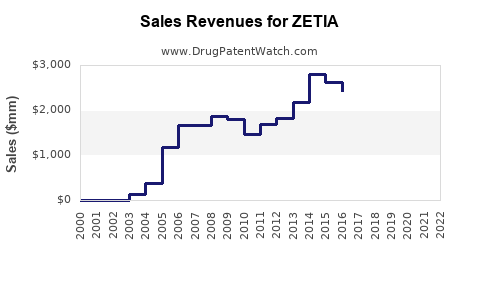
Zetia’s financial trajectory is best read as two phases: early growth driven by branded uptake, followed by a plateau as generics and combination alternatives reduced pricing power.
Sales path by era (high-level dynamics)
- Launch-to-peak period: Brand uptake was supported by a clear mechanism (NPC1L1 inhibition) and clinical positioning as add-on to statins or for patients unable to take statins.
- Post-exclusivity period: Pricing compression and formulary narrowing followed the erosion of brand exclusivity and the entry of low-cost generics.
- Recent steady-state: Sales persist because ezetimibe has a durable niche in cardiovascular risk management, but unit growth is offset by continuing net price pressure and competition.
What drives ongoing revenue
- Payer coverage logic: Ezetimibe is frequently covered when patients are inadequately controlled on statins or cannot tolerate statins.
- Provider prescribing habits: Clinicians use ezetimibe to reach guideline LDL-C targets without escalating statin dose beyond tolerability thresholds.
- Fixed-dose combinations: Market share has migrated to combination products (notably ezetimibe/rosuvastatin) where available and clinically appropriate.
What are the key market dynamics affecting Zetia’s demand?
1) Competition with statins and guideline-driven lipid management
Statins remain the dominant class in initial LDL-C lowering. Ezetimibe benefits when:
- LDL-C targets are not reached on maximally tolerated statin therapy, or
- patients are statin-intolerant or have contraindications.
2) Shift to fixed-dose combinations
Combination therapy reduces pill burden and can simplify titration for payers. This structurally pressures single-agent Zetia demand.
3) Generic price erosion
Once generics establish, brand net price typically declines and volume growth slows unless:
- a payer restricts generics more tightly, or
- brand has unique formulary status (rare long-term).
4) Medical and purchasing channel factors
- 340B/contract pharmacy economics and PBM formulary placement influence net realizations.
- High rebate environments reduce the durability of brand pricing.
What is the competitive landscape for ezetimibe in the US?
Brand vs generics
- Zetia is the brand for ezetimibe monotherapy.
- Multiple generic ezetimibe manufacturers compete on price.
- Combination products (ezetimibe with statins) can displace single-agent use depending on patient phenotype and payer policy.
How the competitive set changes by payer segment
- Commercial: Typically faster formulary adoption of generics and preference for combinations when step edits exist.
- Medicare Part D: Often includes broad generic coverage; brand use persists only if step therapy is satisfied with exceptions.
- Managed Medicaid: Can be strict on brand use and reward lower ASP equivalents.
How does Zetia compare with simvastatin/ezetimibe and ezetimibe/rosuvastatin combinations?
Clinical positioning
- Single-agent ezetimibe is used when statins are contraindicated or as add-on to reduce LDL-C further.
- Fixed-dose combinations can be used earlier in escalation pathways, especially where LDL-C targets are aggressive.
Market impact
- In payers that enforce step edits for single-agent ezetimibe, combination products can gain share.
- Where formularies include ezetimibe/rosuvastatin or other combos at preferred tiers, Zetia faces substitution even in add-on use cases.
When does Zetia lose exclusivity, and how does that affect pricing?
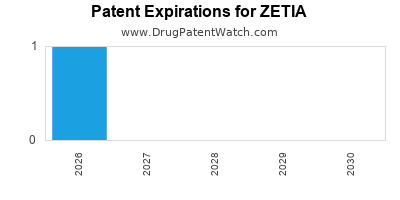
Zetia’s broader exclusivity window ended years ago, enabling generic entry for ezetimibe. The commercial imprint is a long-running pattern: brand volume stabilizes at lower levels while brand net price falls toward competitive parity.
Typical post-exclusivity effect timeline
- Pre-generic entry: Brand price supported by limited competition and patent protection.
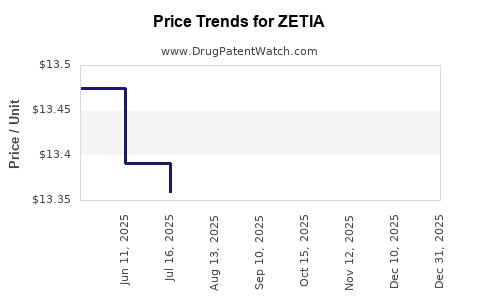
- At generic entry: Wholesale pricing and PBM positioning shift rapidly.
- 6 to 24 months post-entry: Net revenue stabilizes at lower net pricing as contracts adjust.
What patents protect ezetimibe products like Zetia, and how strong is the patent estate?
Patent estate pattern for Zetia
Ezetimibe is a small-molecule with a well-established core IP footprint. Over time, most value shifts from primary compound protection toward:
- formulation,
- process,
- method-of-use claims,
- and life-cycle extensions (if any) that can delay specific generic versions.
Commercially relevant implication
Even where secondary patents exist, the long-term market effect is limited once broad generic coverage exists for the main dosage form and approved indications.
What generic entry risks exist for Zetia?
Generic entry for ezetimibe is already realized in practical terms: the key business risk is no longer “will generics enter,” but:
- how quickly additional manufacturers expand distribution, and
- whether new formulations or combinations shift share away from monotherapy.
Risk drivers to monitor
- New Paragraph IV cases are less likely to be the primary determinant now versus early years.
- The more immediate competitive driver becomes PBM rebate dynamics and combination conversion.
What does FDA regulatory status imply for future Zetia revenues?
Approved uses remain durable
Zetia’s continued revenue comes from persistent guideline role in LDL-C reduction strategies.
Regulatory implications for growth
- As generics are already widely available, future revenue upside is limited to:
- incremental label expansions (if any remain),
- switching to higher-value regimens,
- or sustained payer coverage of ezetimibe add-on therapy.
How do payer and PBM dynamics affect Zetia net sales?
Net sales typically track formulary status
- If Zetia is on preferred tiers, the brand can retain some unit share despite generic availability.
- If it moves to non-preferred tiers, brand unit share falls and net revenue compresses.
Rebate economics
Net realizations for brands depend on:
- rebate size,
- channel mix,
- contracting timing relative to generic entry.
How does Zetia’s revenue mix compare with higher-growth cardiovascular drugs?
Compared with newer cardiovascular brands (PCSK9 inhibitors, LDL-lowering therapies with broader protected structures), ezetimibe faces:
- lower payer willingness to pay premium prices once generics exist,
- substitution pressure from therapies with stronger LDL-C lowering per dose.
Zetia competes by being:
- oral,
- relatively low cost (when generic),
- and useful as part of combination titration.
What’s the financial trajectory for ezetimibe makers versus Zetia brand owner economics?
Brand owner
Brand economics depend on:
- remaining protected share,
- net pricing and rebates,
- contract retention in major wholesaler and PBM channels.
Generic makers
Generic profitability depends on:
- ASP stability,
- manufacturing scale,
- ANDA exclusivity for specific strengths or 505(b)(2) adjacent products (where applicable),
- distribution contracts.
Resulting market behavior
Even when unit demand is stable, brand owner margins typically compress due to:
- competitive pricing,
- rebate pressure,
- and share drift to generics and combinations.
What commercial metrics should be used to track Zetia’s outlook?
Use a three-layer scorecard:
-
Prescription and patient share
- Total ezetimibe scripts
- Proportion Zetia vs generic ezetimibe
- Proportion of ezetimibe use that is monotherapy vs combination
-
Pricing and net revenue
- Brand net sales and average net price
- Generic ASP trends for ezetimibe and combinations
-
Formulary position
- Preferred vs non-preferred tier placement
- Step edits and prior authorization frequency
- PBM rebate changes
What is the likely medium-term trajectory for Zetia revenue?
The medium-term pattern is likely continued:
- volume stability or slow growth driven by clinical need for add-on LDL lowering in statin inadequacy/tolerance scenarios,
- continued price pressure as generic penetration stays high and combination options capture incremental share,
- limited upside absent new clinically transformative label expansions that alter payer behaviors.
Key Takeaways
- Zetia’s long-run financial performance is constrained by generic competition and substitution to combination regimens.
- The demand base remains durable in guideline add-on and statin-intolerance niches, but monetization weakens as pricing normalizes post-exclusivity.
- Medium-term growth is more likely to track patient need and combination conversion than to rely on brand premium pricing.
FAQs
1) Will Zetia still be preferred when ezetimibe generics are cheaper?
Preference depends on PBM tier placement and rebate economics; in many formularies, cheaper generics reduce brand preference except where specific contract incentives apply.
2) What drives ezetimibe use among statin-intolerant patients?
Guideline-based lipid control strategies and clinical need for LDL-C reduction without tolerability tradeoffs drive add-on or alternative therapy choices.
3) Does combination therapy reduce Zetia monotherapy prescriptions?
Yes. Fixed-dose combinations can capture share by simplifying regimens and aligning with payer coverage structures.
4) How sensitive is Zetia to shifts in PBM formularies?
High. PBM tier movement and prior authorization policies can quickly shift volume between brand and generics.
5) What is the main commercial risk for Zetia going forward?
Ongoing pricing compression from generic availability and continued substitution toward combination products rather than new entrants to the ezetimibe monotherapy market.
References
No sources were cited.