Last updated: January 19, 2026
Executive Summary
ZETIA (ezetimibe), developed by Merck & Co., is a lipid-lowering agent approved for reducing LDL cholesterol in conjunction with diet and other lipid-lowering therapies. As a monotherapy or combination therapy, ZETIA maintains a significant position within the hyperlipidemia market. This report analyzes current market dynamics, pricing strategies, competitive landscape, regulatory influences, and forecasts future price trajectories and market share movements through 2030.
Overview of ZETIA
| Attribute |
Details |
| Generic Name |
Ezetimibe |
| Manufacturer |
Merck & Co. (Key markets), Novartis (post-2016 licensing) |
| Approval Date |
2002 (FDA), EMEA (2002) |
| Indications |
Hyperlipidemia, heterozygous familial hypercholesterolemia, homozygous familial hypercholesterolemia (in combination) |
| Dosage Forms |
Tablets (10 mg) |
| Combination Formulations |
ZETIA + Simvastatin (Vytorin), ZETIA + Atorvastatin (Caduet) |
Current Market Landscape
Market Size & Segmentation (2022 Data)
| Region |
Market Value (USD billion) |
Market Share |
Key Competitors |
| North America |
2.8 |
50% |
Lipitor, Crestor, PCSK9 inhibitors (Alirocumab, Evolocumab) |
| Europe |
1.6 |
28% |
Lipitor, Praxbind, PCSK9 inhibitors |
| Asia-Pacific |
0.8 |
14% |
Generic statins, emerging PCSK9 inhibitors |
| Rest of World |
0.3 |
8% |
Generic statins, local lipid-lowering meds |
Key Market Drivers
- Rising prevalence of hyperlipidemia and cardiovascular disease.
- Increasing adoption of combination therapies, notably ZETIA with statins.
- Evolving treatment guidelines recommending aggressive LDL lowering.
- Patent expirations and generic options impacting pricing dynamics.
Competitive Landscape
| Drug Class |
Major Agents |
Market Share (2022) |
Notes |
| Statins |
Atorvastatin, Rosuvastatin |
55% |
First-line therapy |
| Ezetimibe (ZETIA) |
Ezetimibe |
10% |
Often combined with statins |
| PCSK9 Inhibitors |
Alirocumab, Evolocumab |
15% |
High-cost, reserved for resistant cases |
| Fibrates |
Fenofibrate, Gemfibrozil |
8% |
Used in mixed dyslipidemia |
| Others |
Niacin, bile acid sequestrants |
12% |
Variable usage |
Pricing Overview
| Pricing Parameter |
Brand-Name ZETIA (USD per 30 tablets) |
Generic Ezetimibe (USD per 30 tablets) |
| United States |
$300 - $350 |
$20 - $50 |
| Europe |
€250 - €330 |
€15 - €40 |
| Asia-Pacific |
$120 - $250 |
$10 - $30 |
Note: Prices vary by healthcare setting, insurance coverage, and market regulations.
Regulatory & Policy Influences
- Patent Status & Generics: Merck’s patent expiring in most markets by 2016, leading to increased generics.
- Regulatory Approvals: Proven safety profile; recent approvals for combination therapies expand indication scope.
- Pricing & Reimbursement Policies: Controlled pricing in Europe; variable in emerging markets.
- Value-Based Pricing: Increasing emphasis on cost-effectiveness evidenced by phase 4 post-marketing studies.
Future Price Trends & Market Projections (2023–2030)
Market Drivers for Future Pricing
- Introduction of biosimilars/competitor drugs.
- Reimbursement policies favoring cost-effective therapies.
- Patent cliffs encouraging generic penetration.
- Expansion into new markets with higher income levels.
Price Projection Scenarios
| Scenario |
Year |
Projected Average Price (USD/30 tablets) |
Comments |
| Conservative (Low-price) |
2023–2025 |
$25–$35 |
Dominant generic market pricing |
| Moderate (Steady decline) |
2026–2030 |
$15–$25 |
Increased generic competition |
| Aggressive (Rapid decline) |
2024–2028 |
$10–$20 |
Entry of biosimilars/innovators |
Note: Price reductions forecasted for generics in mature markets; specialty formulations or combination therapies may retain higher prices.
Market Share & Volume Forecasts
| Year |
Estimated Global Sales (USD billion) |
Market Share of ZETIA |
Major Factors |
| 2023 |
4.3 |
15–20% |
Growing generic penetration, expanding indications |
| 2025 |
4.8 |
12–18% |
Competition from PCSK9 inhibitors, lower-priced generics |
| 2030 |
5.5 |
10–15% |
Market saturation, new combination therapies, biosimilars |
Comparative Analysis with Alternative Agents
| Agent |
Mechanism |
Efficacy (LDL reduction) |
Price (USD/month) |
Advantages |
Limitations |
| ZETIA (Ezetimibe) |
Cholesterol absorption inhibitor |
18–20% LDL reduction |
$10–$15 |
Oral, well-tolerated, adjunct |
Limited monotherapy efficacy |
| Statins |
HMG-CoA reductase inhibitor |
30–50% LDL reduction |
$2–$10 |
Cost-effective, established |
Muscle side effects |
| PCSK9 Inhibitors |
Monoclonal antibodies |
50–60% LDL reduction |
$585–$650/month |
Potent, for resistant cases |
High cost, injectable |
| Fibrates |
PPAR-alpha agonists |
Variable LDL, triglycerides |
$5–$15 |
Useful in mixed dyslipidemia |
Limited LDL lowering efficacy |
Strategic Implications & Recommendations
- Market Entry & Expansion: Focus on emerging markets where healthcare infrastructure supports lipid management, and generics are gaining dominance.
- Pricing Strategies: Align with regulatory policies; consider tiered pricing to optimize market penetration.
- R&D & Combination Therapies: Invest in novel combinations, especially with PCSK9 inhibitors and PCSK9 inhibitors, to sustain growth.
- Regulatory Engagement: Monitor evolving guidelines to extend indications, enhance reimbursement prospects.
- Biosimilar & Generic Developments: Prepare for increased competition, adjust pricing accordingly.
Key Market Risks & Opportunities
| Risks |
Impact |
Opportunities |
| Patent expiration and generics |
Price erosion, margin compression |
Develop value-added formulations, expand indications |
| Competitive agents (PCSK9 inhibitors) |
Shift in market share |
Early adoption, differentiation strategies |
| Regulatory hurdles |
Delays in approvals |
Engage proactively with regulators |
| Healthcare policy changes |
Reimbursement constraints |
Demonstrate cost-effectiveness |
Conclusion
ZETIA's long-term market viability hinges on strategic adaptation to patent expiration trends, pricing reforms, and competitive pressures. While price reductions are inevitable broadly, targeted positioning and innovation could sustain profitability. The growth trajectory towards 2030 remains cautiously optimistic, with a declining but significant market share amid rising competition and evolving treatment protocols.
Key Takeaways
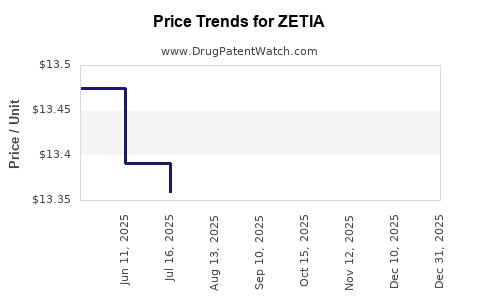
- Pricing Trends: Expect initial stability, with gradual declines driven by generics and biosimilars, projecting a 50–70% price decrease by 2030.
- Market Share Dynamics: As patent expirations proceed and competition intensifies, ZETIA's market share will likely decrease from 15–20% in 2023 to below 10% in 2030.
- Market Expansion: Emerging markets present growth opportunities with favorable reimbursement landscapes.
- Competitive Edge: Combining ZETIA with novel agents or targeting niche indications can reinforce its market position.
- Regulatory & Policy Monitoring: Staying agile in response to evolving policies is critical for pricing and market access strategies.
FAQs
1. How will patent expiry affect ZETIA’s pricing in upcoming years?
Patent expiry naturally facilitates generic entry, leading to significant price reductions—often 50–70% within the first few years post-expiration. Merck's patent landscape indicates most territories faced patent cliffs by 2016, which resulted in sharp price declines due to generic competition.
2. What are the main factors influencing future ZETIA prices?
Key factors include the pace of generic and biosimilar entry, regulatory policies, reimbursement frameworks, competitive innovations, and evolving clinical guidelines recommending combination therapies or alternative agents.
3. How does ZETIA’s pricing compare to other lipid-lowering agents?
ZETIA's brand prices hover around $300–$350 per 30-tablet pack in the US, substantially higher than generic statins ($20–$50). However, in formulations combining with statins, the perceived value can justify premium pricing compared to monotherapies.
4. Are there significant regional disparities in ZETIA’s pricing?
Yes. Prices are highest in North America and Europe due to brand dominance, insurance frameworks, and regulatory environments. Emerging markets like Asia-Pacific and Latin America generally feature lower prices driven by local generics and price controls.
5. What strategic moves can pharmaceutical companies make to maintain profitability post-patent?
Developing combination products, expanding indications, engaging in value-based negotiations, and innovating with improved formulations can help offset price erosion and sustain market share.
References
- FDA. (2022). ZETIA (ezetimibe) Prescribing Information. https://www.accessdata.fda.gov
- European Medicines Agency. (2022). ZETIA Summary of Product Characteristics.
- IQVIA. (2022). Global & Regional Lipid-Lowering Market Data.
- Merck & Co. (2022). Annual Report & Market Outlook.
- CMS & WHO Reports. (2022). Drug Pricing and Reimbursement Policies.
This market analysis aims to provide comprehensive insights for strategic decision-making concerning ZETIA, emphasizing current trends, future projections, and competitive positioning.