You're using a free limited version of DrugPatentWatch: Upgrade for Complete Access

Last Updated: December 11, 2025

ZADITOR Drug Patent Profile


✉ Email this page to a colleague

« Back to Dashboard


When do Zaditor patents expire, and what generic alternatives are available?

Zaditor is a drug marketed by Alcon Pharma and Alcon Pharms Ltd and is included in two NDAs.

The generic ingredient in ZADITOR is ketotifen fumarate. There are five drug master file entries for this compound. Nineteen suppliers are listed for this compound. Additional details are available on the ketotifen fumarate profile page.

AI Deep Research
Questions you can ask:
  • What is the 5 year forecast for ZADITOR?
  • What are the global sales for ZADITOR?
  • What is Average Wholesale Price for ZADITOR?
Drug patent expirations by year for ZADITOR
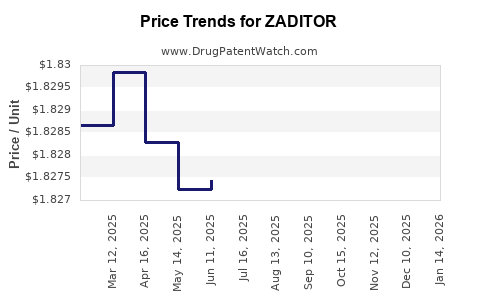
Drug Prices for ZADITOR

See drug prices for ZADITOR

Recent Clinical Trials for ZADITOR

Identify potential brand extensions & 505(b)(2) entrants

SponsorPhase
Sen-Jam PharmaceuticalPhase 2
National University, SingaporePhase 2
Eton Pharmaceuticals, Inc.Phase 3

See all ZADITOR clinical trials

Pharmacology for ZADITOR
Paragraph IV (Patent) Challenges for ZADITOR
Tradename Dosage Ingredient Strength NDA ANDAs Submitted Submissiondate
ZADITOR Ophthalmic Solution ketotifen fumarate 0.025% 021066 1 2004-12-23

US Patents and Regulatory Information for ZADITOR

Applicant Tradename Generic Name Dosage NDA Approval Date TE Type RLD RS Patent No. Patent Expiration Product Substance Delist Req. Exclusivity Expiration
Alcon Pharma ZADITOR ketotifen fumarate SOLUTION/DROPS;OPHTHALMIC 021066-002 Oct 19, 2006 DISCN Yes No ⤷  Get Started Free ⤷  Get Started Free ⤷  Get Started Free
Alcon Pharms Ltd ZADITOR ketotifen fumarate SOLUTION/DROPS;OPHTHALMIC 077200-001 Sep 2, 2008 OTC No Yes ⤷  Get Started Free ⤷  Get Started Free ⤷  Get Started Free
>Applicant >Tradename >Generic Name >Dosage >NDA >Approval Date >TE >Type >RLD >RS >Patent No. >Patent Expiration >Product >Substance >Delist Req. >Exclusivity Expiration

International Patents for ZADITOR

See the table below for patents covering ZADITOR around the world.

Country Patent Number Title Estimated Expiration
Norway 331228 ⤷  Get Started Free
Cyprus 1111126 ⤷  Get Started Free
Austria 491434 ⤷  Get Started Free
Japan 2002509101 ⤷  Get Started Free
Mexico PA02000849 COMPOSICION OFTALMICA QUE COMPRENDE CETOTIFENO. (OPHTHALMIC COMPOSITION COMPRISING KETOTIFEN.) ⤷  Get Started Free
World Intellectual Property Organization (WIPO) 0107049 ⤷  Get Started Free
Australia 6565500 ⤷  Get Started Free
>Country >Patent Number >Title >Estimated Expiration

Market Dynamics and Financial Trajectory for ZADITOR

Last updated: July 29, 2025

Introduction

ZADITOR (ketotifen fumarate ophthalmic solution) is a well-established medication primarily used in the treatment of allergic conjunctivitis. Market dynamics within the ophthalmic allergy treatment sector influence its demand, while patent status, competitive landscape, regulatory environment, and emerging trends shape its financial trajectory. This report analyzes ZADITOR's current market position, competitive factors, and future growth prospects to aid business professionals in making informed decisions.

Historical Background and Product Overview

ZADITOR, developed by Novartis and launched in the United States in the early 1990s, gained popularity due to its efficacy in alleviating allergic eye symptoms. As a Mast cell stabilizer and antihistamine, it offers rapid symptom relief with a favorable safety profile. The product's patent exclusivity lasted until 2017, after which generic equivalents emerged, significantly impacting its market share.

Market Dynamics

1. Patent Expiry and Generic Competition

The expiration of ZADITOR’s patent in 2017 ushered in a wave of generic versions, sharply reducing the drug's price and profit margins for the originator. Generic entrants such as Sandoz, Olon, and Mylan introduced cost-effective alternatives, intensifying price competition. This commoditization of ZADITOR diminished brand value, yet also expanded overall market size due to increased affordability and accessibility.

2. Regulatory Environment

Regulatory policies profoundly impact ZADITOR’s market dynamics. The U.S. Food and Drug Administration (FDA) streamlined approval pathways for generics through the Abbreviated New Drug Application (ANDA) process, facilitating swift market entry for competitors post-patent expiry. Conversely, regulatory barriers in emerging markets may slow generic dissemination, sustaining regional market disparities.

3. Epidemiology and Prescribing Trends

Allergic conjunctivitis affects approximately 20% of the global population, with seasonal and perennial forms prevalent across age groups. Rising urbanization, environmental pollution, and increased awareness have driven demand for allergy medications globally. Off-label use of ZADITOR for other allergic conditions and combination therapies has further sustained its consumption.

4. Competitive Landscape

Post-patent expiration, the market fragmented with multiple generics. While no new branded formulations of ZADITOR have entered the market, drugs such as Patanol (olopatadine) and Zaditor’s successor, Zaditor (ketotifen), face competition from newer antihistamines with improved administration convenience or longer duration of action. However, ZADITOR’s enduring efficacy and safety record maintain its relevance.

5. Distribution Channels and Market Penetration

The product's distribution spans ophthalmologists, allergists, and primary care providers, with OTC availability in some regions. The OTC switch in various markets has increased accessibility, notably in the U.S. and Europe, leading to steady sales despite pricing pressures. Digital health platforms and online pharmacies have also played roles in expanding reach.

Financial Trajectory

1. Revenue Trends

Prior to patent expiry, ZADITOR generated substantial revenues, with estimates reaching over $300 million annually in the U.S. (2010-2012). Post-generic entry, revenue declined sharply, with current estimates hovering around $50-80 million globally, predominantly driven by generic sales.

2. Profitability and Margins

With generic competition, profit margins for ZADITOR’s former manufacturer drastically contracted. While gross margins for generic sales are typically lower than branded ones, economies of scale and increased volume mitigate profitability impacts. Companies continue to capture value through regional distribution and private label manufacturing.

3. Market Expansion Opportunities

Emerging markets, such as Asia-Pacific and Latin America, present growth opportunities owing to increasing healthcare infrastructure and rising allergy prevalence. Strategic partnerships, licensing, and local manufacturing can facilitate market penetration. Additionally, awareness campaigns in these regions could stimulate demand.

4. Innovation and Future Development

No recent proprietary formulations of ZADITOR have been announced. However, potential reformulations or combination products incorporating ZADITOR’s active ingredients could revitalize interest. Investment in sustained-release formulations or improved delivery systems may also extend product lifecycle.

5. Impact of Patent and IP Strategies

While ZADITOR’s original patent has expired, any new formulations or delivery methods could be protected via secondary patents or data exclusivity, delaying generic competition and ensuring revenue streams.

Market Challenges and Risks

  • Price erosion: The proliferation of low-cost generics compresses pricing.
  • Regulatory hurdles: Changes in approval processes and labeling can impact market access.
  • Market saturation: Among established products, growth potential is limited without innovation.
  • Emergence of new therapies: Next-generation antihistamines and immunotherapies might displace ZADITOR.

Future Outlook and Strategic Considerations

Given the current landscape, ZADITOR's future financial trajectory hinges upon strategic repositioning. Options include:

  • Diversification into adjunctive allergy therapies.
  • Licensing deals to expand geographic access.
  • Development of novel delivery systems to improve adherence and efficacy.
  • Consolidation within the ophthalmic allergy market through mergers or collaborations.

Investments in regional expansion, especially in developing markets, could provide revenue diversification. Simultaneously, maintaining a focus on patient safety and efficacy will reinforce ZADITOR’s competitive position amid a crowded landscape.

Key Takeaways

  • Patent expiry and resultant generic competition significantly reduced ZADITOR’s revenue and profitability.
  • The drug remains relevant due to its established efficacy, safety profile, and OTC availability, especially in expanding markets.
  • Growth prospects rely on strategic regional expansion, formulation innovation, and potential combination therapies.
  • Market dynamics are influenced by regulatory policies, epidemiological trends, and the competitive landscape than can quickly shift with new therapies.
  • Companies should explore value-added innovations and market diversification to sustain the product’s financial trajectory.

FAQs

1. What caused the decline in ZADITOR’s market share?
Patent expiry in 2017 led to an influx of generic competitors, drastically reducing sales of the branded product and intensifying price competition.

2. In which regions does ZADITOR currently see the most growth?
Emerging markets such as Asia-Pacific, Latin America, and parts of Europe offer growth opportunities driven by rising allergy prevalence and increasing OTC access.

3. Are there new formulations or patents planned for ZADITOR?
As of now, no recent proprietary reformulations have been announced, though secondary patents on delivery methods could offer some exclusivity.

4. How does regulatory policy affect ZADITOR’s market prospects?
Regulatory hurdles, such as approvals of generics and OTC switches, influence market entry, access, and pricing strategies.

5. What strategic actions can companies take to extend ZADITOR’s market viability?
Investing in formulation innovation, regional expansion, licensing, and combination therapy development can prolong its commercial life.

References

  1. [1] U.S. Food and Drug Administration (FDA). Abbreviated New Drug Application (ANDA) Process.
  2. [2] Market Research Future. Global Allergic Conjunctivitis Market Analysis. 2022.
  3. [3] IMS Health. Ophthalmic Drugs Market Report. 2019.
  4. [4] Novartis Annual Report, 2012-2017.
  5. [5] World Health Organization (WHO). Allergy Prevalence Data, 2020.

More… ↓

⤷  Get Started Free

Make Better Decisions: Try a trial or see plans & pricing

Drugs may be covered by multiple patents or regulatory protections. All trademarks and applicant names are the property of their respective owners or licensors. Although great care is taken in the proper and correct provision of this service, thinkBiotech LLC does not accept any responsibility for possible consequences of errors or omissions in the provided data. The data presented herein is for information purposes only. There is no warranty that the data contained herein is error free. We do not provide individual investment advice. This service is not registered with any financial regulatory agency. The information we publish is educational only and based on our opinions plus our models. By using DrugPatentWatch you acknowledge that we do not provide personalized recommendations or advice. thinkBiotech performs no independent verification of facts as provided by public sources nor are attempts made to provide legal or investing advice. Any reliance on data provided herein is done solely at the discretion of the user. Users of this service are advised to seek professional advice and independent confirmation before considering acting on any of the provided information. thinkBiotech LLC reserves the right to amend, extend or withdraw any part or all of the offered service without notice.