You're using a free limited version of DrugPatentWatch: Upgrade for Complete Access

Last Updated: April 1, 2026

YUPELRI Drug Patent Profile


✉ Email this page to a colleague

« Back to Dashboard


Which patents cover Yupelri, and what generic alternatives are available?

Yupelri is a drug marketed by Mylan Ireland Ltd and is included in one NDA. There are ten patents protecting this drug and one Paragraph IV challenge.

This drug has seventy-three patent family members in thirty-one countries.

The generic ingredient in YUPELRI is revefenacin. One supplier is listed for this compound. Additional details are available on the revefenacin profile page.

DrugPatentWatch® Generic Entry Outlook for Yupelri

Yupelri was eligible for patent challenges on November 9, 2022.

By analyzing the patents and regulatory protections it appears that the earliest date for generic entry will be August 25, 2031. This may change due to patent challenges or generic licensing.

There have been four patent litigation cases involving the patents protecting this drug, indicating strong interest in generic launch. Recent data indicate that 63% of patent challenges are decided in favor of the generic patent challenger and that 54% of successful patent challengers promptly launch generic drugs.

There is one tentative approval for the generic drug (revefenacin), which indicates the potential for near-term generic launch.

Indicators of Generic Entry

< Available with Subscription >

  Start Trial

AI Deep Research
Questions you can ask:
  • What is the 5 year forecast for YUPELRI?
  • What are the global sales for YUPELRI?
  • What is Average Wholesale Price for YUPELRI?
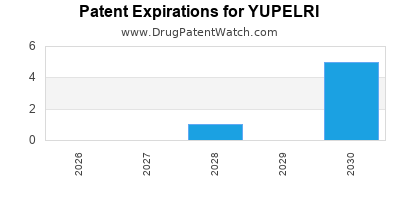
Drug patent expirations by year for YUPELRI
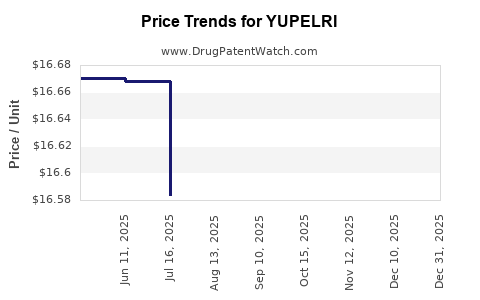
Drug Prices for YUPELRI

See drug prices for YUPELRI

DrugPatentWatch® Estimated Loss of Exclusivity (LOE) Date for YUPELRI
Generic Entry Date for YUPELRI*:
Constraining patent/regulatory exclusivity:
NDA:
Dosage:
SOLUTION;INHALATION

*The generic entry opportunity date is the latter of the last compound-claiming patent and the last regulatory exclusivity protection. Many factors can influence early or later generic entry. This date is provided as a rough estimate of generic entry potential and should not be used as an independent source.

Recent Clinical Trials for YUPELRI

Identify potential brand extensions & 505(b)(2) entrants

SponsorPhase
Theravance BiopharmaPhase 4
Mylan Inc.Phase 4
Mylan PharmaceuticalsPhase 1

See all YUPELRI clinical trials

Pharmacology for YUPELRI
Drug ClassAnticholinergic
Mechanism of ActionCholinergic Antagonists
Paragraph IV (Patent) Challenges for YUPELRI
Tradename Dosage Ingredient Strength NDA ANDAs Submitted Submissiondate
YUPELRI Inhalation Solution revefenacin 175 mcg/3 mL 210598 7 2022-11-09

US Patents and Regulatory Information for YUPELRI

YUPELRI is protected by ten US patents.

Based on analysis by DrugPatentWatch, the earliest date for a generic version of YUPELRI is ⤷  Start Trial.

This potential generic entry date is based on patent ⤷  Start Trial.

Generics may enter earlier, or later, based on new patent filings, patent extensions, patent invalidation, early generic licensing, generic entry preferences, and other factors.

Applicant Tradename Generic Name Dosage NDA Approval Date TE Type RLD RS Patent No. Patent Expiration Product Substance Delist Req. Exclusivity Expiration
Mylan Ireland Ltd YUPELRI revefenacin SOLUTION;INHALATION 210598-001 Nov 9, 2018 RX Yes Yes ⤷  Start Trial ⤷  Start Trial ⤷  Start Trial
Mylan Ireland Ltd YUPELRI revefenacin SOLUTION;INHALATION 210598-001 Nov 9, 2018 RX Yes Yes ⤷  Start Trial ⤷  Start Trial Y ⤷  Start Trial
Mylan Ireland Ltd YUPELRI revefenacin SOLUTION;INHALATION 210598-001 Nov 9, 2018 RX Yes Yes ⤷  Start Trial ⤷  Start Trial ⤷  Start Trial
Mylan Ireland Ltd YUPELRI revefenacin SOLUTION;INHALATION 210598-001 Nov 9, 2018 RX Yes Yes ⤷  Start Trial ⤷  Start Trial Y ⤷  Start Trial
Mylan Ireland Ltd YUPELRI revefenacin SOLUTION;INHALATION 210598-001 Nov 9, 2018 RX Yes Yes ⤷  Start Trial ⤷  Start Trial ⤷  Start Trial
>Applicant >Tradename >Generic Name >Dosage >NDA >Approval Date >TE >Type >RLD >RS >Patent No. >Patent Expiration >Product >Substance >Delist Req. >Exclusivity Expiration

Expired US Patents for YUPELRI

Applicant Tradename Generic Name Dosage NDA Approval Date Patent No. Patent Expiration
Mylan Ireland Ltd YUPELRI revefenacin SOLUTION;INHALATION 210598-001 Nov 9, 2018 ⤷  Start Trial ⤷  Start Trial
>Applicant >Tradename >Generic Name >Dosage >NDA >Approval Date >Patent No. >Patent Expiration

International Patents for YUPELRI

When does loss-of-exclusivity occur for YUPELRI?

Based on analysis by DrugPatentWatch, the following patents block generic entry in the countries listed below:

Australia

Patent: 10273514
Patent: Crystalline freebase forms of a biphenyl compound
Estimated Expiration: ⤷  Start Trial

Brazil

Patent: 2012000890
Patent: formas de base livre cristalina de um composto bifenil
Estimated Expiration: ⤷  Start Trial

Canada

Patent: 65621
Patent: FORMES A BASE LIBRE CRISTALLINE D'UN COMPOSE BIPHENYLE (CRYSTALLINE FREEBASE FORMS OF A BIPHENYL COMPOUND)
Estimated Expiration: ⤷  Start Trial

Patent: 89129
Patent: FORMES A BASE LIBRE CRISTALLINE D'UN COMPOSE BIPHENYLE (CRYSTALLINE FREEBASE FORMS OF BIPHENYL COMPOUND)
Estimated Expiration: ⤷  Start Trial

China

Patent: 2470130
Patent: Crystalline freebase forms of a biphenyl compound
Estimated Expiration: ⤷  Start Trial

Croatia

Patent: 0151344
Estimated Expiration: ⤷  Start Trial

Cyprus

Patent: 17075
Estimated Expiration: ⤷  Start Trial

Denmark

Patent: 53894
Estimated Expiration: ⤷  Start Trial

European Patent Office

Patent: 53894
Patent: FORME CRISTALLINE D'UNE BASE LIBRE D'UNE COMPOSE DE BIPHENYLE (CRYSTALLINE FREEBASE FORM OF A BIPHENYL COMPOUND)
Estimated Expiration: ⤷  Start Trial

Patent: 87490
Patent: FORMES DE BASE LIBRE CRISTALLINE D'UN COMPOSÉ BIPHÉNYLE (CRYSTALLINE FREEBASE FORMS OF A BIPHENYL COMPOUND)
Estimated Expiration: ⤷  Start Trial

Hong Kong

Patent: 68050
Patent: 聯苯化合物的結晶游離碱形式 (CRYSTALLINE FREEBASE FORM OF A BIPHENYL COMPOUND)
Estimated Expiration: ⤷  Start Trial

Patent: 19415
Patent: 聯苯化合物的結晶游離碱形式 (CRYSTALLINE FREEBASE FORMS OF A BIPHENYL COMPOUND)
Estimated Expiration: ⤷  Start Trial

Hungary

Patent: 26414
Estimated Expiration: ⤷  Start Trial

Israel

Patent: 6995
Patent: צורות גבישיות בצורת בסיס חופשי של תרכובת ביפניל (Crystalline freebase forms of a biphenyl compound)
Estimated Expiration: ⤷  Start Trial

Japan

Patent: 51174
Estimated Expiration: ⤷  Start Trial

Patent: 38505
Estimated Expiration: ⤷  Start Trial

Patent: 12533550
Estimated Expiration: ⤷  Start Trial

Patent: 15003929
Patent: ビフェニル化合物の結晶性遊離塩基形 (CRYSTALLINE FREE BASE FORMS OF BIPHENYL COMPOUND)
Estimated Expiration: ⤷  Start Trial

Patent: 16026214
Patent: ビフェニル化合物の結晶性遊離塩基形 (CRYSTALLINE FREEBASE FORMS OF BIPHENYL COMPOUND)
Estimated Expiration: ⤷  Start Trial

Patent: 17171692
Patent: ビフェニル化合物の結晶性遊離塩基形 (CRYSTALLINE FREE BASE FORM OF BIPHENYL COMPOUND)
Estimated Expiration: ⤷  Start Trial

Mexico

Patent: 12000682
Patent: FORMAS DE BASES LIBRES CRISTALINAS DE UN COMPUESTO DE BIFENILO. (CRYSTALLINE FREEBASE FORMS OF A BIPHENYL COMPOUND.)
Estimated Expiration: ⤷  Start Trial

Poland

Patent: 53894
Estimated Expiration: ⤷  Start Trial

Patent: 87490
Estimated Expiration: ⤷  Start Trial

Portugal

Patent: 53894
Estimated Expiration: ⤷  Start Trial

San Marino

Patent: 01600019
Patent: FORMA DI BASE LIBERA CRISTALLINA DI UN COMPOSTO BIFENILICO
Estimated Expiration: ⤷  Start Trial

Singapore

Patent: 8036
Patent: CRYSTALLINE FREEBASE FORMS OF A BIPHENYL COMPOUND
Estimated Expiration: ⤷  Start Trial

Patent: 201407913U
Patent: CRYSTALLINE FREEBASE FORMS OF A BIPHENYL COMPOUND
Estimated Expiration: ⤷  Start Trial

Slovenia

Patent: 53894
Estimated Expiration: ⤷  Start Trial

South Korea

Patent: 1742252
Estimated Expiration: ⤷  Start Trial

Patent: 130027004
Patent: CRYSTALLINE FREEBASE FORMS OF A BIPHENYL COMPOUND
Estimated Expiration: ⤷  Start Trial

Spain

Patent: 57553
Estimated Expiration: ⤷  Start Trial

Patent: 39642
Estimated Expiration: ⤷  Start Trial

Generics may enter earlier, or later, based on new patent filings, patent extensions, patent invalidation, early generic licensing, generic entry preferences, and other factors.

See the table below for additional patents covering YUPELRI around the world.

Country Patent Number Title Estimated Expiration
World Intellectual Property Organization (WIPO) 2005087738 ⤷  Start Trial
Australia 2010273514 ⤷  Start Trial
South Korea 20130027004 CRYSTALLINE FREEBASE FORMS OF A BIPHENYL COMPOUND ⤷  Start Trial
Japan 6338505 ⤷  Start Trial
South Korea 20130027004 ⤷  Start Trial
>Country >Patent Number >Title >Estimated Expiration

YUPELRI: Market Dynamics and Financial Trajectory

Last updated: February 19, 2026

YUPELRI (rehailidronam) has achieved Orphan Drug Designation and is approved in the U.S. and Europe for the maintenance treatment of bronchopulmonary dysplasia (BPD) in preterm infants. Its market position is characterized by a limited number of therapeutic alternatives and a specific patient population. Revenue generation is tied to its specialized indication and patient access.

What is YUPELRI's Approved Indication and Patient Population?

YUPELRI is indicated for the maintenance treatment of bronchopulmonary dysplasia (BPD) in preterm infants. BPD is a chronic lung disease that develops in some premature infants who have been treated with mechanical ventilation and oxygen. The U.S. Food and Drug Administration (FDA) approved YUPELRI on March 27, 2024, following a Priority Review. The European Medicines Agency (EMA) granted marketing authorization for YUPELRI in the European Union on December 12, 2023.

The patient population for YUPELRI is defined by prematurity and the development of BPD. Preterm infants, defined as those born before 37 weeks of gestation, are at risk for BPD, particularly those requiring respiratory support. The severity of BPD can vary, influencing treatment decisions and the potential duration of therapy.

What is the Competitive Landscape for YUPELRI?

The competitive landscape for YUPELRI in BPD treatment is characterized by a lack of direct, approved pharmacological alternatives. Historically, management of BPD has focused on supportive care, including optimizing ventilation, nutritional support, and managing fluid balance.

  • Supportive Care: This remains the cornerstone of BPD management. It includes:
    • Mechanical ventilation strategies aimed at reducing lung injury.
    • Supplemental oxygen therapy.
    • Nutritional support to promote lung growth and repair.
    • Fluid management to prevent pulmonary edema.
  • Bronchodilators: While not a primary treatment for BPD itself, bronchodilators like albuterol may be used in specific cases if bronchospasm is suspected. However, their efficacy in the general BPD population is not well-established.
  • Corticosteroids: Inhaled or systemic corticosteroids have been used in the past, but their use is now generally limited due to concerns about potential adverse effects on growth and neurodevelopment.
  • Other Investigational Therapies: Research is ongoing for various potential treatments for BPD, including mesenchymal stem cells and other regenerative therapies, but these are not yet approved or widely available.

YUPELRI's approval addresses a significant unmet medical need by providing the first targeted pharmacological maintenance therapy for BPD. This positions YUPELRI as a novel entrant in a therapeutic space previously dominated by supportive measures.

What are the Key Differentiating Features of YUPELRI?

YUPELRI's primary differentiating feature is its approval as the first drug for the maintenance treatment of BPD in preterm infants. Its mechanism of action targets specific pathways involved in lung repair and development.

  • Mechanism of Action: YUPELRI is a recombinant humanized monoclonal antibody that targets granulocyte-macrophage colony-stimulating factor (GM-CSF). GM-CSF is a cytokine that plays a crucial role in the lung's inflammatory and repair processes. By modulating GM-CSF activity, YUPELRI aims to promote lung development and reduce inflammation in infants with BPD.
  • Targeted Therapy: Unlike supportive care, YUPELRI offers a direct pharmacological intervention designed to address the underlying pathology of BPD.
  • Orphan Drug Designation: The Orphan Drug Designation granted by regulatory bodies like the FDA and EMA signifies that YUPELRI targets a rare disease, which can provide market exclusivity and incentives for development.
  • Clinical Trial Data: The efficacy and safety profile of YUPELRI were established through clinical trials demonstrating improvements in specific BPD-related endpoints. For example, data from the RESTORE trial showed a reduction in the composite endpoint of death or moderate to severe BPD at 36 weeks postmenstrual age.

The unique indication and mechanism of action differentiate YUPELRI from existing management strategies for BPD.

What are the Regulatory Approvals and Timelines for YUPELRI?

YUPELRI has received key regulatory approvals in major pharmaceutical markets.

  • United States:
    • Approval Date: March 27, 2024.
    • Regulatory Body: U.S. Food and Drug Administration (FDA).
    • Review Pathway: Priority Review.
    • Orphan Drug Designation: Granted.
  • European Union:
    • Marketing Authorization Date: December 12, 2023.
    • Regulatory Body: European Medicines Agency (EMA).
    • Orphan Drug Designation: Granted.

These approvals provide access to the U.S. and EU markets, which represent significant patient populations at risk for BPD. The orphan drug status provides a period of market exclusivity in both regions, protecting the drug from generic competition. The duration of market exclusivity varies by region and can be extended under certain conditions.

What is the Estimated Market Size and Growth Potential for YUPELRI?

Estimating the precise market size for YUPELRI requires detailed epidemiological data on BPD incidence and severity, as well as adoption rates. However, several factors inform the potential market.

  • Incidence of Prematurity: The global incidence of preterm birth is approximately 15 million per year, with higher rates in developed countries due to advanced neonatal care allowing for the survival of extremely premature infants. In the U.S., the preterm birth rate was 10.5% in 2022 (Source: CDC).
  • BPD Prevalence: BPD affects a significant proportion of premature infants requiring respiratory support. Rates vary based on gestational age at birth and the intensity of neonatal intensive care. For infants born before 29 weeks gestation, BPD incidence can exceed 40% (Source: American Academy of Pediatrics).
  • Patient Population for YUPELRI: YUPELRI is indicated for the maintenance treatment of BPD. This suggests a patient population that has already been diagnosed with BPD and is requiring ongoing respiratory support. The specific criteria for initiating YUPELRI will influence the addressable market.
  • Therapeutic Need: As the first approved drug for this indication, YUPELRI has the potential to capture a substantial share of the market if clinical benefits translate into widespread adoption by neonatologists.
  • Market Growth Drivers:
    • Increasing survival rates of extremely premature infants.
    • Advancements in neonatal intensive care leading to longer survival for infants who previously would not have survived.
    • Recognition of the long-term morbidities associated with BPD, driving demand for effective treatments.
    • Potential for expanded indications or improved patient selection in the future.
  • Market Restraints:
    • The cost of treatment, which may be a factor for healthcare systems and payers.
    • Physician and institutional adoption curves.
    • Ongoing research into alternative or adjunct therapies.
    • Potential for stringent reimbursement policies.

While specific financial projections are proprietary to the developers and manufacturers, the unmet need in BPD treatment suggests a potentially significant, albeit specialized, market for YUPELRI.

What is YUPELRI's Pricing and Reimbursement Strategy?

The pricing and reimbursement strategy for YUPELRI is critical for its market success. As a novel therapy for a rare, serious condition in a vulnerable patient population, pricing is likely to reflect the significant R&D investment, clinical value, and the costs associated with neonatal intensive care.

  • Orphan Drug Pricing: Drugs designated as orphan drugs often command premium pricing due to the smaller patient population, high development costs relative to market size, and the societal benefit of treating rare diseases.
  • Value-Based Pricing: Manufacturers will likely emphasize the clinical benefits of YUPELRI, such as reduced hospital stay, decreased need for mechanical ventilation, and improved long-term respiratory outcomes, to justify its price to payers and healthcare providers.
  • Payer Engagement: Early engagement with major payers, including government programs (e.g., Medicare, Medicaid in the U.S.) and private insurers, will be crucial to ensure favorable reimbursement status and formulary placement.
  • Reimbursement Hurdles:
    • Cost-Effectiveness: Payers will assess the cost-effectiveness of YUPELRI against current standards of care (primarily supportive measures). Demonstrating a favorable cost-benefit ratio, including potential reductions in downstream healthcare utilization, will be key.
    • Clinical Practice Guidelines: Alignment with clinical practice guidelines for BPD management will facilitate adoption and reimbursement.
    • Access Programs: Manufacturers may implement patient access programs, co-pay assistance, or financial aid to improve affordability for eligible patients and reduce the financial burden on healthcare facilities.
  • International Pricing: Pricing strategies will also need to consider the economic landscape and reimbursement systems in different countries where YUPELRI is approved.

Specific pricing details are typically not publicly disclosed until shortly before or at the time of commercial launch. However, the pricing is expected to be in line with other specialty and orphan drugs used in neonatal intensive care settings.

What are the Financial Implications for Manufacturers and Investors?

The commercialization of YUPELRI has direct financial implications for its manufacturer and potential investors.

  • Revenue Generation: Revenue will be driven by prescription volume and the established pricing strategy. The market size, adoption rate by healthcare providers, and payer coverage will determine the top-line revenue.
  • Profitability: Profitability will depend on production costs, sales and marketing expenses, ongoing R&D (for potential label expansions or post-market studies), and the impact of any market exclusivity periods.
  • R&D Investment Recovery: The initial R&D investment, clinical trial costs, and regulatory submission expenses need to be recouped through sales.
  • Market Exclusivity: The duration of market exclusivity provided by orphan drug status is a critical factor for investors, as it limits competition from generics and allows for higher profit margins during this period.
  • Potential for Expansion: Future revenue growth could be influenced by:
    • Label Expansion: Investigating YUPELRI for other respiratory conditions in infants or older populations.
    • Geographic Expansion: Launching in additional markets beyond the U.S. and EU.
    • Combination Therapies: Exploring its use in conjunction with other treatments.
  • Competitive Pressures: As the market evolves, new competitors or improved supportive care protocols could impact market share and pricing power.
  • Long-Term Outlook: The long-term financial trajectory will depend on the sustained clinical utility of YUPELRI, its ability to maintain market access, and the emergence of alternative treatments.

For investors, YUPELRI represents an opportunity in a therapeutic area with a significant unmet need. Success hinges on effective commercialization, market penetration, and the ability to leverage its orphan drug status.

What are the Key Takeaways?

YUPELRI is positioned as a novel therapeutic for bronchopulmonary dysplasia (BPD) in preterm infants, addressing a significant unmet medical need. Its approval marks the introduction of the first pharmacological maintenance treatment for this condition. The competitive landscape is limited, with supportive care being the primary alternative. YUPELRI's pricing and reimbursement strategy will be critical for market access, likely reflecting its orphan drug status and clinical value. Financial projections depend on patient population size, adoption rates, and reimbursement success, with market exclusivity providing a key advantage for manufacturers and investors.

Frequently Asked Questions

  1. What is the primary mechanism of action for YUPELRI? YUPELRI is a monoclonal antibody that targets granulocyte-macrophage colony-stimulating factor (GM-CSF), aiming to modulate inflammatory and repair processes in the lungs of infants with BPD.

  2. Are there any approved alternatives to YUPELRI for BPD maintenance treatment? Currently, YUPELRI is the first drug approved for the maintenance treatment of BPD. Management of BPD has historically relied on supportive care measures.

  3. What is the typical patient profile that would receive YUPELRI? YUPELRI is indicated for preterm infants diagnosed with bronchopulmonary dysplasia (BPD) who require ongoing respiratory support.

  4. What is the significance of Orphan Drug Designation for YUPELRI? Orphan Drug Designation provides the drug with a period of market exclusivity in the U.S. and EU, protecting it from generic competition and incentivizing its development for rare diseases.

  5. How might YUPELRI impact the financial trajectory of its manufacturer? Successful commercialization, driven by adoption and favorable reimbursement, could lead to substantial revenue generation, offsetting R&D costs and contributing to profitability, particularly during the market exclusivity period.

Citations

[1] U.S. Food and Drug Administration. (2024, March 27). FDA approves YUPELRI™ (rehailidronam) for the maintenance treatment of bronchopulmonary dysplasia in preterm infants. [Press release]. [2] European Medicines Agency. (2023, December 12). EMA grants marketing authorisation for YUPELRI™ (rehailidronam) for the maintenance treatment of bronchopulmonary dysplasia in preterm infants. [Press release]. [3] Centers for Disease Control and Prevention. (2023, November 14). Preterm Birth. National Center for Health Statistics. [4] American Academy of Pediatrics. (2019). Diagnosis and Management of Bronchopulmonary Dysplasia. Pediatrics, 143(4), e20183490.

More… ↓

⤷  Start Trial

Make Better Decisions: Try a trial or see plans & pricing

Drugs may be covered by multiple patents or regulatory protections. All trademarks and applicant names are the property of their respective owners or licensors. Although great care is taken in the proper and correct provision of this service, thinkBiotech LLC does not accept any responsibility for possible consequences of errors or omissions in the provided data. The data presented herein is for information purposes only. There is no warranty that the data contained herein is error free. We do not provide individual investment advice. This service is not registered with any financial regulatory agency. The information we publish is educational only and based on our opinions plus our models. By using DrugPatentWatch you acknowledge that we do not provide personalized recommendations or advice. thinkBiotech performs no independent verification of facts as provided by public sources nor are attempts made to provide legal or investing advice. Any reliance on data provided herein is done solely at the discretion of the user. Users of this service are advised to seek professional advice and independent confirmation before considering acting on any of the provided information. thinkBiotech LLC reserves the right to amend, extend or withdraw any part or all of the offered service without notice.