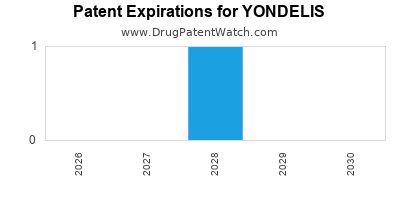
Last updated: September 23, 2026
YONDELIS, the trabectedin intravenous oncology drug marketed by PharmaMar, is a mature orphan oncology product with a narrow addressable market and durable clinical use in advanced soft-tissue sarcoma. Its commercial profile depends on specialist prescribing, hospital reimbursement, and continued demand after anthracycline treatment. Revenue has remained meaningful for PharmaMar but has generally been overshadowed by ZEPZELCA, the company’s small-cell lung cancer product.
The principal long-term risks are market maturity, treatment-center concentration, reimbursement pressure, and potential generic entry after loss of regulatory and patent protection. YONDELIS is a small-molecule drug, so biosimilar competition does not apply.
What is YONDELIS approved to treat?
YONDELIS contains trabectedin, a marine-derived antineoplastic agent that binds DNA and affects transcription and DNA-repair pathways.
The U.S. Food and Drug Administration approved YONDELIS on October 23, 2015, for the treatment of patients with unresectable or metastatic liposarcoma or leiomyosarcoma who previously received an anthracycline-containing regimen.[1]
The labeled U.S. regimen is:
| Parameter |
U.S. label |
| Active ingredient |
Trabectedin |
| Dosage form |
Intravenous infusion |
| Dose |
1.5 mg/m² |
| Administration |
Continuous 24-hour infusion |
| Schedule |
Every three weeks |
| Primary indication |
Unresectable or metastatic liposarcoma or leiomyosarcoma |
| Prior treatment requirement |
Prior anthracycline-containing regimen |
| U.S. regulatory status |
Full approval |
The treatment is administered in specialized oncology centers because of infusion duration, hepatic monitoring, myelosuppression, rhabdomyolysis risk, cardiomyopathy risk, and the need for dexamethasone premedication.
In Europe, the product has a longer commercial history. The European Commission authorized YONDELIS in 2007 for advanced soft-tissue sarcoma after failure of anthracyclines and ifosfamide, or when patients are unsuitable for those agents. The European authorization also covered relapsed ovarian cancer in combination with pegylated liposomal doxorubicin, subject to the applicable European product information.[2]
How large is the YONDELIS market?
YONDELIS addresses a small orphan oncology market rather than a broad solid-tumor population.
Soft-tissue sarcoma is uncommon, and the labeled U.S. population is narrower because patients generally must have unresectable or metastatic disease, prior anthracycline exposure, and either liposarcoma or leiomyosarcoma. This limits volume but supports specialist pricing and reduces direct competition from primary-line therapies.
The product’s market position is defined by four factors:
- A limited number of eligible patients.
- Use in later-line treatment.
- Concentration of prescribing in sarcoma referral centers.
- Competition from other chemotherapy, targeted, and immuno-oncology options.
Relevant competitors include:
| Product |
Active ingredient |
Competitive position |
| YONDELIS |
Trabectedin |
Later-line liposarcoma and leiomyosarcoma |
| HALAVEN |
Eribulin |
Approved for liposarcoma after prior anthracycline therapy |
| VOTRIENT |
Pazopanib |
Advanced soft-tissue sarcoma, excluding adipocytic sarcoma in the U.S. label |
| ADO-TRASTUZUMAB EMANSINE and other targeted drugs |
Varies |
Relevant only to biomarker-defined or disease-specific populations |
| Doxorubicin-based regimens |
Doxorubicin |
Earlier-line standard treatment |
| Gemcitabine-based regimens |
Gemcitabine combinations |
Common later-line alternatives |
| Clinical trials |
Various |
Compete for patients with advanced disease |
The strongest direct branded competitor in the United States is HALAVEN for previously treated liposarcoma. YONDELIS has a broader soft-tissue sarcoma label within the specific liposarcoma and leiomyosarcoma categories, while HALAVEN’s U.S. indication is focused on liposarcoma after prior anthracycline therapy.[1][3]
What is the financial trajectory of YONDELIS?
YONDELIS has generated a mature, recurring revenue stream for PharmaMar, generally in the tens of millions of euros annually. The product has not shown the growth profile of a newly launched specialty oncology asset.
PharmaMar’s reported results indicate that YONDELIS sales have remained broadly stable to moderately declining as the product has matured, while company-wide revenue has fluctuated more sharply because of ZEPZELCA milestones, licensing income, and international commercialization arrangements.[4][5]
| Financial characteristic |
YONDELIS impact |
| Product maturity |
Mature commercial asset |
| Revenue pattern |
Recurring, relatively stable specialty sales |
| Growth driver |
Patient retention and geographic commercialization rather than broad label expansion |
| Margin profile |
Supported by established manufacturing and clinical infrastructure |
| Main erosion risk |
Generic entry and reimbursement pressure |
| Company-level importance |
Material recurring product, but increasingly secondary to ZEPZELCA |
| Commercial sensitivity |
High exposure to sarcoma referral networks and hospital budgets |
PharmaMar’s financial trajectory is therefore best understood as a portfolio transition. YONDELIS provides established cash flow and commercial infrastructure, while ZEPZELCA has been responsible for a larger share of strategic growth expectations. The company has used its YONDELIS platform, regulatory capabilities, and oncology distribution network to support broader licensing and commercialization activity.[4]
U.S. product sales are difficult to isolate from all international revenue streams because commercialization arrangements and geographic rights have changed over time. PharmaMar has retained significant economic interest in the product, while regional marketing and distribution responsibilities have varied.
When did YONDELIS lose regulatory exclusivity?
YONDELIS received U.S. orphan-drug designation and seven years of orphan-drug exclusivity for the approved indication. That exclusivity period began with the FDA approval in October 2015 and generally expired in October 2022.[1][6]
Regulatory exclusivity and patent protection are separate rights:
| Protection |
Approximate status |
| U.S. orphan-drug exclusivity |
Generally expired in October 2022 |
| U.S. new-chemical-entity exclusivity |
Not the primary protection relied on for a 2015 approval of this previously approved active ingredient |
| Patent protection |
Depends on the specific composition, formulation, manufacturing, and method patents |
| European regulatory protection |
Varies by authorization, country, and supplementary protection certificate history |
| Generic approval pathway |
ANDA pathway may become available after applicable protections expire or are successfully challenged |
Expiration of orphan exclusivity does not automatically authorize a generic launch. An ANDA applicant must address listed patents, labeling requirements, bioequivalence, manufacturing controls, and any applicable pediatric or other exclusivity.
What patents protect YONDELIS?
YONDELIS may be protected by a combination of active-ingredient, formulation, manufacturing, and method-of-use rights. The commercial value of the remaining patent estate depends less on the original discovery patent than on whether later-filed patents remain enforceable and relevant to the approved label.
The principal patent categories are:
- Trabectedin composition and chemical-form patents.
- Pharmaceutical-composition and formulation patents.
- Intravenous administration and stability patents.
- Manufacturing and purification processes.
- Treatment methods for sarcoma and other cancers.
- Combination-treatment methods.
The original composition protection for trabectedin is mature. Any remaining U.S. protection is more likely to involve later-issued formulation, process, or method-of-use patents than basic active-ingredient exclusivity.
The FDA Orange Book is the controlling public source for patents listed against the U.S. NDA. Patent listings can change through delisting, expiration, correction, or court-driven action. Because the commercial risk depends on the live Orange Book record and the specific filing date of each ANDA, a current Orange Book review is required for a definitive patent-expiration schedule.[7]
Are there YONDELIS Paragraph IV challenges?
A Paragraph IV certification permits an ANDA applicant to assert that an Orange Book-listed patent is invalid, unenforceable, or not infringed. A challenge can trigger Hatch-Waxman litigation and, in some cases, a 30-month stay of FDA approval.
No major publicly reported U.S. Paragraph IV litigation has established a widely recognized launch timetable for generic trabectedin through the principal public regulatory and company materials reviewed for this analysis. That does not eliminate the risk of an unpublicized filing or a future ANDA challenge.
The most likely generic-entry sequence is:
- An ANDA applicant files with Paragraph IV certifications against any remaining listed patents.
- The patent holder may sue within 45 days.
- FDA approval may be stayed for up to 30 months, subject to statutory exceptions.
- The applicant may launch at risk after approval if litigation remains unresolved.
- A settlement may establish a licensed entry date earlier than the latest patent expiry.
How strong is the YONDELIS patent estate?
The YONDELIS estate is commercially moderate rather than exceptionally strong.
Its strengths are:
- Orphan indication and specialized clinical use.
- Complex continuous-infusion administration.
- Specialist treatment-center concentration.
- Manufacturing and quality-control requirements.
- Limited volume opportunity for generic developers.
- Potential process know-how that may be difficult to replicate efficiently.
Its weaknesses are:
- Mature active ingredient.
- Expired U.S. orphan exclusivity.
- Small-molecule ANDA pathway.
- Limited indication breadth in the United States.
- Substitution potential from established chemotherapy alternatives.
- Possible lack of a strong, late-expiring composition patent.
Manufacturing complexity can delay or deter entry, but it does not create regulatory exclusivity by itself. A generic applicant that can demonstrate pharmaceutical equivalence, bioequivalence where applicable, and adequate chemistry, manufacturing, and controls may still enter without reproducing every proprietary process.
What is the FDA and Orange Book status of YONDELIS?
YONDELIS has full FDA approval for its U.S. indication and is not an accelerated-approval product. The FDA label identifies trabectedin as a prescription oncology product administered by intravenous infusion.[1]
The relevant U.S. regulatory issues are:
- NDA approval under 21 U.S.C. § 355.
- Orange Book patent listings associated with the NDA.
- Potential ANDA applications for generic trabectedin.
- Labeling restrictions tied to liposarcoma and leiomyosarcoma.
- Risk-management obligations reflected in the prescribing information.
There is no biosimilar pathway for YONDELIS because trabectedin is a chemically synthesized small molecule rather than a biological product.
Which companies challenge YONDELIS commercially?
The competitive threat is broader than direct generic substitution.
Branded competition
HALAVEN competes most directly in liposarcoma. Pazopanib, gemcitabine-based regimens, dacarbazine, ifosfamide, and clinical-trial therapies compete across later-line soft-tissue sarcoma treatment.
Generic competition
Generic trabectedin would likely compete primarily on price in hospitals and specialty oncology networks. The commercial opportunity is constrained by the small eligible population and the need for specialized infusion capabilities.
Therapeutic substitution
Physicians may substitute another regimen even without a generic YONDELIS launch because treatment selection depends on histology, prior therapy, toxicity, patient performance status, organ function, and local reimbursement.
What generic launch scenarios exist for YONDELIS?
Three scenarios are commercially relevant.
| Scenario |
Market effect |
| No near-term generic |
Stable branded sales, with erosion from treatment substitution |
| Single generic entrant |
Moderate price pressure and selective hospital conversion |
| Multiple generic entrants |
Faster price erosion, tender competition, and reduced branded volume |
A first generic could obtain a temporary commercial advantage if it enters before multiple competitors. Because the product has a small market, however, the first entrant may not create a large absolute revenue pool. The branded product may retain use in centers that value established supply, physician familiarity, and manufacturer support.
What licensing deals affect YONDELIS?
YONDELIS has been commercialized through licensing and regional partnership arrangements involving PharmaMar and other pharmaceutical companies. The precise economic effect depends on the territory, royalty rate, supply terms, and whether the partner bears sales and marketing costs.
PharmaMar’s strategic position has changed over time from reliance on external commercial partners toward greater control over selected markets. Partnership changes can alter reported product sales, royalties, operating expenses, and geographic revenue recognition without reflecting an equivalent change in underlying patient demand.[4][5]
What is the revenue exposure to YONDELIS?
YONDELIS remains financially relevant but is no longer the central growth engine for PharmaMar.
Revenue exposure is concentrated in:
- European oncology markets.
- U.S. specialist sarcoma centers.
- Hospital procurement contracts.
- Reimbursement for later-line oncology treatment.
- Continued use in patients who have exhausted anthracycline-based therapy.
The most important downside variables are generic entry, reduced reimbursement, lower treatment duration, and competition from newer sarcoma therapies. The most important stabilizing variables are the rarity of the disease, physician familiarity, established safety-management procedures, and the absence of a near-term replacement with identical clinical positioning.
How does YONDELIS compare with HALAVEN?
| Factor |
YONDELIS |
HALAVEN |
| Active ingredient |
Trabectedin |
Eribulin |
| Modality |
Small-molecule cytotoxic agent |
Small-molecule microtubule inhibitor |
| U.S. sarcoma use |
Liposarcoma and leiomyosarcoma after anthracycline |
Liposarcoma after anthracycline |
| Administration |
24-hour intravenous infusion every three weeks |
Intravenous administration on days 1 and 8 of a 21-day cycle |
| Main commercial advantage |
Established specialist use and broader labeled histology coverage |
Simpler administration and direct liposarcoma positioning |
| Generic risk |
Potential ANDA competition |
Potential generic eribulin competition |
| Biosimilar risk |
None |
None |
YONDELIS has a more operationally demanding administration schedule. HALAVEN has a simpler dosing pattern, which can influence treatment-center convenience and total administration burden.
Key Takeaways
- YONDELIS is a mature trabectedin product with a durable but limited orphan-oncology market.
- FDA approval covers unresectable or metastatic liposarcoma and leiomyosarcoma after prior anthracycline therapy.
- U.S. orphan-drug exclusivity generally expired in October 2022.
- The product faces small-molecule generic risk, not biosimilar risk.
- Its remaining patent value depends on live Orange Book listings and any enforceable formulation, process, or method-of-use patents.
- HALAVEN is the most direct branded competitor in liposarcoma.
- Manufacturing complexity can delay generic entry but does not independently prevent it.
- YONDELIS remains a recurring revenue source for PharmaMar, while ZEPZELCA has become the company’s principal growth asset.
- The most likely commercial outcome is gradual erosion rather than an abrupt collapse, unless multiple generics enter simultaneously.
FAQs About YONDELIS Market and Patent Risk
Is YONDELIS a biologic drug?
No. YONDELIS contains trabectedin, a small-molecule chemical drug. Generic applicants use the ANDA pathway rather than the biosimilar pathway.
What is the YONDELIS wholesale acquisition cost?
The applicable price depends on package size, payer contracts, discounts, and market date. Public list prices do not reflect net realized revenue after rebates, hospital discounts, and distribution arrangements.
Can generic trabectedin automatically substitute for YONDELIS?
Substitution depends on FDA approval, state pharmacy-substitution rules, dosage-form equivalence, payer policy, and hospital formulary decisions. An approved ANDA does not guarantee immediate substitution in every treatment setting.
Does YONDELIS have pediatric exclusivity?
The principal U.S. exclusivity associated with the 2015 approval was orphan-drug exclusivity. Pediatric exclusivity would require a separate qualifying FDA action and should not be assumed from the product’s orphan designation.
What is the main investment risk for YONDELIS?
The main investment risk is mature-product erosion. Generic entry, lower reimbursement, reduced treatment duration, and substitution by other sarcoma regimens could reduce sales even if patient demand remains stable.
References
- U.S. Food and Drug Administration. (2015). YONDELIS (trabectedin) prescribing information. FDA. https://www.accessdata.fda.gov
- European Medicines Agency. (n.d.). Yondelis: EPAR. EMA. https://www.ema.europa.eu
- U.S. Food and Drug Administration. (2015). HALAVEN (eribulin mesylate) prescribing information. FDA. https://www.accessdata.fda.gov
- PharmaMar. (2023). Annual report 2023. PharmaMar S.A. https://www.pharmamar.com
- PharmaMar. (2024). Annual report 2024. PharmaMar S.A. https://www.pharmamar.com
- U.S. Food and Drug Administration. (n.d.). Search Orphan Drug Designations and Approvals. FDA. https://www.accessdata.fda.gov
- U.S. Food and Drug Administration. (n.d.). Approved drug products with therapeutic equivalence evaluations: Orange Book. FDA. https://www.accessdata.fda.gov/scripts/cder/ob/