Last updated: September 26, 2026
Xospata (gilteritinib fumarate) is Astellas Pharma’s targeted treatment for adults with relapsed or refractory acute myeloid leukemia (AML) carrying a FLT3 mutation. Its commercial position rests on strong efficacy in FLT3-mutated AML, a concentrated specialist prescriber base, and U.S. patent protection extending into the early 2030s. Growth has been driven by adoption in second-line AML, geographic expansion, and treatment persistence. The primary long-term risks are a limited addressable population, competition from other FLT3 inhibitors, oncology treatment advances, and potential U.S. generic challenges before the nominal patent expiry date.
What is Xospata and which patients does it treat?
Xospata is an oral FLT3 tyrosine kinase inhibitor marketed by Astellas. The active ingredient is gilteritinib fumarate.
The U.S. Food and Drug Administration approved Xospata on November 28, 2018, for adults with relapsed or refractory AML whose leukemia has an FLT3 mutation detected by an FDA-approved test. The approval was based primarily on the ADMIRAL trial, which showed superior overall survival for gilteritinib compared with salvage chemotherapy in relapsed or refractory FLT3-mutated AML.[1]
| Attribute |
Xospata |
| Active ingredient |
Gilteritinib fumarate |
| Drug class |
FLT3 tyrosine kinase inhibitor |
| Company |
Astellas Pharma |
| U.S. approval |
November 28, 2018 |
| Core indication |
Relapsed or refractory FLT3-mutated AML |
| Dosage form |
Oral tablets |
| Standard U.S. dose |
120 mg once daily |
| Companion diagnostic |
LeukoStrat CDx FLT3 Mutation Assay |
| Principal clinical trial |
ADMIRAL |
| Primary commercial market |
Specialist AML treatment |
| Main competitors |
Vanflyta, Rydapt, salvage chemotherapy, clinical trials |
The FDA label requires confirmation of FLT3 mutation status before treatment. Xospata is used in a disease setting where patients have limited options and where molecular testing is integrated into treatment selection.[2]
How large is the Xospata market?
The addressable market is narrower than the broader AML market because Xospata is primarily positioned for relapsed or refractory disease with a qualifying FLT3 alteration.
FLT3 mutations occur in approximately 25% to 30% of AML cases, although the relevant frequency varies by patient population and mutation subtype. The commercial opportunity is therefore determined by four variables:
- The number of newly diagnosed AML patients.
- The proportion who relapse or become refractory.
- The proportion with FLT3 mutations.
- The number of patients able to receive oral targeted therapy.
The market has favorable pricing characteristics because Xospata is used in oncology, has an oral administration route, and addresses a genetically defined population with high unmet need. The same characteristics limit volume growth. Xospata is not a broad AML product and does not treat FLT3-negative disease.
The introduction of Vanflyta (quizartinib) in 2023 expanded the FLT3 inhibitor category but did not directly displace Xospata’s core approved use. Vanflyta is approved with standard cytarabine- and anthracycline-based induction and consolidation chemotherapy, followed by maintenance, for newly diagnosed FLT3-ITD-positive AML. Xospata remains most directly exposed to the relapsed or refractory setting.[3]
What has been Xospata’s financial trajectory?
Xospata has developed into a meaningful specialty oncology product for Astellas, although it remains much smaller than the company’s prostate cancer franchise.
Astellas has reported a steep increase in Xospata revenue since launch. Public company disclosures indicate the following approximate trajectory:
| Astellas fiscal year ending March 31 |
Xospata sales, approximately |
Commercial interpretation |
| FY2019 |
¥8 billion |
Initial launch period |
| FY2020 |
¥25 billion |
Early adoption in the U.S. and Japan |
| FY2021 |
¥45 billion |
Broader specialist use |
| FY2022 |
¥65 billion |
Continued volume growth |
| FY2023 |
¥85 billion to ¥90 billion |
Mature global specialty-product expansion |
| FY2024 |
More than ¥100 billion |
Continued growth before later-life-cycle pressure |
Astellas’ annual reports identify Xospata as one of the company’s growth products, alongside products such as Xtandi, Padcev and Izervay.[4] The product’s revenue base has grown faster than the overall AML market because of increasing molecular testing, clinical familiarity, and use after prior FLT3-directed or intensive therapy.
Xospata’s revenue contribution is still modest relative to Astellas’ total sales. At approximately ¥100 billion in annual revenue, it represents roughly 5% to 7% of a company with annual revenue above ¥1.5 trillion. That limits company-wide financial exposure but creates concentrated product-level exposure for the AML franchise.
What drives Xospata revenue growth?
The principal revenue drivers are:
- Increased FLT3 testing at diagnosis and relapse.
- Use after failure of intensive chemotherapy or prior AML therapy.
- Oral treatment convenience compared with intravenous salvage regimens.
- Longer treatment duration in patients who respond or maintain stable disease.
- International reimbursement and launch expansion.
- Use as a bridge to allogeneic hematopoietic stem-cell transplantation in eligible patients.
Revenue can also vary with the number of patients who remain on therapy long enough to generate recurring monthly sales. Xospata is not administered as a fixed short course, so treatment duration and discontinuation rates affect sales per patient.
What patents protect Xospata?
Xospata is protected by composition-of-matter and use-related patent rights. The most commercially important U.S. patent is generally identified as U.S. Patent No. 9,266,951, covering gilteritinib-related chemical subject matter.
| Patent category |
Protection |
Commercial relevance |
| Composition of matter |
Gilteritinib chemical compounds and related subject matter |
Primary barrier to generic active-ingredient entry |
| Pharmaceutical composition |
Drug compositions containing gilteritinib |
Supports formulation protection |
| Method of treatment |
Treatment of FLT3-mutated AML and related cancers |
May support litigation against labeled generic use |
| Dosage and administration |
Selected dosing regimens and treatment methods |
Potential secondary barrier |
| Regulatory exclusivity |
FDA and pediatric exclusivity, where applicable |
Delays approval or enforceability timing |
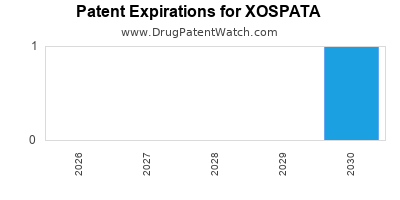
Public patent records and Orange Book data identify a principal U.S. patent expiry in the early 2030s for the core Xospata patent estate. The key listed U.S. patent is commonly reported with an expiration date of January 7, 2031, before any applicable patent-term adjustment or pediatric extension.[5]
The practical generic-entry date can differ from the nominal expiry date. A generic applicant may file an abbreviated new drug application with a Paragraph IV certification and challenge the listed patents before expiry. A successful challenge, settlement, or non-infringement finding could permit entry earlier than 2031.
When does Xospata lose exclusivity?
Xospata’s effective U.S. exclusivity is likely to face its first major test when generic manufacturers file Paragraph IV challenges against the listed patents.
The key timing framework is:
| Exclusivity element |
Xospata implication |
| U.S. approval |
November 2018 |
| New chemical entity exclusivity |
Five years, subject to applicable regulatory rules |
| Orphan-drug exclusivity |
Not the principal protection generally associated with the product |
| Core patent expiry |
Early 2030s, with January 7, 2031 commonly cited for the principal patent |
| Pediatric extension |
Could add six months if granted and applicable |
| Earliest potential generic filing |
Four years after NCE approval for a Paragraph IV filing |
| Potential 30-month stay |
May delay FDA approval after patent litigation begins |
| Commercial generic launch |
Dependent on litigation, settlement, patent outcome and regulatory approval |
The market should distinguish regulatory exclusivity from patent exclusivity. FDA exclusivity expired well before the expected core-patent expiry. The commercial defense therefore depends mainly on patent litigation, product differentiation, and the scope of any settlement agreements.
What is the Orange Book status of Xospata?
The Orange Book is the central U.S. reference for approved drug products, therapeutic equivalence evaluations and patents submitted by the NDA holder.
Xospata’s Orange Book position is important because it identifies the patents that an ANDA applicant must address. A generic applicant can certify that a listed patent has expired, will expire on a stated date, is not infringed, or is invalid. A Paragraph IV certification can trigger patent litigation by the NDA holder.
The principal Orange Book risks are:
- A Paragraph IV challenge to the composition patent.
- A challenge to formulation or treatment patents.
- A generic label that omits patented method-of-use language.
- Litigation over whether the generic product induces use for FLT3-mutated AML.
- A settlement that provides a licensed entry date before patent expiry.
The strength of the Orange Book estate depends less on the number of listed patents than on the validity and enforceability of the core composition patent. A weak composition patent would increase generic risk even if secondary patents remain listed.
Which companies are challenging Xospata patents?
Generic companies commonly target commercially successful oral oncology products well before patent expiry. Public litigation records and patent-docket activity have associated Xospata patent disputes with companies including Zydus, Dr. Reddy’s Laboratories, Teva, Sun Pharmaceutical and Lupin, although the existence, scope and current status of individual cases must be assessed by docket and patent number.
A generic challenge does not establish that entry will occur. The principal outcomes are:
- A court upholds the patent and blocks entry until expiry.
- The patent is invalidated or found not infringed.
- The parties reach a settlement with a defined launch date.
- The applicant narrows its label to avoid a method-of-use patent.
- The ANDA remains pending while litigation proceeds.
For investors, the decisive information is the first filing date, asserted patent claims, the court’s claim-construction position, and any settlement terms. Generic applicants may challenge the core compound patent because it offers the largest commercial reward, while Astellas may rely on method-of-use patents to extend litigation leverage.
How strong is the Xospata patent estate?
The patent estate is moderately strong from a commercial perspective because gilteritinib is a targeted small molecule with a long period between FDA approval and expected core-patent expiry. The main strength is the composition-of-matter protection. Secondary patents provide additional litigation tools but are less valuable if the core compound patent fails.
| Strength factor |
Assessment |
| Core molecule patent |
Strongest protection |
| Time remaining after launch |
Long, extending into the early 2030s |
| Formulation protection |
Secondary; value depends on claim breadth |
| Method-of-use protection |
Useful against labeled AML use, but vulnerable to carve-out strategies |
| Generic substitution risk |
High after core-patent expiry |
| Biosimilar risk |
Not applicable because gilteritinib is a small molecule |
| Manufacturing complexity |
Moderate; less defensible than biologic manufacturing |
| Patent litigation risk |
Material before 2031 |
Gilteritinib is a small-molecule drug, so it does not face biosimilar competition under the biologics framework. The relevant threat is generic substitution through the ANDA pathway.
What formulation patents protect Xospata?
Xospata is marketed as oral film-coated tablets. Formulation patents can cover tablet composition, excipients, crystalline forms, salt forms, dissolution characteristics, stability, or manufacturing processes.
Formulation patents are generally less robust than a valid composition-of-matter patent because generic manufacturers may design around them. A generic could use a different excipient system, solid form, coating process or manufacturing route while preserving the same active ingredient.
The commercial relevance of formulation patents depends on whether the formulation is necessary to achieve bioequivalence, stability or manufacturability. If an alternative formulation can meet FDA bioequivalence requirements, formulation patents are less likely to prevent eventual generic entry.
What method-of-use patents cover Xospata?
Method-of-use patents may cover treatment of AML patients with FLT3 mutations, dosing schedules, sequencing with chemotherapy, or use in patients who have received prior therapy.
These patents can delay a generic launch if the approved generic label would directly encourage an infringing use. However, generic applicants may use a skinny-label strategy that removes patented indications or dosing instructions while retaining non-patented uses.
For Xospata, method-of-use protection has greater value because the product has a concentrated indication. A label carve-out could be commercially difficult if nearly all clinically meaningful use falls within the patented method. The result depends on the patent claims, prescribing behavior and whether Astellas can prove induced infringement.
How does Xospata compare with Vanflyta and Rydapt?
Xospata, Vanflyta and Rydapt are all FLT3-directed products, but they occupy different treatment settings.
| Product |
Active ingredient |
Company |
Main FDA setting |
Competitive relationship |
| Xospata |
Gilteritinib |
Astellas |
Relapsed or refractory FLT3-mutated AML |
Direct second-line competitor |
| Vanflyta |
Quizartinib |
Daiichi Sankyo |
Newly diagnosed FLT3-ITD-positive AML with chemotherapy |
Upstream category competitor |
| Rydapt |
Midostaurin |
Novartis |
Newly diagnosed FLT3-mutated AML with chemotherapy |
Primarily first-line |
| Salvage chemotherapy |
Multiple agents |
Multiple companies |
Relapsed or refractory AML |
Treatment alternative |
| Clinical trials |
Multiple investigational agents |
Multiple companies |
First-line and relapsed settings |
Innovation risk |
Xospata has a clearer position in relapsed or refractory FLT3-mutated AML than its first-line competitors. The main strategic risk is not immediate substitution by Vanflyta or Rydapt, but earlier use of FLT3 inhibitors changing the treatment sequence and affecting later-line response, duration or prescribing preference.
What FDA regulatory events affect Xospata?
The FDA approval was based on the ADMIRAL study, a randomized trial comparing gilteritinib with salvage chemotherapy in relapsed or refractory FLT3-mutated AML.[1] The clinical value proposition is supported by overall survival and response data in a population with poor prognosis.
Key regulatory considerations include:
- FDA approval in 2018 for relapsed or refractory FLT3-mutated AML.
- Required FLT3 testing before treatment.
- Label warnings involving differentiation syndrome, posterior reversible encephalopathy syndrome, QT prolongation and other adverse reactions.
- Use of the LeukoStrat CDx FLT3 Mutation Assay for patient identification.
- Continued reliance on molecular diagnostics as part of the treatment pathway.
Safety monitoring can affect treatment duration and physician selection. QT prolongation and differentiation syndrome are manageable but require clinical surveillance, which can influence treatment in frail patients or those receiving interacting medicines.[2]
What licensing deals and partnerships affect Xospata?
Xospata was developed and commercialized by Astellas, which acquired the underlying program through its acquisition of the oncology business of Ambit Biosciences in 2014. The transaction gave Astellas rights to quizartinib and related FLT3 assets, including the program that became gilteritinib.
The Ambit acquisition provided Astellas with an oncology pipeline asset before Xospata approval. There is no broad co-commercialization structure comparable to some large pharmaceutical oncology partnerships. Astellas controls the principal commercial strategy and global product economics.
What generic launch scenarios exist for Xospata?
Three scenarios define the U.S. post-exclusivity outlook.
Scenario 1: Entry near patent expiry
Generic manufacturers launch after the principal patent expires in 2031, or after any applicable pediatric extension. This is the baseline scenario if Astellas prevails in litigation and no settlement accelerates entry.
Scenario 2: Settled entry before expiry
Astellas reaches settlements with ANDA applicants that permit launch on a negotiated date before the final patent expiry. Such settlements could create several years of continued branded revenue followed by rapid price erosion.
Scenario 3: Early invalidation or non-infringement
A court invalidates the core patent or finds that a generic does not infringe. This would create the highest downside risk because multiple ANDA applicants could enter after regulatory approval.
For a small-molecule oncology drug, generic entry normally produces rapid price and volume pressure. Xospata’s specialist market may slow substitution relative to high-volume primary-care products, but pharmacy and payer substitution can still materially reduce net sales.
What geographic markets support Xospata?
Astellas has commercialized Xospata in the United States, Japan, Europe and other international markets. The United States is likely the largest single market because of higher oncology pricing and broad access to molecular testing. Japan is strategically important because Astellas is headquartered there and maintains a strong domestic commercial infrastructure.
Geographic patent and regulatory protection vary. U.S. entry risk is governed by Orange Book patents and ANDA litigation. Europe depends on national patent validation, supplementary protection certificates where available, national litigation and pricing negotiations. Japan follows its own patent-term, reimbursement and generic-approval framework.
International revenue may decline at different times because patent expiry, generic filings and reimbursement controls are country-specific.
What manufacturing and intellectual-property barriers affect Xospata?
Gilteritinib manufacturing is less difficult to replicate than biologic production but still requires control of chemical synthesis, solid-state properties, impurity profiles, tablet production and analytical methods.
The main barriers are:
- Reproducible active pharmaceutical ingredient synthesis.
- Control of polymorph or salt form.
- Demonstration of pharmaceutical equivalence and bioequivalence.
- Compliance with FDA and international current good manufacturing practices.
- Stable supply of active ingredient and finished dosage forms.
- Regulatory review of facilities and data integrity.
These barriers may delay individual generic applicants but are unlikely to prevent multiple manufacturers from entering after the core patent expires.
What patent litigation affects Xospata?
Xospata litigation risk centers on Paragraph IV ANDA filings. Astellas can sue within the statutory period after receiving notice of a Paragraph IV certification. The resulting litigation can trigger a 30-month stay of FDA approval, subject to statutory exceptions.
The most important litigation questions are:
- Whether the core gilteritinib patent claims are valid.
- Whether a generic product infringes composition claims.
- Whether a proposed label induces use for FLT3-mutated AML.
- Whether formulation or crystalline-form claims are enforceable.
- Whether settlements grant an authorized-generic or licensed-entry date.
A settlement can preserve substantial value even without a complete litigation victory. The commercial impact depends on the entry date, the number of settling applicants and whether a first-filer receives 180-day generic exclusivity.
What is the investment outlook for Xospata?
Xospata is a growing but concentrated revenue asset. Its financial profile has four phases:
| Phase |
Expected commercial pattern |
| Launch and adoption |
Rapid growth from low base after 2018 approval |
| Expansion |
Increased testing and use in relapsed or refractory AML |
| Maturity |
Slower growth as the FLT3-treated population becomes saturated |
| Loss of exclusivity |
Rapid net-sales decline after generic entry |
The product’s value is supported by durable clinical demand, oral administration and patent runway. Its limitations are the small biomarker-defined market, competing FLT3 inhibitors, treatment-sequencing changes and reliance on a single primary indication.
Astellas’ company-wide exposure is manageable because Xospata is a minority share of total revenue. Product-level exposure remains material because a large portion of sales depends on one molecularly defined AML segment.
Key Takeaways
- Xospata is Astellas’ oral gilteritinib product for relapsed or refractory FLT3-mutated AML.
- FDA approval came in November 2018 based on the ADMIRAL trial.
- Sales expanded from launch-stage revenue to more than ¥100 billion annually by FY2024, based on Astellas reporting trends.
- The core U.S. patent estate is generally associated with protection into the early 2030s, with January 7, 2031 commonly cited for the principal patent.
- Paragraph IV litigation is the main route to earlier generic entry.
- Biosimilar risk does not apply because gilteritinib is a small molecule.
- Vanflyta and Rydapt compete in earlier-line AML settings, while Xospata’s strongest position remains relapsed or refractory disease.
- Generic entry would likely produce rapid price erosion despite Xospata’s specialist prescribing base.
- The principal investment variables are patent validity, settlement timing, FLT3 testing rates, treatment duration and the effect of earlier-line FLT3 inhibitors.
FAQs
Is Xospata a biologic or a small-molecule drug?
Xospata is a small-molecule oral kinase inhibitor. Generic manufacturers can use the ANDA pathway rather than the biosimilar pathway.
Does Xospata have orphan-drug exclusivity?
The commercial protection most relevant to Xospata is patent protection and FDA regulatory exclusivity. Orphan-drug exclusivity is not the principal protection generally relied on for the product’s U.S. lifecycle.
Can generic Xospata launch before 2031?
Yes. A generic may seek approval through a Paragraph IV certification and obtain an earlier launch through litigation victory, settlement or a finding that the relevant patent claims are not infringed.
What diagnostic is used before prescribing Xospata?
The LeukoStrat CDx FLT3 Mutation Assay is identified in the FDA labeling for detecting FLT3 mutations relevant to treatment selection.
Is Xospata used before or after chemotherapy?
Xospata is approved for relapsed or refractory FLT3-mutated AML. It is generally used after prior therapy, while Rydapt and Vanflyta are primarily positioned in newly diagnosed FLT3-mutated AML treatment regimens.
References
- U.S. Food and Drug Administration. (2018). FDA approves gilteritinib for relapsed or refractory acute myeloid leukemia with a FLT3 mutation.
- U.S. Food and Drug Administration. (2024). Xospata (gilteritinib fumarate) prescribing information. Astellas Pharma US, Inc.
- U.S. Food and Drug Administration. (2023). FDA approves quizartinib with chemotherapy for newly diagnosed acute myeloid leukemia.
- Astellas Pharma Inc. (2024). Annual report for the fiscal year ended March 31, 2024.
- U.S. Food and Drug Administration. (2024). Approved drug products with therapeutic equivalence evaluations, Orange Book: Xospata.
- Perl, A. E., Martinelli, G., Cortes, J. E., et al. (2019). Gilteritinib or salvage chemotherapy for relapsed or refractory FLT3-mutated AML. New England Journal of Medicine, 381(18), 1728-1740.