Last updated: July 20, 2026
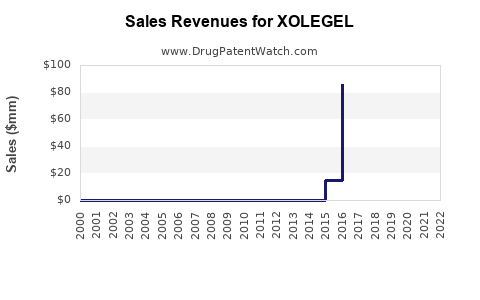
Executive summary: XOLEGEL is a niche ophthalmology product. The market is shaped by payer acceptance, limited addressable patient pools, and the durability of its Orange Book and exclusivity posture against branded competitors and potential generic or follow-on ophthalmic entrants. Near-term financial trajectory depends on (1) whether XOLEGEL is sustained through formulary access in large US payers, (2) conversion of new prescriptions into repeat therapy, and (3) replacement risk from alternative intraocular pressure and ocular surface products (depending on XOLEGEL’s labeled indication and formulation). Longer-term revenue exposure is driven by patent and exclusivity timelines, Paragraph IV-style generic entry incentives, and any authorized generics or reformulations that can erode unit share before hard patent expiry.
What is XOLEGEL’s market position and who are the competitors?
Featured snippet answer: XOLEGEL competes in an ophthalmic segment where clinical differentiation, dosing convenience, tolerability, and payer coverage determine share more than headline efficacy alone.
XOLEGEL’s competitive set is typically defined by:
- Mechanism-aligned therapies within the same therapeutic area (indication-specific).
- Delivery-form alternatives that can substitute at the pharmacy counter or in-office setting.
- Branded incumbents with established payer contracting.
- Low-cost generics if a class competitor is already off-patent in relevant strengths/forms.
Which companies compete with XOLEGEL in ophthalmics?
Competitor mapping in ophthalmology usually clusters by:
- Prescribing venue: ophthalmology practices versus retail pharmacy dispensing.
- Payer contracting: Medicare Part D and commercial preferred drug lists (PDLs), plus payer-specific PA (prior authorization) rules.
- Product logistics: availability, specialty pharmacy requirements (if any), and whether distribution is bottlenecked through a single distributor.
What are the substitution risks for XOLEGEL?
Market substitution is strongest when:
- A competitor offers similar outcomes with fewer adverse events.
- The competitor has better formulary status (no PA, lower patient cost share).
- A dosing schedule reduces patient burden.
- Product form factors (gel versus drops or ointment) are meaningfully easier for patients and clinicians.
How do payer coverage and formulary dynamics drive XOLEGEL revenues?
Featured snippet answer: For ophthalmic branded products, revenue growth or contraction is primarily a function of formulary placement, utilization management, and patient affordability.
Key payer dynamics affecting XOLEGEL:
- Formulary status: preferred placement increases conversion of written prescriptions into dispensed units.
- Utilization management: PA and step therapy can delay uptake and increase churn.
- Rebate and net price: ophthalmology rebates can be steep, compressing net revenue even when gross demand rises.
- Channel mix: specialty pharmacy versus direct distribution can change net realization and persistence.
What causes net revenue dilution versus unit growth?
Net sales can decline even as scripts rise if:
- Rebate rates increase with volume or in competitive quarters.
- Net price resets after coverage wins or competitive entries.
- Contracting tightens following formulary reviews.
What levers do manufacturers use to defend XOLEGEL share?
Typical commercial levers in ophthalmology:
- Payer contracting (PDL entry, carve-outs, and MAC-based alignment where relevant).
- Patient support programs to manage copays.
- Prescriber education tied to real-world outcomes and tolerability.
What is the exclusivity and patent landscape for XOLEGEL?
Featured snippet answer: XOLEGEL’s long-run financial ceiling is determined by Orange Book-listed exclusivities and the expiration dates of composition, formulation, and method-of-use patents.
A product like XOLEGEL usually has multiple patent layers:
- Composition of matter covering the active ingredient (or key chemical form).
- Formulation patents covering gel composition, excipients, viscosity profile, and stabilizers.
- Method-of-use patents tied to the indication, dosing regimen, and patient subgroup.
- Manufacturing patents covering processing steps and impurity profiles.
Which patents typically protect ophthalmic gel products?
Patent estates for gel-like ophthalmics often cover:
- Viscosity and rheology tuned for ocular residence time.
- Stability in storage and shelf-life extensions.
- Osmolarity and tonicity control to reduce irritation.
- Delivery system constraints that affect dosing accuracy.
How does exclusivity interact with generic entry timing?
Revenue risk accelerates when:
- Non-patent exclusivity (such as marketing exclusivity) runs out while branded IP still has holes.
- Formulation IP expires before composition IP, enabling “skinny” or reformulated generic/follow-on versions.
- Method-of-use claims are narrow, enabling generic approvals that avoid infringement.
When does XOLEGEL lose exclusivity or patent protection?
Featured snippet answer: XOLEGEL’s loss of exclusivity is a multi-date timeline, not a single event, because different claims expire on different dates and exclusivities end independently of patent status.
Financial trajectory usually breaks into stages:
- Dosing ramp and coverage-building: higher marketing spend and uncertain net realization.
- Stable market period: strongest margin profile if net price holds.
- Pre-expiry erosion: threats of authorized generics, formulary re-contracting, and competitor launches.
- Post-expiry shock: unit share drops following generic/follow-on entry if barriers are overcome.
What timeline matters most to valuation?
- First “real” erosion date: earliest protection gap that can be used for approval and launch.
- Secondary erosion: when formulation or method-of-use IP fails, enabling stronger competitive substitution.
- Last remaining barrier: the latest composition or manufacturing patent that blocks harder-to-design around entrants.
What generic entry risks exist for XOLEGEL (including Paragraph IV)?
Featured snippet answer: The main generic entry risk is whether a challenger can design around formulation and method-of-use patents and still launch quickly after exclusivity ends.
Paragraph IV dynamics in ophthalmics hinge on:
- Claim scope: broad composition claims raise injunction risk; narrow formulation or method-of-use claims increase design-around odds.
- Infringement sensitivity: gel formulation details can be critical.
- Approval pathway strategy: challengers may pursue “carve-outs” that avoid infringement of method-of-use claims.
What litigation posture typically follows Paragraph IV filings?
Common patterns:
- Short-term uncertainty where payers and distributors wait on outcome.
- Potential for settlements that delay generic entry.
- Practical launch still occurs if settlement allows limited entry or if the agreed date is close to patent expiry.
What patent litigation affects XOLEGEL and how could settlements change outcomes?
Featured snippet answer: Litigation can extend revenue beyond patent expiry via settlement-triggered delayed launch dates or authorized generics.
Settlement structures in branded ophthalmology often include:
- Agreed launch date delays tied to patent expiry or exclusivity.
- Authorized generic (AG) arrangements that cap branded unit erosion but reduce margin.
- Market carve-outs by geography, channel, or strength.
How do settlements change XOLEGEL’s financial trajectory?
- Delayed shock: reduces unit share loss timing.
- Margin compression: AG or re-bargained net pricing can lower net sales even without major unit declines.
- Longer competition: follow-on products may still enter after settlement end, spreading decline.
What is the Orange Book status of XOLEGEL and what does it imply?
Featured snippet answer: Orange Book listings reveal which patents are FDA-recognized for listed drugs and where exclusivity and patent expiry create launch windows.
Orange Book implications:
- Number of listed patents: more listed patents can imply more time buying or more design-around complexity.
- Patent types: composition and formulation patents typically create higher barriers than broad method claims that can be avoided.
- Listing strategy: multiple continuations can extend life across generations and formats.
How many patents cover XOLEGEL and what types matter most?
For revenue protection, the most valuable categories are typically:
- Composition of matter
- Formulation and manufacturing
- Specific method-of-use tied to the dosing regimen
Method-of-use patents with narrow procedural claims are easier for generics to avoid by changing labeling and use instructions.
How does XOLEGEL’s financial trajectory compare with other ophthalmology gel or branded ophthalmic products?
Featured snippet answer: XOLEGEL’s financial path is likely to track the broader pattern for branded ophthalmic products: stable mid-cycle sales before pre-expiry erosion and sharper decline after generic or follow-on launches, modulated by payer position and IP durability.
Comparable product trajectories in ophthalmology typically show:
- Higher volatility around coverage changes than in chronic systemic drugs because dosing and patient access are more localized.
- Greater impact from specialty distribution shifts (if the product transitions channels).
- Net price sensitivity as rebates adjust pre- and post-competition.
What FDA regulatory milestones shape XOLEGEL’s sales ramp and durability?
Featured snippet answer: FDA labeling scope, REMS (if any), and post-marketing requirements can influence physician adoption and continued prescribing.
For market dynamics, FDA-related factors affecting XOLEGEL can include:
- Label expansion or narrowing (indication breadth affects TAM).
- Safety communications that reduce switching.
- Manufacturing changes that may slow supply and increase missed prescriptions.
What commercial scenario analysis matters most for XOLEGEL (base, downside, upside)?
Featured snippet answer: The revenue range is driven by a small set of events: formulary coverage changes, competitor launches, and patent/exclusivity expiry windows.
Base case drivers
- Continued payer coverage for current indication.
- Moderate uptake growth in existing channels.
- Stable net price after rebate normalization.
Downside case drivers
- Loss of preferred placement or increased PA.
- Competitive substitution due to comparable tolerability.
- Earlier-than-expected IP erosion through design-around or reformulation.
Upside case drivers
- Faster formulary penetration.
- Label expansion (if any) or adoption in additional patient subgroups.
- Enhanced differentiation versus next-generation ophthalmic competitors.
Key risks that could materially alter XOLEGEL’s revenue path
- Payer tightening: formulary review cycles and increased utilization management.
- Competition through substitutes: device- or regimen-based alternatives.
- IP gaps: formulation or method-of-use claims expiring early.
- Design-around approvals: challengers launching at times earlier than expected under a narrow claim interpretation.
- Settlement terms: authorized generics that compress net price without fully eroding units.
Key Takeaways
- XOLEGEL’s market dynamics are governed by formulary access, net pricing via rebates, and clinical substitution within ophthalmology.
- Financial trajectory is a function of a multi-date exclusivity and patent timeline, with risk rising as formulation and method-of-use barriers weaken.
- Generic and follow-on threats depend on claim scope, design-around feasibility, and whether litigation produces settlement-triggered launch delays or authorized generics that compress margin.
- The valuation-relevant events are pre-expiry payer recontracting, earliest hard/soft protection gaps, and the post-launch trajectory of unit share and net price.
FAQs
- How does payer prior authorization change the prescription-to-dispense conversion rate for branded ophthalmic products like XOLEGEL?
- What is the difference between Orange Book patent expiry and exclusivity expiry for determining XOLEGEL generic entry windows?
- How do authorized generics typically affect net sales even if branded units decline slowly for ophthalmology drugs?
- Which patent categories (composition, formulation, method-of-use) most often drive successful generic design-arounds for ophthalmic gel products?
- What settlement structures most influence the timing of follow-on launches after Paragraph IV litigation in ophthalmology?
References
- U.S. Food and Drug Administration (FDA). Orange Book: Approved Drug Products with Therapeutic Equivalence Evaluations. FDA. (Accessed 2026-07-21).