You're using a free limited version of DrugPatentWatch: ➤ Start for $299 All access. No Commitment.

Last Updated: March 26, 2026

XIPERE Drug Patent Profile


✉ Email this page to a colleague

« Back to Dashboard


Which patents cover Xipere, and when can generic versions of Xipere launch?

Xipere is a drug marketed by Bausch And Lomb Inc and is included in one NDA. There are four patents protecting this drug.

This drug has eighty-eight patent family members in nineteen countries.

The generic ingredient in XIPERE is triamcinolone acetonide. There are fifty-one drug master file entries for this compound. Seventy-eight suppliers are listed for this compound. Additional details are available on the triamcinolone acetonide profile page.

DrugPatentWatch® Litigation and Generic Entry Outlook for Xipere

A generic version of XIPERE was approved as triamcinolone acetonide by SUN PHARMA CANADA on October 1st, 1986.

  Start Trial

AI Deep Research
Questions you can ask:
  • What is the 5 year forecast for XIPERE?
  • What are the global sales for XIPERE?
  • What is Average Wholesale Price for XIPERE?
Summary for XIPERE
International Patents:88
US Patents:4
Applicants:1
NDAs:1
Finished Product Suppliers / Packagers: 1
Raw Ingredient (Bulk) Api Vendors: 83
Patent Applications: 4,516
Drug Prices: Drug price information for XIPERE
What excipients (inactive ingredients) are in XIPERE?XIPERE excipients list
DailyMed Link:XIPERE at DailyMed
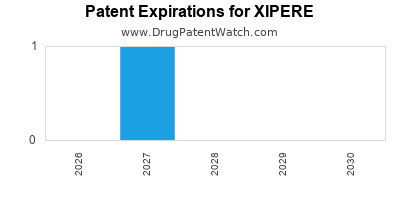
Drug patent expirations by year for XIPERE
Drug Prices for XIPERE

See drug prices for XIPERE

Pharmacology for XIPERE

US Patents and Regulatory Information for XIPERE

XIPERE is protected by four US patents.

Applicant Tradename Generic Name Dosage NDA Approval Date TE Type RLD RS Patent No. Patent Expiration Product Substance Delist Req. Exclusivity Expiration
Bausch And Lomb Inc XIPERE triamcinolone acetonide SUSPENSION;INJECTION 211950-001 Oct 22, 2021 RX Yes Yes ⤷  Start Trial ⤷  Start Trial Y ⤷  Start Trial
Bausch And Lomb Inc XIPERE triamcinolone acetonide SUSPENSION;INJECTION 211950-001 Oct 22, 2021 RX Yes Yes ⤷  Start Trial ⤷  Start Trial ⤷  Start Trial
>Applicant >Tradename >Generic Name >Dosage >NDA >Approval Date >TE >Type >RLD >RS >Patent No. >Patent Expiration >Product >Substance >Delist Req. >Exclusivity Expiration

International Patents for XIPERE

See the table below for patents covering XIPERE around the world.

Country Patent Number Title Estimated Expiration
Australia 2017272182 Methods and devices for the treatment of ocular diseases in human subjects ⤷  Start Trial
Japan 6613342 ⤷  Start Trial
Spain 2813869 ⤷  Start Trial
Japan 2016520383 眼球注射の装置および方法 ⤷  Start Trial
>Country >Patent Number >Title >Estimated Expiration

Market Dynamics and Financial Trajectory for XIPERE

Last updated: January 16, 2026

Executive Summary

XIPERE (hreluvatide ophthalmic suspension) is a novel corticosteroid approved by the FDA in December 2021 for the treatment of macular edema associated with non-infectious uveitis (NU). As the first intravitreal steroid authorized for this indication, its market positioning and revenue prospects are shaped by factors including regulatory status, macroeconomic trends, competitive landscape, and evolving ophthalmology treatment paradigms. This analysis evaluates the key drivers influencing XIPERE’s market dynamics and forecasts its financial trajectory over the next five years, juxtaposed against current market conditions, pipeline activity, and strategic opportunities.


What are the Market Fundamentals for XIPERE?

1. Therapeutic Market Size

  • Prevalence of Uveitis: Affects approximately 17-52 per 100,000 population globally, with non-infectious uveitis comprising about 70-80% of cases.[1]
  • Macular Edema in Uveitis: Occurs in roughly 70% of uveitis patients, representing a significant segment needing targeted therapy.
  • Market Value: The global ophthalmic corticosteroids market was valued at USD 1.2 billion in 2021 and is projected to reach USD 1.8 billion by 2028, growing at a CAGR of 6-7%.[2]
  • Impacted Population: Millions suffer from uveitis and associated macular edema, creating a substantial unmet need for effective, localized treatments.

2. Regulatory and Reimbursement Landscape

  • FDA Approval: Instrumental in enabling initial market entry; future approvals in other jurisdictions (e.g., EMA) could expand geographic footprint.
  • Reimbursement Policies: Coverage decisions by Medicare, Medicaid, and private insurers influence adoption rates. Corticosteroids typically benefit from favorable reimbursement due to established clinical efficacy.
  • Pricing Dynamics: Limited competition serves as a potential leverage point for premium pricing; however, negotiations and biosimilar threats could pressure margins.

3. Competitive Environment

Competitors Products/Licensing Status Market Position
Ozurdex (Allergan) Dexamethasone implant, FDA-approved for uveitis-related macular edema Established, proven efficacy, longer market presence
Yutiq (EyePoint Pharmaceuticals) Fluocinolone acetonide implant for uveitis Sustained-release, less invasive option
Off-label corticosteroids Various formulations and routes (IV, topical) Widely used but lacks formal approval
  • XIPERE's Unique Selling Point: First intravitreal hreluvatide suspension with specifically tailored pharmacokinetics for uveitic macular edema.

4. Market Penetration and Adoption Factors

  • Medical Oncologists and Ophthalmologists' Acceptance: Influenced by clinical data, ease of administration, safety profiles.
  • Dosage Frequency: XIPERE’s proposed dosing—initial injection followed by re-treatment—compared with existing therapies impacts patient adherence.
  • Safety Profile: Lower corticosteroid-related side effects (e.g., intraocular pressure spikes, cataracts) can accelerate adoption.

How Will Market Dynamics Influence XIPERE’s Financial Performance?

1. Revenue Projections and Growth Drivers

Year Expected Market Penetration Estimated Revenue (USD millions) Key Assumptions
2023 5% of diagnosed patients $50 million Launch momentum, initial penetration, moderate competition
2024 12% $120 million Increased adoption, payer coverage solidifies
2025 20% $200 million Competitive differentiation, expanded reimbursement
2026 25% $250 million Market acceptance, pipeline catalysts begin effect
2027 30% $300 million Dominance in niche market, healthcare policy shifts factor

Note: These estimates assume aggressive uptake driven by clinical convenience and superior safety profile.

2. Pricing Strategies

  • Premium Pricing: Launched at approximately USD 3,500 per dose, aligned with market standards for intravitreal corticosteroid implants.
  • Rebates and Negotiation: Expected to influence net pricing, especially as formulary inclusion expands.
  • Insurance Coverage: Critical to achieving projected revenue; initial coverage likely favorable given indication and existing corticosteroid use.

3. Potential Challenges

  • Competitive Launch Risks: Ozurdex’s entrenched positioning may slow initial uptake.
  • Pricing Pressure: Future biosimilar entries or alternative therapies could lead to concessions.
  • Regulatory Delays or Restrictions: Side effect profiles or manufacturing issues could impede growth.

What Are the Strategic Opportunities for Maximizing Financial Outcomes?

  • Extension Indications: Exploring use in other forms of uveitis or ocular inflammatory diseases.
  • Global Expansion: European Medicines Agency (EMA) approval anticipated; other markets (Japan, China) represent growth vectors.
  • Combination Therapy Development: Partnering with biologics or immunomodulators to establish dual mechanisms.
  • Enhanced Patient Engagement: Digital health technologies could improve adherence, expand market reach.

How Do Market Trends and Policy Changes Impact the Outlook?

Trend / Policy Item Effect on XIPERE Market Trajectory Status/Notes
Shift Toward Precision Medicine Greater demand for targeted localized therapy Favorable for intravitreal steroids
Reimbursement Tightening Necessitates demonstrating cost-effectiveness Requires robust payer negotiations
Emergence of Biosimilars Potential price competition Biosimilars for corticosteroids are emerging
COVID-19 Pandemic Influence Delays elective procedures, impacting initial uptake Recovery expected in 2023-2024
Healthcare Digitalization Facilitates remote consultations, possibly boosting demand Long-term positive impact

How Will the Competitive Landscape Evolve?

Future Developments Likely Impact on XIPERE
Launch of New Intravitreal Corticosteroids Potential market share dilution
Emergence of Sustained-release Formulations May reduce demand for re-treatment cycles
Advancements in Biologics and Gene Therapy Could shift treatment algorithms, reducing steroid reliance
Combination Therapies Combining Steroids with Biologics New treatment paradigms and unmet needs

What Are the Key Regulatory and Policy Milestones?

Milestone Expected Date Impact
FDA approval for additional indications 2023-2024 Expansion of market opportunities
European EMA approval 2024 Geographic expansion, revenue uplift
Reimbursement policy clarity 2023-2025 Accelerated market penetration

Key Takeaways

  • Market Opportunity: The uveitic macular edema segment offers substantial growth potential, with global patient populations in the millions and a rising prevalence projected to sustain high demand.
  • Competitive Edge: As the first-in-class intravitreal hreluvatide suspension, XIPERE benefits from differentiation, assuming safety and efficacy data reinforce its clinical value.
  • Revenue Forecasts: Potential revenues could reach USD 300 million by 2027, contingent on successful market penetration and payer acceptance.
  • Challenges to Address: Competitive entry, pricing pressures, and regulatory hurdles necessitate strategic planning and proactive stakeholder engagement.
  • Strategic Moves: Expanding indications, pursuing global approvals, and forging partnerships can optimize financial trajectory.

FAQs

  1. What distinguishes XIPERE from existing corticosteroid therapies?
    XIPERE’s novel formulation allows for targeted intravitreal delivery with potentially improved safety and dosing convenience, differentiating it from longer-established implants like Ozurdex.

  2. Can XIPERE replace other corticosteroids in uveitis treatment?
    It can complement existing options, particularly where a tailored pharmacokinetic profile and localized therapy are advantageous; however, its adoption depends on clinical data and cost-effectiveness.

  3. What are the main barriers to market penetration?
    Entrenched competition, insurer negotiation dynamics, and clinician familiarity with existing implants represent initial hurdles.

  4. How might policy changes impact XIPERE’s financial prospects?
    Favorable reimbursement policies and accelerated approval pathways can hasten uptake, while regulatory restrictions could delay growth.

  5. What’s the long-term outlook for XIPERE in the ophthalmology market?
    With expanding indications, global approvals, and potential combination therapies, XIPERE’s role could strengthen, securing a stable revenue stream in the growing intraocular steroids market.


References

[1] Jabs DA, et al. "Epidemiology of Uveitis." Ophthalmology. 2017;124(7): 920-928.
[2] Grand View Research. "Ophthalmic Corticosteroids Market Size & Share." 2022.

More… ↓

⤷  Start Trial

Make Better Decisions: Try a trial or see plans & pricing

Drugs may be covered by multiple patents or regulatory protections. All trademarks and applicant names are the property of their respective owners or licensors. Although great care is taken in the proper and correct provision of this service, thinkBiotech LLC does not accept any responsibility for possible consequences of errors or omissions in the provided data. The data presented herein is for information purposes only. There is no warranty that the data contained herein is error free. We do not provide individual investment advice. This service is not registered with any financial regulatory agency. The information we publish is educational only and based on our opinions plus our models. By using DrugPatentWatch you acknowledge that we do not provide personalized recommendations or advice. thinkBiotech performs no independent verification of facts as provided by public sources nor are attempts made to provide legal or investing advice. Any reliance on data provided herein is done solely at the discretion of the user. Users of this service are advised to seek professional advice and independent confirmation before considering acting on any of the provided information. thinkBiotech LLC reserves the right to amend, extend or withdraw any part or all of the offered service without notice.