XERMELO Drug Patent Profile
✉ Email this page to a colleague
Which patents cover Xermelo, and when can generic versions of Xermelo launch?
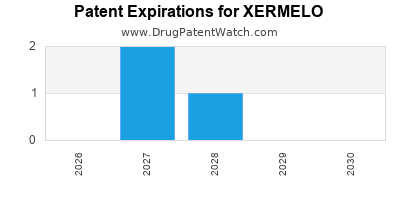
Xermelo is a drug marketed by Tersera and is included in one NDA. There are five patents protecting this drug.
The generic ingredient in XERMELO is telotristat etiprate. There is one drug master file entry for this compound. One supplier is listed for this compound. Additional details are available on the telotristat etiprate profile page.
DrugPatentWatch® Generic Entry Outlook for Xermelo
Xermelo was eligible for patent challenges on February 28, 2021.
By analyzing the patents and regulatory protections it appears that the earliest date
for generic entry will be December 11, 2027. This may change due to patent challenges or generic licensing.
Indicators of Generic Entry
AI Deep Research
Questions you can ask:
- What is the 5 year forecast for XERMELO?
- What are the global sales for XERMELO?
- What is Average Wholesale Price for XERMELO?
Summary for XERMELO
| US Patents: | 5 |
| Applicants: | 1 |
| NDAs: | 1 |
| Finished Product Suppliers / Packagers: | 1 |
| Raw Ingredient (Bulk) Api Vendors: | 56 |
| Clinical Trials: | 5 |
| Patent Applications: | 110 |
| Drug Prices: | Drug price information for XERMELO |
| What excipients (inactive ingredients) are in XERMELO? | XERMELO excipients list |
| DailyMed Link: | XERMELO at DailyMed |

DrugPatentWatch® Estimated Loss of Exclusivity (LOE) Date for XERMELO
Generic Entry Date for XERMELO*:
Constraining patent/regulatory exclusivity:
NDA:
Dosage:
TABLET;ORAL |
*The generic entry opportunity date is the latter of the last compound-claiming patent and the last regulatory exclusivity protection. Many factors can influence early or later generic entry. This date is provided as a rough estimate of generic entry potential and should not be used as an independent source.
Recent Clinical Trials for XERMELO
Identify potential brand extensions & 505(b)(2) entrants
| Sponsor | Phase |
|---|---|
| Aman Chauhan | Phase 2 |
| University of Chicago | Phase 2 |
| European Organisation for Research and Treatment of Cancer - EORTC | Phase 3 |
Pharmacology for XERMELO
| Drug Class | Tryptophan Hydroxylase Inhibitor |
| Mechanism of Action | Tryptophan Hydroxylase Inhibitors |
US Patents and Regulatory Information for XERMELO
XERMELO is protected by five US patents.
Based on analysis by DrugPatentWatch, the earliest date for a generic version of XERMELO is ⤷ Start Trial.
This potential generic entry date is based on patent 7,553,840.
Generics may enter earlier, or later, based on new patent filings, patent extensions, patent invalidation, early generic licensing, generic entry preferences, and other factors.
| Applicant | Tradename | Generic Name | Dosage | NDA | Approval Date | TE | Type | RLD | RS | Patent No. | Patent Expiration | Product | Substance | Delist Req. | Exclusivity Expiration |
|---|---|---|---|---|---|---|---|---|---|---|---|---|---|---|---|
| Tersera | XERMELO | telotristat etiprate | TABLET;ORAL | 208794-001 | Feb 28, 2017 | RX | Yes | Yes | 7,709,493 | ⤷ Start Trial | Y | ⤷ Start Trial | |||
| Tersera | XERMELO | telotristat etiprate | TABLET;ORAL | 208794-001 | Feb 28, 2017 | RX | Yes | Yes | 8,193,204 | ⤷ Start Trial | Y | ⤷ Start Trial | |||
| Tersera | XERMELO | telotristat etiprate | TABLET;ORAL | 208794-001 | Feb 28, 2017 | RX | Yes | Yes | 7,968,559 | ⤷ Start Trial | ⤷ Start Trial | ||||
| Tersera | XERMELO | telotristat etiprate | TABLET;ORAL | 208794-001 | Feb 28, 2017 | RX | Yes | Yes | 8,653,094 | ⤷ Start Trial | ⤷ Start Trial | ||||
| Tersera | XERMELO | telotristat etiprate | TABLET;ORAL | 208794-001 | Feb 28, 2017 | RX | Yes | Yes | 7,553,840 | ⤷ Start Trial | Y | ⤷ Start Trial | |||
| >Applicant | >Tradename | >Generic Name | >Dosage | >NDA | >Approval Date | >TE | >Type | >RLD | >RS | >Patent No. | >Patent Expiration | >Product | >Substance | >Delist Req. | >Exclusivity Expiration |
International Patents for XERMELO
When does loss-of-exclusivity occur for XERMELO?
Based on analysis by DrugPatentWatch, the following patents block generic entry in the countries listed below:
Argentina
Patent: 4279
Estimated Expiration: ⤷ Start Trial
Australia
Patent: 07333120
Estimated Expiration: ⤷ Start Trial
Brazil
Patent: 0720270
Estimated Expiration: ⤷ Start Trial
Canada
Patent: 72233
Estimated Expiration: ⤷ Start Trial
Colombia
Patent: 20855
Estimated Expiration: ⤷ Start Trial
Denmark
Patent: 91940
Estimated Expiration: ⤷ Start Trial
Patent: 76159
Estimated Expiration: ⤷ Start Trial
Ecuador
Patent: 099413
Estimated Expiration: ⤷ Start Trial
Eurasian Patent Organization
Patent: 8150
Estimated Expiration: ⤷ Start Trial
Patent: 0970575
Estimated Expiration: ⤷ Start Trial
European Patent Office
Patent: 91940
Estimated Expiration: ⤷ Start Trial
Patent: 89600
Estimated Expiration: ⤷ Start Trial
Patent: 76159
Estimated Expiration: ⤷ Start Trial
Patent: 08740
Estimated Expiration: ⤷ Start Trial
Hungary
Patent: 27896
Estimated Expiration: ⤷ Start Trial
Patent: 53098
Estimated Expiration: ⤷ Start Trial
Patent: 800010
Estimated Expiration: ⤷ Start Trial
Israel
Patent: 8806
Estimated Expiration: ⤷ Start Trial
Patent: 5288
Patent: צורת מינון המכילה תרכובות המבוססות על 4–פניל–6–(2,2,2–טריפלואורו–1–פנילאתוקסי)פירימידין (Dosage form containing 4-phenyl-6-(2,2,2-trifluoro-1-phenylethoxy)pyrimidine-based compounds)
Estimated Expiration: ⤷ Start Trial
Japan
Patent: 61734
Estimated Expiration: ⤷ Start Trial
Patent: 10512416
Estimated Expiration: ⤷ Start Trial
Mexico
Patent: 09006195
Patent: COMPUESTOS BASADOS EN 4-FENIL-6-(2,2,2-TRIFLUORO-1-FENILETOXI)PIRI MIDINA Y METODOS DE SU USO. (4-PHENYL-6-(2,2,2-TRIFLUORO-1-PHENYLETHOXY)PYRIMIDINE-BASED COMPOUNDS AND METHODS OF THEIR USE.)
Estimated Expiration: ⤷ Start Trial
Netherlands
Patent: 0929
Estimated Expiration: ⤷ Start Trial
New Zealand
Patent: 7004
Patent: 4-PHENYL-6-(2,2,2-TRIFLUORO-1-PHENYLETHOXY)PYRIMIDINE-BASED COMPOUNDS AND METHODS OF THEIR USE
Estimated Expiration: ⤷ Start Trial
Norway
Patent: 5062
Estimated Expiration: ⤷ Start Trial
Patent: 21010
Estimated Expiration: ⤷ Start Trial
Patent: 092639
Estimated Expiration: ⤷ Start Trial
Poland
Patent: 91940
Estimated Expiration: ⤷ Start Trial
Patent: 76159
Estimated Expiration: ⤷ Start Trial
Portugal
Patent: 91940
Estimated Expiration: ⤷ Start Trial
Patent: 76159
Estimated Expiration: ⤷ Start Trial
South Africa
Patent: 0903367
Patent: 4-Phenyl-6-(2,2,2-trifluoro-1-phenylethoxy) pyrimidine-based compounds and methods of their use
Estimated Expiration: ⤷ Start Trial
South Korea
Patent: 1464391
Estimated Expiration: ⤷ Start Trial
Patent: 090087916
Patent: 4-PHENYL-6-(2,2,2-TRIFLUORO-1-PHENYLETHOXY)PYRIMIDINE-BASED COMPOUNDS AND METHODS OF THEIR USE
Estimated Expiration: ⤷ Start Trial
Spain
Patent: 62775
Estimated Expiration: ⤷ Start Trial
Patent: 25083
Estimated Expiration: ⤷ Start Trial
Patent: 56871
Estimated Expiration: ⤷ Start Trial
Taiwan
Patent: 0831102
Patent: 4-phenyl-6-(2,2,2-trifluoro-1-phenylethoxy)pyrimidine-based compounds and methods of their use
Estimated Expiration: ⤷ Start Trial
Patent: 12365
Estimated Expiration: ⤷ Start Trial
Ukraine
Patent: 270
Patent: 4-PHENYL-6-(2,2,2-TRIFLUORO-1-PHENYLETHOXY)PYRIMIDINE-BASED COMPOUNDS AND METHODS OF THEIR USE
Estimated Expiration: ⤷ Start Trial
Generics may enter earlier, or later, based on new patent filings, patent extensions, patent invalidation, early generic licensing, generic entry preferences, and other factors.
See the table below for additional patents covering XERMELO around the world.
| Country | Patent Number | Title | Estimated Expiration |
|---|---|---|---|
| Argentina | 064279 | ⤷ Start Trial | |
| Australia | 2007333120 | ⤷ Start Trial | |
| Brazil | PI0720270 | ⤷ Start Trial | |
| Canada | 2672233 | ⤷ Start Trial | |
| Colombia | 6220855 | ⤷ Start Trial | |
| >Country | >Patent Number | >Title | >Estimated Expiration |
Supplementary Protection Certificates for XERMELO
| Patent Number | Supplementary Protection Certificate | SPC Country | SPC Expiration | SPC Description |
|---|---|---|---|---|
| 2091940 | CA 2018 00011 | Denmark | ⤷ Start Trial | PRODUCT NAME: TELOTRISTAT OR A PHARMACEUTICALLY ACCEPTABLE ESTER, OR A SALT THEREOF, INPARTICULAR TELOTRISTAT ETHYL, MORE PARTICULARLY HIPPURATE SALT OF TELOTRISTAT ETHYL; REG. NO/DATE: EU/1/17/1224 20170920 |
| 2091940 | 300929 | Netherlands | ⤷ Start Trial | DETAILS ASSIGNMENT: CHANGE OF OWNER(S), ASSIGNMENT |
| 2091940 | 122018000025 | Germany | ⤷ Start Trial | PRODUCT NAME: TELOTRISTAT ODER EIN PHARMAZEUTISCH AKZEPTABLES SALZ ODER SOLVAT DAVON, EINSCHLIESSLICH TELOTRISTATETHYL; REGISTRATION NO/DATE: EU/1/17/1224 20170918 |
| 2091940 | 2018C/009 | Belgium | ⤷ Start Trial | DETAILS ASSIGNMENT: CHANGE OF OWNER(S), ASSIGNMENT |
| 2091940 | 1890014-2 | Sweden | ⤷ Start Trial | PRODUCT NAME: TELOTRISTAT OR A PHARMACEUTICALLY ACCEPTABLE ESTER, OR A SALT THEREOF, IN PARTICULARLY TELOTRISTAT ETHYL, MORE PARTICULARLY HIPPURATE SALT OF TELOTRISTAT ETHYL; REG. NO/DATE: EU/1/17/1224 20170920 |
| >Patent Number | >Supplementary Protection Certificate | >SPC Country | >SPC Expiration | >SPC Description |
More… ↓
DrugChatter Q&A for XERMELO
Make Better Decisions: Try a trial or see plans & pricing
Drugs may be covered by multiple patents or regulatory protections. All trademarks and applicant names are the property of their respective owners or licensors. Although great care is taken in the proper and correct provision of this service, thinkBiotech LLC does not accept any responsibility for possible consequences of errors or omissions in the provided data. The data presented herein is for information purposes only. There is no warranty that the data contained herein is error free. We do not provide individual investment advice. This service is not registered with any financial regulatory agency. The information we publish is educational only and based on our opinions plus our models. By using DrugPatentWatch you acknowledge that we do not provide personalized recommendations or advice. thinkBiotech performs no independent verification of facts as provided by public sources nor are attempts made to provide legal or investing advice. Any reliance on data provided herein is done solely at the discretion of the user. Users of this service are advised to seek professional advice and independent confirmation before considering acting on any of the provided information. thinkBiotech LLC reserves the right to amend, extend or withdraw any part or all of the offered service without notice.
ISSN: 2162-2639

Privacy and Cookies
Terms & Conditions
Site Map
DrugPatentWatch Alternatives
LOE / Major Patent Expirations 2026 - 2027
NCE-1 Patent Challenge Dates 2026 - 2027
Friedman, Yali. "DrugPatentWatch" DrugPatentWatch, thinkBiotech, 2026, www.DrugPatentWatch.com.
See Primary Research Papers Citing DrugPatentWatch