Tersera Company Profile
✉ Email this page to a colleague
What is the competitive landscape for TERSERA
TERSERA has six approved drugs.
There are fourteen US patents protecting TERSERA drugs.
Summary for Tersera
| US Patents: | 14 |
| Tradenames: | 4 |
| Ingredients: | 4 |
| NDAs: | 6 |
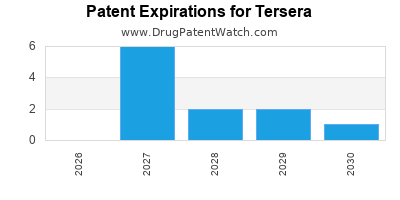
Drugs and US Patents for Tersera
| Applicant | Tradename | Generic Name | Dosage | NDA | Approval Date | TE | Type | RLD | RS | Patent No. | Patent Expiration | Product | Substance | Delist Req. | Exclusivity Expiration |
|---|---|---|---|---|---|---|---|---|---|---|---|---|---|---|---|
| Tersera | QMIIZ ODT | meloxicam | TABLET, ORALLY DISINTEGRATING;ORAL | 211210-002 | Oct 19, 2018 | DISCN | Yes | No | 8,545,879 | ⤷ Start Trial | Y | ⤷ Start Trial | |||
| Tersera | ZOLADEX | goserelin acetate | IMPLANT;IMPLANTATION | 020578-001 | Jan 11, 1996 | RX | Yes | Yes | ⤷ Start Trial | ⤷ Start Trial | |||||
| Tersera | XERMELO | telotristat etiprate | TABLET;ORAL | 208794-001 | Feb 28, 2017 | RX | Yes | Yes | 7,709,493 | ⤷ Start Trial | Y | ⤷ Start Trial | |||
| Tersera | VARUBI | rolapitant hydrochloride | TABLET;ORAL | 206500-001 | Sep 1, 2015 | RX | Yes | Yes | 7,049,320 | ⤷ Start Trial | Y | Y | ⤷ Start Trial | ||
| Tersera | VARUBI | rolapitant hydrochloride | EMULSION;INTRAVENOUS | 208399-001 | Oct 25, 2017 | DISCN | Yes | No | 9,101,615 | ⤷ Start Trial | ⤷ Start Trial | ||||
| Tersera | VARUBI | rolapitant hydrochloride | EMULSION;INTRAVENOUS | 208399-001 | Oct 25, 2017 | DISCN | Yes | No | 8,404,702 | ⤷ Start Trial | ⤷ Start Trial | ||||
| Tersera | VARUBI | rolapitant hydrochloride | TABLET;ORAL | 206500-001 | Sep 1, 2015 | RX | Yes | Yes | 8,404,702 | ⤷ Start Trial | ⤷ Start Trial | ||||
| >Applicant | >Tradename | >Generic Name | >Dosage | >NDA | >Approval Date | >TE | >Type | >RLD | >RS | >Patent No. | >Patent Expiration | >Product | >Substance | >Delist Req. | >Exclusivity Expiration |
Expired US Patents for Tersera
| Applicant | Tradename | Generic Name | Dosage | NDA | Approval Date | Patent No. | Patent Expiration |
|---|---|---|---|---|---|---|---|
| Tersera | ZOLADEX | goserelin acetate | IMPLANT;IMPLANTATION | 020578-001 | Jan 11, 1996 | 5,366,734 | ⤷ Start Trial |
| Tersera | VARUBI | rolapitant hydrochloride | EMULSION;INTRAVENOUS | 208399-001 | Oct 25, 2017 | 8,796,299 | ⤷ Start Trial |
| Tersera | ZOLADEX | goserelin acetate | IMPLANT;IMPLANTATION | 019726-001 | Dec 29, 1989 | 5,366,734 | ⤷ Start Trial |
| Tersera | ZOLADEX | goserelin acetate | IMPLANT;IMPLANTATION | 019726-001 | Dec 29, 1989 | 7,118,552 | ⤷ Start Trial |
| Tersera | ZOLADEX | goserelin acetate | IMPLANT;IMPLANTATION | 019726-001 | Dec 29, 1989 | 4,767,628 | ⤷ Start Trial |
| Tersera | ZOLADEX | goserelin acetate | IMPLANT;IMPLANTATION | 020578-001 | Jan 11, 1996 | 4,767,628 | ⤷ Start Trial |
| Tersera | ZOLADEX | goserelin acetate | IMPLANT;IMPLANTATION | 020578-001 | Jan 11, 1996 | 7,500,964 | ⤷ Start Trial |
| >Applicant | >Tradename | >Generic Name | >Dosage | >NDA | >Approval Date | >Patent No. | >Patent Expiration |
International Patents for Tersera Drugs
| Country | Patent Number | Estimated Expiration |
|---|---|---|
| Brazil | PI0720270 | ⤷ Start Trial |
| Mexico | 2012001872 | ⤷ Start Trial |
| Argentina | 068558 | ⤷ Start Trial |
| Mexico | 2008012935 | ⤷ Start Trial |
| Lithuania | PA2017031 | ⤷ Start Trial |
| Japan | 4500984 | ⤷ Start Trial |
| Japan | 6122411 | ⤷ Start Trial |
| >Country | >Patent Number | >Estimated Expiration |
Supplementary Protection Certificates for Tersera Drugs
| Patent Number | Supplementary Protection Certificate | SPC Country | SPC Expiration | SPC Description |
|---|---|---|---|---|
| 2091940 | C02091940/01 | Switzerland | ⤷ Start Trial | PRODUCT NAME: TELOTRISTAT; REGISTRATION NO/DATE: SWISSMEDIC-ZULASSUNG 66374 28.03.2018 |
| 1463716 | LUC00043 | Luxembourg | ⤷ Start Trial | PRODUCT NAME: ROLAPITANT, OPTIONALLY IN THE FORM OF A PHARMACEUTICALLY ACCEPTABLE SALT, INCLUDING ROLAPITANT HYDROCHLORIDE MONOHYDRATE; AUTHORISATION NUMBER AND DATE: EU/1/17/1180/001 20170424 |
| 1463716 | 17C1037 | France | ⤷ Start Trial | PRODUCT NAME: ROLAPITANT, OPTIONNELLEMENT SOUS LA FORME D'UN SEL PHARMACEUTIQUEMENT ADMISSIBLE, INCLUANT LE MONOHYDRATE DE CHLORHYDRATE DE ROLAPITANT.; REGISTRATION NO/DATE: EU/1/17/1180 20170424 |
| 2091940 | 132018000000181 | Italy | ⤷ Start Trial | PRODUCT NAME: TELOTRISTAT O UN SUO ESTERE FARMACEUTICAMENTE ACCETTABILE, O UN SUO SALE, IN PARTICOLARE TELOTRISTAT ETILE, PIU IN PARTICOLARE SALE IPPURATO DI TELOTRISAT ETILE(XERMELO); AUTHORISATION NUMBER(S) AND DATE(S): EU/1/17/1224, 20170920 |
| 2004646 | 132017000117656 | Italy | ⤷ Start Trial | PRODUCT NAME: ROLAPITANT IDROCLORURO MONOIDRATO(VARUBY); AUTHORISATION NUMBER(S) AND DATE(S): EU/1/17/1180/001, 20170424 |
| 2091940 | CA 2018 00011 | Denmark | ⤷ Start Trial | PRODUCT NAME: TELOTRISTAT OR A PHARMACEUTICALLY ACCEPTABLE ESTER, OR A SALT THEREOF, INPARTICULAR TELOTRISTAT ETHYL, MORE PARTICULARLY HIPPURATE SALT OF TELOTRISTAT ETHYL; REG. NO/DATE: EU/1/17/1224 20170920 |
| 2091940 | 122018000025 | Germany | ⤷ Start Trial | PRODUCT NAME: TELOTRISTAT ODER EIN PHARMAZEUTISCH AKZEPTABLES SALZ ODER SOLVAT DAVON, EINSCHLIESSLICH TELOTRISTATETHYL; REGISTRATION NO/DATE: EU/1/17/1224 20170918 |
| >Patent Number | >Supplementary Protection Certificate | >SPC Country | >SPC Expiration | >SPC Description |
Similar Applicant Names
Applicants may be listed under multiple names.
Here is a list of applicants with similar names.
Here is a list of applicants with similar names.
