Last updated: September 28, 2026
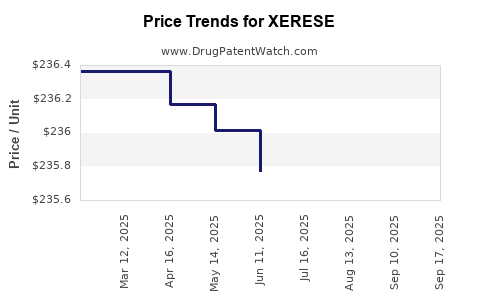
XERESE is a mature prescription topical treatment containing acyclovir 5% and hydrocortisone 1% for recurrent herpes labialis. Its commercial value is constrained by a narrow indication, short treatment course, competition from oral antivirals and over-the-counter products, and limited public disclosure of standalone sales. The product has no biosimilar exposure because it is a small-molecule cream. Its primary commercial risk is generic substitution and continued price erosion rather than loss of biologic exclusivity.
What is XERESE and how does it compete in the cold sore market?
XERESE combines an antiviral and a corticosteroid in a topical cream. The acyclovir component inhibits herpes simplex virus replication, while hydrocortisone reduces local inflammatory symptoms. The FDA approved XERESE in 2009 for the early treatment of recurrent herpes labialis, commonly known as cold sores or fever blisters.[1]
| Product |
Active ingredient |
Route |
U.S. regulatory status |
Primary commercial position |
| XERESE |
Acyclovir 5% plus hydrocortisone 1% |
Topical cream |
Prescription |
Combination treatment for recurrent herpes labialis |
| Zovirax cream |
Acyclovir 5% |
Topical cream |
Prescription |
Established topical antiviral |
| Valtrex |
Valacyclovir |
Oral tablet |
Prescription |
Convenient systemic treatment |
| Abreva |
Docosanol 10% |
OTC topical cream |
Nonprescription |
Consumer self-treatment |
| Generic acyclovir |
Acyclovir 5% |
Topical cream or ointment |
Prescription |
Lower-cost antiviral alternative |
XERESE’s differentiation is convenience through combination therapy. Its commercial limitation is that recurrent herpes labialis is episodic, and most patients use treatment for a short period. That limits refill frequency and makes market share more important than chronic adherence.
Clinical studies supporting XERESE found that the combination reduced the duration of ulcerative cold sore episodes compared with vehicle treatment and reduced progression to ulcerative lesions when applied early.[2] The product does not eliminate latent herpes simplex virus infection and does not prevent future recurrences.
What is the FDA regulatory status of XERESE?
XERESE was approved under New Drug Application 021988. The approved dosage form is a topical cream containing acyclovir 5% and hydrocortisone 1%.[1]
FDA milestones
| Event |
Date |
| FDA approval |
2009 |
| Approved indication |
Early treatment of recurrent herpes labialis |
| Dosage form |
Topical cream |
| Prescription status |
Prescription-only |
| Biologic classification |
Not applicable |
| Reference product type |
Small-molecule combination drug |
The product is not a biologic and does not qualify for biosimilar protection or biosimilar substitution rules. A competing product would generally be evaluated through the generic-drug pathway, subject to formulation, bioequivalence, product-quality, and regulatory requirements.
The FDA label directs patients to apply a thin layer to affected areas five times daily for five days, beginning at the earliest sign of recurrence.[1] The short regimen supports early intervention but limits the number of units used per episode.
What patents protect XERESE and when does it lose exclusivity?
XERESE’s original protection was based on patents covering topical compositions that combine an antiviral agent with a corticosteroid and methods for treating herpes labialis. The commercial patent estate is mature, and the principal U.S. exclusivity period associated with the original product has expired or is no longer a meaningful barrier to generic competition.
Patent and exclusivity profile
| Protection category |
Relevance to XERESE |
Current commercial effect |
| Composition patents |
Acyclovir and corticosteroid combination |
Historical protection; mature |
| Method-of-use patents |
Treatment of recurrent herpes labialis |
Historical protection; likely expired or commercially weak |
| Formulation patents |
Topical cream vehicle and delivery characteristics |
Potentially relevant only if unexpired and listed |
| FDA regulatory exclusivity |
New-drug approval exclusivity |
Expired |
| Orphan-drug exclusivity |
Not applicable |
None |
| Pediatric exclusivity |
No material public indication |
None |
| Biologic exclusivity |
Not applicable |
None |
The critical distinction is between patents that originally supported market entry and patents that remain enforceable against a present-day generic applicant. A combination product can retain technical or formulation patents after its original approval, but those patents must be unexpired, properly listed where applicable, and broad enough to cover the proposed generic product.
What formulation patents protect XERESE?
Potential formulation protection may concern the cream vehicle, the stability of acyclovir and hydrocortisone in the same dosage form, particle dispersion, preservative systems, and manufacturing controls. These features can complicate development, but they do not automatically prevent approval of a generic.
A generic applicant may design around a formulation patent by changing inactive ingredients while preserving the same active ingredients, strength, dosage form, route, and therapeutic performance. The commercial value of a formulation patent therefore depends on claim breadth, product equivalence requirements, and the cost of developing an alternative vehicle.
What is the Orange Book status of XERESE?
XERESE is associated with NDA 021988. The FDA Orange Book is the controlling source for current patent-listing and exclusivity information for approved small-molecule products.[3]
The commercial significance of the Orange Book position is limited by the age of the product. A listed patent can trigger certification obligations for an ANDA applicant, including a Paragraph IV certification if the applicant contends that the patent is invalid, unenforceable, or not infringed. An Orange Book listing does not guarantee that the patent will block approval or survive litigation.
The key diligence points for XERESE are:
- Whether any patents remain listed against NDA 021988.
- Whether those patents have unexpired terms.
- Whether the listed claims cover the active ingredient combination, the cream formulation, or only a narrow method of use.
- Whether FDA-approved generic products have entered the market.
- Whether any 30-month stay or patent litigation remains relevant.
Which companies are challenging XERESE, and what is the Paragraph IV risk?
No major, publicly documented current Paragraph IV litigation involving XERESE is identified in the FDA and company materials cited in this analysis. The lack of a prominent litigation record does not eliminate generic-entry risk. It indicates that the product is unlikely to be protected by an active, high-value litigation campaign comparable to a recently launched specialty drug.
A generic applicant could pursue one of several regulatory strategies:
| Generic strategy |
Likely effect on XERESE |
| ANDA with Paragraph III certification |
Launch after patent expiry |
| ANDA with Paragraph IV certification |
Potential early litigation and possible 180-day generic exclusivity |
| Formulation design-around |
Reduces dependence on disputed formulation claims |
| Alternative acyclovir product |
Competes without replicating the combination |
| Compounded or non-equivalent topical product |
Limited direct substitutability but may affect demand |
For a product of XERESE’s age and market size, litigation economics are important. The expected return from defending a patent depends on remaining branded revenue, expected generic price erosion, legal costs, and the probability that a generic entrant obtains approval.
How strong is the XERESE patent estate?
The XERESE patent estate is commercially weak to moderate as a current defense and historically stronger as a product-launch tool.
Strength assessment
| Factor |
Assessment |
| Remaining patent life |
Limited or exhausted for core protection |
| Product differentiation |
Moderate; combination of antiviral and steroid |
| Switching barriers |
Low |
| Manufacturing complexity |
Moderate for a stable dual-active cream |
| Prescription dependence |
High |
| Generic substitution risk |
High |
| Litigation leverage |
Limited unless unexpired formulation claims remain |
| Biosimilar risk |
None |
| OTC substitution risk |
High |
The product’s technical combination gives it some differentiation from plain acyclovir, but the differentiation is not difficult for the generic industry to understand. The main barriers are formulation development, comparative testing, regulatory filing costs, and commercial scale.
What is XERESE’s financial trajectory?
Bausch Health does not generally report XERESE as a standalone revenue line in its public financial statements. The product is included within broader dermatology or prescription-product reporting, making precise product-level revenue, gross margin, and unit-volume analysis unavailable from public company disclosures.[4]
Commercial lifecycle
| Period |
Commercial phase |
Financial implication |
| 2009-2012 |
Initial launch and physician adoption |
Product differentiation supported branded pricing |
| 2012-2013 |
Medicis acquisition and transition into Valeant’s portfolio |
Product became part of a larger dermatology platform |
| 2013-2018 |
Portfolio expansion and price-focused commercialization |
Revenue depended heavily on branded prescription pricing |
| 2018 onward |
Bausch Health ownership and mature-product management |
Lower growth, greater exposure to generic and payer pressure |
| Current mature phase |
Episodic demand and limited public disclosure |
Likely stable-to-declining commercial contribution |
The financial trajectory is more consistent with a mature niche dermatology asset than with a growth pharmaceutical product. Revenue is likely influenced by four variables:
- Prescription volume for recurrent herpes labialis.
- Net price after payer discounts and rebates.
- Availability and uptake of generic or alternative topical products.
- Physician preference for oral antivirals and OTC self-treatment.
The product’s revenue exposure to any individual patient is low because treatment is episodic. A patient generally uses a small amount of cream for a five-day course, which limits annual revenue per treated patient. This profile makes pricing, distribution, and formulary access more important than long-term adherence.
What market dynamics affect XERESE sales?
Oral antiviral competition
Valacyclovir and acyclovir tablets offer systemic treatment and are familiar to physicians. Oral therapy can be preferred for patients with frequent, severe, or inconvenient recurrences. Generic oral antivirals also create significant price pressure.
OTC competition
Docosanol 10% is available without a prescription and has strong consumer recognition. OTC access allows patients to self-treat without a physician visit. This is a direct commercial threat to a prescription topical product, particularly for mild episodes.
Treatment timing
XERESE must be applied early, generally at the first sign of tingling or burning. Delayed treatment reduces the practical value of the product and creates an adherence challenge. Consumers who recognize symptoms early may use OTC products or keep previously prescribed oral antivirals available.
Payer and pharmacy substitution
Because XERESE is a small-molecule topical product, payers and pharmacies can favor lower-cost alternatives. A branded product can retain demand through physician familiarity, patient preference, or a perceived benefit from the dual-active formulation, but those advantages are vulnerable when reimbursement is restrictive.
Market access and channel mix
The product is primarily dependent on prescription channels, dermatology and primary-care prescribing, and pharmacy dispensing. Telehealth and digital prescribing can expand access, but these channels also make generic oral and OTC alternatives easier to compare and obtain.
What manufacturing and intellectual-property barriers affect XERESE?
Manufacturing a dual-active topical cream requires control of:
- Acyclovir particle size and dispersion.
- Hydrocortisone uniformity.
- Physical stability of both active ingredients.
- Cream viscosity and spreadability.
- Microbial quality and preservative performance.
- Packaging compatibility and shelf life.
These requirements create a higher development burden than a simple single-active cream. They do not create the same barrier as sterile injectables, inhaled products, or complex biologics. The principal barrier is formulation and quality-control execution rather than proprietary manufacturing equipment.
Geographic protection is also limited. U.S. protection is governed by FDA approval, Orange Book listings, and U.S. patent law. Foreign markets have separate patent terms, regulatory approvals, reimbursement environments, and trademark positions. A U.S. patent expiry does not establish identical freedom to operate in Europe, Japan, Canada, or other markets.
What generic launch scenarios exist for XERESE?
Scenario 1: No near-term generic substitution
A generic may not launch if the market is too small, reimbursement is unattractive, or formulation development does not justify the expected return. In that case, XERESE could retain a niche branded position despite its mature lifecycle.
Scenario 2: Single generic entrant
One approved generic could produce a sharp reduction in branded net price and pharmacy demand. The first entrant may obtain temporary competitive advantages depending on the certification and exclusivity pathway.
Scenario 3: Multiple generic entrants
Multiple entrants would accelerate price erosion and reduce XERESE’s negotiating power with payers and distributors. The product could become a low-volume branded alternative maintained for patient familiarity.
Scenario 4: Substitution by oral or OTC therapy
Even without a direct generic version, XERESE can lose volume to generic valacyclovir, generic oral acyclovir, docosanol, and physician-directed treatment alternatives.
What patent litigation and settlement risks affect XERESE?
The litigation risk is lower than for a recently launched branded drug because the product has an established history and a limited remaining exclusivity runway. A new generic challenge would have value mainly if the brand retains sufficient net sales to justify litigation.
A settlement could involve delayed entry, a license to specific formulation technology, or commercial supply arrangements. No prominent current XERESE settlement agreement is identified in the cited public materials. Any settlement would need to be assessed against the FTC’s scrutiny of agreements that restrict generic entry.
How does XERESE compare with competing herpes labialis treatments?
| Attribute |
XERESE |
Generic valacyclovir |
Generic acyclovir cream |
Docosanol |
| Route |
Topical |
Oral |
Topical |
Topical |
| Prescription required |
Yes |
Yes |
Yes |
No |
| Combination therapy |
Yes |
No |
No |
No |
| Treatment convenience |
Moderate |
High |
Moderate |
High |
| Generic pressure |
High |
High |
High |
Not applicable in the same way |
| Consumer access |
Limited to pharmacy prescription |
Prescription |
Prescription |
OTC |
| Differentiation |
Dual-active cream |
Systemic treatment |
Established topical antiviral |
Consumer brand and access |
XERESE’s strongest competitive feature is the combination of antiviral and anti-inflammatory activity in one prescription cream. Its weakest features are prescription dependence, short-course economics, and the availability of low-cost or nonprescription alternatives.
Key Takeaways
- XERESE is a mature prescription combination cream containing acyclovir 5% and hydrocortisone 1%.
- FDA approval dates to 2009, and the product’s core exclusivity is no longer a strong commercial barrier.
- The product has no biosimilar risk because it is a small-molecule topical drug.
- Generic substitution, oral antivirals, and OTC docosanol are the main competitive threats.
- Bausch Health does not publicly disclose standalone XERESE revenue, preventing precise product-level financial modeling.
- The likely financial trajectory is mature to declining, with revenue dependent on branded pricing, prescription volume, and the pace of generic or therapeutic substitution.
- A dual-active cream creates formulation work but not the high manufacturing barrier associated with sterile or biologic products.
- No major current Paragraph IV litigation or settlement involving XERESE is identified in the cited public materials.
FAQs
Is XERESE still commercially relevant?
Yes, but as a niche mature product. Its relevance depends on physician preference for a combined topical treatment and the absence of a lower-cost directly substitutable product in a given market.
Is there a generic version of XERESE?
Generic acyclovir and oral antiviral products compete with XERESE. The commercial question is whether an approved generic equivalent of the acyclovir-hydrocortisone combination is available in the relevant jurisdiction and pharmacy channel.
Can XERESE be replaced by valacyclovir?
Valacyclovir is a therapeutic alternative, not an automatic pharmaceutical equivalent. It uses an oral route and may be preferred when systemic treatment or dosing convenience is more important than topical therapy.
Does XERESE have biosimilar competition?
No. XERESE is a small-molecule topical cream, so competition would arise through generic-drug pathways rather than biosimilar approval.
What would most reduce XERESE revenue?
The largest risks are direct generic entry, lower branded reimbursement, increased prescribing of generic valacyclovir, and continued consumer use of OTC docosanol.
References
- U.S. Food and Drug Administration. (2009). XERESE (acyclovir and hydrocortisone) cream, 5%/1%: Prescribing information.
- Spruance, S. L., et al. (2011). Acyclovir and hydrocortisone cream for the treatment of recurrent herpes labialis. Antimicrobial Agents and Chemotherapy.
- U.S. Food and Drug Administration. (2024). Approved drug products with therapeutic equivalence evaluations: Orange Book.
- Bausch Health Companies Inc. (2023). Annual report on Form 10-K for the fiscal year ended December 31, 2023.