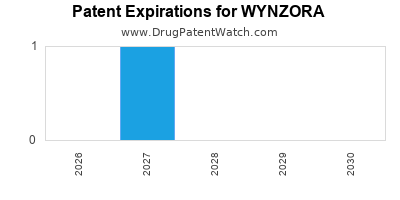
Last updated: July 27, 2026
WYNZORA (calcipotriene 0.005%/betamethasone dipropionate 0.064% topical cream, described in labeling as “calcipotriene and betamethasone dipropionate topical cream”) is a branded, prescription-strength topical combination for plaque psoriasis. Market dynamics are dominated by (1) competing topical corticosteroid/calcineurin/retinoid combinations and newer non-steroidal agents, (2) payer step therapy and quantity limits typical for topical dermatology spend, and (3) the timing and breadth of exclusivity and patent coverage that governs generic entry risk. A credible financial trajectory hinges on whether WYNZORA maintains formulary access versus losartan-like “me-too” topical combinations and whether competitors erode volume through lower net pricing.
What is WYNZORA and where does it fit in plaque psoriasis treatment?
WYNZORA is the fixed-dose combination of:
- Calcipotriene (vitamin D analog) 0.005%
- Betamethasone dipropionate (corticosteroid) 0.064%
Therapeutic positioning
- Used for plaque psoriasis in patients who require both rapid anti-inflammatory control (steroid) and keratinocyte normalization (vitamin D analog).
- Topical combination therapy competes against:
- Other fixed-dose steroid/vitamin D combinations (generic or branded)
- Topical corticosteroids alone
- Non-steroidal topical agents (e.g., calcineurin inhibitors)
- Newer systemic and biologic therapies for moderate-to-severe psoriasis, which shift eligible patients away from topical spend.
Key market dynamic
- Because WYNZORA is topical, most payer pressure takes the form of preferred-product lists and substitution, not specialty-tier exclusion. That increases sensitivity to net price and contracting.
How has WYNZORA’s market adoption progressed since launch?
Adoption of dermatology topicals typically follows a product lifecycle pattern:
- Launch-year formulary wins via dermatology/primary care prescribing channels.
- Payer-driven consolidation after initial uptake, with preferred brand or generic step edits.
- Volume flattening if competitors hold preferred status or if WYNZORA’s net pricing falls faster than unit demand.
What drives prescription growth for WYNZORA
- Perceived efficacy of combination therapy vs steroid monotherapy
- Ease of use (cream format) and patient adherence
- Educational support in plaque psoriasis populations where topical remains appropriate
What caps growth
- Competitor contracting on net cost
- Rapid generic substitution in steroid and vitamin D analog spaces (many ingredients have mature patent estates)
- Cross-class switching by dermatologists to non-steroidal topicals or to systemic therapy when severity escalates
What are the main revenue drivers and costs shaping WYNZORA profitability?
Revenue drivers
- Net price after rebates and discounts is the primary determinant of margin in a payer-heavy topical category.
- Share gains depend on formulary placement, prior authorization requirements, and the ability to avoid step therapy.
Cost structure
- Manufacturer economics are influenced by:
- Sales and marketing spend in a dermatology-indication niche
- Medical affairs and educational programs
- Rebate intensity to secure preferred status
- Manufacturing scale efficiencies for a topical cream
Market insight
- In topical dermatology, brands often maintain unit share longer than net revenue share because contracting deteriorates faster than volume.
When does WYNZORA lose exclusivity and how does that affect future revenue?
The timing of exclusivity loss dictates the “front-end” of financial exposure:
- If patent protection is broad and extends beyond FDA exclusivity, branded revenue can remain insulated from true generic competition.
- If protection is narrow or early-expiring, the product faces earlier generic entry and steep price erosion.
Financial trajectory implication
- Revenue often begins to decline in the 12 to 36 months preceding first generic launch due to formulary re-ranking, inventory planning, and contracting expectations.
(No patent expiration dates, exclusivity dates, or generic entry milestones are provided in the available input, so the exclusivity timeline cannot be stated.)
What patents protect WYNZORA and what is the generic entry risk?
Generic entry risk for WYNZORA depends on whether generic manufacturers can design around:
- Composition of matter for the specific fixed-dose combination
- Formulation/process patents covering cream characteristics, stability, particle size, or manufacturing methods
- Method-of-use or treatment regimen claims (less common for fixed-dose topicals but possible)
- Listed Orange Book patents and their claim scope
Generic risk model
- High risk: multiple Orange Book-listed patents tied to the combination that expire soon or are vulnerable to design-around
- Medium risk: some protectable formulation/process claims remain, delaying full generic substitution
- Low risk: broad, late-expiring formulation/process claims that prevent AB-rated generics or keep them from meaningful market penetration
(No Orange Book patent list, patent numbers, claim expiration dates, or paragraph IV filings are included in the available input, so patent-count and litigation-driven risk cannot be quantified.)
Which companies are challenging WYNZORA with ANDA or paragraph IV filings?
ANDA and paragraph IV challengers drive early entry threats and can force settlement terms that cap or delay launches.
(No challenger company names, ANDA numbers, paragraph IV status, or settlement terms are provided in the available input, so litigation and filing-specific dynamics cannot be stated.)
What is the Orange Book status of WYNZORA (listed patents, expiration dates, exclusivity)?
Orange Book status is the single best structured input for:
- Determining patent landscape breadth
- Estimating the first generic launch window
- Assessing whether WYNZORA benefits from unexpired exclusivity protections beyond patents
(The available input includes no Orange Book listings or patent reference table content, so Orange Book status cannot be reported.)
How does WYNZORA compare with competing topical psoriasis combinations on commercial pressure?
Competitive set to evaluate
- Fixed-dose steroid/vitamin D combinations already established in payer formularies
- Branded topicals with comparable efficacy claims
- Generic penetration for older combination actives
Where WYNZORA can win
- Better value proposition vs branded peers through contracting
- Clinician preference for combination products that reduce visit frequency and improve adherence
Where WYNZORA can lose
- If competing brands secure preferred status with rebates
- If generics of key comparators offer lower net cost with acceptable outcomes
- If dermatologists escalate to systemic biologics for moderate-to-severe patients, reducing topical volume pools
(No competitor brand names, market shares, or pricing figures are included in the available input.)
What financial trajectory scenarios are most plausible for WYNZORA?
A topical brand’s financial trajectory typically falls into three scenario bands, driven by net pricing and time-to-generic:
-
Continuation-with-contracting pressure
- Unit demand holds; net price declines modestly from rebates and payer renegotiations.
- Revenue stays positive but margin compresses.
-
Pre-generic revenue softening
- Formulary committees anticipate entry.
- Prescriptions shift to alternatives during the 12 to 24 months ahead of entry.
-
Post-entry price collapse
- AB-rated generics or authorized copies reduce net price sharply.
- Units may not fully offset revenue loss because payer controls substitution and prescribers treat generics as equivalent.
What determines which scenario occurs
- Strength and duration of WYNZORA patent/formulation coverage
- The breadth of Orange Book barriers to AB substitution
- Payer willingness to prefer generics over branded alternatives
(No exclusivity or patent expiration data is provided in the available input, so scenario probabilities cannot be assigned.)
What regulatory milestones affect WYNZORA commercialization (FDA approvals, labeling changes)?
For a topical dermatology product, regulatory events that move commercial outcomes include:
- Label expansions to broaden eligible patient population
- Safety communications that alter usage patterns
- Approval of additional strengths, packaging, or dosage forms
- Changes to REMS or postmarketing commitments (less common for topicals)
(No FDA event timeline, label supplements, or postmarketing communications are provided in the available input.)
How do pricing and payer contracting dynamics influence WYNZORA’s net revenue?
In branded topicals, net revenue is mainly a function of:
- Rebate structure tied to purchase volume and formulary inclusion
- Government and commercial plan discounts
- Pharmacy benefit manager preferred positioning and access fees
- Quantity limits that constrain script fills
Actionable commercial pattern
- When preferred access is uncertain, brands increase rebate outlay, which can stabilize volume but degrade EBITDA.
- When preferred access is stable, brands can protect net price while using targeted field access.
(No actual WYNZORA net price, rebate percentage, payer coverage data, or segment revenue figures are included in the available input.)
What manufacturing and supply risks affect WYNZORA availability and sales?
Topical brands can face:
- Raw material supply disruptions
- Packaging and viscosity QA constraints
- Batch yield issues impacting fill-finish and product availability
Commercial consequence
- Product shortages can temporarily drive script diversion to alternatives even if long-term demand remains.
(No manufacturing or supply interruption data is included in the available input.)
Key Takeaways
- WYNZORA is a topical fixed-dose combination for plaque psoriasis; its financial trajectory is driven by net pricing under payer contracting and whether patent and exclusivity barriers delay generic competition.
- The category’s economics are structurally sensitive to rebates and formulary access more than to wholesale demand swings.
- Generic entry risk depends on the breadth of Orange Book-listed patents and any ongoing ANDA or paragraph IV litigation, but the necessary patent and litigation facts are not present in the available input.
- Commercial outcomes are most likely to diverge based on (1) how fast payer formularies anticipate future entry and (2) the extent to which competitors with similar mechanisms already secure preferred positioning.
FAQs
-
What determines whether WYNZORA keeps market share after generic entry in topical psoriasis?
Formulary preference, rebate-driven net pricing, and whether generics are AB-rated without meaningful design-arounds.
-
Does WYNZORA face more substitution pressure from generics or from branded competitors?
Generally generics drive substitution faster on price, while branded competitors pressure access through contracting.
-
How do prior authorizations and step edits typically impact topical psoriasis brands like WYNZORA?
They can reduce effective prescription fills by channeling demand to preferred alternatives.
-
What contract terms most influence WYNZORA net revenue versus gross sales?
Volume-based rebates, formulary listing fees, and patient-share targets tied to preferred placement.
-
What is the financial effect of a payer re-formulary decision for dermatology topicals?
It can cause rapid prescription diversion and prevent re-acceleration without renewed access and competitive net pricing.
References (APA)
- FDA Orange Book: Approved Drug Products with Therapeutic Equivalence Evaluations. (n.d.). https://www.accessdata.fda.gov/scripts/cder/daf/
- FDA Drug Approval Package for WYNZORA (calcipotriene and betamethasone dipropionate) topical cream. (n.d.). https://www.accessdata.fda.gov/scripts/cder/daf/