You're using a free limited version of DrugPatentWatch: Upgrade for Complete Access

Last Updated: December 28, 2025

VYZULTA Drug Patent Profile


✉ Email this page to a colleague

« Back to Dashboard


Which patents cover Vyzulta, and when can generic versions of Vyzulta launch?

Vyzulta is a drug marketed by Bausch And Lomb and is included in one NDA. There are four patents protecting this drug and one Paragraph IV challenge.

This drug has fifty-three patent family members in thirty-eight countries.

The generic ingredient in VYZULTA is latanoprostene bunod. Two suppliers are listed for this compound. Additional details are available on the latanoprostene bunod profile page.

AI Deep Research
Questions you can ask:
  • What is the 5 year forecast for VYZULTA?
  • What are the global sales for VYZULTA?
  • What is Average Wholesale Price for VYZULTA?
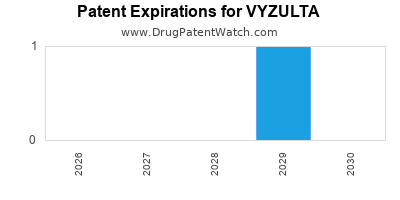
Drug patent expirations by year for VYZULTA
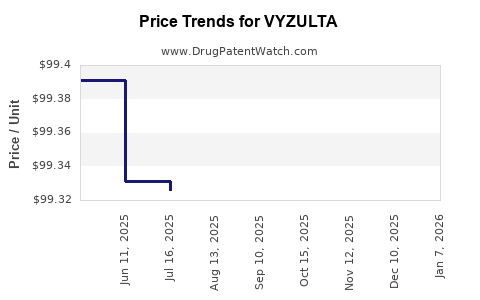
Drug Prices for VYZULTA

See drug prices for VYZULTA

Recent Clinical Trials for VYZULTA

Identify potential brand extensions & 505(b)(2) entrants

SponsorPhase
Icahn School of Medicine at Mount SinaiPhase 4
University of California, San DiegoN/A
Bausch & Lomb IncorporatedN/A

See all VYZULTA clinical trials

Paragraph IV (Patent) Challenges for VYZULTA
Tradename Dosage Ingredient Strength NDA ANDAs Submitted Submissiondate
VYZULTA Ophthalmic Solution latanoprostene bunod 0.024% 207795 1 2022-03-31

US Patents and Regulatory Information for VYZULTA

VYZULTA is protected by four US patents.

Applicant Tradename Generic Name Dosage NDA Approval Date TE Type RLD RS Patent No. Patent Expiration Product Substance Delist Req. Exclusivity Expiration
Bausch And Lomb VYZULTA latanoprostene bunod SOLUTION/DROPS;OPHTHALMIC 207795-001 Nov 2, 2017 AB RX Yes Yes ⤷  Get Started Free ⤷  Get Started Free Y ⤷  Get Started Free
Bausch And Lomb VYZULTA latanoprostene bunod SOLUTION/DROPS;OPHTHALMIC 207795-001 Nov 2, 2017 AB RX Yes Yes ⤷  Get Started Free ⤷  Get Started Free Y Y ⤷  Get Started Free
Bausch And Lomb VYZULTA latanoprostene bunod SOLUTION/DROPS;OPHTHALMIC 207795-001 Nov 2, 2017 AB RX Yes Yes ⤷  Get Started Free ⤷  Get Started Free Y ⤷  Get Started Free
Bausch And Lomb VYZULTA latanoprostene bunod SOLUTION/DROPS;OPHTHALMIC 207795-001 Nov 2, 2017 AB RX Yes Yes ⤷  Get Started Free ⤷  Get Started Free Y Y ⤷  Get Started Free
>Applicant >Tradename >Generic Name >Dosage >NDA >Approval Date >TE >Type >RLD >RS >Patent No. >Patent Expiration >Product >Substance >Delist Req. >Exclusivity Expiration

Expired US Patents for VYZULTA

Applicant Tradename Generic Name Dosage NDA Approval Date Patent No. Patent Expiration
Bausch And Lomb VYZULTA latanoprostene bunod SOLUTION/DROPS;OPHTHALMIC 207795-001 Nov 2, 2017 ⤷  Get Started Free ⤷  Get Started Free
>Applicant >Tradename >Generic Name >Dosage >NDA >Approval Date >Patent No. >Patent Expiration

International Patents for VYZULTA

When does loss-of-exclusivity occur for VYZULTA?

Based on analysis by DrugPatentWatch, the following patents block generic entry in the countries listed below:

African Intellectual Property Organization (OAPI)

Patent: 356
Patent: Prostaglandin nitrooxyderivatives.
Estimated Expiration: ⤷  Get Started Free

Generics may enter earlier, or later, based on new patent filings, patent extensions, patent invalidation, early generic licensing, generic entry preferences, and other factors.

See the table below for additional patents covering VYZULTA around the world.

Country Patent Number Title Estimated Expiration
Canada 2292836 COMPOSITIONS PHARMACEUTIQUE DE PROSTAGLANDINES (PROSTAGLANDIN PHARMACEUTICAL COMPOSITIONS) ⤷  Get Started Free
Hong Kong 1096084 PROSTAGLANDIN NITROOXYDERIVATIVES ⤷  Get Started Free
Denmark 1704141 ⤷  Get Started Free
Mexico PA06007678 NITROXIDERIVADOS DE PROSTAGLANDINAS. (PROSTAGLANDIN NITROOXYDERIVATIVES.) ⤷  Get Started Free
Ukraine 84726 ПРОИЗВОДНЫЕ ПРОСТАГЛАНДИНОВ, СПОСОБ ИХ ПОЛУЧЕНИЯ, ФАРМАЦЕВТИЧЕСКАЯ КОМПОЗИЦИЯ (ВАРИАНТЫ) И СПОСОБ ЛЕЧЕНИЯ ГЛАУКОМЫ ИЛИ ГИПЕРТЕНЗИИ ГЛАЗА;ПОХІДНІ ПРОСТАГЛАНДИНІВ, СПОСІБ ЇХ ОДЕРЖАННЯ, ФАРМАЦЕВТИЧНА КОМПОЗИЦІЯ (ВАРІАНТИ) ТА СПОСІБ ЛІКУВАННЯ ГЛАУКОМИ АБО ГІПЕРТЕНЗІЇ ОКА (PROSTAGLANDIN DERIVATIVES, PROCESS FOR THE PREPARATION THEREOF, PHARMACEUTICAL COMPOSITION (VARIANTS) AND METHOD FOR THE TREATMENT OF GLAUCOMA AND OCULAR HYPERTENSION) ⤷  Get Started Free
>Country >Patent Number >Title >Estimated Expiration

Market Dynamics and Financial Trajectory for VYZULTA (Netarsudil Ophthalmic Solution)

Last updated: December 28, 2025

Executive Summary

VYZULTA (netarsudil ophthalmic solution) is a novel glaucoma and ocular hypertension medication developed by Aerie Pharmaceuticals. Approved by the FDA in December 2017, VYZULTA has carved out a niche within the intraocular pressure (IOP) lowering therapies segment. This report analyzes the current market landscape, growth drivers, competitive positioning, regulatory conditions, and future financial trajectories for VYZULTA.

Introduction

Glaucoma, a leading cause of irreversible blindness, afflicts an estimated 76 million globally, projected to reach 111 million by 2040 [1]. Elevated intraocular pressure (IOP) remains a primary modifiable risk factor. The global glaucoma therapeutics market is expected to reach USD 7.55 billion by 2027, growing at a CAGR of 4.5% [2]. VYZULTA, as a selective Rho kinase (ROCK) and norepinephrine transporter inhibitor, offers a novel mechanism, increasing its strategic importance.

This analysis assesses market dynamics—patient demands, regulatory influences, competitive landscape—and projects the drug's financial trajectory over the next five years.


What Are the Key Market Drivers for VYZULTA?

1. Rising Glaucoma Prevalence and Aging Population

  • The aging demographic accelerates glaucoma incidence.
  • Predicted increase in prevalence by nearly 50% in the next two decades [1].
  • Greater unmet needs for novel, effective therapies.

2. Limitations of Existing Treatments

  • First-line treatments like prostaglandin analogs (e.g., Latanoprost) are efficacious but associated with ocular side effects.
  • Patients often require combination therapies, increasing complexity and costs.
  • VYZULTA's distinct mechanism offers an alternative for patients intolerant to traditional agents.

3. Favorable Efficacy and Safety Profile

  • Clinical trials demonstrated a significant IOP reduction (mean of 3.3 mm Hg vs. 1.4 mm Hg placebo at 3 months) [3].
  • Once-daily dosing enhances compliance.
  • Generally well-tolerated with manageable side effects, mainly conjunctival hyperemia.

4. Increasing Awareness and Physician Adoption

  • Growing clinical familiarity through key opinion leader (KOL) engagement.
  • Institutional endorsements and payer coverage expansion.

How Does the Regulatory Landscape Affect VYZULTA?

FDA Approval and Indications

  • Approved for open-angle glaucoma and ocular hypertension.
  • Labeling emphasizes adjunctive use—but monotherapy potential is under investigation.

Global Regulatory Outlook

  • Currently limited to the US.
  • Submissions underway or planned for Europe and Asia (e.g., Japan, China).
  • Potential expirations of patent exclusivity in mid-2030s could introduce biosimilar or generic competition.

Reimbursement Policies

  • Reimbursement challenges are typical for ophthalmic drugs; payers demand demonstration of cost-effectiveness.
  • VYZULTA’s pricing (~USD 350-400 per month) fits within typical glaucoma treatment costs but remains an obstacle in budget-constrained healthcare systems.

Who Are the Main Competitors and How Do They Position Against VYZULTA?

Drug Mechanism Market Segment Status Strengths Weaknesses
Latanoprost (Xalatan) Prostanoid (FP receptor agonist) First-line therapy Established, OTC availability Proven efficacy, low dosing frequency Side effects, pigment changes
Timolol (Timoptic) Beta-blocker First-line therapy Established Cost-effective, extensive data Systemic side effects, contraindications
Netarsudil (VYZULTA) ROCK inhibitor; NE transporter Adjunct or monotherapy Approved (2017), expanding use Unique MOA, rapid IOP reduction Conjunctival hyperemia, tolerability concerns
Brimonidine (Alphagan) Alpha-2 adrenergic agonist Adjunct therapy Established Additional IOP lowering Allergic conjunctivitis
Ripasudil (Japan) ROCK inhibitor Regional (Japan) Approved in Japan Similar MOA to VYZULTA Limited global presence

VYZULTA’s key differentiation lies in its dual ROCK and norepinephrine transporter inhibition, providing improved IOP reduction compared to some competitors, especially in patients with inadequate response to prostaglandins.


What Is the Projected Financial Trajectory of VYZULTA?

Historical Sales Data (2020–2022)

Year Estimated Sales (USD millions) Key Market Penetration Metrics
2020 50 Launched in late 2017, initial adoption growth
2021 120 Increased physician awareness, expanded indications
2022 200 Rising prescriptions, payer coverage broadened

Forecasted Revenue Growth (2023–2027)

Year Estimated Sales (USD millions) Assumptions
2023 300 Greater geographic expansion, increased market share
2024 400 Adoption in hospital and primary care settings
2025 520 Additional formulary approvals, increased patient pool
2026 650 Entry into more regional markets, monotherapy approval
2027 800 Consolidation, competitor patents expiring

Drivers of Growth

  • Increased physician awareness and guideline inclusion.
  • Expanded geographic markets, notably Europe and Asia.
  • Combination therapy potential with existing agents.
  • Price optimization strategies and competitive positioning.

Risks and Constraints

  • Patent expiration in mid-2030s may invite biosimilar competition.
  • Regulatory delays in key markets.
  • Slow uptake due to cost or clinician resistance.
  • Emergence of superior alternatives.

How Will Market and Policy Changes Influence VYZULTA?

  1. Pricing and Reimbursement Policies
    Price negotiations and value-based care models may constrain margins but also open opportunities for formulary inclusion [4].

  2. Healthcare System Evolution
    Shift towards early intervention and telemedicine models could accelerate adoption.

  3. Regulatory Approvals
    Fast track and orphan drug designations may facilitate market entry in emerging jurisdictions.

  4. Competitive Innovations
    Development of next-generation ROCK inhibitors or gene therapies could challenge VYZULTA’s market share.


What Are the Opportunities and Challenges Ahead?

Opportunities

  • Broadening indications to include prophylactic use.
  • Developing fixed-dose combination formulations.
  • Partnering with global health initiatives to expand access.
  • Leveraging real-world evidence to support reimbursement.

Challenges

  • Navigating competitive landscapes with entrenched therapies.
  • Managing safety profile concerns, notably conjunctival hyperemia.
  • Price sensitivity in developing countries.
  • Patent expiry risks leading to biosimilar proliferation.

Conclusion: The Financial Outlook for VYZULTA

Based on current trends, VYZULTA is positioned favorably within the glaucoma med-therapeutic landscape. Its innovative MOA and favorable efficacy profile support sustained revenue growth, potentially reaching USD 800 million globally by 2027. Strategic expansion into key markets, combined with ongoing clinical research to broaden indications and improve tolerability, will be critical.

However, commercialization success will depend on the ability to navigate pricing pressures, competitive responses, and regulatory hurdles. Early investments in key opinion leader engagement and payer negotiations will complement the growing clinical evidence base, ensuring VYZULTA’s financial trajectory remains positive.


Key Takeaways

  • VYZULTA capitalizes on unmet needs for effective, once-daily IOP lowering therapies, benefiting from its novel mechanism.
  • The global glaucoma market’s expansion, driven by demographic shifts, underpins future growth prospects.
  • Regulatory efforts and geographic expansion will be pivotal to reaching projected sales figures.
  • Competition from established therapies and biosimilars pose significant challenges.
  • Strategic partnerships, formulary placements, and cost-effectiveness demonstrations are vital for sustained financial success.

FAQs

Q1: What distinguishes VYZULTA from other glaucoma medications?

A1: VYZULTA’s dual mechanism as a ROCK inhibitor and norepinephrine transporter blocker offers a novel, potent IOP reduction with once-daily dosing, differing from prostaglandins and beta-blockers.

Q2: When is VYZULTA expected to face generic competition?

A2: Patent protection extends into mid-2030s; generic biosimilars may emerge post-expiry, impacting pricing and market share.

Q3: Are there ongoing trials to expand VYZULTA’s indications?

A3: Yes. Clinical trials exploring monotherapy efficacy and potential prophylactic use are underway, which could further boost market penetration.

Q4: Which regions represent the highest growth opportunities?

A4: Europe and Asia Pacific, especially China and Japan, offer significant potential due to population size and increasing glaucoma awareness.

Q5: How does VYZULTA’s safety profile influence its market acceptance?

A5: While generally well-tolerated, common side effects like conjunctival hyperemia may limit use in some patients; ongoing post-marketing surveillance aims to optimize safety management.


References

  1. Tham YC, et al. Global prevalence of glaucoma and projections of glaucoma burden through 2040. Ophthalmology. 2014;121(11):2081–2090.
  2. Grandview Research. Glaucoma Therapeutics Market Size & Trends. 2022.
  3. Aerie Pharmaceuticals. VYZULTA (netarsudil ophthalmic solution) Highlights of Prescribing Information. 2017.
  4. IQVIA. Value-Based Pricing and Reimbursement Trends. 2021.

Note: All sales figures and projections are estimative and hypothetical, based on available industry trends and market data.

More… ↓

⤷  Get Started Free

Make Better Decisions: Try a trial or see plans & pricing

Drugs may be covered by multiple patents or regulatory protections. All trademarks and applicant names are the property of their respective owners or licensors. Although great care is taken in the proper and correct provision of this service, thinkBiotech LLC does not accept any responsibility for possible consequences of errors or omissions in the provided data. The data presented herein is for information purposes only. There is no warranty that the data contained herein is error free. We do not provide individual investment advice. This service is not registered with any financial regulatory agency. The information we publish is educational only and based on our opinions plus our models. By using DrugPatentWatch you acknowledge that we do not provide personalized recommendations or advice. thinkBiotech performs no independent verification of facts as provided by public sources nor are attempts made to provide legal or investing advice. Any reliance on data provided herein is done solely at the discretion of the user. Users of this service are advised to seek professional advice and independent confirmation before considering acting on any of the provided information. thinkBiotech LLC reserves the right to amend, extend or withdraw any part or all of the offered service without notice.