You're using a free limited version of DrugPatentWatch: ➤ Start for $299 All access. No Commitment.

Last Updated: December 30, 2025

VYONDYS 53 Drug Patent Profile


✉ Email this page to a colleague

« Back to Dashboard


When do Vyondys 53 patents expire, and when can generic versions of Vyondys 53 launch?

Vyondys 53 is a drug marketed by Sarepta Theraps Inc and is included in one NDA. There are eight patents protecting this drug.

This drug has thirty patent family members in thirteen countries.

The generic ingredient in VYONDYS 53 is golodirsen. One supplier is listed for this compound. Additional details are available on the golodirsen profile page.

DrugPatentWatch® Generic Entry Outlook for Vyondys 53

Vyondys 53 was eligible for patent challenges on December 12, 2023.

By analyzing the patents and regulatory protections it appears that the earliest date for generic entry will be December 12, 2026. This may change due to patent challenges or generic licensing.

There have been two patent litigation cases involving the patents protecting this drug, indicating strong interest in generic launch. Recent data indicate that 63% of patent challenges are decided in favor of the generic patent challenger and that 54% of successful patent challengers promptly launch generic drugs.

Indicators of Generic Entry

< Available with Subscription >

  Get Started Free

AI Deep Research
Questions you can ask:
  • What is the 5 year forecast for VYONDYS 53?
  • What are the global sales for VYONDYS 53?
  • What is Average Wholesale Price for VYONDYS 53?
Summary for VYONDYS 53
International Patents:30
US Patents:8
Applicants:1
NDAs:1
Finished Product Suppliers / Packagers: 1
Patent Litigation and PTAB cases: See patent lawsuits and PTAB cases for VYONDYS 53
What excipients (inactive ingredients) are in VYONDYS 53?VYONDYS 53 excipients list
DailyMed Link:VYONDYS 53 at DailyMed
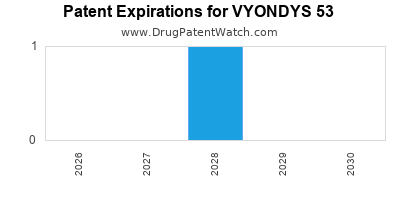
Drug patent expirations by year for VYONDYS 53
DrugPatentWatch® Estimated Loss of Exclusivity (LOE) Date for VYONDYS 53
Generic Entry Date for VYONDYS 53*:
Constraining patent/regulatory exclusivity:
INDICATED FOR THE TREATMENT OF DUCHENNE MUSCULAR DYSTROPHY (DMD) IN PATIENTS WHO HAVE A CONFIRMED MUTATION OF THE DMD GENE THAT IS AMENABLE TO EXON 53 SKIPPING
NDA:
Dosage:
SOLUTION;INTRAVENOUS

*The generic entry opportunity date is the latter of the last compound-claiming patent and the last regulatory exclusivity protection. Many factors can influence early or later generic entry. This date is provided as a rough estimate of generic entry potential and should not be used as an independent source.

Pharmacology for VYONDYS 53

US Patents and Regulatory Information for VYONDYS 53

VYONDYS 53 is protected by eight US patents and one FDA Regulatory Exclusivity.

Based on analysis by DrugPatentWatch, the earliest date for a generic version of VYONDYS 53 is ⤷  Get Started Free.

This potential generic entry date is based on INDICATED FOR THE TREATMENT OF DUCHENNE MUSCULAR DYSTROPHY (DMD) IN PATIENTS WHO HAVE A CONFIRMED MUTATION OF THE DMD GENE THAT IS AMENABLE TO EXON 53 SKIPPING.

Generics may enter earlier, or later, based on new patent filings, patent extensions, patent invalidation, early generic licensing, generic entry preferences, and other factors.

Applicant Tradename Generic Name Dosage NDA Approval Date TE Type RLD RS Patent No. Patent Expiration Product Substance Delist Req. Exclusivity Expiration
Sarepta Theraps Inc VYONDYS 53 golodirsen SOLUTION;INTRAVENOUS 211970-001 Dec 12, 2019 RX Yes Yes 10,266,827 ⤷  Get Started Free ⤷  Get Started Free
Sarepta Theraps Inc VYONDYS 53 golodirsen SOLUTION;INTRAVENOUS 211970-001 Dec 12, 2019 RX Yes Yes 10,421,966 ⤷  Get Started Free Y Y ⤷  Get Started Free
Sarepta Theraps Inc VYONDYS 53 golodirsen SOLUTION;INTRAVENOUS 211970-001 Dec 12, 2019 RX Yes Yes 10,227,590 ⤷  Get Started Free Y Y ⤷  Get Started Free
>Applicant >Tradename >Generic Name >Dosage >NDA >Approval Date >TE >Type >RLD >RS >Patent No. >Patent Expiration >Product >Substance >Delist Req. >Exclusivity Expiration

Expired US Patents for VYONDYS 53

Applicant Tradename Generic Name Dosage NDA Approval Date Patent No. Patent Expiration
Sarepta Theraps Inc VYONDYS 53 golodirsen SOLUTION;INTRAVENOUS 211970-001 Dec 12, 2019 9,416,361 ⤷  Get Started Free
Sarepta Theraps Inc VYONDYS 53 golodirsen SOLUTION;INTRAVENOUS 211970-001 Dec 12, 2019 10,227,590 ⤷  Get Started Free
Sarepta Theraps Inc VYONDYS 53 golodirsen SOLUTION;INTRAVENOUS 211970-001 Dec 12, 2019 10,968,450 ⤷  Get Started Free
>Applicant >Tradename >Generic Name >Dosage >NDA >Approval Date >Patent No. >Patent Expiration

Market Dynamics and Financial Trajectory for VYONDYS 53

Last updated: July 27, 2025


Introduction

VYONDYS 53 (casimersen), marketed by Sarepta Therapeutics, is an antisense oligonucleotide designed to treat Duchenne Muscular Dystrophy (DMD) caused by specific genetic mutations. Approved by the FDA in February 2023, VYONDYS 53 targets exon 53 skipping, expanding the therapeutic options for a subset of DMD patients. Understanding its market dynamics and financial trajectory is crucial for stakeholders—including investors, healthcare professionals, and the biotech industry—as they evaluate potential growth, competitive landscape, and overall economic impact.


Market Landscape for Duchenne Muscular Dystrophy

Medical Need and Patient Population

DMD is a severe, progressive neuromuscular disorder predominantly affecting boys, with an estimated global prevalence of 1 in 3,500 to 5,000 male births. Current standard of care revolves around corticosteroids, which offer symptomatic relief but do not halt disease progression. The advent of exon-skipping therapies, like VYONDYS 53, aims to modify disease trajectory by restoring dystrophin production.

The patient population amenable to VYONDYS 53, targeting exon 53 skipping, encompasses approximately 8-12% of DMD patients globally, based on mutation analyses [1]. Precision medicine approaches and genetic testing are critical for identifying eligible patients.

Competitive Therapeutic Landscape

VYONDYS 53 enters a competitive space comprising other exon-skipping drugs like Sarepta’s SYNDYST (eteplirsen) and VYONDYS 51 (casimersen), alongside potential emerging therapies. Notably, SYNDYST—approved in 2016—targets exon 51 and captures a significant market share, owing to early launch and regulatory acceptance.

Other players, including Reckitt Benckiser (for rascoltide) and Eli Lilly (with investigational exon-skipping candidates), pose potential competition. The market’s fragmentation depends on patient genetic profiles, regulatory approvals, and clinical outcomes.


Regulatory and Reimbursement Environment

FDA Approval and Post-Market Strategy

The FDA’s approval of VYONDYS 53 signifies a pivotal moment, marking Sarepta’s expansion in exon-skipping therapies. Post-approval, the company faces the challenge of demonstrating real-world efficacy and securing favorable reimbursement policies.

Sarepta’s engagement with payers involves negotiations over pricing, formulary placements, and value-based agreements. Given the high costs of rare disease therapies, reimbursement landscape influences market penetration significantly.

Pricing and Reimbursement Outlook

The drug’s pricing, initially positioned around $300,000–$400,000 per patient annually (similar to other exon-skipping therapies), will be a primary determinant of revenue. Reimbursement policies vary across countries, but in the U.S., payers’ acceptance hinges on evidence of clinical benefit and cost-effectiveness.


Market Penetration and Adoption Dynamics

Factors Driving Uptake

  • Genetic Testing Expansion: Increased access to diagnostic testing broadens the eligible patient pool.
  • Physician Awareness: Education about exon-skipping options accelerates adoption.
  • Clinical Outcomes: Real-world data affirming efficacy and safety bolster confidence.
  • Regulatory Support: Clear guidelines from health authorities streamline approvals.

Barriers to Market Penetration

  • Limited Patient Awareness: Lack of widespread genetic screening delays diagnosis and treatment initiation.
  • High Cost and Reimbursement Hurdles: Financial barriers constrain access.
  • Competitive Pressure: Existing treatments with established payer coverage may restrict VYONDYS 53's market share initially.

Prescribing Trends and Geographic Variations

Initially launched in the U.S., Sarepta plans international expansions, contingent upon regulatory approvals. Adoption rates tend to be slow in early phases but accelerate as clinical data support efficacy, and payer policies align.


Financial Trajectory and Revenue Projections

Revenue Estimates and Growth Drivers

Analysts project VYONDYS 53’s peak sales in the next five years to range between $150 million and $400 million, contingent upon:

  • The rate of patient identification.
  • The degree of market penetration among exon 53 mutation carriers.
  • Competitive landscape evolution.
  • The extent of reimbursement and affordability.

Revenue Drivers

  • Market Penetration Rate: Early adoption may be cautious; growth accelerates with real-world data validation.
  • Pricing Strategy: Premium pricing based on clinical benefit will enhance revenue streams.
  • Global Expansion: Entry into European and Asian markets under regulatory approval broadens revenue base.

Potential Challenges

  • Delays in regulatory approvals in multiple countries.
  • Biosimilar or alternative therapies emerging.
  • Reimbursement denials or restrictions.

Long-term Financial Outlook

Given the orphan drug status and limited eligible patient pool, revenues will likely stabilize at high hundreds of millions annually, with strong profitability margins driven by high R&D and manufacturing margins for specialized oligonucleotides.


Strategic Considerations

Investments in Clinical Development

Sarepta’s upcoming trials, including combination therapies and broader mutation targets, aim to expand VYONDYS 53’s market reach and prolong product lifecycle.

Partnership and Licensing Opportunities

Collaborations with global health organizations and local distributors facilitate market entry, especially in regions with limited infrastructure for genetic testing and specialty care.

Market Expansion and Diversification

Adapting the platform to target additional exons or related neuromuscular disorders could diversify revenue streams and leverage existing R&D investments.


Key Takeaways

  • VYONDYS 53 is positioned as a targeted exon 53 skipping therapy with modest but promising sales potential constrained by a limited patient base.
  • Market adoption depends heavily on genetic testing expansion, clinician education, and reimbursement policies.
  • Revenue growth is projected to reach hundreds of millions annually, scaling with global expansion and clinical momentum.
  • Competitive landscape and regulatory pathways remain dynamic, requiring continuous strategic adaptation.
  • Long-term success hinges on demonstrating real-world efficacy, securing reimbursement, and expanding indications.

FAQs

1. What is VYONDYS 53’s primary mechanism of action?
VYONDYS 53 employs antisense oligonucleotides to induce exon 53 skipping during messenger RNA processing, restoring the dystrophin gene reading frame to produce functional dystrophin protein in DMD patients with specific mutations.

2. How does VYONDYS 53 compare to existing DMD therapies?
Unlike corticosteroids that manage symptoms, VYONDYS 53 aims to modify disease progression by addressing the genetic root cause. Compared to SYNDYST (exon 51), VYONDYS 53 targets a different mutation subset, broadening therapeutic coverage.

3. What are the main barriers to VYONDYS 53’s market growth?
Challenges include limited patient eligibility, high treatment costs, reimbursement hurdles, delayed diagnosis due to insufficient genetic testing, and stiff competition from existing exon-skipping therapies.

4. How significant is the global market opportunity?
While the worldwide DMD population is approximately 70,000–100,000, only a fraction carry mutations eligible for exon 53 skipping, constraining total addressable market size. Nonetheless, global expansion, especially in countries with improving healthcare infrastructure, can augment revenue streams.

5. What is the outlook for VYONDYS 53’s future?
Ongoing clinical trials, real-world efficacy data, and expanding genetic screening efforts suggest a cautiously optimistic outlook. Market penetration will depend on regulatory approvals in additional territories and the ability to establish reimbursement frameworks.


References

[1] Aartsma-Rus, A., & Van Deutekom, J. C. (2014). Duchenne Muscular Dystrophy: From Genetic Insight to Therapy. Current Opinion in Pharmacology, 17, 128–135.

More… ↓

⤷  Get Started Free

Make Better Decisions: Try a trial or see plans & pricing

Drugs may be covered by multiple patents or regulatory protections. All trademarks and applicant names are the property of their respective owners or licensors. Although great care is taken in the proper and correct provision of this service, thinkBiotech LLC does not accept any responsibility for possible consequences of errors or omissions in the provided data. The data presented herein is for information purposes only. There is no warranty that the data contained herein is error free. We do not provide individual investment advice. This service is not registered with any financial regulatory agency. The information we publish is educational only and based on our opinions plus our models. By using DrugPatentWatch you acknowledge that we do not provide personalized recommendations or advice. thinkBiotech performs no independent verification of facts as provided by public sources nor are attempts made to provide legal or investing advice. Any reliance on data provided herein is done solely at the discretion of the user. Users of this service are advised to seek professional advice and independent confirmation before considering acting on any of the provided information. thinkBiotech LLC reserves the right to amend, extend or withdraw any part or all of the offered service without notice.