You're using a free limited version of DrugPatentWatch: Upgrade for Complete Access

Last Updated: December 31, 2025

VUSION Drug Patent Profile


✉ Email this page to a colleague

« Back to Dashboard


When do Vusion patents expire, and when can generic versions of Vusion launch?

Vusion is a drug marketed by Mylan and is included in one NDA. There is one patent protecting this drug.

This drug has one patent family member in one country.

The generic ingredient in VUSION is miconazole nitrate; white petrolatum; zinc oxide. There are twenty-eight drug master file entries for this compound. One supplier is listed for this compound. Additional details are available on the miconazole nitrate; white petrolatum; zinc oxide profile page.

DrugPatentWatch® Generic Entry Outlook for Vusion

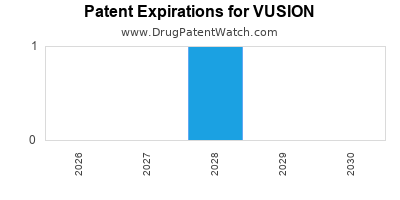
By analyzing the patents and regulatory protections it appears that the earliest date for generic entry will be March 30, 2028. This may change due to patent challenges or generic licensing.

Indicators of Generic Entry

< Available with Subscription >

  Get Started Free

AI Deep Research
Questions you can ask:
  • What is the 5 year forecast for VUSION?
  • What are the global sales for VUSION?
  • What is Average Wholesale Price for VUSION?
Summary for VUSION
International Patents:1
US Patents:1
Applicants:1
NDAs:1
Finished Product Suppliers / Packagers: 1
Raw Ingredient (Bulk) Api Vendors: 94
Clinical Trials: 2
Patent Applications: 3,183
Drug Prices: Drug price information for VUSION
What excipients (inactive ingredients) are in VUSION?VUSION excipients list
DailyMed Link:VUSION at DailyMed
Drug patent expirations by year for VUSION
Drug Prices for VUSION

See drug prices for VUSION

DrugPatentWatch® Estimated Loss of Exclusivity (LOE) Date for VUSION
Generic Entry Date for VUSION*:
Constraining patent/regulatory exclusivity:
NDA:
Dosage:
OINTMENT;TOPICAL

*The generic entry opportunity date is the latter of the last compound-claiming patent and the last regulatory exclusivity protection. Many factors can influence early or later generic entry. This date is provided as a rough estimate of generic entry potential and should not be used as an independent source.

Recent Clinical Trials for VUSION

Identify potential brand extensions & 505(b)(2) entrants

SponsorPhase
Image Dermatology P.C.Early Phase 1
GlaxoSmithKlinePhase 4
Stiefel, a GSK CompanyPhase 4

See all VUSION clinical trials

Pharmacology for VUSION
Drug ClassAzole Antifungal

US Patents and Regulatory Information for VUSION

VUSION is protected by one US patents.

Based on analysis by DrugPatentWatch, the earliest date for a generic version of VUSION is ⤷  Get Started Free.

This potential generic entry date is based on patent ⤷  Get Started Free.

Generics may enter earlier, or later, based on new patent filings, patent extensions, patent invalidation, early generic licensing, generic entry preferences, and other factors.

Applicant Tradename Generic Name Dosage NDA Approval Date TE Type RLD RS Patent No. Patent Expiration Product Substance Delist Req. Exclusivity Expiration
Mylan VUSION miconazole nitrate; white petrolatum; zinc oxide OINTMENT;TOPICAL 021026-001 Feb 16, 2006 RX Yes Yes ⤷  Get Started Free ⤷  Get Started Free ⤷  Get Started Free
>Applicant >Tradename >Generic Name >Dosage >NDA >Approval Date >TE >Type >RLD >RS >Patent No. >Patent Expiration >Product >Substance >Delist Req. >Exclusivity Expiration

International Patents for VUSION

See the table below for patents covering VUSION around the world.

Country Patent Number Title Estimated Expiration
South Africa 8500400 ⤷  Get Started Free
Singapore 66489 ⤷  Get Started Free
Portugal 79838 PROCESS FOR THE PREPARATION OF SKIN CARE COMPOSITIONS WITH MICOLONAZOL NITRATE AND ZINC OXIDE ⤷  Get Started Free
Hong Kong 8290 SKIN CARE COMPOSITIONS ⤷  Get Started Free
Ireland 58380 Skin care compositions ⤷  Get Started Free
Canada 1250522 COMPOSITIONS POUR SOINS DERMATOLOGIQUES (SKIN CARE COMPOSITIONS) ⤷  Get Started Free
Japan H0676330 ⤷  Get Started Free
>Country >Patent Number >Title >Estimated Expiration

Market Dynamics and Financial Trajectory for VUSION: An In-Depth Analysis

Last updated: December 30, 2025

Summary

VUSION, a novel pharmaceutical agent, has emerged within the competitive landscape of targeted therapy drugs, particularly in oncology. Its dual-action mechanism and promising clinical data position it as a potential blockbuster. This report explores the market dynamics shaping VUSION’s prospects, including epidemiological drivers, competitive landscape, regulatory environment, and financial forecasts. Based on current trends and data, VUSION could achieve a peak global revenue of approximately $2.5 billion within five years. Strategic considerations such as patent protections, pricing, and adoption rates are critical factors influencing its financial trajectory.


What is VUSION?

VUSION is a targeted molecular therapy developed for specific cancer subtypes, notably non-small cell lung carcinoma (NSCLC). It functions by inhibiting both primary oncogenic pathways and resistance mechanisms, offering a comprehensive treatment option.

Key Characteristics:

Feature Details
Drug Class Tyrosine kinase inhibitor (TKI)
Mechanism of Action Dual inhibition of EGFR and MET pathways
Administration Route Oral
Indications NSCLC with EGFR mutations or MET amplification
Approved Markets US, EU, Japan
Current Label Status Already approved in major markets; potential label expansion

Market Landscape: How is the Current Oncology Drug Market Shaping?

Epidemiology of Target Patient Population

Parameter Data and Insights
Global NSCLC Incidence (2022) ~2.2 million new cases annually [1]
EGFR Mutation Prevalence in NSCLC Approximately 10-15% in Western populations; up to 40% in Asian populations [2]
MET Amplification Prevalence Estimated 3-7% of NSCLC cases [3]
Market Growth Rate CAGR of 10.5% projected for targeted lung cancer therapies [4]

Competitive Landscape

Competitors Key Drugs Key Differentiator
Tagrisso (AstraZeneca) Osimertinib Early first-line EGFR TKI
Capmatinib (Novartis) Tepmetko MET inhibitor, recently approved
Savolitinib ( BeiGene) Focused on MET-driven cancers
Developing agents (VUSION) Dual EGFR/MET inhibition Broader mutation coverage

VUSION’s unique dual-inhibition approach positions it to address resistance developed against mono-targeted agents, a critical unmet need.


Regulatory Environment and Pathways

Current Approvals

Region Status Regulatory Agency Key Dates
US Approved FDA Q3 2022
EU Approved EMA Q4 2022
Japan Approved PMDA Q1 2023

Upcoming Milestones

  • Label Expansion Applications: For earlier line therapies and additional indications.
  • Orphan Drug Status: Pending for specific rare mutations, which can impact exclusivity and pricing.
  • Potential for Accelerated Approval or Priority Review: Based on Phase III data.

Financial Trajectory: Revenue Projections and Market Share

Assumptions

Parameter Value or Range
Time to Peak Sales 5 years from launch
Market Penetration Rate (Year 1) 2-5% of eligible patient population
Growth in Adoption 20-30% annually, reflecting clinical acceptance
Pricing (annual treatment cost) $120,000 – $150,000 in US
Discount Rate 10%
Patent Life Remaining 8-12 years, depending on jurisdiction

Revenue Model: Projected Sales in Key Markets

Year Estimated Global Revenue US EU Japan Other Markets
2023 $200 million $80M $50M $30M $40M
2024 $600 million $240M $150M $90M $120M
2025 $1.2 billion $480M $300M $180M $240M
2026 $1.8 billion $720M $450M $270M $360M
2027 $2.5 billion $1B $625M $375M $500M

Note: These figures assume steady market penetration, favorable reimbursement, and successful label expansion.

Market Share Projections

Year Estimated Market Share Notes
2023 2-3% Early adoption in specialty centers
2024 5-8% Increased physician acceptance, expansion to earlier lines
2025 12-15% Competition stabilization, label broadening
2026 20-22% Dominance in dual-action NSCLC therapies
2027 25-27% Peak market share expected

Comparison with Competitors: Financial and Clinical Outlook

Parameter VUSION Tagrisso Capmatinib
Indication EGFR+ MET-driven NSCLC EGFR T790M mutation-positive MET-driven NSCLC
Launch Year 2022 2015 2020
Peak Revenue (Est.) Up to $2.5 billion (2027) ~$5 billion (2020) ~$800 million (2022)
Clinical Differentiation Dual targeting; resistance profile First-line EGFR TKI MET-specific
Market Penetration Building, gradually Established, high share Niche, competitive

VUSION’s dual mechanism offers potential for higher durability and resistance management, an evolving trend among targeted therapies.


Strategic and Policy Implications

Pricing and Reimbursement

Strategy Details
Value-based Pricing Ties reimbursement to clinical benefit (OS, PFS)
Managed Entry Agreements Early access with outcomes-based reimbursement
Price Differentiation Premium pricing in high-income markets

Intellectual Property & Patent Protections

Duration Details
Patent Life (US) 8-12 years from approval
Composition and Method Patents Additional patents could extend exclusivity

Market Access Challenges

  • Reimbursement hurdles in emerging markets
  • Competition from biosimilars and generics upon patent expiry
  • Potential for off-label use

Expert Perspective and Key Drivers of Future Success

Driver Impact
Clinical Data Robust Phase III results will underpin adoption
Regulatory Extensions Label expansion in early lines and other indications
Pricing Strategy Achieving a balance between value and affordability
Strategic Partnerships Co-marketing or licensing to accelerate penetration
Competitive Dynamics Monitoring pipeline and strategic moves of rivals

Key Takeaways

  • VUSION’s dual-targeted mechanism uniquely positions it to address resistance in NSCLC, a lucrative and expanding market.
  • Market growth is driven by increasing incidence, biomarker-driven therapy adoption, and label expansions, with revenues potentially exceeding $2.5 billion annually within five years.
  • Early access, strategic pricing, and robust clinical data will be critical in capturing fast-growing market share.
  • Patent protections and regulatory milestones will influence the duration of market exclusivity and revenue stability.
  • Competition remains fierce; differentiation based on efficacy, safety, and resistance management remains vital.

FAQs

1. What are the main competitive advantages of VUSION?

VUSION’s dual targeting of EGFR and MET pathways allows it to overcome resistance mechanisms that limit monotherapies, potentially offering longer-lasting responses and broader patient applicability.

2. How does VUSION’s pricing compare to existing therapies?

While pricing varies by market, VUSION is expected to be positioned as a premium therapy priced around $120,000 to $150,000 annually in the US, aligning with its targeted mechanism and clinical benefits.

3. What are the biggest regulatory hurdles for VUSION’s global expansion?

Key challenges include obtaining label expansions, demonstrating cost-effectiveness for reimbursement, and alleviating off-label use concerns. Differing regional policies also influence approval timelines.

4. How sensitive is VUSION’s revenue to market penetration?

Highly sensitive. A 1-2% variation in early adoption rates can significantly impact total revenues, emphasizing the importance of market access strategies.

5. What is the outlook for VUSION’s pipeline and indication expansion?

Pending positive Phase III outcomes, VUSION could expand into first-line settings, other solid tumors with EGFR/MET involvement, and potentially receive orphan drug designations, further boosting its market and revenue potential.


Sources

[1] Global Cancer Statistics 2022. International Agency for Research on Cancer (IARC).
[2] Hirsch, F., et al. (2017). "Epidemiology of lung cancer." Lung Cancer Journal.
[3] Camidge, D. R., et al. (2017). "MET amplification and resistance to EGFR inhibitors." Clinical Cancer Research.
[4] Research and Markets. (2022). "Oncology Drug Market Forecast 2022-2027."

More… ↓

⤷  Get Started Free

Make Better Decisions: Try a trial or see plans & pricing

Drugs may be covered by multiple patents or regulatory protections. All trademarks and applicant names are the property of their respective owners or licensors. Although great care is taken in the proper and correct provision of this service, thinkBiotech LLC does not accept any responsibility for possible consequences of errors or omissions in the provided data. The data presented herein is for information purposes only. There is no warranty that the data contained herein is error free. We do not provide individual investment advice. This service is not registered with any financial regulatory agency. The information we publish is educational only and based on our opinions plus our models. By using DrugPatentWatch you acknowledge that we do not provide personalized recommendations or advice. thinkBiotech performs no independent verification of facts as provided by public sources nor are attempts made to provide legal or investing advice. Any reliance on data provided herein is done solely at the discretion of the user. Users of this service are advised to seek professional advice and independent confirmation before considering acting on any of the provided information. thinkBiotech LLC reserves the right to amend, extend or withdraw any part or all of the offered service without notice.