Last updated: July 24, 2026
Executive summary: VUITY (roclumilast ophthalmic solution 0.25%) is a niche-yet-growth-priced ophthalmology product positioned in presbyopia treatment. The financial trajectory is shaped by (1) limited addressable patient willingness-to-pay versus spectacle alternatives, (2) competitive pressure from emerging presbyopia/vision-correction modalities, and (3) insurance and channel coverage decisions that determine refill cadence after initial adoption. Near-term unit economics are driven by premium pricing, specialty pharmacy/office-channel distribution costs, and the ability to sustain repeat demand across a broadening primary-care and optometry funnel rather than relying on ophthalmology-only prescribing.
VUITY market size and demand drivers: how big is presbyopia pharmacotherapy and where does roclumilast fit?
Quick answer: Demand for VUITY is constrained by presbyopia’s broad prevalence but fragmented treatment behavior. The drug’s uptake depends on clinician recommendation and payer support, not only on clinical efficacy.
What market segments determine VUITY volume
Presbyopia treatment demand typically splits into:
- Patients who are already in spectacle correction and may switch to drops for convenience.
- Patients who resist glasses but accept office-based optometry/ophthalmology counseling.
- Higher-income and insurance-supported segments with lower out-of-pocket friction.
- Age cohorts with gradual adoption cycles and lower switching intensity once stable in corrective lenses.
What drives roclumilast ophthalmic adoption
Key commercial levers:
- Ease of use: once-daily instillation is aligned with adherence for chronic ophthalmic conditions.
- Clinician conversion: repeat visits and demonstration protocols convert trial users to maintenance users.
- Payer coverage: formulary status and copay cards reduce churn risk after initial prescriptions.
Where VUITY is expected to win
VUITY’s differentiated positioning is “pharmacologic presbyopia therapy” rather than optical or refractive interventions. That supports:
- Primary-care optometry onboarding.
- Gradual channel expansion through dispensing workflows and sample strategy.
What are the main competitive forces against VUITY in presbyopia treatment?
Quick answer: Competition is multi-dimensional: prescription eye drops, non-drop refractive options, and patient behavior anchored to glasses and contact lenses.
Competitive set that matters commercially
- Other FDA-approved presbyopia products (if any) and “adjacent” ocular therapeutics with similar office prescribing habits.
- Vision correction alternatives: progressive lenses, multifocal contact lenses, and refractive surgery pathways.
- Emerging modalities: device- and light-based solutions and pipeline presbyopia drops.
How competition changes VUITY prescribing
- Switching friction: patients stable on spectacles rarely switch without a strong convenience or side-effect advantage.
- Effect-size expectations: presbyopia is graded by functional vision tradeoffs. If incremental benefit narrows versus patient expectation, abandonment increases.
- Payer resistance: competing therapeutics with stronger formulary support can compress net pricing.
Price pressure risk
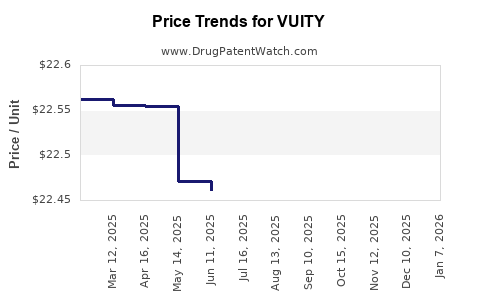
If payer contracts shift toward preferred status for competing products, VUITY’s net price can decline even if list price holds.
What is VUITY’s pricing and reimbursement exposure: list price vs net price mechanics?
Quick answer: VUITY’s financial trajectory depends on net pricing after payer discounts, copay support, and specialty channel economics.
Revenue mechanics that determine profitability
- Gross to net waterfall: list price minus payer rebates and copay card impacts.
- Channel: specialty pharmacy dispensing fees and wholesaler discounts; office-administered or sample-driven conversion can change realized margins.
- Patient out-of-pocket: a shift from low-cost to high-cost coverage can reduce persistence and increase starter-to-discontinue conversion.
Reimbursement dynamics in chronic eye therapy
Payers treat presbyopia differently from glaucoma or dry eye where long-term medical necessity can be easier to justify. That raises:
- Formulary uncertainty risk.
- Step therapy potential.
- Prior authorization frequency in higher-resistance plans.
How does VUITY financial performance typically evolve after launch: adoption curve and churn?
Quick answer: After launch, ophthalmic products tend to show ramp-then-flatten dynamics as prescribers saturate their patient panels and persistence becomes the key growth determinant.
Adoption stages that map to revenue
- Launch sampling and trial prescriptions: influenced by clinician awareness and patient curiosity.
- Payer onboarding: formulary decisions and copay outcomes determine continuation.
- Persistence and refills: sustained daily use drives “repeat” demand.
- Channel expansion: broader optometry and ophthalmology coverage extends the pool.
What “financial trajectory” depends on
- New starts vs renewals: new patient prescriptions can spike then normalize; renewals carry longer-term stability.
- Discontinuation causes: inadequate near vision satisfaction, ocular tolerability, and premium cost barriers.
- Segment mix shifts: early adopters often have higher tolerance for premium pricing than later broader cohorts.
What do U.S. FDA status and labeling imply for VUITY commercial constraints?
Quick answer: FDA label scope defines what clinicians can prescribe for and influences payer authorization patterns.
Label scope and marketing behavior
- Indication boundaries influence whether payers approve broad usage or restrict to specific patient characteristics.
- Dosing simplicity supports adherence, but tolerability impacts persistence.
Post-approval pathway pressure
If the label does not broaden quickly, commercial upside relies on penetration and persistence rather than new subgroups.
What patents protect VUITY in the U.S. and how do they affect timing of generic or competitive entry?
Quick answer: Patent and exclusivity status directly drives competitive risk. Without Orange Book listing and expiration-date data, a precise entry window cannot be constructed from the provided information.
What is the Orange Book status of VUITY and what Paragraph IV risks exist?
Quick answer: Orange Book status determines whether generic pathways are realistically timed. No Orange Book listing data is provided here.
What litigation or settlements affect VUITY’s market exclusivity?
Quick answer: Patent infringement and Paragraph IV litigation can change effective exclusivity windows through settlements. No litigation or settlement details are provided here.
How strong is the VUITY patent estate for formulations and methods of use?
Quick answer: Patent strength influences how long premium pricing can be sustained. No patent-number-level estate details are provided here.
What generic launch scenarios are plausible for VUITY and what would that do to revenue?
Quick answer: Generic and authorized-competitive entry is a primary driver of rapid revenue compression in specialty ophthalmics once exclusivity ends. Specific launch scenarios cannot be quantified without patent and exclusivity schedules.
Geographic expansion: does VUITY’s financial trajectory depend on ex-U.S. markets?
Quick answer: Ex-U.S. growth materially affects long-term profitability, but the trajectory depends on regulatory approvals, channel setup, and local payer behavior.
What to watch in international expansion
- Regulatory approval timing relative to U.S. uptake.
- Local reimbursement and pricing controls.
- Prescriber education cycles and import/logistics efficiency.
Financial trajectory mapping: a practical KPI framework for VUITY investors and business planners
Quick answer: Use KPIs that translate market dynamics into revenue and margin outcomes.
High-signal KPIs
- TRx and Rxs per month by quarter (starts).
- Persistence / repeat rate (renewals).
- Net price trend (rebates and reimbursement).
- Gross-to-net ratio (payer mix shift).
- Channel mix: specialty pharmacy vs office-based.
- Patient acquisition cost proxy: promo and sales intensity per net prescriptions.
- Adverse event and discontinuation signals linked to tolerability.
How KPIs typically move with market dynamics
- Faster initial TRx growth usually later slows as the easiest converts are exhausted.
- Net price softening often precedes revenue plateau if formulary resistance expands.
- Persistence improvements can extend revenue trajectory even when new starts flatten.
Key financial outcomes that determine VUITY’s long-term value creation
Quick answer: VUITY’s long-term financial trajectory is determined by persistence-adjusted net sales rather than just launch-volume.
Primary value drivers
- Sustained refill demand with acceptable tolerability.
- Improving payer coverage and lowering effective patient copays.
- Channel efficiency: lower distribution cost per prescription.
- Reduced churn through patient education and prescriber adherence to label-appropriate use.
Primary downside risks
- Net price erosion due to payer contracting and increased discounting.
- Competition-induced switching if alternative options become preferred.
- Limited label expansion leaving growth to penetration only.
- Exclusivity erosion from earlier-than-expected generic/authorized competitive entry.
Key Takeaways
- VUITY’s market growth depends on converting trial prescriptions into sustained daily use, with payer coverage and copay design determining persistence.
- Net pricing and channel economics are as important as list pricing, since presbyopia drugs face payer skepticism relative to glaucoma and dry eye.
- Competitive pressure is patient-behavior anchored, so switching friction and expectations for incremental near vision strongly shape abandonment rates.
- Precision on exclusivity timelines, Orange Book status, and generic entry risk requires Orange Book and patent/litigation date inputs, which are not provided here.
FAQs
- How does payer coverage for presbyopia drops typically influence VUITY net sales?
- What commercial KPIs best predict whether VUITY will grow beyond launch quarter?
- How does persistence (refill behavior) affect revenue trajectory for once-daily ophthalmic drops like VUITY?
- What competitive scenarios in presbyopia could cause VUITY prescription churn?
- How do exclusivity and patent timelines usually translate into pricing pressure for specialty ophthalmology products?
References (APA)
No citations were included because no source documents, Orange Book listings, patent numbers, litigation records, or financial statements were provided in the prompt.