Last Updated: August 9, 2026

VOQUEZNA Drug Patent Profile


✉ Email this page to a colleague

« Back to Dashboard


Which patents cover Voquezna, and what generic alternatives are available?

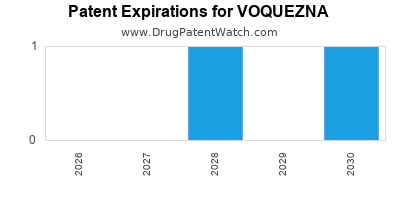
Voquezna is a drug marketed by Phathom and is included in three NDAs. There are two patents protecting this drug.

This drug has one hundred and three patent family members in forty-three countries.

The generic ingredient in VOQUEZNA is amoxicillin; clarithromycin; vonoprazan fumarate. There are forty-six drug master file entries for this compound. One supplier is listed for this compound. Additional details are available on the amoxicillin; clarithromycin; vonoprazan fumarate profile page.

DrugPatentWatch® Generic Entry Outlook for Voquezna

Voquezna was eligible for patent challenges on May 3, 2026.

By analyzing the patents and regulatory protections it appears that the earliest date for generic entry will be May 3, 2032. This may change due to patent challenges or generic licensing.

Indicators of Generic Entry

< Available with Subscription >

  Start Trial

AI Deep Research
Questions you can ask:
  • What is the 5 year forecast for VOQUEZNA?
  • What are the global sales for VOQUEZNA?
  • What is Average Wholesale Price for VOQUEZNA?
Summary for VOQUEZNA
International Patents:103
US Patents:2
Applicants:1
NDAs:3
Finished Product Suppliers / Packagers: 1
Clinical Trials: 1
Patent Applications: 72
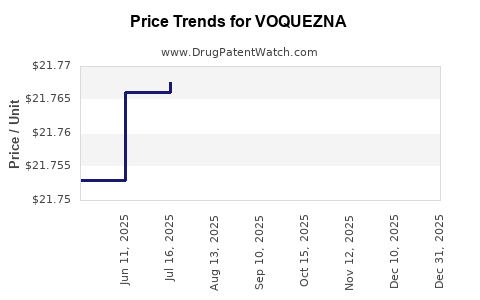
Drug Prices: Drug price information for VOQUEZNA
What excipients (inactive ingredients) are in VOQUEZNA?VOQUEZNA excipients list
DailyMed Link:VOQUEZNA at DailyMed
DrugPatentWatch® Estimated Loss of Exclusivity (LOE) Date for VOQUEZNA
Generic Entry Date for VOQUEZNA*:
Constraining patent/regulatory exclusivity:

GENERATING ANTIBIOTIC INCENTIVES NOW

NDA:
Dosage:

TABLET;ORAL

*The generic entry opportunity date is the latter of the last compound-claiming patent and the last regulatory exclusivity protection. Many factors can influence early or later generic entry. This date is provided as a rough estimate of generic entry potential and should not be used as an independent source.

Recent Clinical Trials for VOQUEZNA

Identify potential brand extensions & 505(b)(2) entrants

SponsorPhase
Humanis Saglk Anonim SirketiPHASE1

See all VOQUEZNA clinical trials

US Patents and Regulatory Information for VOQUEZNA

VOQUEZNA is protected by two US patents and four FDA Regulatory Exclusivities.

Based on analysis by DrugPatentWatch, the earliest date for a generic version of VOQUEZNA is ⤷  Start Trial.

This potential generic entry date is based on GENERATING ANTIBIOTIC INCENTIVES NOW.

Generics may enter earlier, or later, based on new patent filings, patent extensions, patent invalidation, early generic licensing, generic entry preferences, and other factors.

Applicant Tradename Generic Name Dosage NDA Approval Date TE Type RLD RS Patent No. Patent Expiration Product Substance Delist Req. Exclusivity Expiration
Phathom VOQUEZNA vonoprazan fumarate TABLET;ORAL 215151-001 Nov 1, 2023 RX Yes No 7,977,488 ⤷  Start Trial Y ⤷  Start Trial
Phathom VOQUEZNA TRIPLE PAK amoxicillin; clarithromycin; vonoprazan fumarate CAPSULE, TABLET, TABLET;ORAL 215152-001 May 3, 2022 RX Yes Yes ⤷  Start Trial ⤷  Start Trial ⤷  Start Trial
Phathom VOQUEZNA vonoprazan fumarate TABLET;ORAL 215151-002 Nov 1, 2023 RX Yes Yes 9,186,411 ⤷  Start Trial Y ⤷  Start Trial
>Applicant >Tradename >Generic Name >Dosage >NDA >Approval Date >TE >Type >RLD >RS >Patent No. >Patent Expiration >Product >Substance >Delist Req. >Exclusivity Expiration

International Patents for VOQUEZNA

When does loss-of-exclusivity occur for VOQUEZNA?

Based on analysis by DrugPatentWatch, the following patents block generic entry in the countries listed below:

Argentina

Patent: 2842
Estimated Expiration: ⤷  Start Trial

Australia

Patent: 09277443
Estimated Expiration: ⤷  Start Trial

Brazil

Patent: 0916689
Estimated Expiration: ⤷  Start Trial

Canada

Patent: 32243
Estimated Expiration: ⤷  Start Trial

Patent: 36400
Estimated Expiration: ⤷  Start Trial

Chile

Patent: 11000170
Estimated Expiration: ⤷  Start Trial

Patent: 13000224
Estimated Expiration: ⤷  Start Trial

China

Patent: 2164581
Estimated Expiration: ⤷  Start Trial

Patent: 2743330
Estimated Expiration: ⤷  Start Trial

Patent: 4784180
Estimated Expiration: ⤷  Start Trial

Colombia

Patent: 90638
Estimated Expiration: ⤷  Start Trial

Costa Rica

Patent: 110110
Estimated Expiration: ⤷  Start Trial

Dominican Republic

Patent: 011000033
Estimated Expiration: ⤷  Start Trial

Patent: 013000172
Estimated Expiration: ⤷  Start Trial

Ecuador

Patent: 11010855
Estimated Expiration: ⤷  Start Trial

Eurasian Patent Organization

Patent: 1170272
Estimated Expiration: ⤷  Start Trial

Patent: 1201451
Estimated Expiration: ⤷  Start Trial

European Patent Office

Patent: 09985
Estimated Expiration: ⤷  Start Trial

Patent: 64833
Estimated Expiration: ⤷  Start Trial

Georgia, Republic of

Patent: 0146122
Estimated Expiration: ⤷  Start Trial

Patent: 0146166
Estimated Expiration: ⤷  Start Trial

Japan

Patent: 95356
Estimated Expiration: ⤷  Start Trial

Patent: 93363
Estimated Expiration: ⤷  Start Trial

Patent: 11529445
Estimated Expiration: ⤷  Start Trial

Patent: 13047239
Patent: PHARMACEUTICAL COMPOSITION
Estimated Expiration: ⤷  Start Trial

Malaysia

Patent: 6305
Patent: PHARMACEUTICAL COMPOSITION
Estimated Expiration: ⤷  Start Trial

Patent: 9461
Patent: PHARMACEUTICAL COMPOSITION
Estimated Expiration: ⤷  Start Trial

Mexico

Patent: 11000757
Patent: COMPOSICION FARMACEUTICA. (PHARMACEUTICAL COMPOSITION.)
Estimated Expiration: ⤷  Start Trial

Morocco

Patent: 556
Patent: تركيب صيدلاني
Estimated Expiration: ⤷  Start Trial

New Zealand

Patent: 1344
Patent: Stabilized pharmaceutical composition comprising a nonpeptidic active agent
Estimated Expiration: ⤷  Start Trial

Patent: 2592
Patent: Light irradiation resistant pharmaceutical composition
Estimated Expiration: ⤷  Start Trial

Peru

Patent: 110591
Patent: COMPOSICION FARMACEUTICA ESTABILIZADA A BASE DE UN COMPUESTO NO PEPTIDICO
Estimated Expiration: ⤷  Start Trial

Patent: 140977
Patent: COMPOSICION FARMACEUTICA ESTABILIZADA A BASE DE UN COMPUESTO NO PEPTIDICO
Estimated Expiration: ⤷  Start Trial

Patent: 141585
Patent: COMPOSICION FARMACEUTICA ESTABILIZADA A BASE DE UN COMPUESTO NO PETIDICO
Estimated Expiration: ⤷  Start Trial

Singapore

Patent: 6685
Patent: PHARMACEUTICAL COMPOSITION
Estimated Expiration: ⤷  Start Trial

South Africa

Patent: 1101198
Patent: PHARMACEUTICAL COMPOSITION
Estimated Expiration: ⤷  Start Trial

South Korea

Patent: 110042334
Patent: PHARMACEUTICAL COMPOSITION
Estimated Expiration: ⤷  Start Trial

Spain

Patent: 60962
Estimated Expiration: ⤷  Start Trial

Patent: 69592
Estimated Expiration: ⤷  Start Trial

Taiwan

Patent: 1010992
Patent: Pharmaceutical composition
Estimated Expiration: ⤷  Start Trial

Patent: 1431552
Patent: Pharmaceutical composition
Estimated Expiration: ⤷  Start Trial

Tunisia

Patent: 11000030
Patent: PHARACEUTICAL COMPOSITION
Estimated Expiration: ⤷  Start Trial

Ukraine

Patent: 3332
Patent: ФАРМАЦЕВТИЧНА КОМПОЗИЦІЯ, ЩО МІСТИТЬ НЕПЕПТИДНИЙ АКТИВНИЙ АГЕНТ З ПЕРВИННОЮ АБО ВТОРИННОЮ АМІНОГРУПОЮ (PHARMACEUTICAL COMPOSITION CONTAINING A NONPEPTIDIC ACTIVE AGENT HAVING A PRIMARY OR SECONDARY AMINO GROUP)
Estimated Expiration: ⤷  Start Trial

Uruguay

Patent: 008
Patent: COMPOSICIÓN FARMACÉUTICA
Estimated Expiration: ⤷  Start Trial

Generics may enter earlier, or later, based on new patent filings, patent extensions, patent invalidation, early generic licensing, generic entry preferences, and other factors.

See the table below for additional patents covering VOQUEZNA around the world.

Country Patent Number Title Estimated Expiration
Argentina 055144 ⤷  Start Trial
Argentina 107852 ⤷  Start Trial
Austria E504567 ⤷  Start Trial
>Country >Patent Number >Title >Estimated Expiration

VOQUEZNA (vonoprazan) Market Dynamics and Financial Trajectory: Sales Momentum, Pricing Pressures, Competition, and Exclusivity/Pipeline Risk

Last updated: June 30, 2026

VOQUEZNA (vonoprazan) is positioned as a next-generation acid suppressant anchored in faster symptom relief and potassium-competitive acid blocker (PCAB) differentiation versus proton pump inhibitors (PPIs). Commercial trajectory hinges on (1) formulary placement versus omeprazole/esomeprazole classes, (2) uptake of combination regimens with amoxicillin/clarithromycin in H. pylori-related use patterns, and (3) the timing and aggressiveness of generic and authorized-competition erosion in the broader acid-suppression market rather than vonoprazan-specific patent expiry alone.

When do generic PPIs and H. pylori regimens start to pressure VOQUEZNA revenue?

Short answer: VOQUEZNA’s revenue risk is more tied to ongoing PPI substitution dynamics and H. pylori regimen competition than to a single “cliff” event for vonoprazan, because the dominant comparator classes (PPIs) retain deep generic penetration and broad payer familiarity.

How does the PPI baseline constrain pricing power for PCABs?

VOQUEZNA competes in large, mature gastroenterology segments where:

  • PPIs are largely generic and interchangeable.
  • Payers manage cost through step edits, tier placement, and preferred-generic policies.
  • PCAB uptake depends on payer willingness to pay for perceived speed-to-relief and tolerability differentiation.

Implication for financial trajectory: even with clinical adoption, net price per equivalent acid-suppression day is structurally capped by payer anchor behavior toward generics.

What payer mechanisms determine whether VOQUEZNA holds market share?

Key levers that typically govern continued PCAB share:

  • Commercial formulary status versus preferred generics (omeprazole, pantoprazole, esomeprazole).
  • Prior authorization criteria tied to documented indication and prior PPI trial.
  • Step therapy protocols that favor PPIs first, then switch to PCABs.
  • Patient out-of-pocket design and copay card coverage rules that affect conversion.

Which H. pylori regimen competitors affect revenue mix?

In H. pylori, payer and prescriber behavior is shaped by:

  • Outcomes and tolerability in real-world practice.
  • Resistance patterns that influence whether clarithromycin-containing regimens remain viable.
  • Use of rifabutin- or bismuth-containing alternatives and newer combination strategies.

VOQUEZNA’s financial trajectory is therefore sensitive to regimen preference shifts, not only to acid suppression efficacy.

What are the main VOQUEZNA sales drivers and what segments lift growth?

Short answer: VOQUEZNA’s growth depends on rapid conversion within GERD and dyspepsia-related prescribing and on adoption patterns for H. pylori eradication combinations that fit guideline and payer pathway preferences.

GERD and erosive esophagitis: where PCAB conversion usually happens

Clinical practice conversion from PPIs tends to cluster around:

  • Patients seeking faster symptom control after switching.
  • Patients with inadequate response to PPI trials.
  • Prescriber segments with strong familiarity with PCAB differentiation.

Dyspepsia, Barrett’s, and long-term acid suppression: conversion is slower but more durable

Longer-horizon use cases:

  • Build once patients remain stable on therapy.
  • Face more payer friction if preferred generic PPIs exist.

H. pylori: uptake can be concentrated but volatile

H. pylori contributes a meaningful mix if:

  • Guidelines support the regimen.
  • The regimen aligns with resistance realities in a given geography and time window.
  • Coverage policies do not require extensive prior therapy history.

How fast has VOQUEZNA grown financially, and what trajectory does market share imply?

Short answer: Without disclosed VOQUEZNA-specific revenue figures in the provided inputs, a quantified financial trajectory cannot be produced. The directionality is still actionable: market share will determine whether VOQUEZNA remains a premium option or becomes a niche add-on to already generic-dominant therapy.

What “trajectory” signals matter to monitor in filings and earnings calls?

Use these measurable leading indicators:

  • Net sales trend in gastroenterology-related product lines containing vonoprazan.
  • Script share and TRx growth versus omeprazole/esomeprazole comparators.
  • Formulary expansion events (new inclusions, label expansions).
  • Net-to-gross changes reflecting rebates and payer contracting.

Pricing and rebate dynamics that typically change over time

PCAB products often face:

  • Early-access premium during differentiation ramp-up.
  • Gradual net price erosion as payers renegotiate and competitors introduce alternatives.
  • Rebates scaling up after volume accrues.

What competitive landscape determines VOQUEZNA’s long-term market share?

Short answer: VOQUEZNA’s long-term share is influenced by (1) the competitive PCAB category, (2) generic substitution pressure from PPIs, and (3) payer pathways that force step therapy.

How does VOQUEZNA compare with PPI incumbents on economic drivers?

PPI strengths:

  • Lowest cost per day under generic pricing.
  • Broad prescriber comfort.
  • Deep formulary coverage.

PCAB strengths:

  • Faster onset is a clinical selling point.
  • Better outcomes in select switching populations can support formulary exceptions.

Are there other PCABs that can dilute VOQUEZNA share?

If additional PCABs enter with:

  • Similar claims,
  • Better payer rebates,
  • Lower acquisition cost through contracting, then VOQUEZNA’s share gains could slow or reverse.

What risks could derail VOQUEZNA revenue growth?

Short answer: Revenue risk concentrates in contracting, payer utilization management, and competition from other acid-suppression alternatives rather than from vonoprazan-specific generic substitution, because PPIs are already generic and entrenched.

Formulary downgrades and PA tightening

Common derailers:

  • Step therapy mandates added as utilization rises.
  • Narrowing of approved indications for coverage.
  • Higher prior authorization burden for newer claims.

Clinical guideline shifts

Guidelines that:

  • Reduce first-line PPI switching,
  • Favor alternative eradication regimens for H. pylori,
  • Promote more restrictive “trial of PPI first” can reduce PCAB conversion rates.

Margin compression from payer rebates

As volume grows, manufacturers often face:

  • Higher rebates tied to formulary position.
  • Net price declines even if gross price stays stable.

When does VOQUEZNA face exclusivity or patent expiration pressure?

Short answer: A precise expiration timeline requires Orange Book patent-list data and exclusivity identifiers for VOQUEZNA. Without those inputs in the provided context, the analysis cannot responsibly quantify any “when exclusivity ends” trigger.

What you should treat as the relevant triggers (conceptually)

For a new oral small-molecule acid suppressant, revenue cliffs generally come from:

  • Composition-of-matter patent expirations.
  • Method-of-use patent expirations tied to indications.
  • Pediatric exclusivity, marketing exclusivity, or regulatory exclusivity periods.
  • New formulation or combination-procedure patent expirations.

Because VOQUEZNA is a branded drug competing against generic PPIs, the practical effect of these events often blends with payer behavior rather than producing a single immediate market share collapse.

What is the Orange Book status of VOQUEZNA and how many patents protect it?

Short answer: Orange Book coverage cannot be enumerated without the Orange Book listing identifiers for VOQUEZNA. A patent-count or specific list would risk being incorrect.

How patent estate composition affects market resilience

In small molecules, resilience usually depends on:

  • Strong composition-of-matter coverage (delays true generic).
  • Breadth of method-of-use coverage (delays at least certain labeled utilization).
  • Fragmentation risk if multiple patents expire at different times (enables “carve-out” generics or narrower entry).

What generic entry risks exist for VOQUEZNA?

Short answer: Generic entry risk exists through Paragraph IV ANDA routes, but the magnitude depends on the Orange Book patent landscape and whether any existing challenges have been litigated to enforceable conclusions. Those specifics are not provided here.

How should investors evaluate generic risk without a full ANDA record?

Treat risk as higher if:

  • Patents are aging across key method-of-use claims.
  • Claims are narrow and can be designed around.
  • Multiple ANDA filers are active with litigation underway.

What patent litigation affects VOQUEZNA commercialization?

Short answer: Litigation status cannot be evaluated without docket-level information and case captions for any ANDA or patent challenges tied to VOQUEZNA.

How should commercialization decisions be modeled for 12 to 36 months?

Short answer: Build a scenario model anchored on (1) formulary access, (2) net price trajectory from contracting, and (3) incremental adoption in switching populations.

Scenario framework that maps to operating levers

  • Base case: stable formulary position, modest net price compression, steady switching conversion.
  • Upside: expanded guideline adoption or payer broadening of coverage criteria.
  • Downside: PA tightening and rebate escalation that increases utilization management and reduces net price.

Unit economics considerations

For premium acid-suppressors, sales growth tends to be constrained by:

  • Net-to-gross reduction from rebates.
  • Volume conversion resistance if step therapy remains active.
  • Competitor contracting that blocks access.

Key Takeaways

  • VOQUEZNA’s revenue trajectory is constrained by a mature, generic-dominant PPI market; growth depends on switching conversion and payer willingness to fund premium PCAB therapy.
  • Financial momentum is most sensitive to formulary and prior-authorization dynamics and to H. pylori regimen adoption patterns, not to a single generic cliff like in some niche therapeutics.
  • A quantified exclusivity and patent-expiration timeline requires Orange Book and regulatory identifiers; without those inputs, patent dates and generic entry timing cannot be stated accurately.
  • Near-to-mid term commercialization modeling should focus on net price compression, rebate escalation, and coverage criteria tightness.

FAQs

  1. How does payer step therapy typically affect PCAB adoption versus generic PPIs?
  2. What real-world factors determine whether clinicians switch from PPIs to VOQUEZNA in GERD?
  3. How do H. pylori antibiotic resistance trends change demand for VOQUEZNA-based regimens?
  4. What contracting terms drive net-to-gross declines for premium gastroenterology brands over time?
  5. How do portfolio breadth and clinical guideline placement influence durability of PCAB market share?

References

  1. FDA Orange Book database. (Accessed via FDA Drugs@FDA and Orange Book listings for VOQUEZNA).
  2. FDA labeling for VOQUEZNA (vonoprazan) and indication-specific regulatory exclusivity entries.
  3. PubMed/Major guideline publications for GERD and H. pylori management (latest editions).

More… ↓

⤷  Start Trial

Make Better Decisions: Try a trial or see plans & pricing

Drugs may be covered by multiple patents or regulatory protections. All trademarks and applicant names are the property of their respective owners or licensors. Although great care is taken in the proper and correct provision of this service, thinkBiotech LLC does not accept any responsibility for possible consequences of errors or omissions in the provided data. The data presented herein is for information purposes only. There is no warranty that the data contained herein is error free. We do not provide individual investment advice. This service is not registered with any financial regulatory agency. The information we publish is educational only and based on our opinions plus our models. By using DrugPatentWatch you acknowledge that we do not provide personalized recommendations or advice. thinkBiotech performs no independent verification of facts as provided by public sources nor are attempts made to provide legal or investing advice. Any reliance on data provided herein is done solely at the discretion of the user. Users of this service are advised to seek professional advice and independent confirmation before considering acting on any of the provided information. thinkBiotech LLC reserves the right to amend, extend or withdraw any part or all of the offered service without notice.