VITRAKVI Drug Patent Profile
✉ Email this page to a colleague
Which patents cover Vitrakvi, and when can generic versions of Vitrakvi launch?
Vitrakvi is a drug marketed by Bayer Hlthcare and Bayer Healthcare and is included in two NDAs. There are twenty patents protecting this drug and one Paragraph IV challenge.
The generic ingredient in VITRAKVI is larotrectinib sulfate. There is one drug master file entry for this compound. Two suppliers are listed for this compound. Additional details are available on the larotrectinib sulfate profile page.
DrugPatentWatch® Generic Entry Outlook for Vitrakvi
Vitrakvi was eligible for patent challenges on November 26, 2022.
By analyzing the patents and regulatory protections it appears that the earliest date
for generic entry will be August 15, 2036. This may change due to patent challenges or generic licensing.
There have been nine patent litigation cases involving the patents protecting this drug, indicating strong interest in generic launch. Recent data indicate that 63% of patent challenges are decided in favor of the generic patent challenger and that 54% of successful patent challengers promptly launch generic drugs.
Indicators of Generic Entry
AI Deep Research
Questions you can ask:
- What is the 5 year forecast for VITRAKVI?
- What are the global sales for VITRAKVI?
- What is Average Wholesale Price for VITRAKVI?
Summary for VITRAKVI
| US Patents: | 20 |
| Applicants: | 2 |
| NDAs: | 2 |
| Finished Product Suppliers / Packagers: | 2 |
| Raw Ingredient (Bulk) Api Vendors: | 121 |
| Clinical Trials: | 5 |
| Patent Applications: | 1,174 |
| Drug Prices: | Drug price information for VITRAKVI |
| Patent Litigation and PTAB cases: | See patent lawsuits and PTAB cases for VITRAKVI |
| What excipients (inactive ingredients) are in VITRAKVI? | VITRAKVI excipients list |
| DailyMed Link: | VITRAKVI at DailyMed |
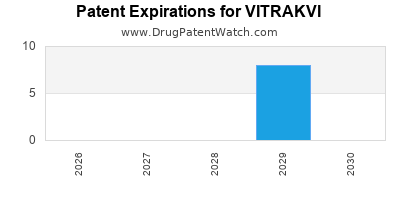

DrugPatentWatch® Estimated Loss of Exclusivity (LOE) Date for VITRAKVI
Generic Entry Dates for VITRAKVI*:
Constraining patent/regulatory exclusivity:
NDA:
Dosage:
CAPSULE;ORAL |
Generic Entry Dates for VITRAKVI*:
Constraining patent/regulatory exclusivity:
NDA:
Dosage:
SOLUTION;ORAL |
*The generic entry opportunity date is the latter of the last compound-claiming patent and the last regulatory exclusivity protection. Many factors can influence early or later generic entry. This date is provided as a rough estimate of generic entry potential and should not be used as an independent source.
Recent Clinical Trials for VITRAKVI
Identify potential brand extensions & 505(b)(2) entrants
| Sponsor | Phase |
|---|---|
| M.D. Anderson Cancer Center | Phase 2 |
| Children's Oncology Group | Phase 2 |
| Bristol-Myers Squibb | Phase 2 |
Pharmacology for VITRAKVI
| Drug Class | Kinase Inhibitor |
| Mechanism of Action | Tropomyosin Receptor Kinases Inhibitors |
Paragraph IV (Patent) Challenges for VITRAKVI
| Tradename | Dosage | Ingredient | Strength | NDA | ANDAs Submitted | Submissiondate |
|---|---|---|---|---|---|---|
| VITRAKVI | Capsules | larotrectinib sulfate | 25 mg and 100 mg | 210861 | 1 | 2025-05-06 |
US Patents and Regulatory Information for VITRAKVI
VITRAKVI is protected by twenty-one US patents.
Based on analysis by DrugPatentWatch, the earliest date for a generic version of VITRAKVI is ⤷ Start Trial.
This potential generic entry date is based on patent 10,799,505.
Generics may enter earlier, or later, based on new patent filings, patent extensions, patent invalidation, early generic licensing, generic entry preferences, and other factors.
| Applicant | Tradename | Generic Name | Dosage | NDA | Approval Date | TE | Type | RLD | RS | Patent No. | Patent Expiration | Product | Substance | Delist Req. | Exclusivity Expiration |
|---|---|---|---|---|---|---|---|---|---|---|---|---|---|---|---|
| Bayer Healthcare | VITRAKVI | larotrectinib sulfate | SOLUTION;ORAL | 211710-001 | Nov 26, 2018 | RX | Yes | Yes | 9,676,783 | ⤷ Start Trial | ⤷ Start Trial | ||||
| Bayer Healthcare | VITRAKVI | larotrectinib sulfate | SOLUTION;ORAL | 211710-001 | Nov 26, 2018 | RX | Yes | Yes | 8,865,698 | ⤷ Start Trial | ⤷ Start Trial | ||||
| Bayer Healthcare | VITRAKVI | larotrectinib sulfate | SOLUTION;ORAL | 211710-001 | Nov 26, 2018 | RX | Yes | Yes | 10,668,072 | ⤷ Start Trial | Y | ⤷ Start Trial | |||
| Bayer Hlthcare | VITRAKVI | larotrectinib sulfate | CAPSULE;ORAL | 210861-002 | Nov 26, 2018 | RX | Yes | Yes | 10,799,505 | ⤷ Start Trial | Y | Y | ⤷ Start Trial | ||
| >Applicant | >Tradename | >Generic Name | >Dosage | >NDA | >Approval Date | >TE | >Type | >RLD | >RS | >Patent No. | >Patent Expiration | >Product | >Substance | >Delist Req. | >Exclusivity Expiration |
International Patents for VITRAKVI
When does loss-of-exclusivity occur for VITRAKVI?
Based on analysis by DrugPatentWatch, the following patents block generic entry in the countries listed below:
Argentina
Patent: 8090
Estimated Expiration: ⤷ Start Trial
Australia
Patent: 15346046
Patent: Crystalline form of (S)-N-(5-((R)-2-(2,5-difluorophenyl)-pyrrolidin-1-yl)-pyrazolo(1,5-a)pyrimidin-3-yl)-3-hydroxypyrrolidine-1-carboxamide hydrogen sulfate
Estimated Expiration: ⤷ Start Trial
Patent: 17246547
Estimated Expiration: ⤷ Start Trial
Patent: 17246554
Estimated Expiration: ⤷ Start Trial
Brazil
Patent: 2017010141
Patent: forma cristalina de hidrogenossulfato de (s)-n-(5-((r)-2-(2,5-difluorofenil)-pirrolidin-1-il)-pirazolo[1,5-a]pirimidin-3-il)-3-hidroxipirrolidina-1-carboxamida
Estimated Expiration: ⤷ Start Trial
Patent: 2018070017
Estimated Expiration: ⤷ Start Trial
Patent: 2018070304
Estimated Expiration: ⤷ Start Trial
Canada
Patent: 67951
Patent: FORME CRISTALLINE D'HYDROGENOSULFATE DE (S)-N-(5-((R)-2-(2,5-DIFLUOROPHENYL)-PYRROLIDIN-1-YL)-PYRAZOLO[1,5-A]PYRIMIDIN-3-YL)-3-HYDROXYPYRROLIDINE-1-CARBOXAMIDE (CRYSTALLINE FORM OF (S)-N-(5-((R)-2-(2,5-DIFLUOROPHENYL)-PYRROLIDIN-1-YL)-PYRAZOLO[1,5-A]PYRIMIDIN-3-YL)-3-HYDROXYPYRROLIDINE-1-CARBOXAMIDE HYDROGEN SULFATE)
Estimated Expiration: ⤷ Start Trial
Patent: 19661
Estimated Expiration: ⤷ Start Trial
Patent: 19671
Estimated Expiration: ⤷ Start Trial
Chile
Patent: 17001249
Patent: Forma cristalina de sulfato de hidrógeno (s)-n-(5-((r)-2-(2,5-difluorofenil)-pirrolidinaa-1-il)-pirazolo[1,5-a] pirimidinaa-3-il)-3-hidroxipirrolidinaa-1-carboxamida.
Estimated Expiration: ⤷ Start Trial
Patent: 18002806
Estimated Expiration: ⤷ Start Trial
Patent: 18002807
Estimated Expiration: ⤷ Start Trial
Patent: 19002238
Estimated Expiration: ⤷ Start Trial
Patent: 19002239
Estimated Expiration: ⤷ Start Trial
China
Patent: 7428760
Estimated Expiration: ⤷ Start Trial
Patent: 9310694
Estimated Expiration: ⤷ Start Trial
Patent: 9414442
Estimated Expiration: ⤷ Start Trial
Patent: 3354649
Patent: 一种新的晶型 (Novel crystalline form)
Estimated Expiration: ⤷ Start Trial
Colombia
Patent: 17005483
Patent: Forma cristalina de sulfato de hidrógeno de (s)-n-(5-((r)-2-(2,5-difluorofenil)-pirrolidin-1- il)-pirazol[1,5-a]pirimidin-3-il)-3-hidroxipirrolidina-1-carboxamida
Estimated Expiration: ⤷ Start Trial
Patent: 18010761
Estimated Expiration: ⤷ Start Trial
Costa Rica
Patent: 170263
Patent: FORMA CRISTALINA DE SULFATO ACIDO DE (S)-N- (5- ( (R)-2- (2,5-DIFLUOROFENIL)-PIRROLIDIN-1-IL)-PIRAZOLO[1,5-A]-PIRIMIDIN-3-IL)-3-HIDROXIPIRROLIDINA-1-CARBOXAMIDA
Estimated Expiration: ⤷ Start Trial
Patent: 180501
Estimated Expiration: ⤷ Start Trial
Croatia
Patent: 0230271
Estimated Expiration: ⤷ Start Trial
Patent: 0241282
Estimated Expiration: ⤷ Start Trial
Patent: 0241295
Estimated Expiration: ⤷ Start Trial
Cuba
Patent: 180125
Estimated Expiration: ⤷ Start Trial
Cyprus
Patent: 25935
Estimated Expiration: ⤷ Start Trial
Denmark
Patent: 39662
Estimated Expiration: ⤷ Start Trial
Patent: 39663
Estimated Expiration: ⤷ Start Trial
Patent: 99181
Estimated Expiration: ⤷ Start Trial
Dominican Republic
Patent: 018000214
Estimated Expiration: ⤷ Start Trial
Ecuador
Patent: 18083443
Estimated Expiration: ⤷ Start Trial
European Patent Office
Patent: 18380
Patent: FORME CRISTALLINE D'HYDROGÉNOSULFATE DE (S)-N-(5-((R)-2-(2,5-DIFLUOROPHÉNYL)-PYRROLIDIN-1-YL)-PYRAZOLO[1,5-A]PYRIMIDIN-3-YL)-3-HYDROXYPYRROLIDINE-1-CARBOXAMIDE (CRYSTALLINE FORM OF (S)-N-(5-((R)-2-(2,5-DIFLUOROPHENYL)-PYRROLIDIN-1-YL)-PYRAZOLO[1,5-A]PYRIMIDIN-3-YL)-3-HYDROXYPYRROLIDINE-1-CARBOXAMIDE HYDROGEN SULFATE)
Estimated Expiration: ⤷ Start Trial
Patent: 39662
Estimated Expiration: ⤷ Start Trial
Patent: 39663
Estimated Expiration: ⤷ Start Trial
Patent: 99181
Patent: FORME CRISTALLINE D'HYDROGÉNOSULFATE DE (S)-N-(5-((R)-2-(2,5-DIFLUOROPHÉNYL)-PYRROLIDIN-1-YL)-PYRAZOLO[1,5-A]PYRIMIDIN-3-YL)-3-HYDROXYPYRROLIDINE-1-CARBOXAMIDE (CRYSTALLINE FORM OF (S)-N-(5-((R)-2-(2,5-DIFLUOROPHENYL)-PYRROLIDIN-1-YL)-PYRAZOLO[1,5-A]PYRIMIDIN-3-YL)-3-HYDROXYPYRROLIDINE-1-CARBOXAMIDE HYDROGEN SULFATE)
Estimated Expiration: ⤷ Start Trial
Finland
Patent: 39662
Estimated Expiration: ⤷ Start Trial
Patent: 39663
Estimated Expiration: ⤷ Start Trial
Patent: 99181
Estimated Expiration: ⤷ Start Trial
Georgia, Republic of
Patent: 202114914
Estimated Expiration: ⤷ Start Trial
Patent: 0227339
Estimated Expiration: ⤷ Start Trial
Hong Kong
Patent: 44483
Estimated Expiration: ⤷ Start Trial
Hungary
Patent: 61448
Estimated Expiration: ⤷ Start Trial
Patent: 68542
Estimated Expiration: ⤷ Start Trial
Patent: 68971
Estimated Expiration: ⤷ Start Trial
Israel
Patent: 2270
Patent: צורה גבישית של (s)-n-(5-)-2-(r)) 5,2-דיפלואורופניל)-פירולידין-1-איל)-פיראזולו[5,1-a]פירימידין-3-איל)-3-הידרוקסיפירולידין-1-קרבוקסאמיד מימן סולפאט (Crystalline form of (s)-n-(5-((r)-2-(2,5-difluorophenyl)-pyrrolidin-1-yl)-pyrazolo[1,5-a]pyrimidin-3-yl)-3-hydroxypyrrolidine-1-carboxamide hydrogen sulfate)
Estimated Expiration: ⤷ Start Trial
Patent: 2003
Estimated Expiration: ⤷ Start Trial
Patent: 2005
Estimated Expiration: ⤷ Start Trial
Patent: 0905
Patent: צורה גבישית של (s)-n-(5-)-2-(r)) 5,2-דיפלואורופניל)-פירולידין-1-איל)-פיראזולו[5,1-a]פירימידין-3-איל)-3-הידרוקסיפירולידין-1-קרבוקסאמיד מימן סולפאט (Crystalline form of (s)-n-(5-((r)-2-(2,5-difluorophenyl)-pyrrolidin-1-yl)-pyrazolo[1,5-a]pyrimidin-3-yl)-3-hydroxypyrrolidine-1-carboxamide hydrogen sulfate)
Estimated Expiration: ⤷ Start Trial
Patent: 4018
Estimated Expiration: ⤷ Start Trial
Japan
Patent: 14834
Estimated Expiration: ⤷ Start Trial
Patent: 57343
Estimated Expiration: ⤷ Start Trial
Patent: 61602
Estimated Expiration: ⤷ Start Trial
Patent: 17535550
Patent: (S)−N−(5−((R)−2−(2,5−ジフルオロフェニル)−ピロリジン−1−イル)−ピラゾロ[1,5−a]ピリミジン−3−イル)−3−ヒドロキシピロリジン−1−カルボキサミド硫酸水素塩の結晶形
Estimated Expiration: ⤷ Start Trial
Patent: 19510827
Estimated Expiration: ⤷ Start Trial
Patent: 19511575
Estimated Expiration: ⤷ Start Trial
Patent: 21169496
Patent: (S)−N−(5−((R)−2−(2,5−ジフルオロフェニル)−ピロリジン−1−イル)−ピラゾロ[1,5−a]ピリミジン−3−イル)−3−ヒドロキシピロリジン−1−カルボキサミド硫酸水素塩の結晶形 (CRYSTALLINE FORM OF (S)-N-(5-((R)-2-(2,5-DIFLUOROPHENYL)-PYRROLIDIN-1-YL)-PYRAZOLO[1,5-a]PYRIMIDIN-3-YL)-3-HYDROXYPYRROLIDINE-1-CARBOXAMIDE HYDROGEN SULFATE)
Estimated Expiration: ⤷ Start Trial
Lithuania
Patent: 39662
Estimated Expiration: ⤷ Start Trial
Patent: 39663
Estimated Expiration: ⤷ Start Trial
Patent: 99181
Estimated Expiration: ⤷ Start Trial
Mexico
Patent: 6478
Estimated Expiration: ⤷ Start Trial
Patent: 6415
Estimated Expiration: ⤷ Start Trial
Patent: 6416
Estimated Expiration: ⤷ Start Trial
Patent: 17006412
Estimated Expiration: ⤷ Start Trial
Patent: 18012163
Estimated Expiration: ⤷ Start Trial
Patent: 18012165
Estimated Expiration: ⤷ Start Trial
Patent: 20011079
Estimated Expiration: ⤷ Start Trial
Morocco
Patent: 601
Estimated Expiration: ⤷ Start Trial
Patent: 610
Estimated Expiration: ⤷ Start Trial
Patent: 612
Estimated Expiration: ⤷ Start Trial
Patent: 504
Patent: Forme cristalline d'hydrogénosulfate de (s)-n-(5-((r)-2-(2,5-difluorophényl)-pyrrolidin-1-yl)-pyrazolo[1,5-a]pyrimidin-3-yl)-3-hydroxypyrrolidine-1-carboxamide
Estimated Expiration: ⤷ Start Trial
New Zealand
Patent: 1909
Estimated Expiration: ⤷ Start Trial
Patent: 7135
Estimated Expiration: ⤷ Start Trial
Patent: 7140
Estimated Expiration: ⤷ Start Trial
Nicaragua
Patent: 1800102
Estimated Expiration: ⤷ Start Trial
Peru
Patent: 181888
Estimated Expiration: ⤷ Start Trial
Philippines
Patent: 017500900
Estimated Expiration: ⤷ Start Trial
Patent: 018502124
Estimated Expiration: ⤷ Start Trial
Patent: 018502134
Estimated Expiration: ⤷ Start Trial
Patent: 021550809
Estimated Expiration: ⤷ Start Trial
Poland
Patent: 39662
Estimated Expiration: ⤷ Start Trial
Patent: 39663
Estimated Expiration: ⤷ Start Trial
Patent: 99181
Estimated Expiration: ⤷ Start Trial
Portugal
Patent: 39662
Estimated Expiration: ⤷ Start Trial
Patent: 39663
Estimated Expiration: ⤷ Start Trial
Patent: 99181
Estimated Expiration: ⤷ Start Trial
Russian Federation
Patent: 23990
Patent: CRYSTALLINE FORM (S)-N-(5-((R)-2-(2,5-DIFLUOROPHENYL)-PYRROLIDIN-1-YL)-PYRAZOLO[1,5-A]PYRIMIDIN-3-YL)-3-HYDROXYPYRROLIDINE-1-CARBOXAMIDE HYDROSULPHATE
Estimated Expiration: ⤷ Start Trial
Patent: 51636
Estimated Expiration: ⤷ Start Trial
Patent: 51767
Estimated Expiration: ⤷ Start Trial
Patent: 17120846
Estimated Expiration: ⤷ Start Trial
Patent: 18137206
Estimated Expiration: ⤷ Start Trial
Patent: 18138579
Estimated Expiration: ⤷ Start Trial
Saudi Arabia
Patent: 8400168
Estimated Expiration: ⤷ Start Trial
Serbia
Patent: 122
Estimated Expiration: ⤷ Start Trial
Patent: 987
Estimated Expiration: ⤷ Start Trial
Patent: 988
Estimated Expiration: ⤷ Start Trial
Singapore
Patent: 201703962X
Patent: CRYSTALLINE FORM OF (S)-N-(5-((R)-2-(2,5-DIFLUOROPHENYL)-PYRROLIDIN-1-YL)-PYRAZOLO[1,5-A]PYRIMIDIN-3-YL)-3-HYDROXYPYRROLIDINE-1-CARBOXAMIDE HYDROGEN SULFATE
Estimated Expiration: ⤷ Start Trial
Patent: 201808559P
Estimated Expiration: ⤷ Start Trial
Patent: 201808676R
Estimated Expiration: ⤷ Start Trial
Slovenia
Patent: 39662
Estimated Expiration: ⤷ Start Trial
Patent: 39663
Estimated Expiration: ⤷ Start Trial
Patent: 99181
Estimated Expiration: ⤷ Start Trial
South Africa
Patent: 1703501
Estimated Expiration: ⤷ Start Trial
Patent: 1806684
Estimated Expiration: ⤷ Start Trial
South Korea
Patent: 2400423
Estimated Expiration: ⤷ Start Trial
Patent: 2649887
Estimated Expiration: ⤷ Start Trial
Patent: 170082628
Estimated Expiration: ⤷ Start Trial
Patent: 180128484
Estimated Expiration: ⤷ Start Trial
Patent: 180129911
Estimated Expiration: ⤷ Start Trial
Patent: 210010652
Estimated Expiration: ⤷ Start Trial
Spain
Patent: 41630
Estimated Expiration: ⤷ Start Trial
Patent: 87474
Estimated Expiration: ⤷ Start Trial
Patent: 87501
Estimated Expiration: ⤷ Start Trial
Taiwan
Patent: 1625636
Estimated Expiration: ⤷ Start Trial
Patent: 1801730
Estimated Expiration: ⤷ Start Trial
Patent: 2206436
Estimated Expiration: ⤷ Start Trial
Patent: 46426
Estimated Expiration: ⤷ Start Trial
Patent: 46537
Estimated Expiration: ⤷ Start Trial
Patent: 67858
Estimated Expiration: ⤷ Start Trial
Tunisia
Patent: 18000335
Estimated Expiration: ⤷ Start Trial
Patent: 18000338
Estimated Expiration: ⤷ Start Trial
Patent: 19000332
Estimated Expiration: ⤷ Start Trial
Ukraine
Patent: 3044
Estimated Expiration: ⤷ Start Trial
Patent: 5025
Estimated Expiration: ⤷ Start Trial
Patent: 5026
Estimated Expiration: ⤷ Start Trial
Generics may enter earlier, or later, based on new patent filings, patent extensions, patent invalidation, early generic licensing, generic entry preferences, and other factors.
See the table below for additional patents covering VITRAKVI around the world.
| Country | Patent Number | Title | Estimated Expiration |
|---|---|---|---|
| Argentina | 074052 | ⤷ Start Trial | |
| Argentina | 112833 | ⤷ Start Trial | |
| Australia | 2009308465 | ⤷ Start Trial | |
| Australia | 2015200511 | ⤷ Start Trial | |
| >Country | >Patent Number | >Title | >Estimated Expiration |
Supplementary Protection Certificates for VITRAKVI
| Patent Number | Supplementary Protection Certificate | SPC Country | SPC Expiration | SPC Description |
|---|---|---|---|---|
| 3106463 | 301033 | Netherlands | ⤷ Start Trial | PRODUCT NAME: LAROTRECTINIB, DESGEWENST IN DE VORM VAN EEN FARMACEUTISCH AANVAARDBAAR ZOUT, IN HET BIJZONDER LAROTRECTINIBSULFAAT, MET INBEGRIP VAN LAROTRECTINIBSULFAAT MONOHYDRAAT; REGISTRATION NO/DATE: EU/1/19/1385 20190923 |
| 3106463 | PA2020504 | Lithuania | ⤷ Start Trial | PRODUCT NAME: LAROTREKTINIBAS IR (ARBA) FARMACINIU POZIURIU PRIIMTINOS DRUSKOS, YPAC LAROTREKTINIBO SULFATAS, ISKAITANT LAROTREKTINIBO VANDENILIO SULFATA; REGISTRATION NO/DATE: EU/1/19/1385 20190919 |
| 3106463 | CA 2020 00013 | Denmark | ⤷ Start Trial | PRODUCT NAME: LAROTRECTINIB OG/ELLER ET FARMACEUTISK ACCEPTABELT SALT DERAF, SAERLIGT LAROTRECTINIBSULFAT, INKLUSIV LAROTRECTINIBHYDROGENSULFAT; REG. NO/DATE: EU/1/19/1385 20190923 |
| 3106463 | 122020000012 | Germany | ⤷ Start Trial | PRODUCT NAME: LAROTRECTINIB ODER ANDERE PHARMAZEUTISCH ANNEHMBARE SALZE DAVON, EINSCHLIESSLICH LAROTRECTINIBSULFATE UMFASSEND LAROTRECTINIBHYDROGENSULFAT; REGISTRATION NO/DATE: EU/1/19/1385 20190919 |
| >Patent Number | >Supplementary Protection Certificate | >SPC Country | >SPC Expiration | >SPC Description |
VITRAKVI (larotrectinib) market dynamics and financial trajectory: sales trend, exclusivity, competition, and patent-driven risk
More… ↓
Make Better Decisions: Try a trial or see plans & pricing
Drugs may be covered by multiple patents or regulatory protections. All trademarks and applicant names are the property of their respective owners or licensors. Although great care is taken in the proper and correct provision of this service, thinkBiotech LLC does not accept any responsibility for possible consequences of errors or omissions in the provided data. The data presented herein is for information purposes only. There is no warranty that the data contained herein is error free. We do not provide individual investment advice. This service is not registered with any financial regulatory agency. The information we publish is educational only and based on our opinions plus our models. By using DrugPatentWatch you acknowledge that we do not provide personalized recommendations or advice. thinkBiotech performs no independent verification of facts as provided by public sources nor are attempts made to provide legal or investing advice. Any reliance on data provided herein is done solely at the discretion of the user. Users of this service are advised to seek professional advice and independent confirmation before considering acting on any of the provided information. thinkBiotech LLC reserves the right to amend, extend or withdraw any part or all of the offered service without notice.
ISSN: 2162-2639

Privacy and Cookies
Terms & Conditions
Site Map
DrugPatentWatch Alternatives
LOE / Major Patent Expirations 2026 - 2027
NCE-1 Patent Challenge Dates 2026 - 2027
Friedman, Yali. "DrugPatentWatch" DrugPatentWatch, thinkBiotech, 2026, www.DrugPatentWatch.com.
See Primary Research Papers Citing DrugPatentWatch