Share This Page
VISTARIL Drug Patent Profile
✉ Email this page to a colleague
Which patents cover Vistaril, and what generic alternatives are available?
Vistaril is a drug marketed by Pfizer and is included in three NDAs.
The generic ingredient in VISTARIL is hydroxyzine hydrochloride. There are two drug master file entries for this compound. Fifty-four suppliers are listed for this compound. Additional details are available on the hydroxyzine hydrochloride profile page.
DrugPatentWatch® Litigation and Generic Entry Outlook for Vistaril
A generic version of VISTARIL was approved as hydroxyzine hydrochloride by CHARTWELL RX on April 12th, 1982.
AI Deep Research
Questions you can ask:
- What is the 5 year forecast for VISTARIL?
- What are the global sales for VISTARIL?
- What is Average Wholesale Price for VISTARIL?
Summary for VISTARIL
| US Patents: | 0 |
| Applicants: | 1 |
| NDAs: | 3 |
| Raw Ingredient (Bulk) Api Vendors: | 1 |
| Clinical Trials: | 3 |
| Patent Applications: | 5,638 |
| Drug Prices: | Drug price information for VISTARIL |
| Drug Sales Revenues: | Drug sales revenues for VISTARIL |
| What excipients (inactive ingredients) are in VISTARIL? | VISTARIL excipients list |
| DailyMed Link: | VISTARIL at DailyMed |

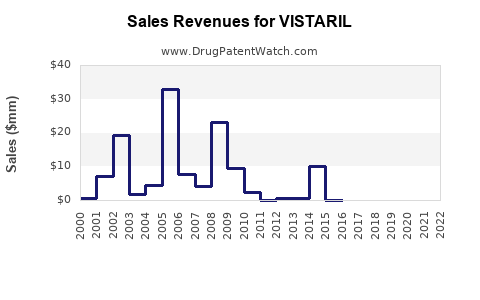
Recent Clinical Trials for VISTARIL
Identify potential brand extensions & 505(b)(2) entrants
| Sponsor | Phase |
|---|---|
| Sultan Qaboos University | Phase 4 |
| University of Colorado, Denver | N/A |
| Stanford University | N/A |
US Patents and Regulatory Information for VISTARIL
| Applicant | Tradename | Generic Name | Dosage | NDA | Approval Date | TE | Type | RLD | RS | Patent No. | Patent Expiration | Product | Substance | Delist Req. | Exclusivity Expiration |
|---|---|---|---|---|---|---|---|---|---|---|---|---|---|---|---|
| Pfizer | VISTARIL | hydroxyzine pamoate | CAPSULE;ORAL | 011459-002 | Approved Prior to Jan 1, 1982 | AB | RX | Yes | No | ⤷ Start Trial | ⤷ Start Trial | ⤷ Start Trial | |||
| Pfizer | VISTARIL | hydroxyzine hydrochloride | INJECTABLE;INJECTION | 011111-001 | Approved Prior to Jan 1, 1982 | DISCN | Yes | No | ⤷ Start Trial | ⤷ Start Trial | ⤷ Start Trial | ||||
| Pfizer | VISTARIL | hydroxyzine pamoate | CAPSULE;ORAL | 011459-004 | Approved Prior to Jan 1, 1982 | AB | RX | Yes | No | ⤷ Start Trial | ⤷ Start Trial | ⤷ Start Trial | |||
| Pfizer | VISTARIL | hydroxyzine pamoate | CAPSULE;ORAL | 011459-006 | Approved Prior to Jan 1, 1982 | DISCN | Yes | No | ⤷ Start Trial | ⤷ Start Trial | ⤷ Start Trial | ||||
| Pfizer | VISTARIL | hydroxyzine pamoate | SUSPENSION;ORAL | 011795-001 | Approved Prior to Jan 1, 1982 | DISCN | Yes | No | ⤷ Start Trial | ⤷ Start Trial | ⤷ Start Trial | ||||
| >Applicant | >Tradename | >Generic Name | >Dosage | >NDA | >Approval Date | >TE | >Type | >RLD | >RS | >Patent No. | >Patent Expiration | >Product | >Substance | >Delist Req. | >Exclusivity Expiration |
Vistaril Market Dynamics, Patent Status, and Financial Trajectory
Vistaril, the brand name for hydroxyzine pamoate, is a mature antihistamine and anxiolytic with no meaningful remaining patent or regulatory exclusivity. Its commercial position is driven by generic hydroxyzine pamoate, low manufacturing complexity, limited brand differentiation, and substitution by hydroxyzine hydrochloride and newer antihistamines. Standalone Vistaril revenue is not publicly reported, so the financial trajectory must be assessed through prescription volume, generic pricing, supplier participation, and the absence of brand-level exclusivity.
What is Vistaril and how is it used?
Vistaril contains hydroxyzine pamoate, an H1 histamine antagonist with sedative and anxiolytic activity. The FDA-approved label identifies indications for anxiety, pruritus caused by allergic conditions, and preoperative sedation.[1]
| Attribute | Vistaril |
|---|---|
| Active ingredient | Hydroxyzine pamoate |
| Drug class | First-generation antihistamine; anxiolytic |
| Dosage forms | Capsules; oral suspension |
| Administration | Oral |
| Original regulatory status | Legacy NDA product |
| Current commercial status | Mature brand and generic market |
| Controlled-substance status | Not federally scheduled |
| Primary alternatives | Hydroxyzine hydrochloride, cetirizine, diphenhydramine, buspirone and other anxiolytics |
| Biosimilar exposure | None |
Hydroxyzine pamoate is also prescribed off label for insomnia, agitation and short-term anxiety. Those uses expand demand but do not create additional regulatory exclusivity.
What is the FDA regulatory status of Vistaril?
Vistaril is an FDA-approved legacy product. Hydroxyzine pamoate products are also available as abbreviated new drug applications, or ANDAs, allowing generic competition under the Hatch-Waxman framework.[2]
The market is divided between:
- Brand or branded-generic hydroxyzine pamoate;
- Generic hydroxyzine pamoate capsules;
- Generic hydroxyzine pamoate oral solution or suspension;
- Hydroxyzine hydrochloride tablets, syrup and solution.
The FDA label carries safety information relevant to current prescribing. Hydroxyzine can prolong the QT interval and has been associated with torsades de pointes, particularly in patients with cardiac risk factors or when combined with other QT-prolonging medicines.[1] Sedation, anticholinergic effects and impaired alertness also constrain use in older patients and in combination with central nervous system depressants.
The FDA has not granted Vistaril a modern exclusivity period comparable to those available for newly approved small-molecule drugs. Its commercial lifecycle predates current exclusivity structures.
What patents protect Vistaril?
No active composition-of-matter patent is understood to protect hydroxyzine pamoate in the United States. The active ingredient has been marketed for decades, and the basic compound, salt form and conventional oral dosage forms are outside the effective life of any original patent protection.
| IP category | Vistaril status |
|---|---|
| Composition-of-matter patent | Expired or no longer commercially relevant |
| Hydroxyzine pamoate salt protection | No meaningful active exclusivity identified |
| Capsule formulation patents | No material current barrier identified |
| Oral suspension patents | No material current barrier identified |
| Method-of-use patents | No material current exclusivity identified |
| Manufacturing patents | Potential process know-how, but no known market-blocking barrier |
| FDA Orange Book protection | No commercially meaningful active patent barrier |
The relevant patent question is not whether historic hydroxyzine patents existed. It is whether a current patent could block an ANDA or generic launch. For Vistaril, the answer is effectively no.
The FDA Orange Book provides patent and exclusivity information for approved drug products. Mature hydroxyzine pamoate products do not have a patent estate comparable to branded drugs launched during the past two decades.[2]
When does Vistaril lose exclusivity?
Vistaril has already lost market exclusivity. The product is in the post-exclusivity generic phase, and generic hydroxyzine pamoate has been available for many years.
| Exclusivity type | Status |
|---|---|
| New chemical entity exclusivity | Expired |
| Orphan-drug exclusivity | None |
| Pediatric exclusivity | None currently relevant |
| New clinical investigation exclusivity | None identified |
| Patent term extension | None currently relevant |
| Generic entry restriction | None of commercial significance |
There is no credible basis for a future "Vistaril loss-of-exclusivity" event. The relevant commercial event occurred decades ago when generic hydroxyzine products entered the market.
How many patents cover Vistaril?
No active U.S. patent portfolio appears to provide meaningful protection for Vistaril or hydroxyzine pamoate. Any patent documents associated with historic hydroxyzine development would have expired long before the current generic market.
The remaining intellectual-property value is limited to:
- Manufacturing specifications;
- Supplier qualification;
- Formulation know-how;
- Trade secrets;
- Trademark recognition for the Vistaril name.
Those rights can support product quality and marketing but do not prevent generic substitution.
What formulations are protected by Vistaril?
The principal Vistaril dosage forms are capsules and oral suspension. Neither form presents a meaningful current patent barrier.
Capsules
Hydroxyzine pamoate capsules are relatively simple immediate-release solid oral dosage forms. Multiple manufacturers can produce them using conventional encapsulation, blending and quality-control processes. The product has limited formulation complexity and no delivery technology that would materially delay generic competition.
Oral suspension
The oral suspension has greater manufacturing and quality-control requirements than capsules because sponsors must demonstrate uniformity, stability, preservative performance and dose reproducibility. Those requirements can create operational barriers, particularly for small manufacturers, but they do not create durable exclusivity.
A company could pursue a differentiated formulation, such as an extended-release product, but that would require new clinical, bioequivalence and regulatory work. No such formulation is central to the current Vistaril market.
Are there Paragraph IV challenges to Vistaril?
Paragraph IV litigation is not a significant current risk factor for Vistaril. Paragraph IV certifications are used when an ANDA applicant challenges listed patents. Because hydroxyzine pamoate lacks a commercially meaningful active patent estate, generic entrants do not face the type of patent challenge commonly seen with modern branded drugs.
| Litigation issue | Vistaril assessment |
|---|---|
| Active Orange Book patent challenge | No material current issue identified |
| Paragraph IV litigation | No significant current litigation driver |
| 30-month stay risk | Not a meaningful market constraint |
| Launch-at-risk exposure | Minimal from patent perspective |
| Settlement agreements | No major current settlement affecting entry identified |
The more relevant risks are regulatory observations, product recalls, manufacturing interruptions and pricing pressure.
What is the Orange Book status of Vistaril?
The Orange Book does not provide Vistaril with a meaningful continuing barrier to generic approval. Generic applicants can rely on the reference product's safety and efficacy findings through the ANDA pathway, subject to applicable bioequivalence and quality requirements.[2]
The commercial significance of Orange Book status is therefore limited. Unlike products such as Eliquis, Eylea or Trelegy, Vistaril has no dense patent listing capable of extending branded control after loss of exclusivity.
Which companies compete with Vistaril?
Competition exists at both the product and therapeutic-substitution levels.
Hydroxyzine suppliers
The U.S. market includes multiple generic suppliers and contract manufacturers. Depending on the presentation and period, products may be distributed under manufacturers' labels, pharmacy private labels, or repackager names. The supplier field can change as companies enter or exit low-margin generic categories.
Therapeutic competitors
Hydroxyzine competes with:
- Hydroxyzine hydrochloride;
- Cetirizine and levocetirizine for allergic symptoms;
- Diphenhydramine for short-term antihistamine use;
- Buspirone for chronic anxiety;
- Benzodiazepines for selected short-term anxiety indications;
- Sedating antidepressants and other off-label therapies for insomnia.
Hydroxyzine's advantage is its low price and broad familiarity. Its disadvantages include sedation, anticholinergic burden, QT-prolongation concerns and the availability of less-sedating alternatives.
How strong is the Vistaril patent estate?
The patent estate is weak from a commercial protection perspective because it does not block generic entry or support premium pricing.
| Patent-strength factor | Assessment |
|---|---|
| Remaining patent term | None of commercial significance |
| Composition protection | None |
| Formulation differentiation | Limited |
| Manufacturing complexity | Low to moderate |
| Regulatory switching cost | Low |
| Generic competition | High |
| Brand pricing power | Minimal |
| Litigation leverage | Minimal |
The product's remaining defensibility comes from market familiarity, distribution relationships, supply reliability and physician recognition. Those factors can support a branded-generic position but cannot sustain the economics of a patented specialty medicine.
What is Vistaril's financial trajectory?
No major public company reports standalone Vistaril revenue in its financial filings. Pfizer's public reporting does not disclose a separate current Vistaril revenue line, and generic manufacturers generally aggregate hydroxyzine sales within broader generic-pharmaceutical categories.[3]
The likely financial trajectory has four stages:
- Initial branded period: Revenue was supported by originator status and physician familiarity.
- Generic entry: Volume shifted toward lower-priced generic hydroxyzine products.
- Mature generic phase: Revenue became fragmented across suppliers, wholesalers and private-label distributors.
- Current phase: Unit demand is relatively stable, while manufacturer revenue is constrained by price competition and periodic supply changes.
The product category can generate recurring prescription volume because anxiety, pruritus and short-term sedative use remain common. That volume does not translate into high product-level revenue because hydroxyzine is inexpensive and widely substitutable.
Revenue exposure
Vistaril is unlikely to represent material revenue exposure for a diversified pharmaceutical company. The financial profile is characterized by:
- Low average selling prices;
- High substitution;
- Limited marketing investment;
- Minimal switching costs;
- Weak brand premium;
- Commodity-style procurement;
- Potentially volatile manufacturer participation.
A supplier may benefit from temporary shortages or competitor exits, but those gains are generally tactical rather than structural.
What factors drive the Vistaril market?
Prescription demand
Demand is supported by broad indications and low cost. Hydroxyzine is used in primary care, psychiatry, dermatology, emergency medicine and perioperative settings.
Generic pricing
Pricing is the dominant commercial variable. Multiple suppliers can compress prices, while manufacturing disruptions can create temporary increases. Pharmacy benefit managers and wholesalers favor dependable low-cost supply.
Safety restrictions
QT-prolongation warnings and sedation reduce use in patients with cardiac risk, older adults and patients receiving other sedatives. These restrictions limit growth relative to less-sedating antihistamines.
Substitution
Hydroxyzine hydrochloride is the closest pharmaceutical substitute. The two salts have different formulations and labeling histories but compete for overlapping clinical use. Cetirizine and levocetirizine reduce demand in allergic rhinitis and urticaria, while buspirone and other anxiolytics compete in chronic anxiety treatment.
Supply reliability
The market can become concentrated when manufacturers discontinue low-margin products. A shortage can shift volume to remaining suppliers, but the absence of patent protection allows competitors to re-enter if economics improve.
What generic launch scenarios exist for Vistaril?
The most likely scenarios are operational rather than patent-driven.
| Scenario | Market effect |
|---|---|
| Stable multi-supplier market | Continued low prices and fragmented share |
| Manufacturer exit | Temporary share gains for remaining suppliers |
| Supply shortage | Higher spot pricing and substitution to hydroxyzine HCl |
| New entrant | Further price pressure |
| Differentiated formulation | Limited premium opportunity, but substantial regulatory cost |
| Safety-driven prescribing decline | Lower demand in older or high-risk populations |
A conventional generic entrant would face low legal risk but uncertain commercial returns. The main entry question is whether expected volume justifies formulation, registration, manufacturing and distribution costs.
What is the competitive outlook for Vistaril versus hydroxyzine hydrochloride?
Hydroxyzine pamoate and hydroxyzine hydrochloride are both mature generic markets. Hydroxyzine hydrochloride has broader tablet and liquid availability in many channels, while hydroxyzine pamoate retains recognition through the Vistaril name and capsule presentation.
| Factor | Hydroxyzine pamoate | Hydroxyzine hydrochloride |
|---|---|---|
| Brand association | Vistaril | Atarax legacy brand |
| Generic maturity | High | High |
| Patent barrier | None of significance | None of significance |
| Dosage-form breadth | Capsules and suspension | Tablets, syrup and solution, depending on supplier |
| Price power | Very low | Very low |
| Therapeutic overlap | High | High |
| Main commercial advantage | Legacy brand familiarity | Broad generic availability |
Neither product has a strong basis for sustained premium pricing. The market will continue to favor suppliers with low manufacturing costs, reliable supply and established pharmacy distribution.
What patent litigation and settlement agreements affect Vistaril?
No major current patent litigation or settlement agreement is known to materially affect U.S. Vistaril entry or pricing. The product's commercial risks are outside the typical branded-drug litigation cycle.
Relevant monitoring areas include:
- FDA drug shortages;
- Manufacturing-site inspections;
- Product recalls;
- ANDA approvals and withdrawals;
- Changes in supplier participation;
- Label updates concerning QT prolongation and sedation;
- Reimbursement and formulary treatment.
What are the geographic market dynamics for Vistaril?
The United States is a mature generic market with low brand protection. International markets use hydroxyzine under different brand names and regulatory classifications. Patent status is similarly mature, but product availability, prescription practices and reimbursement vary by country.
In Europe and other regulated markets, hydroxyzine use may be more affected by restrictions on long-term treatment, QT risk and pediatric dosing. Geographic revenue cannot be inferred from U.S. brand performance because Vistaril branding and supplier arrangements differ across jurisdictions.
Key Takeaways
- Vistaril is hydroxyzine pamoate, a decades-old oral antihistamine and anxiolytic.
- Its U.S. patent and regulatory exclusivity has expired.
- No active patent estate appears to block generic hydroxyzine pamoate entry.
- Paragraph IV litigation and patent settlements are not meaningful current market factors.
- Capsules and oral suspension have limited formulation complexity.
- Revenue is not publicly disclosed on a standalone Vistaril basis.
- The financial profile is that of a mature, low-price generic category rather than a branded growth product.
- Competitive pressure comes from hydroxyzine hydrochloride, newer antihistamines and alternative anxiolytics.
- Future commercial changes will be driven by supplier exits, shortages, pricing and safety-related prescribing changes.
FAQs
Is Vistaril still sold as a brand-name drug?
Hydroxyzine pamoate remains associated with the Vistaril brand, but most current U.S. dispensing is expected to occur through generic or branded-generic channels rather than a premium originator product.
Does Vistaril have any remaining patent protection?
No commercially meaningful U.S. composition, formulation or method-of-use patent protection is identified for hydroxyzine pamoate.
Can a generic company launch hydroxyzine pamoate without a patent settlement?
Yes. The absence of a material blocking patent means generic entry is not dependent on a branded settlement of the type common in protected small-molecule markets.
Is Vistaril a high-revenue pharmaceutical product?
No. Standalone revenue is not publicly reported, and the product's mature generic economics indicate low pricing power and fragmented supplier revenue.
What is the main investment risk in the Vistaril market?
The main risks are low margins, supplier competition, manufacturing disruption, regulatory safety concerns and substitution by hydroxyzine hydrochloride or newer therapies.
References
- U.S. Food and Drug Administration. (n.d.). Vistaril (hydroxyzine pamoate) prescribing information. DailyMed.
- U.S. Food and Drug Administration. (n.d.). Approved drug products with therapeutic equivalence evaluations. FDA Orange Book.
- Pfizer Inc. (2024). Annual report and Form 10-K. Pfizer Investor Relations.
More… ↓
