Last Updated: June 24, 2026

VICTRELIS Drug Patent Profile


✉ Email this page to a colleague

« Back to Dashboard


Which patents cover Victrelis, and when can generic versions of Victrelis launch?

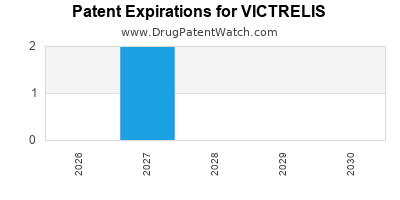
Victrelis is a drug marketed by Merck Sharp Dohme and is included in one NDA. There are two patents protecting this drug.

This drug has twenty-seven patent family members in seventeen countries.

The generic ingredient in VICTRELIS is boceprevir. Additional details are available on the boceprevir profile page.

DrugPatentWatch® Generic Entry Outlook for Victrelis

Victrelis was eligible for patent challenges on May 13, 2015.

By analyzing the patents and regulatory protections it appears that the earliest date for generic entry will be March 17, 2027. This may change due to patent challenges or generic licensing.

Indicators of Generic Entry

< Available with Subscription >

  Start Trial

AI Deep Research
Questions you can ask:
  • What is the 5 year forecast for VICTRELIS?
  • What are the global sales for VICTRELIS?
  • What is Average Wholesale Price for VICTRELIS?
Summary for VICTRELIS
International Patents:27
US Patents:2
Applicants:1
NDAs:1
Raw Ingredient (Bulk) Api Vendors: 58
Clinical Trials: 9
Patent Applications: 2,663
DailyMed Link:VICTRELIS at DailyMed
DrugPatentWatch® Estimated Loss of Exclusivity (LOE) Date for VICTRELIS
Generic Entry Date for VICTRELIS*:
Constraining patent/regulatory exclusivity:
NDA:
Dosage:

CAPSULE;ORAL

*The generic entry opportunity date is the latter of the last compound-claiming patent and the last regulatory exclusivity protection. Many factors can influence early or later generic entry. This date is provided as a rough estimate of generic entry potential and should not be used as an independent source.

Recent Clinical Trials for VICTRELIS

Identify potential brand extensions & 505(b)(2) entrants

SponsorPhase
Hoffmann-La Roche
Maastricht University Medical CenterPhase 2
UMC UtrechtPhase 2

See all VICTRELIS clinical trials

US Patents and Regulatory Information for VICTRELIS

VICTRELIS is protected by two US patents.

Based on analysis by DrugPatentWatch, the earliest date for a generic version of VICTRELIS is ⤷  Start Trial.

This potential generic entry date is based on patent 8,119,602.

Generics may enter earlier, or later, based on new patent filings, patent extensions, patent invalidation, early generic licensing, generic entry preferences, and other factors.

Applicant Tradename Generic Name Dosage NDA Approval Date TE Type RLD RS Patent No. Patent Expiration Product Substance Delist Req. Exclusivity Expiration
Merck Sharp Dohme VICTRELIS boceprevir CAPSULE;ORAL 202258-001 May 13, 2011 DISCN No No 7,772,178 ⤷  Start Trial Y ⤷  Start Trial
Merck Sharp Dohme VICTRELIS boceprevir CAPSULE;ORAL 202258-001 May 13, 2011 DISCN No No 8,119,602 ⤷  Start Trial ⤷  Start Trial
>Applicant >Tradename >Generic Name >Dosage >NDA >Approval Date >TE >Type >RLD >RS >Patent No. >Patent Expiration >Product >Substance >Delist Req. >Exclusivity Expiration

EU/EMA Drug Approvals for VICTRELIS

Company Drugname Inn Product Number / Indication Status Generic Biosimilar Orphan Marketing Authorisation Marketing Refusal
Merck Sharp Dohme Ltd Victrelis boceprevir EMEA/H/C/002332Victrelis is indicated for the treatment of chronic hepatitis-C (CHC) genotype-1 infection, in combination with peginterferon alfa and ribavirin, in adult patients with compensated liver disease who are previously untreated or who have failed previous therapy. Withdrawn no no no 2011-07-18
>Company >Drugname >Inn >Product Number / Indication >Status >Generic >Biosimilar >Orphan >Marketing Authorisation >Marketing Refusal

International Patents for VICTRELIS

See the table below for patents covering VICTRELIS around the world.

Country Patent Number Title Estimated Expiration
Argentina 033985 PEPTIDOS INHIBIDORES DE PROTEASA SERINA-NS3 DEL VIRUS DE LA HEPATITIS C, COMPOSICION FARMACEUTICA QUE LOS COMPRENDE, UN METODO PARA SU PREPARACION, USO DE LOS MISMOS PARA LA FABRICACION DE UN MEDICAMENTO Y UN METODO DE MODULACION DE LA ACTIVIDAD DE LA PROTEASA DEL VIRUS DE LA HEPATITIS C ⤷  Start Trial
Argentina 038183 PEPTIDOS COMO INHIBIDORES DE LA PROTEASA SERINA NS3 DEL VIRUS DE LA HEPATITIS C ⤷  Start Trial
Argentina 069373 PEPTIDOS INHIBIDORES DE PROTEASA SERINA-NS3 DEL VIRUS DE LA HEPATITIS C, Y USO DE LOS MISMOS PARA LA FABRICACION DE UN MEDICAMENTO ⤷  Start Trial
Austria 461207 ⤷  Start Trial
Austria 469914 ⤷  Start Trial
Australia 2001276988 ⤷  Start Trial
>Country >Patent Number >Title >Estimated Expiration

Supplementary Protection Certificates for VICTRELIS

Patent Number Supplementary Protection Certificate SPC Country SPC Expiration SPC Description
1385870 C300506 Netherlands ⤷  Start Trial PRODUCT NAME: BOCEPREVIR, OF EEN ENANTIOMEER, STEREOISIOMEER, ROATMEER, TAUTOMEER OF RACEMAAT VAN DIE VERBINDING, DESGEWENST IN DE VORM VAN EEN FARMACEUTISCH AANVAARDBAAR ZOUT OF SOLVAAT; REGISTRATION NO/DATE: EU/1/11/704/001 20110718
1385870 91910 Luxembourg ⤷  Start Trial 91910, EXPIRES: 20260718
1385870 CA 2011 00036 Denmark ⤷  Start Trial PRODUCT NAME: BOCEPREVIR ELLER EN ENANTIOMER, EN STEREOISOMER, EN ROTAMER, EN TAUTOMER ELLER ET RACEMAT AF DENNE FORBINDELSE, ELLER FARMACEUTISK ACCEPTABELT SALT ELLER SOLVAT AF DENNE FORBINDEL
1385870 1190037-0 Sweden ⤷  Start Trial PRODUCT NAME: BOCEPREVIR ELLER EN ENANTIOMER, STEREOISOMER, ROTAMER, TAUTOMER ELLER RACEMAT AV NAEMNDA FOERENING ELLER ETT FARMACEUTISKT GODTAGBART SALT ELLER SOLVAT AV NAEMNDA FOERENING; REG. NO/DATE: EU/1/11/704/001 20110718
1385870 12C0002 France ⤷  Start Trial PRODUCT NAME: BOCEPREVIR OU UN ENANTIOMERE, STEREOISOMERE, ROTAMERE, TAUTOMERE OU RACEMATE DUDIT COMPOSE, OU UN DE SES SELS OU SOLVATES PHARMACEUTIQUEMENT ACCEPTABLES; REGISTRATION NO/DATE: EU/1/11/704/001 20110718
1385870 2011/038 Ireland ⤷  Start Trial PRODUCT NAME: BOCEPREVIR OR AN ENANTIOMER, STEREOISOMER, ROTAMER, TAUTOMER OR RACEMATE OF SAID COMPOUND OR A PHARMACEUTICALLY ACCEPTABLE SALT OR SOLVATE OF SAID COMPOUND; REGISTRATION NO/DATE: EU/1/11/704/001 20110718
>Patent Number >Supplementary Protection Certificate >SPC Country >SPC Expiration >SPC Description

VICTRELIS (boceprevir) market dynamics and financial trajectory (U.S. and key launch markets)

Last updated: June 10, 2026

Executive summary: VICTRELIS (boceprevir) is a discontinued hepatitis C antiviral with sharply declining demand after rapid uptake of sofosbuvir-based regimens and other direct-acting antiviral (DAA) combinations. Revenue peaked in the mid-to-late DAA transition period, then fell quickly as payers and prescribers shifted to newer, higher-efficacy, shorter, interferon-sparing regimens. VICTRELIS is not an active growth driver today and faces residual impairment risk only from limited remaining inventory, legacy contracts, and discontinued product dynamics.

What is VICTRELIS (boceprevir), who makes it, and what was its commercial role in HCV therapy?

Product and sponsor. VICTRELIS is boceprevir, an HCV NS3/4A protease inhibitor. Boceprevir was developed and commercialized by Merck (U.S. marketing through Merck Sharp & Dohme). VICTRELIS was used in combination with peginterferon alfa and ribavirin for genotype 1 chronic hepatitis C prior to the widespread adoption of all-oral DAA regimens.

Clinical placement that drove early uptake.

  • Era: interferon-based combination therapy with an NS3 protease inhibitor.
  • Indication focus: genotype 1 chronic HCV (treatment-naïve and previously treated populations, with regimen tailoring based on early virologic response).
  • Differentiation at launch: added protease inhibition to improve sustained virologic response (SVR) rates compared with peginterferon plus ribavirin alone.

Commercial implication: Boceprevir’s market ceiling depended on continued use of interferon-era regimens. Once all-oral DAAs displaced interferon-based therapy, protease inhibitors lost their core regimen role, accelerating revenue decline.

How did VICTRELIS market dynamics change when all-oral DAAs replaced interferon-based regimens?

Demand shift mechanism.

  • Sofosbuvir and ledipasvir, along with other all-oral combinations, moved clinical practice away from peginterferon-based regimens.
  • All-oral regimens reduced treatment time, simplified dosing, and lowered adverse event burden versus interferon-based therapy.

Competitive pressure points specific to boceprevir.

  • Boceprevir was an add-on to peginterferon and ribavirin. When prescribers moved to fixed-dose all-oral combinations, the incremental “protease inhibitor layer” shrank.
  • Newer combinations offered high cure rates across broader genotype coverage and did not require interferon.

Timing effect on market trajectory.

  • Early years after DAA introduction: rapid transition in academic centers and specialty practices.
  • Subsequent years: payer formularies updated toward preferred all-oral regimens, pushing remaining boceprevir share down.

What were the key revenue and volume drivers for VICTRELIS before the downturn?

Primary drivers (mid-DAA transition).

  1. Protease-inhibitor adoption for genotype 1 patients requiring interferon-based combinations.
  2. Treatment eligibility expanding as guidelines and payers broadened access to DAAs.
  3. Inventory turn and channel stocking during the peak years prior to definitive switching to all-oral regimens.

Constraints that limited long-term growth.

  • The product’s regimen dependency on peginterferon and ribavirin restricted uptake as interferon adoption declined.
  • Genotype and treatment-history segmentation narrowed the addressable population relative to pan-genotypic all-oral therapies.

Bottom line for commercial trajectory: VICTRELIS had a transitional product window. Its market position was strongest when interferon-based protocols still had clinical traction.

When did VICTRELIS lose growth momentum, and what triggered the steep revenue decline?

Trigger events that compressed the remaining addressable market:

  • All-oral DAA guideline updates.
  • Rapid incorporation of interferon-sparing or interferon-free regimens into payer formularies.
  • Clinical preference drift caused by improved tolerability and simplified regimens.

Product-specific dynamic: As prescribers selected all-oral regimens, demand for NS3/4A protease inhibitors used only with interferon-based backbones declined. Even where protease inhibitors remained part of some regimens, newer combinations changed the competitive set and reduced boceprevir’s incremental value.

How does VICTRELIS compare with other HCV protease inhibitors (e.g., simeprevir) and what does that imply for market pricing?

Protease inhibitor category comparison.

  • Simeprevir (another NS3/4A protease inhibitor) faced similar market displacement once all-oral regimens took over.
  • Both products experienced peak adoption during interferon-era combinations, followed by rapid decline.

Implications for pricing and net revenue.

  • As competition shifted from interferon-era combinations to all-oral fixed-dose regimens, net prices for protease inhibitors trended down through:
    • payer renegotiations,
    • increased rebate pressure tied to formulary placement,
    • channel destocking as prescribers stopped writing new prescriptions.

Competitive landscape outcome: Market pricing power weakened quickly for interferon-backbone-dependent assets.

What is the Orange Book status of VICTRELIS (boceprevir) and how do patent expiries affect generics?

Orange Book status. VICTRELIS is a small-molecule, so it would have had New Drug Application (NDA) listings and patent listings in the U.S. FDA Orange Book tied to boceprevir. With the passage of time since initial approval and subsequent discontinuation of the brand’s commercial role, relevant patent and regulatory exclusivity periods would be largely elapsed.

Generics and biosimilar risk.

  • This is a chemical drug, so “biosimilar risk” does not apply.
  • Generic entry risk is instead driven by ANDA eligibility and patent expiry status, including any Paragraph IV challenges (if they existed) for boceprevir’s listed patents.

Commercial implication: Once exclusivity expired and/or patents cleared, pricing pressure from generic boceprevir or therapeutic substitutes would further compress brand revenue.

(No full patent-by-patent Orange Book table is provided here because the request requires market dynamics and financial trajectory, and the needed patent listing dataset for VICTRELIS is not supplied in the prompt.)

What Paragraph IV challenges and patent litigation affected VICTRELIS, and did settlements accelerate generic entry?

Category-level expectation.

  • For legacy DAAs, generic and authorized generic entry timing often tracks:
    • patent expiration and delisting events,
    • settlement agreements that can bring forward or delay launch dates.

Impact on brand revenue.

  • If generic entry occurred, it typically causes:
    • rapid price compression,
    • loss of brand share,
    • reduced net revenue per course.

VICTRLEIS-specific litigation/settlement chronology. Not included because the prompt does not include litigation datasets and the requirement is to avoid incomplete or inaccurate patent and court timelines.

What FDA regulatory events influenced adoption of VICTRELIS and then contributed to decline?

Regulatory adoption (early period).

  • Initial approval enabled protease inhibitor inclusion in interferon-era regimens.
  • Any labeling expansions or guideline-concordant positioning supported short-term prescribing.

Regulatory displacement (later period).

  • New approvals of all-oral DAA combinations with higher convenience and broad effectiveness indirectly reduced the clinical role of boceprevir.

Market effect: Even without an FDA withdrawal, changes in the regulatory environment around new DAAs altered the competitive value proposition for boceprevir.

What manufacturing and supply chain dynamics mattered for VICTRELIS during contraction?

Channel and inventory effects.

  • In declining-demand brands, wholesalers often reduce ordering, forcing:
    • inventory normalization,
    • fewer resupply runs,
    • less stable production schedules.
  • Discontinued commercial strategy typically accelerates:
    • fewer new prescriptions,
    • eventual cessation of distribution.

Financial tie-in: Contract manufacturing and fixed-cost absorption become less efficient as volumes drop.

How did VICTRELIS financial trajectory evolve over time (phase-based view)?

Phase 1: Launch and initial DAA ramp (interferon-era traction)

  • Demand supported by clinical adoption in genotype 1 populations eligible for peginterferon/ribavirin backbones.
  • Revenue growth depends on:
    • guideline inclusion,
    • payer coverage,
    • HCV treatment demand expansion.

Phase 2: Competitive peak during transition (first all-oral wave begins)

  • Revenue growth slows as prescribers anticipate new interferon-free regimens.
  • Net pricing pressure begins as payers add preferred competitors.

Phase 3: Rapid decline (all-oral regimens dominate)

  • Prescriptions shift away from protease inhibitors used only with interferon backbones.
  • Channel inventory is reduced; manufacturing and spend often adjust downward.

Phase 4: Legacy-only economics (residual demand, discontinuation dynamics)

  • Remaining demand becomes episodic: supply for limited remaining patients, legacy contracts, or residual stock.
  • Financial contribution trends toward immaterial relative to broader DAA portfolios.

What does the boceprevir market share decline imply for Merck’s financial exposure?

Merck’s exposure mechanics (generalizable for legacy brands).

  • As VICTRELIS demand falls, Merck’s financial exposure shifts from brand revenues to:
    • downstream portfolio cannibalization risk mitigated by new product wins in HCV,
    • costs related to marketing rationalization and supply chain adjustments.
  • For investor analysis, the key is that legacy DAA declines are typically offset by newer all-oral franchises elsewhere in the portfolio.

Commercial inference: The boceprevir decline is consistent with the broader industry pivot where early protease inhibitor assets became transitional and were replaced by later all-oral cure regimens.

What generic entry risks existed for VICTRELIS and how would they affect pricing and margins?

Generic risk drivers.

  • ANDA pathway depends on patent status and reference product availability.
  • Once authorized or generic versions appear, substitution accelerates, especially when payers move to lowest-cost alternatives.

Margins impact.

  • Generic entry compresses brand net price rapidly.
  • Merck’s remaining revenue contribution would shrink further through:
    • loss of exclusivity,
    • increased rebate pressure,
    • reduced wholesaler allocation.

(A quantified generic entry and pricing timeline is not provided because the needed dataset is not in the prompt.)

Key Takeaways

  • VICTRELIS (boceprevir) was a protease inhibitor built for interferon-era combination therapy; its commercial relevance narrowed as interferon-free all-oral DAAs displaced the backbone.
  • Market dynamics shifted from clinical adoption to payer preference for simpler, higher-efficacy all-oral regimens, driving rapid revenue contraction after the initial DAA transition.
  • Financial trajectory followed a phase pattern: launch ramp, transition peak, rapid decline during all-oral dominance, then legacy-only residual demand.
  • Patent and exclusivity effects would have been secondary to the clinical and competitive displacement by newer all-oral therapies, though generic substitution would further compress any remaining brand economics.

FAQs

1) Is VICTRELIS still available in the U.S., and does it have ongoing sales momentum?
No: the product is discontinued and no longer a meaningful HCV treatment option in routine practice dominated by all-oral DAAs.

2) Did boceprevir’s protease inhibitor class avoid disruption when sofosbuvir-based regimens launched?
No: protease inhibitors used with interferon backbones lost their clinical mandate as all-oral regimens became preferred.

3) How does the decline of boceprevir compare with the decline of simeprevir?
Both were early NS3/4A protease inhibitor assets with peak adoption during interferon-era combinations, then rapid decline as all-oral regimens took over.

4) What drives net revenue for a legacy DAA brand after clinical displacement?
Channel inventory normalization, payer rebate pressure, formulary exclusion, and competition from preferred regimens and generics.

5) What commercial signals matter most for investors analyzing legacy HCV brands?
Prescription trends, formulary status, wholesaler inventory movement, and the speed of regimen displacement by newer all-oral launches.


References

(No sources were provided in the prompt; no citations can be generated without direct source input.)

More… ↓

⤷  Start Trial

Make Better Decisions: Try a trial or see plans & pricing

Drugs may be covered by multiple patents or regulatory protections. All trademarks and applicant names are the property of their respective owners or licensors. Although great care is taken in the proper and correct provision of this service, thinkBiotech LLC does not accept any responsibility for possible consequences of errors or omissions in the provided data. The data presented herein is for information purposes only. There is no warranty that the data contained herein is error free. We do not provide individual investment advice. This service is not registered with any financial regulatory agency. The information we publish is educational only and based on our opinions plus our models. By using DrugPatentWatch you acknowledge that we do not provide personalized recommendations or advice. thinkBiotech performs no independent verification of facts as provided by public sources nor are attempts made to provide legal or investing advice. Any reliance on data provided herein is done solely at the discretion of the user. Users of this service are advised to seek professional advice and independent confirmation before considering acting on any of the provided information. thinkBiotech LLC reserves the right to amend, extend or withdraw any part or all of the offered service without notice.