You're using a free limited version of DrugPatentWatch: Upgrade for Complete Access

Last Updated: December 15, 2025

VENLAFAXINE BESYLATE Drug Patent Profile


✉ Email this page to a colleague

« Back to Dashboard


Which patents cover Venlafaxine Besylate, and what generic alternatives are available?

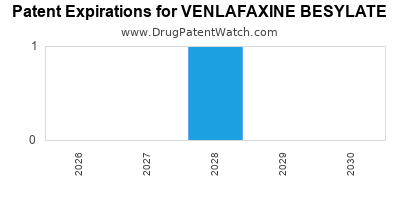
Venlafaxine Besylate is a drug marketed by Almatica and is included in one NDA. There is one patent protecting this drug.

The generic ingredient in VENLAFAXINE BESYLATE is venlafaxine besylate. There are seventy-one drug master file entries for this compound. One supplier is listed for this compound. Additional details are available on the venlafaxine besylate profile page.

DrugPatentWatch® Litigation and Generic Entry Outlook for Venlafaxine Besylate

A generic version of VENLAFAXINE BESYLATE was approved as venlafaxine besylate by ALMATICA on June 29th, 2022.

  Get Started Free

AI Deep Research
Questions you can ask:
  • What is the 5 year forecast for VENLAFAXINE BESYLATE?
  • What are the global sales for VENLAFAXINE BESYLATE?
  • What is Average Wholesale Price for VENLAFAXINE BESYLATE?
Drug patent expirations by year for VENLAFAXINE BESYLATE
Recent Clinical Trials for VENLAFAXINE BESYLATE

Identify potential brand extensions & 505(b)(2) entrants

SponsorPhase
Haining Health-Coming Biotech Co., Ltd.Phase 2
Alphacait, LLCPhase 2

See all VENLAFAXINE BESYLATE clinical trials

Pharmacology for VENLAFAXINE BESYLATE
Anatomical Therapeutic Chemical (ATC) Classes for VENLAFAXINE BESYLATE

US Patents and Regulatory Information for VENLAFAXINE BESYLATE

VENLAFAXINE BESYLATE is protected by one US patents.

Applicant Tradename Generic Name Dosage NDA Approval Date TE Type RLD RS Patent No. Patent Expiration Product Substance Delist Req. Exclusivity Expiration
Almatica VENLAFAXINE BESYLATE venlafaxine besylate TABLET, EXTENDED RELEASE;ORAL 215429-001 Jun 29, 2022 RX Yes Yes 7,776,358 ⤷  Get Started Free Y ⤷  Get Started Free
>Applicant >Tradename >Generic Name >Dosage >NDA >Approval Date >TE >Type >RLD >RS >Patent No. >Patent Expiration >Product >Substance >Delist Req. >Exclusivity Expiration

Premature patent expiration for: VENLAFAXINE BESYLATE

Expiration due to failure to pay maintenance fee

Patent Number Tradename Expiration Date
⤷  Get Started Free VENLAFAXINE BESYLATE ⤷  Get Started Free

International Patents for VENLAFAXINE BESYLATE

See the table below for patents covering VENLAFAXINE BESYLATE around the world.

Country Patent Number Title Estimated Expiration
Argentina 039163 BESILATO DE VENLAFAXINA ⤷  Get Started Free
European Patent Office 1485344 BESYLATE DE VENLAFAXINE (VENLAFAXINE BESYLATE) ⤷  Get Started Free
South Africa 200406461 Venlafaxine besylate ⤷  Get Started Free
Australia 2003221535 VENLAFAXINE BESYLATE ⤷  Get Started Free
World Intellectual Property Organization (WIPO) 03082804 ⤷  Get Started Free
>Country >Patent Number >Title >Estimated Expiration

Market Dynamics and Financial Trajectory for VENLAFAXINE BESYLATE

Last updated: August 3, 2025


Introduction

Venlafaxine besylate, a serotonin-norepinephrine reuptake inhibitor (SNRI), is a widely prescribed antidepressant primarily used to treat major depressive disorder (MDD), generalized anxiety disorder (GAD), social anxiety disorder (SAD), and panic disorder. Since its market introduction, venlafaxine faced evolving market dynamics shaped by patent expirations, generic competition, regulatory shifts, and emerging treatment alternatives. This report analyzes the current landscape and project future financial trajectories for venlafaxine besylate.


Market Overview

Venlafaxine was initially developed by Wyeth (later acquired by Pfizer) and launched in 1993 under the brand name Effexor. Its patent expiration in multiple markets, such as the U.S. in 2014, catalyzed the entry of generics, significantly influencing sales dynamics. The drug's versatile efficacy and relatively tolerable side effect profile maintained consistent demand, particularly for moderate to severe depression and anxiety disorders.

The global antidepressant market, valued at approximately $14 billion in 2022, exhibits a compound annual growth rate (CAGR) of 2-3%. Venlafaxine constitutes a notable segment within this, although declining branded sales and rising generics have shifted revenue streams towards broad-based generic prescribing.


Market Dynamics

1. Patent Expirations and Generic Competition

The expiration of patent protections—most notably in the U.S. and Europe—marked a pivotal market shift. Post-patent expiry, branded Effexor experienced steep revenue declines, with generic versions capturing substantial market share. In the U.S., generic venlafaxine now dominates prescriptions, capturing approximately 90% of the market share for depression treatment (as per IQVIA data). This intensified price competition and eroded initial brand dominance, pressuring revenue growth for branded formulations.

2. Regulatory and Pricing Pressures

Regulatory agencies continually scrutinize antidepressant formulations for safety and efficacy, impacting market scope and labeling. Additionally, payer policies increasingly favor generics to contain costs, further disadvantaging branded formulations. The increasing cost-efficiency of generics has prompted physicians and insurers to prefer cost-effective options, influencing prescribing behavior.

3. Market Evolution and Emerging Therapies

Newer antidepressants and atypical agents, such as vortioxetine and esketamine, have gained prominence, offering clinical advantages in specific patient subsets. Although venlafaxine remains a first-line treatment, the advent of these novel therapies could redirect treatment patterns, especially for treatment-resistant cases.

4. Geographic Market Variations

While the U.S. accounts for a significant share of antidepressant revenues, emerging markets in Asia, Latin America, and Africa are witnessing growth due to increased mental health awareness and expanding healthcare infrastructure. In these regions, the availability and affordability of generics bolster access to venlafaxine.


Financial Trajectory

1. Revenue Decline and Stabilization

Historical data indicates that branded effexor sales peaked around $2.2 billion in 2008. Post-patent expiry, sales declined sharply, with Pfizer reporting approximately $50 million in U.S. sales in 2020, primarily from branded formulations. Despite this decline, global generics sales remain robust, driven largely by off-patent formulations and competitive pricing.

2. Generics Market Share and Pricing

The proliferation of generic venlafaxine led to price erosion, with generic formulations often priced 80-90% lower than branded versions. This commodification resulted in a shift where the overall market value is maintained, but profit margins for manufacturers decrease unless differentiated by manufacturing efficiencies or formulation innovations.

3. Market Forecast to 2030

Analysts project a continued decline in branded venlafaxine revenues, stabilizing at a low single-digit million-dollar level in mature markets. Conversely, the global generic market is expected to sustain steady growth, supported by increasing acceptance and expanding healthcare access in emerging economies. Overall, the pharmaceutical industry's revenue from venlafaxine is anticipated to taper, with the majority of income shifting to generic producers.

4. Investment Outlook

Pharmaceutical companies investing in synthetic chemistry, manufacturing scale, and biosimilar-like formulations of venlafaxine may sustain profitability margins. Patent litigations, such as patent challenges on formulations or manufacturing processes, could influence future market dynamics.


Strategic Implications

For Brand Pharmaceutical Firms:
Continued investment in new formulations, combination therapies, or novel delivery systems can prolong product lifecycle. Expanding into adjunctive therapies or niche indications may offset declining revenues from primary indications.

For Generics Manufacturers:
Focus on cost-efficient manufacturing and strategic patent challenges to secure market share. Innovations, such as sustained-release formulations, might offer competitive advantage.

For Investors and Stakeholders:
Assess the long-term viability of brands post-patent expiry, balancing between lower-margin generic sales and developing pipeline drugs for depression and anxiety disorders.


Conclusion

The market landscape for venlafaxine besylate is characterized by a transition from branded dominance to a predominantly generic-driven environment. Patent expirations catalyzed a steep decline in branded revenues, replaced by a steady stream of low-cost generics—especially in mature markets. Future financial trajectories will depend on regulatory policies, emergence of new treatments, and geographic market dynamics. While the core antidepressant segment is mature, niche markets and formulation advancements may present incremental growth avenues.

Understanding these dynamics enables stakeholders to make informed decisions regarding investment, research priorities, and market positioning within the antidepressant class.


Key Takeaways

  • Patent expiry significantly diminished branded venlafaxine revenues, with generic versions dominating the market.
  • Price erosion due to generics results in decreasing profit margins for original manufacturers.
  • Growth in emerging markets and ongoing demand for cost-effective treatments sustain the volume of generic prescriptions.
  • Innovation in formulations and therapeutic positioning can extend the product's lifecycle amidst generic competition.
  • The overall market for venlafaxine is shifting toward stabilization at lower revenue levels with potential niche opportunities.

FAQs

1. What is the current market share of generic venlafaxine?
Generics account for approximately 90% of venlafaxine prescriptions in the U.S., reflecting their dominant role post-patent expiration.

2. How has patent expiry impacted the revenues of branded venlafaxine?
Patents expiring around 2014 led to a steep decline in branded sales, reducing revenue from over $2 billion annually to a few tens of millions.

3. Are there new formulations or delivery mechanisms for venlafaxine under development?
While current development is limited, some companies explore extended-release formulations and combinations with other agents to differentiate their products.

4. Which regions are expected to drive future growth in venlafaxine prescriptions?
Emerging markets in Asia, Latin America, and Africa are projected to see increased generic adoption, supporting volume growth despite pricing pressures.

5. What therapeutic alternatives threaten venlafaxine’s market position?
Newer antidepressants such as vortioxetine, esketamine, and atypical agents offer alternative options, especially for treatment-resistant depression, potentially reducing venlafaxine's market share.


Sources:
[1] IQVIA. "Global Prescription Drug Market Data." 2022.
[2] Pfizer Annual Report. "Effexor Market Performance," 2020.
[3] MarketResearch.com. "Antidepressant Market Outlook," 2023.

More… ↓

⤷  Get Started Free

Make Better Decisions: Try a trial or see plans & pricing

Drugs may be covered by multiple patents or regulatory protections. All trademarks and applicant names are the property of their respective owners or licensors. Although great care is taken in the proper and correct provision of this service, thinkBiotech LLC does not accept any responsibility for possible consequences of errors or omissions in the provided data. The data presented herein is for information purposes only. There is no warranty that the data contained herein is error free. We do not provide individual investment advice. This service is not registered with any financial regulatory agency. The information we publish is educational only and based on our opinions plus our models. By using DrugPatentWatch you acknowledge that we do not provide personalized recommendations or advice. thinkBiotech performs no independent verification of facts as provided by public sources nor are attempts made to provide legal or investing advice. Any reliance on data provided herein is done solely at the discretion of the user. Users of this service are advised to seek professional advice and independent confirmation before considering acting on any of the provided information. thinkBiotech LLC reserves the right to amend, extend or withdraw any part or all of the offered service without notice.