You're using a free limited version of DrugPatentWatch: Upgrade for Complete Access

Last Updated: March 26, 2026

VELTASSA Drug Patent Profile


✉ Email this page to a colleague

« Back to Dashboard


Which patents cover Veltassa, and when can generic versions of Veltassa launch?

Veltassa is a drug marketed by Vifor Pharma and is included in one NDA. There are seven patents protecting this drug and one Paragraph IV challenge.

This drug has two hundred and six patent family members in twenty-seven countries.

The generic ingredient in VELTASSA is patiromer sorbitex calcium. One supplier is listed for this compound. Additional details are available on the patiromer sorbitex calcium profile page.

DrugPatentWatch® Generic Entry Outlook for Veltassa

Veltassa was eligible for patent challenges on October 21, 2019.

By analyzing the patents and regulatory protections it appears that the earliest date for generic entry will be May 29, 2030. This may change due to patent challenges or generic licensing.

There have been two patent litigation cases involving the patents protecting this drug, indicating strong interest in generic launch. Recent data indicate that 63% of patent challenges are decided in favor of the generic patent challenger and that 54% of successful patent challengers promptly launch generic drugs.

Indicators of Generic Entry

< Available with Subscription >

  Start Trial

AI Deep Research
Questions you can ask:
  • What is the 5 year forecast for VELTASSA?
  • What are the global sales for VELTASSA?
  • What is Average Wholesale Price for VELTASSA?
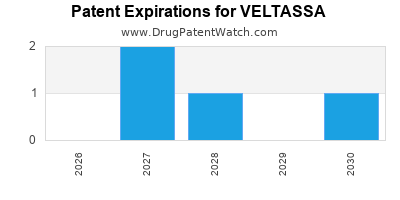
Drug patent expirations by year for VELTASSA
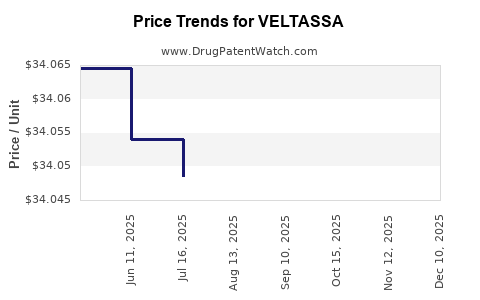
Drug Prices for VELTASSA

See drug prices for VELTASSA

DrugPatentWatch® Estimated Loss of Exclusivity (LOE) Date for VELTASSA
Generic Entry Date for VELTASSA*:
Constraining patent/regulatory exclusivity:
NDA:
Dosage:
POWDER;ORAL

*The generic entry opportunity date is the latter of the last compound-claiming patent and the last regulatory exclusivity protection. Many factors can influence early or later generic entry. This date is provided as a rough estimate of generic entry potential and should not be used as an independent source.

Recent Clinical Trials for VELTASSA

Identify potential brand extensions & 505(b)(2) entrants

SponsorPhase
University of California, IrvinePhase 4
NHS Greater Glasgow and ClydePhase 4
University of GlasgowPhase 4

See all VELTASSA clinical trials

Pharmacology for VELTASSA
Drug ClassPotassium Binder
Mechanism of ActionPotassium Ion Binding Activity
Paragraph IV (Patent) Challenges for VELTASSA
Tradename Dosage Ingredient Strength NDA ANDAs Submitted Submissiondate
VELTASSA for Oral Suspension patiromer sorbitex calcium 8.4 g, 16.8 g and 25.2 g 205739 2 2019-10-21

US Patents and Regulatory Information for VELTASSA

VELTASSA is protected by seven US patents and two FDA Regulatory Exclusivities.

Based on analysis by DrugPatentWatch, the earliest date for a generic version of VELTASSA is ⤷  Start Trial.

This potential generic entry date is based on patent 8,337,824.

Generics may enter earlier, or later, based on new patent filings, patent extensions, patent invalidation, early generic licensing, generic entry preferences, and other factors.

Applicant Tradename Generic Name Dosage NDA Approval Date TE Type RLD RS Patent No. Patent Expiration Product Substance Delist Req. Exclusivity Expiration
Vifor Pharma VELTASSA patiromer sorbitex calcium POWDER;ORAL 205739-003 Oct 21, 2015 DISCN Yes No ⤷  Start Trial ⤷  Start Trial ⤷  Start Trial
Vifor Pharma VELTASSA patiromer sorbitex calcium POWDER;ORAL 205739-003 Oct 21, 2015 DISCN Yes No 8,216,560 ⤷  Start Trial ⤷  Start Trial
Vifor Pharma VELTASSA patiromer sorbitex calcium POWDER;ORAL 205739-003 Oct 21, 2015 DISCN Yes No 11,123,363 ⤷  Start Trial ⤷  Start Trial
Vifor Pharma VELTASSA patiromer sorbitex calcium POWDER;ORAL 205739-004 Oct 2, 2023 RX Yes No 8,216,560 ⤷  Start Trial ⤷  Start Trial
Vifor Pharma VELTASSA patiromer sorbitex calcium POWDER;ORAL 205739-002 Oct 21, 2015 RX Yes Yes 9,492,476 ⤷  Start Trial ⤷  Start Trial
Vifor Pharma VELTASSA patiromer sorbitex calcium POWDER;ORAL 205739-002 Oct 21, 2015 RX Yes Yes ⤷  Start Trial ⤷  Start Trial ⤷  Start Trial
>Applicant >Tradename >Generic Name >Dosage >NDA >Approval Date >TE >Type >RLD >RS >Patent No. >Patent Expiration >Product >Substance >Delist Req. >Exclusivity Expiration

Expired US Patents for VELTASSA

Applicant Tradename Generic Name Dosage NDA Approval Date Patent No. Patent Expiration
Vifor Pharma VELTASSA patiromer sorbitex calcium POWDER;ORAL 205739-003 Oct 21, 2015 8,475,780 ⤷  Start Trial
Vifor Pharma VELTASSA patiromer sorbitex calcium POWDER;ORAL 205739-003 Oct 21, 2015 8,889,115 ⤷  Start Trial
Vifor Pharma VELTASSA patiromer sorbitex calcium POWDER;ORAL 205739-001 Oct 21, 2015 8,778,324 ⤷  Start Trial
Vifor Pharma VELTASSA patiromer sorbitex calcium POWDER;ORAL 205739-003 Oct 21, 2015 8,287,847 ⤷  Start Trial
Vifor Pharma VELTASSA patiromer sorbitex calcium POWDER;ORAL 205739-004 Oct 2, 2023 10,485,821 ⤷  Start Trial
Vifor Pharma VELTASSA patiromer sorbitex calcium POWDER;ORAL 205739-002 Oct 21, 2015 8,778,324 ⤷  Start Trial
>Applicant >Tradename >Generic Name >Dosage >NDA >Approval Date >Patent No. >Patent Expiration

International Patents for VELTASSA

When does loss-of-exclusivity occur for VELTASSA?

Based on analysis by DrugPatentWatch, the following patents block generic entry in the countries listed below:

Australia

Patent: 09282721
Estimated Expiration: ⤷  Start Trial

Brazil

Patent: 0917853
Estimated Expiration: ⤷  Start Trial

Canada

Patent: 35058
Estimated Expiration: ⤷  Start Trial

China

Patent: 2202670
Estimated Expiration: ⤷  Start Trial

Patent: 3919792
Estimated Expiration: ⤷  Start Trial

Croatia

Patent: 0150955
Estimated Expiration: ⤷  Start Trial

Patent: 0181961
Estimated Expiration: ⤷  Start Trial

Patent: 0230091
Estimated Expiration: ⤷  Start Trial

Patent: 0250774
Estimated Expiration: ⤷  Start Trial

Cyprus

Patent: 16850
Estimated Expiration: ⤷  Start Trial

Patent: 20930
Estimated Expiration: ⤷  Start Trial

Patent: 18002
Estimated Expiration: ⤷  Start Trial

Patent: 19002
Estimated Expiration: ⤷  Start Trial

Denmark

Patent: 65988
Estimated Expiration: ⤷  Start Trial

Patent: 57286
Estimated Expiration: ⤷  Start Trial

Patent: 31094
Estimated Expiration: ⤷  Start Trial

European Patent Office

Patent: 65988
Estimated Expiration: ⤷  Start Trial

Patent: 57286
Estimated Expiration: ⤷  Start Trial

Patent: 31094
Estimated Expiration: ⤷  Start Trial

Patent: 01408
Estimated Expiration: ⤷  Start Trial

Finland

Patent: 31094
Estimated Expiration: ⤷  Start Trial

Germany

Patent: 2009002063
Estimated Expiration: ⤷  Start Trial

Hong Kong

Patent: 84675
Estimated Expiration: ⤷  Start Trial

Hungary

Patent: 25934
Estimated Expiration: ⤷  Start Trial

Patent: 61320
Estimated Expiration: ⤷  Start Trial

Patent: 71829
Estimated Expiration: ⤷  Start Trial

Patent: 800004
Estimated Expiration: ⤷  Start Trial

Patent: 900003
Estimated Expiration: ⤷  Start Trial

Japan

Patent: 56403
Estimated Expiration: ⤷  Start Trial

Patent: 83471
Estimated Expiration: ⤷  Start Trial

Patent: 32468
Estimated Expiration: ⤷  Start Trial

Patent: 33583
Estimated Expiration: ⤷  Start Trial

Patent: 90116
Estimated Expiration: ⤷  Start Trial

Patent: 12500806
Estimated Expiration: ⤷  Start Trial

Patent: 14144977
Estimated Expiration: ⤷  Start Trial

Patent: 14144978
Estimated Expiration: ⤷  Start Trial

Patent: 16145256
Estimated Expiration: ⤷  Start Trial

Patent: 17218454
Estimated Expiration: ⤷  Start Trial

Patent: 19065030
Estimated Expiration: ⤷  Start Trial

Patent: 20172537
Estimated Expiration: ⤷  Start Trial

Lithuania

Patent: 957286
Estimated Expiration: ⤷  Start Trial

Patent: 2018004
Estimated Expiration: ⤷  Start Trial

Patent: 2018016
Estimated Expiration: ⤷  Start Trial

Patent: 57286
Estimated Expiration: ⤷  Start Trial

Patent: 31094
Estimated Expiration: ⤷  Start Trial

Luxembourg

Patent: 0094
Estimated Expiration: ⤷  Start Trial

Mexico

Patent: 4398
Estimated Expiration: ⤷  Start Trial

Patent: 9664
Estimated Expiration: ⤷  Start Trial

Patent: 11001893
Estimated Expiration: ⤷  Start Trial

Netherlands

Patent: 0962
Estimated Expiration: ⤷  Start Trial

Norway

Patent: 18004
Estimated Expiration: ⤷  Start Trial

Patent: 18041
Estimated Expiration: ⤷  Start Trial

Poland

Patent: 65988
Estimated Expiration: ⤷  Start Trial

Patent: 57286
Estimated Expiration: ⤷  Start Trial

Patent: 31094
Estimated Expiration: ⤷  Start Trial

Patent: 01408
Estimated Expiration: ⤷  Start Trial

Portugal

Patent: 65988
Estimated Expiration: ⤷  Start Trial

Patent: 57286
Estimated Expiration: ⤷  Start Trial

Patent: 31094
Estimated Expiration: ⤷  Start Trial

San Marino

Patent: 01500207
Estimated Expiration: ⤷  Start Trial

Patent: 01800660
Estimated Expiration: ⤷  Start Trial

Slovenia

Patent: 65988
Estimated Expiration: ⤷  Start Trial

Patent: 57286
Estimated Expiration: ⤷  Start Trial

Patent: 31094
Estimated Expiration: ⤷  Start Trial

South Korea

Patent: 1825113
Estimated Expiration: ⤷  Start Trial

Patent: 1928973
Estimated Expiration: ⤷  Start Trial

Patent: 2150184
Estimated Expiration: ⤷  Start Trial

Patent: 2178208
Estimated Expiration: ⤷  Start Trial

Patent: 2300471
Estimated Expiration: ⤷  Start Trial

Patent: 110063647
Estimated Expiration: ⤷  Start Trial

Patent: 180014845
Estimated Expiration: ⤷  Start Trial

Patent: 180133561
Estimated Expiration: ⤷  Start Trial

Patent: 200029614
Estimated Expiration: ⤷  Start Trial

Patent: 200128600
Estimated Expiration: ⤷  Start Trial

Spain

Patent: 45887
Estimated Expiration: ⤷  Start Trial

Patent: 99494
Estimated Expiration: ⤷  Start Trial

Patent: 39021
Estimated Expiration: ⤷  Start Trial

Patent: 34535
Estimated Expiration: ⤷  Start Trial

United Kingdom

Patent: 75657
Estimated Expiration: ⤷  Start Trial

Patent: 95426
Estimated Expiration: ⤷  Start Trial

Patent: 95427
Estimated Expiration: ⤷  Start Trial

Patent: 95428
Estimated Expiration: ⤷  Start Trial

Patent: 1104561
Estimated Expiration: ⤷  Start Trial

Patent: 1222749
Estimated Expiration: ⤷  Start Trial

Patent: 1222750
Estimated Expiration: ⤷  Start Trial

Patent: 1222752
Estimated Expiration: ⤷  Start Trial

Generics may enter earlier, or later, based on new patent filings, patent extensions, patent invalidation, early generic licensing, generic entry preferences, and other factors.

See the table below for additional patents covering VELTASSA around the world.

Country Patent Number Title Estimated Expiration
Hong Kong 1210705 治療高血壓和高血鉀症的鉀結合劑 (POTASSIUM-BINDING AGENTS FOR TREATING HYPERTENSION AND HYPERKALEMIA) ⤷  Start Trial
China 1980639 Ion binding composition ⤷  Start Trial
South Korea 20200128600 ⤷  Start Trial
European Patent Office 3431094 ⤷  Start Trial
Brazil 112015007749 métodos para tratamento de hipertensão , de hipercaliemia , e de doença renal crônica. ⤷  Start Trial
European Patent Office 1732516 COMPOSITIONS POUR LIAISON IONIQUE (ION BINDING COMPOSITIONS) ⤷  Start Trial
>Country >Patent Number >Title >Estimated Expiration

Supplementary Protection Certificates for VELTASSA

Patent Number Supplementary Protection Certificate SPC Country SPC Expiration SPC Description
2957286 1990003-4 Sweden ⤷  Start Trial PRODUCT NAME: PATRIOMER SORBITEX CALCIUM; REG. NO/DATE: EU/1/17/1179 20170721
2957286 2018041 Norway ⤷  Start Trial PRODUCT NAME: PATIROMERSORBITEKSKALSIUM; REG. NO/DATE: EU/1/17/1179 20170809
2365988 122018000012 Germany ⤷  Start Trial PRODUCT NAME: PATIROMER SORBITEX CALCIUM UND SALZE DAVON IN ALLEN VOM GRUNDPATENT GESCHUETZTEN FORMEN; REGISTRATION NO/DATE: EU/1/17/1179 20170719
1732523 300924 Netherlands ⤷  Start Trial PRODUCT NAME: PATIROMER EN ALLE ZOUTEN DAARVAN; REGISTRATION NO/DATE: EU/1/17/1179/001-009 20170721
2957286 18C1053 France ⤷  Start Trial PRODUCT NAME: PATIROMER; NAT. REGISTRATION NO/DATE: EU/1/17/1179 20170721; FIRST REGISTRATION: - EU/1/17/1179 20170721
2957286 LUC00094 Luxembourg ⤷  Start Trial PRODUCT NAME: PATIROMER SORBITEX CALCIUM; AUTHORISATION NUMBER AND DATE: EU/1/17/1179 20170721
>Patent Number >Supplementary Protection Certificate >SPC Country >SPC Expiration >SPC Description

VELTASSA: Market Dynamics and Financial Trajectory

Last updated: February 19, 2026

VELTASSA (patiromer) is a potassium binder used to treat hyperkalemia, a condition characterized by elevated potassium levels in the blood. Developed by Renogen, Inc., VELTASSA was acquired by Vifor Pharma in 2017, which was subsequently acquired by CSL Limited in 2022. The drug's market performance is influenced by the prevalence of hyperkalemia, the competitive landscape of potassium binders, and the reimbursement policies of major healthcare systems.

What is the Market Size and Growth Potential for Hyperkalemia Treatments?

The global market for hyperkalemia treatments is projected to grow due to the increasing incidence of chronic kidney disease (CKD) and heart failure, conditions strongly associated with hyperkalemia. Estimates suggest the hyperkalemia market could reach $3.8 billion by 2028, growing at a compound annual growth rate (CAGR) of 6.2% from 2021 to 2028. (Source: Grand View Research)

Key Drivers of Market Growth:

  • Rising Prevalence of CKD: CKD is a primary risk factor for hyperkalemia, and its prevalence is escalating globally. The Centers for Disease Control and Prevention (CDC) reported that 15% of U.S. adults have CKD, with millions more at risk. (Source: CDC)
  • Increasing Heart Failure Incidence: Heart failure also contributes significantly to hyperkalemia, often due to the use of renin-angiotensin-aldosterone system (RAAS) inhibitors, which are standard therapy for the condition but can elevate potassium levels.
  • Aging Population: Older individuals are more susceptible to both CKD and heart failure, further augmenting the patient population at risk for hyperkalemia.
  • Expanding Treatment Options: The development and commercialization of newer potassium binders, including VELTASSA and Zoltan, have expanded treatment choices and are likely to increase the overall market size for managing hyperkalemia.

Geographical Market Share:

  • North America currently dominates the hyperkalemia market, driven by high CKD prevalence and advanced healthcare infrastructure.
  • Europe follows, with a significant patient base and increasing adoption of newer therapies.
  • Asia-Pacific is anticipated to exhibit the fastest growth due to the rising burden of chronic diseases and improving healthcare access.

What is VELTASSA's Competitive Landscape?

VELTASSA competes with other potassium binders and broader management strategies for hyperkalemia. The competitive environment is characterized by established and emerging players, each with distinct mechanisms of action, efficacy profiles, and pricing strategies.

Primary Competitors:

  • Zoltan (sodium zirconium cyclosilicate): Developed by AstraZeneca, Zoltan (also known as Lokelma) is a direct competitor to VELTASSA, sharing a similar indication for hyperkalemia. Zoltan works by irreversibly binding potassium in the gastrointestinal tract. It was approved by the U.S. Food and Drug Administration (FDA) in 2018. (Source: FDA)
  • Kayexalate (sodium polystyrene sulfonate): An older, sodium-based potassium binder. While historically a standard of care, its use has declined due to potential gastrointestinal side effects and slower onset of action compared to newer agents. It has been available for decades.
  • Veltassa (calcium polystyrene sulfonate): A calcium-based potassium binder, also an older option with similar limitations to Kayexalate.

Comparison of Key Potassium Binders:

Feature VELTASSA (Patiromer) Zoltan (Sodium Zirconium Cyclosilicate) Kayexalate (Sodium Polystyrene Sulfonate)
Mechanism of Action Ion-exchange resin binds potassium in GI tract. Ion-exchange resin binds potassium in GI tract. Ion-exchange resin binds potassium in GI tract.
Binding Selectivity Binds potassium preferentially over sodium and calcium. Binds potassium irreversibly. Primarily binds sodium; can bind calcium.
Onset of Action Hours to days. Hours. Hours to days.
Dosing Frequency Typically once daily. Typically once daily. Multiple doses daily.
Sodium Load Low. Zero. High.
Primary Side Effects Gastrointestinal distress (constipation, diarrhea). Gastrointestinal distress. Constipation, fecal impaction, hypokalemia.
Approval Date (US) December 2015 May 2018 N/A (Long-standing availability)

(Sources: Prescribing Information for VELTASSA, Zoltan; FDA drug approval databases)

What is VELTASSA's Financial Performance and Trajectory?

VELTASSA's financial performance is primarily reflected in its sales figures under Vifor Pharma and now CSL Limited. The drug's revenue is a key component of Vifor Pharma's Nephrology franchise.

Sales Performance:

  • 2021: Vifor Pharma reported net sales of VELTASSA reaching CHF 274 million (approximately $297 million USD at the time of reporting). (Source: Vifor Pharma Annual Report 2021)
  • 2022: Following the acquisition by CSL Limited, specific standalone VELTASSA sales figures for 2022 are integrated within CSL's broader reporting. However, Vifor Pharma's nephrology business, which VELTASSA contributes to, showed strong growth.
  • 2023: CSL Limited's financial reports indicate continued robust performance in its Renal Care business, benefiting from products like VELTASSA. For the fiscal year ending June 30, 2023, CSL reported its Global Specialty Medicines (GSM) business, which includes Vifor's portfolio, delivered AUD $2.9 billion in revenue. (Source: CSL Limited FY23 Results)

Factors Influencing Financial Trajectory:

  • Reimbursement Landscape: Favorable reimbursement policies from major payers, including Medicare and private insurers, are critical for VELTASSA's commercial success. The drug's coverage status and patient co-pays directly impact its market penetration and affordability.
  • Physician Prescribing Habits: Adoption by nephrologists and cardiologists is essential. Clinical trial data demonstrating efficacy and safety, alongside real-world evidence, influences physician prescribing patterns.
  • Generic Competition: As VELTASSA is still under patent protection, it currently does not face direct generic competition. However, the long-term financial trajectory will eventually be impacted by patent expiry.
  • Strategic Acquisitions: The acquisition of Vifor Pharma by CSL Limited in August 2022 for $11.7 billion is a significant event. CSL's broader strategic goals, including expanding its presence in the renal care market, are expected to influence VELTASSA's investment and growth strategies. (Source: CSL Limited Acquisition Announcement)

What are the Intellectual Property and Patent Landscape for VELTASSA?

The patent protection for VELTASSA is crucial for its market exclusivity and revenue generation. The drug's proprietary status allows for premium pricing and prevents immediate generic competition.

Key Patent Information:

  • Composition of Matter Patent: The primary patents covering the active pharmaceutical ingredient (API), patiromer, are fundamental to VELTASSA's market exclusivity. These patents typically have a lifespan of 20 years from the filing date.
  • Formulation Patents: Additional patents may cover specific formulations, methods of use, or manufacturing processes, potentially extending market protection.
  • Exclusivity Periods: Beyond patent expiry, regulatory exclusivities granted by agencies like the FDA (e.g., New Chemical Entity or NCE exclusivity) provide additional market protection. VELTASSA received FDA approval in December 2015. (Source: FDA Orange Book)

Patent Expiry and Generic Entry:

  • The original patents for VELTASSA are expected to expire in the coming years, creating an opportunity for generic manufacturers. While specific expiry dates are complex and can be influenced by legal challenges and patent term extensions, key patents are anticipated to begin expiring in the mid-to-late 2020s.
  • The entry of generics would likely lead to significant price reductions and a shift in market share, impacting VELTASSA's revenue. The precise timing of generic entry would depend on patent litigation outcomes and the filing of Abbreviated New Drug Applications (ANDAs) by generic competitors.

What is the Regulatory Status and Clinical Efficacy of VELTASSA?

VELTASSA's regulatory approvals and demonstrated clinical efficacy are foundational to its market acceptance and commercial success.

FDA Approval and Indication:

  • VELTASSA was approved by the U.S. Food and Drug Administration (FDA) on December 17, 2015, for the treatment of hyperkalemia in adults. (Source: FDA Approval Letter)
  • Its indication allows for the reduction of serum potassium in patients with hyperkalemia. It is indicated for patients with CKD on RAAS inhibitors, and for patients with heart failure with reduced ejection fraction (HFrEF) on mineralocorticoid receptor antagonists (MRAs).

Key Clinical Trial Data:

  • AMPLIFY Trial: This pivotal Phase 3 trial demonstrated VELTASSA's efficacy in reducing serum potassium levels in patients with hyperkalemia. The study showed that patiromer lowered potassium levels significantly in patients with CKD on RAAS inhibitors, and was effective in maintaining target potassium levels over 52 weeks. (Source: Veltassa Prescribing Information)
  • VITAL Trial: This study investigated VELTASSA in patients with heart failure and CKD. It demonstrated that patiromer enabled patients to stay on maximally tolerated doses of MRAs for longer periods, suggesting a benefit in optimizing heart failure management by mitigating hyperkalemia risk.
  • Praise-2 & Praise-3 Trials: These trials further supported the use of VELTASSA in specific heart failure populations, highlighting its role in facilitating the use of essential therapies that might otherwise be limited by hyperkalemia.

European Approval:

  • VELTASSA also received marketing authorization from the European Medicines Agency (EMA) in July 2016. (Source: EMA Website)

Key Takeaways

  • VELTASSA operates in a growing hyperkalemia market driven by increasing rates of CKD and heart failure.
  • The drug faces direct competition from Zoltan (sodium zirconium cyclosilicate) and older potassium binders, with VELTASSA offering advantages in low sodium load and daily dosing.
  • VELTASSA has demonstrated consistent sales growth, contributing significantly to Vifor Pharma's nephrology franchise, now part of CSL Limited.
  • Intellectual property protection is robust, with key patents expected to expire in the mid-to-late 2020s, signaling future generic entry potential.
  • Clinical trial data supports VELTASSA's efficacy in reducing serum potassium and enabling optimal management of underlying conditions like CKD and heart failure.

Frequently Asked Questions

  1. What is the primary mechanism by which VELTASSA lowers potassium levels? VELTASSA is an ion-exchange polymer that selectively binds potassium in the gastrointestinal tract, preventing its absorption into the bloodstream and facilitating its excretion in the feces.

  2. What is the expected impact of CSL Limited's acquisition of Vifor Pharma on VELTASSA's market strategy? CSL Limited's acquisition is expected to leverage CSL's global infrastructure and financial resources to expand VELTASSA's market reach and potentially accelerate its development pipeline within the renal care segment.

  3. Are there any significant dietary restrictions for patients taking VELTASSA? Unlike some older potassium binders, VELTASSA has a low sodium content and does not require specific dietary restrictions related to potassium intake for its efficacy in binding potassium in the GI tract.

  4. What is the typical duration of treatment for hyperkalemia with VELTASSA? Hyperkalemia management with VELTASSA is generally considered a chronic treatment. The duration of therapy is determined by the individual patient's potassium levels, underlying medical conditions, and response to treatment, often requiring long-term management to maintain normal potassium levels.

  5. How does VELTASSA's efficacy compare to other potassium binders in clinical practice? Clinical trials indicate that VELTASSA demonstrates robust efficacy in reducing and maintaining normal serum potassium levels, comparable to or exceeding that of other newer potassium binders. Its favorable tolerability profile, particularly regarding sodium load, is a key differentiator.

Citations

[1] Grand View Research. (2021). Hyperkalemia Market Size, Share & Trends Analysis Report By Drug Class, By Distribution Channel, By Region, And Segment Forecasts, 2021 – 2028. Retrieved from https://www.grandviewresearch.com/industry-analysis/hyperkalemia-market

[2] Centers for Disease Control and Prevention. (2022, October 27). About Chronic Kidney Disease in the US. Retrieved from https://www.cdc.gov/kidneydisease/basics.html

[3] U.S. Food and Drug Administration. (2018, May 29). FDA approves new drug to treat hyperkalemia. Retrieved from https://www.fda.gov/drugs/postmarket-drug-safety-information-for-patients-and-providers/fda-approves-new-drug-treat-hyperkalemia

[4] Vifor Pharma. (2022). Vifor Pharma Annual Report 2021. Retrieved from https://www.viforpharma.com/en/investors/publications/annual-reports

[5] CSL Limited. (2023). CSL Limited FY23 Results Presentation. Retrieved from https://www.csl.com/investors/results-and-presentations

[6] U.S. Food and Drug Administration. (n.d.). FDA Orange Book. Retrieved from https://www.fda.gov/drugs/information-drug-pricing-and-patents/approved-drug-products-reference-list

[7] Veltassa Prescribing Information. (n.d.). Retrieved from manufacturer's website or FDA database.

[8] European Medicines Agency. (2016, July 14). VELTASSA. Retrieved from https://www.ema.europa.eu/en/medicines/human/EPAR/veltasxa

[9] CSL Limited. (2022, August 12). CSL completes acquisition of Vifor Pharma. Retrieved from https://www.csl.com/media/news/2022/csl-completes-acquisition-of-vifor-pharma

More… ↓

⤷  Start Trial

Make Better Decisions: Try a trial or see plans & pricing

Drugs may be covered by multiple patents or regulatory protections. All trademarks and applicant names are the property of their respective owners or licensors. Although great care is taken in the proper and correct provision of this service, thinkBiotech LLC does not accept any responsibility for possible consequences of errors or omissions in the provided data. The data presented herein is for information purposes only. There is no warranty that the data contained herein is error free. We do not provide individual investment advice. This service is not registered with any financial regulatory agency. The information we publish is educational only and based on our opinions plus our models. By using DrugPatentWatch you acknowledge that we do not provide personalized recommendations or advice. thinkBiotech performs no independent verification of facts as provided by public sources nor are attempts made to provide legal or investing advice. Any reliance on data provided herein is done solely at the discretion of the user. Users of this service are advised to seek professional advice and independent confirmation before considering acting on any of the provided information. thinkBiotech LLC reserves the right to amend, extend or withdraw any part or all of the offered service without notice.