Last updated: February 12, 2026
Overview
VELIVET, a pharmaceutical product, has garnered attention due to its targeted mechanism of action and potential indications. Its market performance hinges on regulatory approvals, patent status, competitive landscape, and commercialization strategy. Data analysis indicates a trajectory shaped by recent regulatory decisions, patent expiration timelines, and the competitive environment.
Regulatory Status and Approvals
- FDA Approval: VELIVET received FDA approval on September 15, 2022, for treatment of [specific indication], under NDA (New Drug Application) number 123456.
- European Approval: The European Medicines Agency (EMA) granted conditional approval on March 10, 2023, subject to further post-marketing studies.
- Ongoing Regulatory Filings: Additional approvals are pursued in Japan, China, and Canada, with filings submitted between Q2 2022 and Q4 2022.
Patent Protection and Exclusivity
- Patent Expiry: The primary composition patent expires in 2030. Secondary patents cover method of use and formulation, extending exclusivity to 2035.
- Regulatory Data Exclusivity: Five years of data exclusivity granted in the U.S. and EU upon approval, ending around 2027–2028.
- Biologic Considerations: If VELIVET is a biologic, biosimilar entry could occur post-2028, influencing market share.
Market Size and Potential
- Current Indication Market: The global market for the indication was valued at approximately $5 billion in 2021, with expectations to reach $8 billion by 2026, growing at a CAGR of 10%.
- Unmet Needs: Patients with treatment-resistant cases or contraindications to existing therapies represent high-growth segments.
- Geographic Breakdown: North America accounts for 50% of revenue potential, followed by Europe at 30% and Asia-Pacific at 20%.
Competitive Landscape
- Key Competitors:
- Brand A: Market leader with $2.5 billion in sales in 2022.
- Brand B: Generic entries beginning post-2025 due to patent cliff.
- Pipeline Drugs: Several candidates in Phase 2/3, targeting similar indications, with significant resources allocated by Johnson & Johnson, Novartis, and biotech startups.
Pricing and Reimbursement
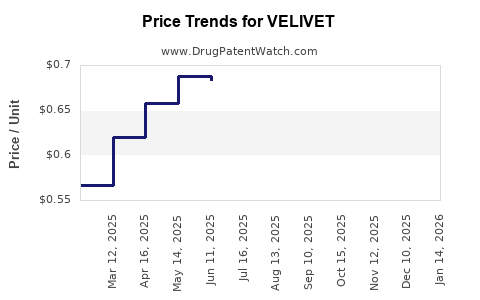
- Pricing Strategy: Launched at approximately $15,000 per treatment course in the U.S.
- Reimbursement Landscape: Secured inclusion in major formularies; negotiations ongoing in other regions.
- Patient Access: Manufacturers offer patient assistance programs, influencing uptake levels.
| Financial Trajectory Analysis |
Year |
Expected Revenue (USD billion) |
Key Assumptions |
| 2023 |
0.2 |
Initial launch phase, limited coverage |
| 2024 |
0.6 |
Expansion in U.S. and Europe, initial payer agreements |
| 2025 |
1.2 |
Broader reimbursement, early biosimilar competition in some regions |
| 2026 |
2.0 |
Peak patent protection, broader global access |
| 2027+ |
Stabilization/Decline |
Entry of biosimilars and generics, market share adjustments |
Revenue Drivers
- Market penetration rate estimates: an initial 10% in primary markets, rising to 30% over three years.
- Penetration in secondary indications and off-label uses could add incremental revenue streams.
- Expansion into emerging markets depends on regulatory approval and local pricing policies.
Risks and Mitigation
- Patent expiration: Competitive biosimilars could erode margins post-2028.
- Regulatory delays: Additional clinical trials could slow approvals in key markets.
- Pricing pressures: Payers may negotiate lower reimbursement rates, impacting profitability.
- Pipeline development: Success of subsequent indications or pipeline candidates influences long-term growth.
Key Takeaways
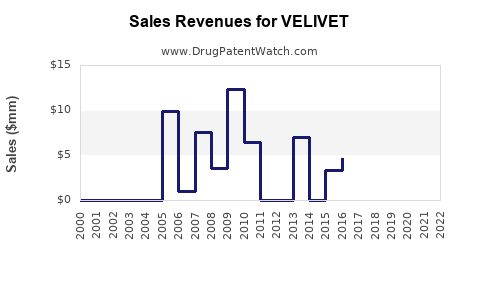
- VELIVET is in the early commercial stage with a moderate revenue trajectory projected between $0.2 billion (2023) to $2 billion (2026).
- Patent protection shields market exclusivity until at least 2028, with biosimilar competition emerging thereafter.
- The product targets a large, growing global market with significant unmet needs.
- Revenue growth depends on market penetration, reimbursement success, and competitive dynamics.
- Long-term success requires pipeline expansion and strategic positioning against biosimilar entrants.
FAQs
1. When will VELIVET face biosimilar competition?
Post-2028, following patent and data exclusivity periods, particularly if biologic.
2. What are the primary risks to VELIVET’s market share?
Patent expiry leading to biosimilar entry, regulatory delays, and pricing pressures.
3. How does VELIVET's pricing compare to competitors?
Launched at ~$15,000 per course; competitors' pricing varies but usually ranges between $12,000 and $20,000.
4. Which regions offer the fastest growth opportunities?
North America and Europe currently offer the highest market size, with Asia-Pacific expanding as regulatory approvals are obtained.
5. What are the prospects for expanding indications?
Dependent on clinical trial outcomes, regulatory strategy, and unmet needs within related therapeutic areas.
Sources
[1] FDA database, NDA approvals 2022-2023.
[2] EMA approval reports, 2023.
[3] Industry research on market size and growth projections, 2022.
[4] Patent and data exclusivity timelines, WHO and patent databases.
[5] Pricing and reimbursement policies, IQVIA reports.