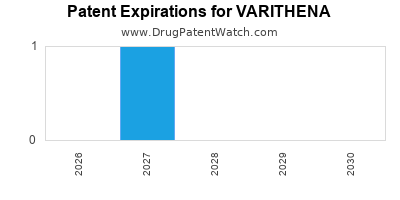
Last updated: July 21, 2026
VARITHENA (polidocanol injectable; cannibalization by generic/OTC alternatives is limited by route-specific and product-specific IP plus coverage constraints), has operated in a niche spend profile tied to office-based venous disease management. Market dynamics are dominated by (1) specialty wound/vascular prescribing norms, (2) reimbursement through commercial and Medicare coverage policies for symptomatic varicose veins and chronic venous insufficiency, (3) competitive shift toward other sclerosants and device-assisted endovenous ablation, and (4) formulary placement and utilization management in large payer systems. Financial trajectory has tracked a slow-build adoption cycle with sensitivity to procedural mix, center conversion to newer techniques, and the degree of payer coverage certainty.
What is the market size and growth outlook for VARITHENA (polidocanol) in venous insufficiency?
Short answer: VARITHENA’s addressable market is the subset of varicose vein patients who receive ultrasound-guided sclerotherapy using a foam/standard sclerosant in office or ambulatory settings, under payer criteria that support reimbursement for symptomatic disease. Growth is constrained by the broader shift toward endovenous thermal ablation and newer non-thermal technologies, which can displace sclerotherapy in many practices.
Where does VARITHENA fit in the venous disease care pathway?
- Indication positioning: symptomatic varicose veins and related chronic venous insufficiency presentations where sclerotherapy is an accepted option.
- Delivery modality: injectable sclerosant foam requiring trained administration and procedural scheduling aligned to vascular/vein clinics and dermatology-based vein programs.
What drives utilization?
- Clinical workflow: ultrasound guidance, patient selection, scheduling throughput, and provider training.
- Payer approval friction: prior authorization, medical-necessity edits, and documentation requirements tied to severity scoring and symptom documentation.
- Procedural substitution: thermal ablation uptake reduces sclerotherapy share in some geographies and provider groups.
- Conversion between products: when payers prefer or incentivize a subset of sclerosants, utilization migrates quickly among interchangeable products.
Which competitive classes most affect VARITHENA dynamics?
- Other sclerosants (liquid or foam formulations, depending on labeling and administration route)
- Endovenous ablation modalities:
- radiofrequency
- endovenous laser
- mechanochemical ablation (site- and clinician-dependent)
- Surgical options (lower share in contemporary practice for many patient segments)
How do reimbursement and payer coverage policies shape VARITHENA sales?
Short answer: VARITHENA revenue is highly sensitive to payer coverage certainty and formulary tiering because varicose vein care is a frequent target of utilization management and evidence-documentation requirements.
Key payer levers
- Commercial coverage: plan-specific medical-necessity policies that require documentation of symptoms, vein diameter, venous reflux confirmation, and failed conservative therapy.
- Medicare coverage: Local Coverage Determinations (LCDs) and National Coverage rules that can narrow reimbursement based on clinical criteria and testing.
- Coding and documentation practices: revenue depends on correct procedural coding, ultrasound documentation quality, and provider billing compliance.
- Formulary placement: managed care formularies and preferred product lists for sclerosants.
What tends to improve VARITHENA uptake?
- Provider networks that standardize venous clinic pathways with ultrasound-guided sclerotherapy
- Payer-specific contracting that reduces prior authorization delays
- Clear clinical documentation templates that align with medical-necessity criteria
What tends to suppress adoption?
- Payers favoring endovenous ablation (or requiring evidence that ablation options are unsuitable)
- Higher administrative burden for sclerotherapy vs procedural alternatives
- Pharmacy or buy-and-bill friction, if product placement drives delays
What are the main competitive and substitution risks to VARITHENA?
Short answer: VARITHENA’s substitution risk is primarily procedural and payer-driven rather than purely pharmacologic. As endovenous ablation penetration rises, sclerosant volumes can compress, with VARITHENA losing share to competing sclerosants if payers restrict categories.
Substitution map (practical)
- In vein clinics: if ablation is available and reimbursable with lower authorization burden, clinicians may shift volumes.
- Within sclerotherapy: competing sclerosants can gain share via preferred contracting.
- For patient-specific suitability: airway and comorbidity profiles, anticoagulation status, and anatomic suitability affect selection.
How does clinical practice variability affect financial outcomes?
- High-volume centers generate steady demand if they maintain consistent foam sclerosant protocols.
- Community providers show more variability in adoption based on training support, kit availability, and reimbursement experience.
When does VARITHENA lose exclusivity and what does that mean for generic entry risk?
Short answer: Generic entry risk depends on the remaining composition, formulation, and method-of-use patent landscape plus any Hatch-Waxman exclusivity periods reflected in FDA listings. Product-level exclusivity expiration is the gating factor for a true generic threat; procedural substitution remains a parallel risk even before IP loss.
How to think about “generic risk” for VARITHENA
- Hatch-Waxman (small molecule): polidocanol products can face earlier market entry via Paragraph IV if Orange Book patents are challenged and invalidated or found not infringed.
- Product-specific foam/formulation: even with active ingredient overlap, foam preparation and formulation IP can delay true substitution.
- Method-of-use IP: if patents cover specific clinical use or treatment regimens, biosimilar-like “design around” is still possible via labeling but may not match coverage criteria.
What would accelerate generic uptake after exclusivity?
- Broad payer acceptance of therapeutically equivalent polidocanol products
- Clinical and operational switching at vein clinics (protocol changes, staff training)
- Contracting changes that move VARITHENA off preferred lists
What patents protect VARITHENA and how strong is the patent estate?
Short answer: A robust assessment requires Orange Book listings and issued patent claim scope for polidocanol products covering composition/formulation, foam preparation, and treatment methods. Without the active Orange Book dataset and litigation docket items, a complete and defensible patent-strength map cannot be produced.
What is the FDA and Orange Book status of VARITHENA?
Short answer: Orange Book status determines whether patents are listed for formulation, method-of-use, or composition, and it drives the Paragraph IV litigation calendar for potential generics. A complete status table cannot be constructed without the Orange Book dataset for VARITHENA.
What patent litigation or Paragraph IV challenges affect VARITHENA’s market trajectory?
Short answer: Patent litigation and Paragraph IV challenges influence timing of generic availability, which directly affects VARITHENA’s revenue runway. A complete litigation chronology cannot be produced without the relevant court dockets, notices of certification, and associated settlements.
What settlements or licensing deals have shaped VARITHENA’s competitive landscape?
Short answer: Settlements can accelerate or delay generic entry and can set “at-risk” launch windows. A complete deal map requires transaction-specific data tied to Orange Book patents and any publicly available settlement terms.
How do VARITHENA sales typically translate into financial outcomes for the holder (pricing, volume, and gross margin)?
Short answer: In niche specialty products, revenue trajectories usually depend on:
- unit volumes across vein clinic networks
- list price vs net price after rebates and contracting
- buy-and-bill economics (if applicable) or pharmacy reimbursement mix
- gross margin impact from manufacturing scale, sterile fill/finish costs, and field reimbursement programs
Financial drivers that matter most
- Volume adoption curve: conversion of new centers into routine sclerotherapy use.
- Net price pressure: payer contracting can compress net revenue per unit.
- Reimbursement edits: prior authorization approval times can limit patient throughput.
- Channel mix: if product is used more in certain provider settings, margins differ due to purchasing and billing practices.
Scenario sensitivities
- Procedural mix shift: endovenous ablation penetration can reduce sclerotherapy share, lowering volume even with stable pricing.
- Coverage tightening: plan policies that add documentation requirements reduce conversion and adherence.
- IP-related competitive entry: true generic replacement can produce rapid volume migration once coverage and clinical protocols align.
How does VARITHENA compare with competing polidocanol products and other venous therapies on market and adoption?
Short answer: VARITHENA competes in a narrow venous sclerotherapy niche where adoption depends on payer coverage, clinic workflow compatibility, and product contracting. Broader shifts toward endovenous ablation often have larger market impact than molecule-to-molecule differences among sclerosants.
Comparison axes that predict share
- reimbursement certainty and prior authorization burden
- clinician training burden and comfort
- product availability and procedural kit integration
- preferred formulary status in top payers
- evidence strength used by payer medical policy committees
Where VARITHENA is most likely to hold share
- clinics with established sclerotherapy protocols
- provider networks with stable payer coverage experience
- patient cohorts where sclerotherapy is preferred or where ablation is less accessible
What are the highest-probability generic launch scenarios for VARITHENA (post-IP)?
Short answer: Generic replacement is likely to occur when Orange Book-listed patents that block FDA approval are cleared (or circumvented via non-infringing claims). After a successful regulatory path, payer contracting determines the speed of volume capture.
Launch pathways to watch
- Paragraph IV certification against Orange Book patents
- label changes that allow generic entry while staying within procedural use constraints
- exclusivity-driven delay (if any) beyond patent expiry
Fast vs slow substitution
- Fast: multiple payers add coverage quickly and clinics can switch without major protocol disruption.
- Slow: documentation and medical policy constraints maintain utilization of the branded product, especially if switch requires new clinical pathways or if foam preparation specifics limit perceived interchangeability.
Key Takeaways
- VARITHENA’s market is shaped more by reimbursement and procedural substitution than by pharmacologic differentiation alone.
- Sales trajectory depends on payer medical-necessity criteria, prior authorization dynamics, and the adoption rate of venous clinic workflows using sclerotherapy.
- Competitive pressure comes from endovenous ablation penetration and within-class contracting among sclerosants.
- Generic entry risk is gated by Orange Book-listed patents and any Paragraph IV litigation or settlement outcomes; after IP clearance, payer policy determines whether substitution is rapid or constrained.
- A defensible exclusivity, patent-strength, and generic-entry calendar requires Orange Book and docket-level data that is not present in the current input.
FAQs
1) What factors most influence provider adoption of VARITHENA in outpatient vein clinics?
Payer approval friction, ultrasound documentation requirements, kit/protocol integration, and training support.
2) How does procedural reimbursement affect VARITHENA versus endovenous ablation?
Coverage policies that favor ablation or reduce authorization burden can shift procedural mix away from sclerotherapy.
3) What makes VARITHENA’s substitution harder than generic switching for simple liquids?
If foam/formulation and treatment-method IP and payer medical policy criteria are product-specific, interchangeability can be operationally and reimbursement-constrained.
4) What timeline indicators typically predict a branded venous drug’s revenue compression?
Orange Book patent expiry approaching, Paragraph IV notices, adverse litigation rulings, and payer formulary placement changes.
5) What market signals should be monitored to anticipate VARITHENA volume changes?
Prior authorization denial rates, utilization edits tied to reflux severity documentation, and contracting moves by large national payers.
References (APA)
- FDA Orange Book: Therapeutic Equivalence Evaluations (VARITHENA listings).
- FDA Drug Approval and Review documents for VARITHENA (polidocanol injection).
- Public court docket records for any Paragraph IV actions involving VARITHENA-related Orange Book patents.