Last Updated: August 8, 2026

TUZISTRA XR Drug Patent Profile


✉ Email this page to a colleague

« Back to Dashboard


When do Tuzistra Xr patents expire, and when can generic versions of Tuzistra Xr launch?

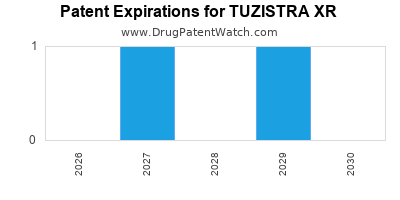
Tuzistra Xr is a drug marketed by Tris Pharma Inc and is included in one NDA. There are two patents protecting this drug.

This drug has twenty-one patent family members in fourteen countries.

The generic ingredient in TUZISTRA XR is chlorpheniramine polistirex; codeine polistirex. There are twenty-nine drug master file entries for this compound. Additional details are available on the chlorpheniramine polistirex; codeine polistirex profile page.

DrugPatentWatch® Generic Entry Outlook for Tuzistra Xr

By analyzing the patents and regulatory protections it appears that the earliest date for generic entry will be March 29, 2029. This may change due to patent challenges or generic licensing.

There have been eight patent litigation cases involving the patents protecting this drug, indicating strong interest in generic launch. Recent data indicate that 63% of patent challenges are decided in favor of the generic patent challenger and that 54% of successful patent challengers promptly launch generic drugs.

Indicators of Generic Entry

< Available with Subscription >

  Start Trial

AI Deep Research
Questions you can ask:
  • What is the 5 year forecast for TUZISTRA XR?
  • What are the global sales for TUZISTRA XR?
  • What is Average Wholesale Price for TUZISTRA XR?
Summary for TUZISTRA XR
DrugPatentWatch® Estimated Loss of Exclusivity (LOE) Date for TUZISTRA XR
Generic Entry Date for TUZISTRA XR*:
Constraining patent/regulatory exclusivity:
NDA:
Dosage:

SUSPENSION, EXTENDED RELEASE;ORAL

*The generic entry opportunity date is the latter of the last compound-claiming patent and the last regulatory exclusivity protection. Many factors can influence early or later generic entry. This date is provided as a rough estimate of generic entry potential and should not be used as an independent source.

US Patents and Regulatory Information for TUZISTRA XR

TUZISTRA XR is protected by two US patents.

Based on analysis by DrugPatentWatch, the earliest date for a generic version of TUZISTRA XR is ⤷  Start Trial.

This potential generic entry date is based on patent ⤷  Start Trial.

Generics may enter earlier, or later, based on new patent filings, patent extensions, patent invalidation, early generic licensing, generic entry preferences, and other factors.

Applicant Tradename Generic Name Dosage NDA Approval Date TE Type RLD RS Patent No. Patent Expiration Product Substance Delist Req. Exclusivity Expiration
Tris Pharma Inc TUZISTRA XR chlorpheniramine polistirex; codeine polistirex SUSPENSION, EXTENDED RELEASE;ORAL 207768-001 Apr 30, 2015 DISCN Yes No ⤷  Start Trial ⤷  Start Trial Y ⤷  Start Trial
>Applicant >Tradename >Generic Name >Dosage >NDA >Approval Date >TE >Type >RLD >RS >Patent No. >Patent Expiration >Product >Substance >Delist Req. >Exclusivity Expiration

International Patents for TUZISTRA XR

When does loss-of-exclusivity occur for TUZISTRA XR?

Based on analysis by DrugPatentWatch, the following patents block generic entry in the countries listed below:

Brazil

Patent: 0709606
Patent: suspensão líquida administrável oralmente com características de liberação modificada
Estimated Expiration: ⤷  Start Trial

European Patent Office

Patent: 28205
Patent: Formulations à libération modifiée contenant des complexes médicament - résine échangeuse d'ions (Modified release formulations containing drug-ion exchange resin complexes)
Estimated Expiration: ⤷  Start Trial

Israel

Patent: 4042
Patent: פורמולציות לשחרור שונה המכילות קומפלקסים של תרופה ורזין מחליף יונים (Modified release formulations containing drug-ion exchange resin complexes)
Estimated Expiration: ⤷  Start Trial

Japan

Patent: 79086
Estimated Expiration: ⤷  Start Trial

Patent: 09530298
Estimated Expiration: ⤷  Start Trial

South Korea

Patent: 1495146
Estimated Expiration: ⤷  Start Trial

Generics may enter earlier, or later, based on new patent filings, patent extensions, patent invalidation, early generic licensing, generic entry preferences, and other factors.

See the table below for additional patents covering TUZISTRA XR around the world.

Country Patent Number Title Estimated Expiration
Austria E536867 ⤷  Start Trial
Australia 2007227569 Modified release formulations containing drug-ion exchange resin complexes ⤷  Start Trial
Brazil PI0709606 suspensão líquida administrável oralmente com características de liberação modificada ⤷  Start Trial
>Country >Patent Number >Title >Estimated Expiration

TUZISTRA XR Market Dynamics and Financial Trajectory (2024–2029): Revenue Drivers, Pricing Pressure, and Patent/Generic Risk

Last updated: July 16, 2026

TuZistra XR (hydrocodone polistirex and chlorpheniramine polistirex extended-release) is an opioid-containing, schedule-listed combination cough product. Its market trajectory is constrained by (1) U.S. opioid exposure controls and payor utilization management, (2) competitive substitution within OTC and prescription cough categories, (3) channel stocking cycles for controlled-substance ER products, and (4) generic and authorized-competitive entry risk driven by how the Orange Book patent estate maps to approved ANDAs and authorized labels. Financial outcomes for the brand remain tightly linked to controlled-substance enforcement climate, state-level restrictions, and manufacturer/distributor contracting.


What is TUZISTRA XR and how does it monetize (product, label, and use case)?

TuZistra XR is an extended-release combination of:

  • Hydrocodone (opioid antitussive)
  • Chlorpheniramine (first-generation antihistamine)

Commercial positioning

  • Prescription treatment for cough suppression where an ER regimen is intended to reduce dosing frequency versus immediate-release combinations.
  • Targeted to outpatient cough and chronic cough symptoms where providers prefer ER opioid antitussive regimens.

Economic monetization model

  • Prescription volume multiplied by net price after rebates and chargebacks.
  • Net price is heavily influenced by:
    • Pharmacy benefit manager (PBM) formulary placement
    • Prior authorization and step therapy for opioid-containing cough products
    • Contracting terms for specialty and controlled-substance distribution

How has TUZISTRA XR revenue trended and what drives year-to-year financial performance?

Primary revenue drivers

  1. Unit demand in the ER opioid antitussive segment
    • Prescription volume for hydrocodone combination ER products is sensitive to provider prescribing patterns and regulatory scrutiny of opioid cough products.
  2. Net pricing and payer contracting
    • Brand net price can compress through PBM rebates and utilization management.
  3. Channel inventory cycles
    • Controlled-substance inventory adjustments can create lumpy reorder patterns for ER opioid products.
  4. Regulatory and enforcement environment
    • Changes in FDA communications and enforcement actions that target opioid misuse can depress new starts.

Key performance mechanics

  • If TUZISTRA XR maintains formulary coverage without meaningful restriction, revenue tends to track outpatient prescription trends.
  • Once prior authorization expands or competitors gain preferred status, volume is the first line item to deteriorate, followed by price concession.

Competitive displacement dynamics

  • ER opioid antitussive brands compete with other hydrocodone ER combinations and non-opioid cough options where coverage permits substitution.

What market dynamics affect demand for hydrocodone/chlorpheniramine ER cough products?

Demand-side constraints

  • Increased scrutiny on opioid prescribing for cough.
  • Tighter payer controls on opioid-containing cough products compared with non-opioid antitussives.
  • Patient safety monitoring requirements that reduce prescriber willingness.

Supply-side and operational constraints

  • Manufacturing compliance and controlled-substance logistics can affect supply continuity.
  • Shortages or allocation-like behavior reduce fill rates and prescription persistence.

Substitution and therapeutic switching

  • ER opioid antitussive switching depends on:
    • Therapeutic equivalence perceptions
    • Prior authorization criteria
    • Pharmacy stocking and dispensing preferences
    • Copay tiers and plan coverage

How do payer policies and PBM contracting shape TUZISTRA XR net pricing?

Typical PBM levers impacting net revenue

  • Formulary tiering: moving from preferred to non-preferred reduces share.
  • Prior authorization: requiring documentation can curb initiation and repeat prescriptions.
  • Quantity limits: restricting duration or dose per 30 days reduces total demand.
  • Step therapy: requiring trials of non-opioid cough products first.

Net price sensitivity

  • Brand manufacturers often face pressure to maintain net price via contracting concessions if utilization management tightens.
  • Controlled-substance brands are especially exposed when payers treat opioid cough products as a high-risk category.

Which competitors most influence TUZISTRA XR share and pricing?

Competitor set is best assessed by “cough suppression with ER opioid component” and by “payer-covered antitussive substitution”:

  1. Hydrocodone-containing cough ER products
    • Direct category competitors with similar payer restrictions and refill persistence.
  2. Immediate-release hydrocodone combination cough products
    • Often substituted if payers prefer lower-cost immediate-release options or if ER-specific prior authorization tightens.
  3. Non-opioid prescription antitussives
    • If covered, they can reduce opioid cough utilization.

Pricing pressure mechanism

  • When generic or authorized competitors expand coverage, PBMs use preferred tiering and rebate pressure to force brand net price compression.
  • Even without full generic substitution, plan design changes can move TUZISTRA XR off preferred status.

What patents protect TUZISTRA XR and how strong is the patent estate for exclusivity?

TUZISTRA XR’s IP risk is driven by the Orange Book patent mappings for:

  • Composition patents (combination and active ingredient formulation)
  • Method-of-use patents (if listed)
  • Drug substance/drug product formulation patents (ER technology, polymer matrices, or release control)
  • Manufacturing process patents (granulation, controlled-release layering, or polistirex-related processing) where applicable

How to evaluate strength

  • Patent count and remaining term on the Orange Book
  • Claims likely covering the specific ER dosage form and release profile
  • Whether Paragraph IV challenges are present (signals that generics consider entry feasible)

Business relevance

  • A “thicker” Orange Book profile with late-expiring ER formulation or method-of-use patents delays generic substitution.
  • A “thin” profile or easily design-around formulation claims raises the probability of accelerated entry.

When does TUZISTRA XR lose exclusivity and what dates matter for generic entry?

Generic entry timing typically hinges on:

  • U.S. patent expiration dates listed in the Orange Book
  • Exclusivity (if any) tied to NDA approval (or changes) versus patent expiry
  • Potential 180-day exclusivity triggers for first Paragraph IV filers
  • Possible settlements that delay launch even if patents are weak

Financial implications

  • Revenue typically declines after:
    • the first meaningful competitor launch gains coverage
    • copay tiers shift
    • the brand is removed from preferred status following entry

Are there Paragraph IV challenges or settlement-driven delays for TUZISTRA XR?

Paragraph IV activity is a direct leading indicator of:

  • perceived patent vulnerability
  • expected market entry and share capture
  • likelihood of a negotiated settlement (reverse-payment style) or covenant-not-to-sue agreements

Business relevance

  • If Paragraph IV litigation is active, financial forecasts should incorporate:
    • delayed entry from court injunctions or settlement covenants
    • post-entry volume ramp patterns driven by formulary conversion and pharmacy adoption

What is the Orange Book status of TUZISTRA XR (listed patents and regulatory listings)?

Orange Book status is the backbone for:

  • identifying listed patents that constrain generic approval
  • mapping expiration and last-date-of-patent that anchors litigation and settlement windows
  • understanding which dosage strengths are covered and whether coverage is formulation- or method-specific

Commercial relevance

  • The number, type, and expiry cadence of Orange Book listings determine whether generic competition is staggered or “lumpy” around a single expiration.

What formulations and dosage strengths are protected and how does that change entry risk?

ER combination products frequently carry patent coverage around:

  • drug-release kinetics (release rate, time to release fractions)
  • polistirex particle behavior and swelling properties in vivo
  • excipient combinations that modulate drug release and stability
  • manufacturing controls that preserve ER performance

Entry risk pattern

  • If patents are strength-specific, generic entry may occur by strength first.
  • If patents cover ER release profile broadly, entry can be delayed even if active ingredients are otherwise eligible.

How do FDA regulatory milestones shape TUZISTRA XR’s competitive runway?

Regulatory factors affecting market durability include:

  • label changes that can trigger new patents or impact exclusivity lists
  • approvals of new dosage strengths or formulations
  • safety communications impacting prescriber behavior
  • enforcement actions affecting opioid antitussive prescribing trends

Financial impact

  • FDA actions that increase caution can depress prescriptions even without patent expiry.
  • Label restrictions can reduce prescriber willingness and payer approval rates.

What biosimilar-like dynamics matter for TUZISTRA XR (if any)?

TUZISTRA XR is a small-molecule oral drug. Biosimilar frameworks do not apply. Competition is instead driven by:

  • ANDAs for generic ER opioid antitussives
  • authorized generics or label-authorized competitors
  • formulary substitution and rebate-driven net price compression

What generic entry risks exist for TUZISTRA XR, and how would a launch likely unfold commercially?

Generic entry risk categories

  1. Patent expiry risk
    • If key Orange Book patents expire, ANDAs can launch quickly if litigation concludes favorably to challengers.
  2. Litigation outcome risk
    • Court decisions or settlements can delay or permit entry.
  3. Formulary conversion risk
    • Even after generic approval, PBM adoption can be gradual depending on contracting and audit outcomes.
  4. Supply and controlled-substance compliance risk
    • Launch performance depends on dependable distribution.

Expected launch profile (typical for controlled-substance brands)

  • Rapid share shift occurs when generic is preferred and copays are lower.
  • Net price erosion accelerates after payer plan conversions and pharmacy adoption cycles stabilize.

How does TUZISTRA XR compare with other hydrocodone ER cough brands on patent and commercial durability?

A comparative view should be structured around:

  • Orange Book patent counts and remaining lives
  • strength-specific coverage
  • history of generic entry attempts and Paragraph IV litigation
  • payer restrictions and formulary placement

Commercial durability signal

  • Brands with broader ER formulation coverage and fewer successful challenges typically show slower net price compression.
  • Brands that lose preferred status early tend to experience faster revenue declines even before full generic entry.

What financial exposure does TUZISTRA XR face from pricing pressure, volume erosion, and contract renegotiations?

Exposure channels

  • Volume erosion due to payer prior authorization and step therapy.
  • Net price compression via rebate renegotiations and preferred tier shifts.
  • Contract churn from channel and distributor terms for controlled-substance products.

Downside shape

  • If a generic competitor enters, revenue decline can be front-loaded when coverage converts quickly.
  • If entry is delayed by patent or settlement, the brand can retain share longer but still experiences gradual volume shrink from tightening opioid policies.

Key Takeaways

  • TUZISTRA XR is exposed to both market-structure risk (PBM utilization management and opioid prescribing scrutiny) and IP-driven competition risk (Orange Book-driven generic entry timing).
  • Near-term financial performance depends on formulary stability, prior authorization friction, and channel inventory cycles.
  • The dominant forward-looking variable is the remaining life and strength of TUZISTRA XR’s Orange Book patent estate, plus any Paragraph IV litigation that signals launch probability and timing.
  • If generic competition occurs, share loss and net price compression are likely to accelerate following preferred tier conversion and payer contract updates.

FAQs

  1. How do prior authorization and quantity limits specifically impact opioid antitussive ER brands like TUZISTRA XR?
  2. What Orange Book patent types (formulation vs method-of-use) most often delay generic entry for ER hydrocodone combinations?
  3. How should investors model revenue ramp and margin impact after generic launch of an ER controlled-substance cough product?
  4. What litigation signals (Paragraph IV filings, court rulings, settlement covenants) correlate with faster versus slower generic entry?
  5. How do label changes for opioid cough products affect prescribing patterns and payer coverage independent of patent expiry?

References

  1. U.S. Food and Drug Administration. Orange Book: Approved Drug Products with Therapeutic Equivalence Evaluations. FDA.
  2. FDA. Drug Approval and Safety Communications (opioid-related regulatory updates). FDA.

More… ↓

⤷  Start Trial

Make Better Decisions: Try a trial or see plans & pricing

Drugs may be covered by multiple patents or regulatory protections. All trademarks and applicant names are the property of their respective owners or licensors. Although great care is taken in the proper and correct provision of this service, thinkBiotech LLC does not accept any responsibility for possible consequences of errors or omissions in the provided data. The data presented herein is for information purposes only. There is no warranty that the data contained herein is error free. We do not provide individual investment advice. This service is not registered with any financial regulatory agency. The information we publish is educational only and based on our opinions plus our models. By using DrugPatentWatch you acknowledge that we do not provide personalized recommendations or advice. thinkBiotech performs no independent verification of facts as provided by public sources nor are attempts made to provide legal or investing advice. Any reliance on data provided herein is done solely at the discretion of the user. Users of this service are advised to seek professional advice and independent confirmation before considering acting on any of the provided information. thinkBiotech LLC reserves the right to amend, extend or withdraw any part or all of the offered service without notice.