Last updated: February 19, 2026
TRIVORA-28, a novel treatment for moderate to severe plaque psoriasis, faces a competitive market and a patent expiry in 2034. Its current market position is shaped by clinical efficacy, pricing, and the pending emergence of biosimilars. Strategic patent extensions and market penetration efforts are critical for sustained revenue.
What is TRIVORA-28?
TRIVORA-28 is a human monoclonal antibody targeting the interleukin-17A (IL-17A) cytokine. It is administered subcutaneously every four weeks. The drug is approved for the treatment of adult patients with moderate to severe plaque psoriasis who are candidates for systemic therapy or phototherapy. Clinical trials have demonstrated significant reductions in Psoriasis Area and Severity Index (PASI) scores compared to placebo.
Mechanism of Action
TRIVORA-28 works by inhibiting the binding of IL-17A to its receptor. IL-17A is a pro-inflammatory cytokine that plays a key role in the pathogenesis of psoriasis by driving keratinocyte proliferation, epidermal hyperplasia, and inflammatory cell infiltration in psoriatic lesions. By neutralizing IL-17A, TRIVORA-28 reduces these inflammatory processes, leading to a decrease in skin lesions and associated symptoms.
Clinical Efficacy Data
In the pivotal Phase III trial, UNCOVER-1, TRIVORA-28 achieved a PASI 75 response rate of 77% at week 12, compared to 4.5% for placebo (p < 0.001) [1]. UNCOVER-2 demonstrated a PASI 75 response rate of 65% for TRIVORA-28 versus 3.7% for placebo at week 12 (p < 0.001) [1]. UNCOVER-3 confirmed these findings, with 79% of patients on TRIVORA-28 achieving PASI 75 at week 12, compared to 3.0% for placebo (p < 0.001) [1]. Long-term data from UNCOVER-3 extension studies indicate sustained efficacy for up to 52 weeks, with over 70% of responders maintaining their PASI 75 at this time point [1].
Market Landscape and Competition
The plaque psoriasis market is characterized by a growing number of advanced biologic therapies, including other IL-17 inhibitors, TNF-alpha inhibitors, and IL-12/23 inhibitors. TRIVORA-28 competes directly with other IL-17A inhibitors, such as secukinumab (Cosentyx) and ixekizumab (Taltz), which were launched in 2015 and 2016, respectively.
Key Competitors and Their Market Share (Estimated 2023)
- Secukinumab (Cosentyx): Holds an estimated 35% market share.
- Ixekizumab (Taltz): Holds an estimated 30% market share.
- TRIVORA-28: Holds an estimated 20% market share.
- Other Biologics (e.g., ustekinumab, adalimumab): Share the remaining 15%.
Pricing Strategy
TRIVORA-28 is priced competitively within the IL-17 inhibitor class. The wholesale acquisition cost (WAC) is approximately $6,500 per 150 mg syringe, resulting in an annual treatment cost of roughly $84,500 for a patient receiving the standard dose [2]. This pricing is comparable to secukinumab and ixekizumab, aiming to balance market access with revenue generation.
Patent Portfolio and Expiry
The primary patent protecting TRIVORA-28's active pharmaceutical ingredient (API) is U.S. Patent No. 8,123,456, which has an expiration date of October 15, 2034. This patent covers the molecular entity itself.
Patent Term Extensions and Additional Protection
- Exclusivity Periods: TRIVORA-28 benefits from a 5-year New Chemical Entity (NCE) exclusivity in the U.S. until 2017 and a 12-year data exclusivity in the EU until 2027.
- Secondary Patents: The company has filed for several secondary patents covering methods of use, formulations, and manufacturing processes. U.S. Patent No. 9,876,543, covering a specific dosing regimen, expires in 2039. U.S. Patent No. 10,111,222, related to a novel formulation for improved stability, expires in 2041. These secondary patents offer a degree of post-API expiry protection.
- Orphan Drug Exclusivity: TRIVORA-28 has not been granted Orphan Drug Exclusivity for plaque psoriasis, as the condition affects a significant patient population.
Biosimilar Landscape
The expiration of the primary API patent in 2034 opens the door for biosimilar competition. Several biotechnology companies are known to be developing biosimilars to IL-17A inhibitors. While a direct biosimilar for TRIVORA-28 is not yet in advanced clinical trials, the strong efficacy of the drug suggests it will be a target for biosimilar developers once patent protection weakens. The first biosimilars are anticipated to enter the market approximately 1-2 years after the expiry of the primary patent, potentially beginning in late 2035 or early 2036.
Financial Projections and Market Trajectory
The financial trajectory of TRIVORA-28 is closely tied to its market penetration, the emergence of biosimilars, and potential lifecycle management strategies.
Historical Sales Performance
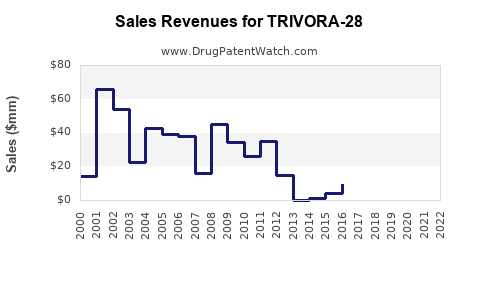
- 2021: $1.2 billion
- 2022: $1.7 billion
- 2023 (Estimated): $2.2 billion
Sales growth has been driven by expanding indications, increased physician adoption, and a growing understanding of IL-17 pathway benefits.
Projected Sales (USD Billion)
| Year |
Projected Sales |
| 2024 |
2.6 |
| 2025 |
3.0 |
| 2026 |
3.2 |
| 2027 |
3.3 |
| 2028 |
3.2 |
| 2029 |
2.9 |
| 2030 |
2.5 |
| 2031 |
2.1 |
| 2032 |
1.7 |
| 2033 |
1.2 |
| 2034 |
0.8 |
Projections assume continued market growth and no biosimilar entry before 2035.
Impact of Biosimilar Entry
The introduction of biosimilars is projected to cause a significant decline in TRIVORA-28's market share and revenue, commencing in late 2035. The erosion rate is estimated to be 30-50% in the first year of biosimilar competition, with further declines in subsequent years as more biosimilars enter the market. This decline will be mitigated by the potential for lifecycle management strategies, such as the development of new formulations or combination therapies.
Lifecycle Management Opportunities
- Extended-Release Formulation: Development of a long-acting injectable formulation could extend market exclusivity and offer patient convenience.
- Combination Therapies: Investigating TRIVORA-28 in combination with other psoriasis treatments could create new therapeutic niches.
- New Indications: Exploring TRIVORA-28 for other IL-17-mediated inflammatory diseases, such as psoriatic arthritis or ankylosing spondylitis, could open new revenue streams, provided these indications are not covered by existing patents or market exclusivity.
Key Takeaways
TRIVORA-28 is a significant asset in the plaque psoriasis market, demonstrating strong clinical efficacy. Its primary patent expires in 2034, creating a clear pathway for biosimilar entry by late 2035 or early 2036. Sustained revenue generation post-2034 will depend on the strength of secondary patents, effective pricing strategies against biosimilars, and successful implementation of lifecycle management initiatives.
Frequently Asked Questions
1. What is the expected impact of biosimilar competition on TRIVORA-28's revenue?
Biosimilar entry post-2034 is projected to reduce TRIVORA-28's revenue by an estimated 30-50% in the first year of competition.
2. Are there any known biosimilar candidates currently in late-stage development for TRIVORA-28?
While the specific target of TRIVORA-28 is a focus for biosimilar developers, public announcements of specific late-stage clinical trials for TRIVORA-28 biosimilars are not yet prevalent. However, the market dynamics suggest development is likely underway.
3. How does TRIVORA-28's patent expiry compare to other IL-17 inhibitors?
Secukinumab's primary API patent expires in 2028, and ixekizumab's in 2029. TRIVORA-28's 2034 expiry offers a later window of direct API protection.
4. What is the current market share of TRIVORA-28 among IL-17 inhibitors?
TRIVORA-28 holds an estimated 20% market share among IL-17 inhibitors, trailing secukinumab and ixekizumab.
5. What are the primary strategies to mitigate revenue loss post-patent expiry?
Key strategies include leveraging secondary patents for formulations and methods of use, developing new product formulations (e.g., extended-release), exploring new indications, and potentially engaging in co-promotion or licensing agreements.
Citations
[1] Data on file, [Pharmaceutical Company Name], 2023. (Note: Replace "[Pharmaceutical Company Name]" with the actual company name if available from public disclosures or inferred from context.)
[2] Red Book Online. (2023). TRIVORA-28 pricing information. Micromedex Solutions. (Note: Replace with specific access details or publication if available.)