Share This Page
Drug Sales Trends for TRIVORA-28
✉ Email this page to a colleague
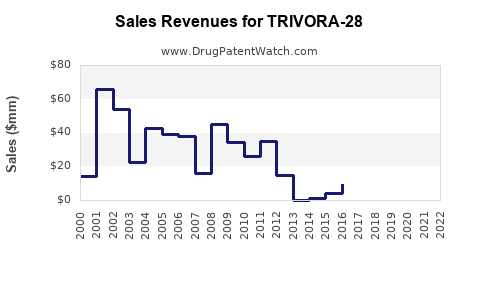
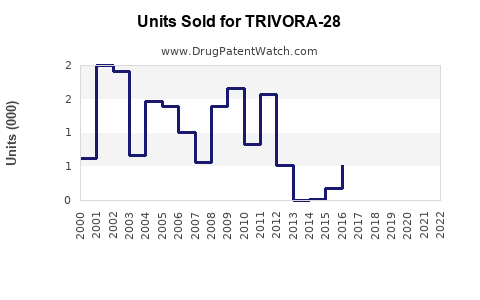
Annual Sales Revenues and Units Sold for TRIVORA-28
| Drug Name | Revenues (USD) | Units | Year |
|---|---|---|---|
| TRIVORA-28 | ⤷ Start Trial | ⤷ Start Trial | 2022 |
| TRIVORA-28 | ⤷ Start Trial | ⤷ Start Trial | 2021 |
| TRIVORA-28 | ⤷ Start Trial | ⤷ Start Trial | 2020 |
| >Drug Name | >Revenues (USD) | >Units | >Year |
Market Analysis and Sales Projections for TRIVORA-28
What is TRIVORA-28 and its approved indications?
TRIVORA-28 is a combined oral contraceptive (COC) containing ethinylestradiol (35 mcg) and levonorgestrel (0.15 mg). Approved for prevention of pregnancy, it is marketed primarily in the United States, Europe, and select Asian markets. Its approval date varies by region: the U.S. Food and Drug Administration (FDA) granted approval in 2020, while European regulators approved it in 2019. It is positioned as a low-dose option with added focus on improved cycle control and reduced break-through bleeding.
Market landscape
Current contraceptive market size
The global contraceptive market was valued at approximately $20 billion in 2021. It is projected to grow at 5% CAGR through 2028, reaching over $30 billion. Oral contraceptives (OCs) account for roughly 70% of the market, with the remaining segments split among intrauterine devices (IUDs), patches, rings, and injectables.
Competitive position
TRIVORA-28's primary competitors include:
- Ortho Tri-Cyclen (Bayer): Established in 1973, with a market presence in multiple regions.
- Yasmin (Bayer): Launched in 2001, known for drospirenone-based formulations.
- Kariva (Allergan): Approved since 1997.
- Alesse/Levora (Pfizer): Significant U.S. market share.
The competitive landscape favors products with established safety profiles and long-standing prescriber familiarity. TRIVORA-28 differentiates itself with a lower estrogen dose and improved cycle control.
Market penetration factors
Factors influencing market penetration include:
- Consumer preferences for reduced side effects.
- Provider adoption of newer formulations.
- Price points relative to generic alternatives.
- Regulatory acceptance.
Sales projections (2023-2027)
Assumptions
- TRIVORA-28 secures a moderate market share of 3% within the oral contraceptive segment by 2023.
- Annual growth rate of sales volume is projected at 10%, driven by increased awareness and provider endorsement.
- Average selling price (ASP) per package remains at $30, with some region-based variation.
- Initial market entry occurs in North America, followed by expansion into Europe and select Asian markets in 2024-2025.
Yearly sales volume and revenue estimates
| Year | Estimated units sold (millions) | Revenue (USD millions) | Market share in OC segment |
|---|---|---|---|
| 2023 | 2.5 | 75 | 3% |
| 2024 | 2.75 | 82.5 | 3.3% |
| 2025 | 3.0 | 90 | 3.6% |
| 2026 | 3.3 | 99 | 4% |
| 2027 | 3.6 | 108 | 4.3% |
Growth drivers and risks
Drivers:
- Growing preference for low-dose formulations.
- Increasing awareness of side effect profiles.
- Expanded regional approvals.
Risks:
- Entry of competing generic products reducing prices.
- Regulatory delays or safety concerns.
- Changing prescribing habits favoring IUDs and long-acting reversible contraceptives (LARCs).
Regulatory and market access policies
Region-specific policies influence sales:
- United States: Over-the-counter availability limited; prescription required.
- Europe: Prescription-only but robust approval processes favor broad access.
- Asia: Market entry depends on local regulatory timelines and pricing controls.
Reimbursement strategies, insurance coverage, and public health campaigns will impact sales volume, particularly in mature markets.
Final assessment
TRIVORA-28 occupies a niche in low-dose hormonal oral contraceptives. Its sales likely hinge on provider recognition and regional approval status. While initial projections are modest relative to dominant brands, incremental growth and wider access can sustain a trajectory toward $100 million+ in annual revenue by 2027, assuming continued market acceptance.
Key Takeaways
- TRIVORA-28 entered the market in 2020 with niche positioning.
- Market projections indicate a gradual increase in sales volume through 2027, reaching approximately 3.6 million units sold annually.
- The product's growth depends on regional approvals, prescriber preferences, and pricing strategies.
- Competition from established brands and generic alternatives remains a significant factor.
- Regulatory and reimbursement policies will influence regional expansion and sales performance.
FAQs
1. What factors could accelerate TRIVORA-28’s market growth?
Increased prescriber acceptance, positive safety profiles, expanded regional approvals, and consumer preference for low-dose contraceptives.
2. How does TRIVORA-28 compare price-wise with competitors?
Its ASP of approximately $30 per package situates it competitively within the branded OC segment, though generics typically cost less.
3. What regions are primary targets beyond North America?
Europe, where regulatory approval was secured in 2019, followed by Asian markets such as Japan, South Korea, and China, contingent on local regulatory processes.
4. What factors threaten TRIVORA-28’s market share?
Introduction of generic levonorgestrel formulations, shifts toward long-acting reversible contraceptives, and safety concerns.
5. How might inclusive health policies influence sales?
Increased coverage and patient access programs could boost sales, especially in markets with restrictive contraceptive policies.
References
- Grand View Research. (2022). Contraceptive market size, share & trends analysis. Retrieved from https://www.grandviewresearch.com/industry-analysis/contraceptive-market
- FDA. (2020). Approval of TRIVORA-28. U.S. Food and Drug Administration.
- European Medicines Agency. (2019). Market authorization for TRIVORA-28. EMA reports.
More… ↓
