Last updated: August 23, 2026
Trilipix is the U.S. brand for fenofibric acid delayed-release capsules, approved by the FDA in 2008 for dyslipidemia, including use with statins in selected patients. Its commercial decline followed the loss of exclusivity for the branded product, the availability of generic fenofibrate products, limited differentiation within the fibrate class, and reduced physician demand for combination lipid therapy. Trilipix has no biosimilar risk because it is a small-molecule drug, but generic substitution and formulary pressure materially reduced its revenue opportunity.
What is Trilipix and how does it work?
Trilipix contains fenofibric acid, the active metabolite of fenofibrate. It activates peroxisome proliferator-activated receptor alpha, or PPAR-alpha, to reduce triglycerides and increase high-density lipoprotein cholesterol. The product was supplied as delayed-release capsules in 45 mg and 135 mg strengths.
The FDA approved Trilipix under New Drug Application 022224 in December 2008. Abbott Laboratories developed and commercialized the product before its pharmaceutical business was transferred to AbbVie in 2013. The product was positioned for:
- Severe hypertriglyceridemia.
- Primary hypercholesterolemia or mixed dyslipidemia.
- Combination treatment with a statin in patients requiring additional lipid control.
The label required attention to renal function, liver function, gallbladder disease, myopathy, and interactions with statins. Trilipix was not positioned as a replacement for statins in cardiovascular risk reduction. The FDA label stated that the effect of fenofibric acid on cardiovascular morbidity and mortality had not been established in the relevant clinical trials.[1]
When did Trilipix lose market exclusivity?
Trilipix lost meaningful commercial exclusivity during the mid-2010s as generic fenofibric acid delayed-release capsules entered the U.S. market. The product's commercial protection was affected by both patent expiry and the broader availability of therapeutically substitutable fibrates.
| Milestone |
Date |
Commercial effect |
| FDA approval of Trilipix |
December 2008 |
Established the branded fenofibric acid product |
| Initial U.S. launch |
2009 |
Created a differentiated delayed-release fibrate option |
| Abbott pharmaceutical business transferred to AbbVie |
January 2013 |
AbbVie assumed U.S. commercialization |
| Generic fenofibric acid approvals |
Mid-2010s |
Increased substitution and payer pressure |
| Mature generic market |
Late 2010s onward |
Reduced branded pricing power and volume |
The precise commercial loss-of-exclusivity date depends on the patent, regulatory exclusivity, and first generic approval being evaluated. Trilipix did not have the type of long-lived market protection associated with biologics or heavily patented specialty medicines. Generic competition became the decisive commercial event.
FDA records identify fenofibric acid delayed-release capsules as an abbreviated new drug application product category. Generic products were approved in the same 45 mg and 135 mg strengths, allowing direct dosage-form substitution.[2]
What patents protected Trilipix?
Trilipix was protected primarily through formulation and composition patents covering fenofibric acid pharmaceutical products and delayed-release dosage forms. The relevant intellectual-property value was concentrated in the oral formulation rather than in a novel chemical entity with broad, long-duration compound protection.
The patent estate had several commercial limitations:
- Fenofibric acid was closely related to the established fenofibrate product class.
- The therapeutic category had multiple generic alternatives.
- Formulation claims were narrower than compound claims.
- The product competed with generic fenofibrate, not only with direct fenofibric acid substitutes.
- Combination use with statins did not create a durable stand-alone market barrier.
The FDA Orange Book is the controlling source for patents listed against an approved drug product. Historical Orange Book entries and patent records should be reviewed by product strength, dosage form, and NDA because patent listing status can change over time.[3]
What formulations were protected by Trilipix patents?
The central formulation concept was a delayed-release capsule containing fenofibric acid. Delayed release was designed to support absorption and dosing characteristics distinct from older fenofibrate formulations.
Formulation protection generally covered:
- Fenofibric acid as the active pharmaceutical ingredient.
- Delayed-release oral capsules.
- Pharmaceutical excipients and release characteristics.
- Dose strengths of 45 mg and 135 mg.
- Manufacturing and formulation parameters linked to bioavailability.
Formulation patents typically provide narrower enforcement positions than composition-of-matter patents. A generic manufacturer can challenge infringement by designing around specific excipient, release-profile, or process limitations, although FDA bioequivalence requirements still apply.
Did Trilipix face Paragraph IV challenges?
Trilipix was exposed to Paragraph IV risk because generic manufacturers could challenge Orange Book-listed patents while seeking FDA approval under an abbreviated new drug application. Paragraph IV litigation is the standard U.S. pathway for a generic applicant asserting that listed patents are invalid, unenforceable, or not infringed.
The commercial record indicates that generic fenofibric acid products ultimately reached the U.S. market. That outcome confirms that branded exclusivity did not prevent generic entry indefinitely. The available market history does not identify a major, long-lasting litigation settlement that preserved a meaningful late-stage monopoly for Trilipix.
A Paragraph IV case involving a formulation patent could have produced one of four outcomes:
- Early generic launch following a successful invalidity or non-infringement decision.
- Delayed launch under a settlement agreement.
- Entry after patent expiry without a final trial judgment.
- Commercial launch after FDA approval where remaining patents had limited practical value.
The absence of a durable branded monopoly after the mid-2010s indicates that any patent litigation did not preserve material market exclusivity.
What was Trilipix’s financial trajectory?
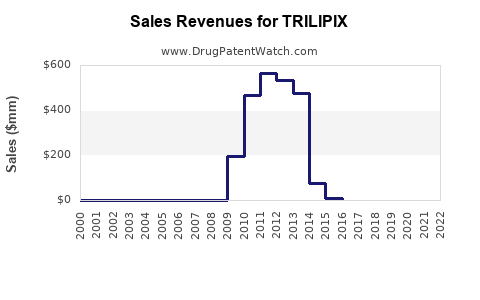
Trilipix was a meaningful but non-core product during Abbott’s and later AbbVie’s lipid franchise period. Its revenue trajectory followed the standard pattern for an oral branded cardiovascular drug: rapid uptake after launch, maturation during the early 2010s, and erosion after generic entry.
Public-company filings did not consistently report Trilipix as a separately disclosed global revenue line across the full product life cycle. It was often grouped with other pharmaceutical products or reported within broader therapeutic categories. This limits the reliability of standalone annual revenue estimates.
Financial trajectory by commercial phase
| Phase |
Approximate period |
Financial characteristics |
| Launch |
2009-2010 |
Physician adoption supported by delayed-release dosing and combination-use positioning |
| Growth |
2010-2012 |
Benefited from the established fibrate market and Abbott’s commercial infrastructure |
| Maturity |
2012-2014 |
Faced statin dominance, generic fenofibrate competition, and questions about cardiovascular-outcome benefit |
| Erosion |
2015 onward |
Generic entry reduced price, formulary access, and branded prescription volume |
| Residual market |
Late 2010s to present |
Primarily generic fenofibric acid demand, with limited branded economic value |
Trilipix revenue was also constrained by the size of the fibrate market. Statins remained the dominant pharmacologic treatment for atherosclerotic cardiovascular disease, while newer therapies, including prescription omega-3 products and later triglyceride-lowering agents, competed for patients with elevated triglycerides.
The economic profile was therefore less attractive than that of a first-line statin. Trilipix had a narrower target population, more complex safety monitoring, and weaker outcome differentiation.
How did generic entry affect Trilipix pricing?
Generic entry affected Trilipix through three channels:
- Pharmacy substitution moved prescriptions from the brand to lower-priced generic fenofibric acid.
- Payers reduced reimbursement for the branded product or excluded it from preferred formularies.
- Prescribers had little reason to maintain brand use once an equivalent delayed-release generic became available.
The price decline was reinforced by generic fenofibrate products, which competed for the same clinical indications even when the active ingredient and formulation differed. The result was a rapid reduction in branded net price and prescription retention.
Trilipix did not have a durable specialty-pharmacy or administration-related barrier. It was an oral capsule taken in the outpatient setting, which made substitution operationally straightforward.
What is the FDA regulatory status of Trilipix?
Trilipix received standard FDA approval rather than biologic approval, accelerated approval, or a rare-disease designation. Its regulatory characteristics were:
| Regulatory attribute |
Status |
| Active ingredient |
Fenofibric acid |
| Dosage form |
Delayed-release capsule |
| Strengths |
45 mg and 135 mg |
| FDA pathway |
New Drug Application |
| Generic pathway |
Abbreviated New Drug Application |
| Biosimilar pathway |
Not applicable |
| Therapeutic category |
Lipid-modifying agent |
| Key safety monitoring |
Renal, hepatic, muscular, and gallbladder risks |
There is no biosimilar pathway for Trilipix because fenofibric acid is a small molecule. The relevant competitive threat is generic substitution, not biosimilar interchangeability.
What is the Orange Book status of Trilipix?
The Orange Book provides the authoritative record for approved products, therapeutic equivalence evaluations, and listed patents. Trilipix’s commercial exposure is best analyzed through its historical NDA record and the corresponding entries for generic fenofibric acid delayed-release capsules.
For market-access purposes, the key questions are:
- Whether a current branded Trilipix product remains actively marketed.
- Whether an FDA-approved generic has an AB therapeutic-equivalence rating.
- Whether any listed patent remains unexpired.
- Whether pediatric or regulatory exclusivity remains active.
- Whether the branded product is available through normal retail channels.
The practical Orange Book conclusion is that no active regulatory exclusivity protects Trilipix from generic substitution today. Generic fenofibric acid products have established the relevant competitive standard.[3]
Which companies challenged or competed with Trilipix?
Competition came from both direct generic manufacturers and other lipid-treatment companies.
Direct generic competitors
Generic fenofibric acid products have been associated with major generic manufacturers and marketing partners, including companies operating through ANDA approvals, authorized-generic arrangements, or product portfolios. Market participants included large generic suppliers such as Teva, Actavis, and other FDA-approved manufacturers, depending on the period and product listing.
Therapeutic competitors
Trilipix also competed with:
- Generic fenofibrate.
- Fenofibrate tablets and capsules.
- Statins, including atorvastatin and rosuvastatin.
- Prescription omega-3 products.
- Niacin products during the earlier commercial period.
- Later triglyceride-focused therapies for severe hypertriglyceridemia.
The most important competitive threat was not a single branded rival. It was the combination of inexpensive generic fibrates and the clinical preference for statins as the foundation of lipid management.
How strong was the Trilipix patent estate?
The Trilipix patent estate was commercially moderate at launch but weak after generic entry. Its strengths were formulation specificity, an FDA-approved product, and an established safety and dosing profile. Its weaknesses were the absence of a broad new-molecule monopoly, a crowded fibrate market, and limited clinical differentiation.
| Patent-estate factor |
Assessment |
| Chemical-entity protection |
Limited relative to a new molecular entity |
| Formulation protection |
More important than compound protection |
| Method-of-use protection |
Narrow and tied to labeled dyslipidemia uses |
| Manufacturing protection |
Potentially relevant but unlikely to block all generic supply |
| Design-around risk |
Material |
| Biosimilar barrier |
Not applicable |
| Long-term exclusion value |
Low after generic approval |
Method-of-use patents covering triglyceride reduction, mixed dyslipidemia, or combination treatment with statins would have faced narrow enforcement and validity positions because the underlying therapeutic concepts were established within the fibrate class.
What patent litigation affects Trilipix?
Trilipix’s current market is not defined by an active litigation campaign. The principal legal issue was historical generic entry and the expiry or resolution of formulation-related protection.
There is no current litigation-driven commercial barrier comparable to those affecting high-value oncology, autoimmune, or rare-disease products. The product’s legal risk is therefore primarily retrospective:
- Historical Paragraph IV certifications.
- Patent expiry dates.
- Generic approval timing.
- Potential settlement terms.
- Whether any authorized generic was launched.
- Whether remaining patents covered meaningful commercial products.
For investors and licensing teams, the absence of active litigation means that the key diligence issue is market relevance, not enforcement uncertainty.
What generic launch scenarios existed for Trilipix?
The principal generic launch scenarios were:
Early launch after patent challenge
A successful Paragraph IV challenge could have allowed launch before the nominal expiry of one or more formulation patents. This would have accelerated branded erosion.
Launch after patent expiry
The more conventional scenario was generic approval after the listed patents expired or ceased to present an effective barrier. This would produce a rapid transition from brand pricing to generic pricing.
Limited authorized-generic competition
An authorized generic could have allowed the brand owner to retain some manufacturing or supply-chain economics while reducing third-party generic share. There is no clear public evidence that an authorized-generic strategy preserved significant long-term value for Trilipix.
Multiple-generic price compression
Once several manufacturers entered, price competition would have reduced the economic value of the active ingredient. This is the likely mature-market outcome for fenofibric acid delayed-release capsules.
How does Trilipix compare with fenofibrate?
| Attribute |
Trilipix |
Generic fenofibrate |
| Active ingredient |
Fenofibric acid |
Fenofibrate |
| Formulation |
Delayed-release capsule |
Multiple oral formulations |
| Brand status |
Legacy branded product |
Predominantly generic |
| Price |
Historically premium |
Lower |
| Prescribing rationale |
Combination use and formulation profile |
Cost and established class familiarity |
| Patent value |
Historical formulation protection |
Limited current branded protection |
| Generic substitution |
Direct fenofibric acid substitution |
Broad class competition |
| Commercial outlook |
Low |
Stable, price-sensitive generic demand |
Trilipix’s formulation and active-metabolite positioning created a product distinction, but not a durable commercial moat. Once generic fenofibric acid became available, the distinction was insufficient to support premium pricing.
What revenue exposure remains for Trilipix?
Current revenue exposure is limited. The principal economic activity has shifted from branded Trilipix sales to generic fenofibric acid volume, manufacturing contracts, and residual prescriptions where a payer or physician continues to specify the branded product.
The product has no material biosimilar exposure, no substantial specialty distribution barrier, and no high-growth indication expansion. Its remaining value is primarily associated with:
- Generic supply contracts.
- Mature lipid-treatment demand.
- Institutional or payer-specific formulary arrangements.
- Manufacturing capabilities for delayed-release capsules.
- Historical intellectual-property know-how.
For AbbVie, Trilipix is not a material growth driver relative to the company’s immunology, oncology, aesthetics, and neuroscience franchises. The product should be treated as a legacy cardiovascular asset rather than a strategic pipeline or licensing platform.
Key Takeaways
- Trilipix is fenofibric acid delayed-release capsules in 45 mg and 135 mg strengths.
- The FDA approved the product in December 2008.
- Abbott developed Trilipix; AbbVie assumed ownership of the pharmaceutical business in 2013.
- The product’s protection centered on formulation and dosage-form patents rather than a powerful long-duration compound patent.
- Generic fenofibric acid entered the U.S. market during the mid-2010s.
- Trilipix revenue declined as generic substitution reduced volume, price, and formulary access.
- Statins and generic fenofibrate created substantial therapeutic competition.
- Biosimilar risk is irrelevant because fenofibric acid is a small molecule.
- No active litigation barrier currently supports a meaningful branded market.
- Trilipix is a mature or legacy product with limited current revenue and licensing value.
FAQs
Is Trilipix still available in the United States?
Generic fenofibric acid delayed-release capsules are available. The commercial availability of branded Trilipix has been limited compared with the product’s launch period, and prescribing has shifted toward generic alternatives.
What is the generic name for Trilipix?
The generic name is fenofibric acid delayed-release capsules. Fenofibrate is a related but distinct active ingredient and is not the same generic product.
Can Trilipix be substituted with fenofibrate?
Substitution depends on the specific product, dose, formulation, prescription, and pharmacist and payer rules. Fenofibrate and fenofibric acid are related products but are not automatically interchangeable in every setting.
Did Trilipix have pediatric exclusivity?
Trilipix was approved for adult dyslipidemia indications. No material current pediatric exclusivity protects the product from generic competition.
Is Trilipix a cardiovascular-outcomes drug?
No. Trilipix was approved to treat lipid abnormalities. Its FDA labeling did not establish a cardiovascular morbidity or mortality benefit comparable to the outcome evidence used for statin therapy.
References
-
U.S. Food and Drug Administration. (2008). Trilipix (fenofibric acid) delayed-release capsules prescribing information. https://www.accessdata.fda.gov/drugsatfda_docs/label/2008/022224lbl.pdf
-
U.S. Food and Drug Administration. (n.d.). Drugs@FDA: FDA-approved drugs. https://www.accessdata.fda.gov/scripts/cder/daf/
-
U.S. Food and Drug Administration. (n.d.). Approved drug products with therapeutic equivalence evaluations, Orange Book. https://www.fda.gov/drugs/drug-approvals-and-databases/approved-drug-products-therapeutic-equivalence-evaluations-orange-book
-
AbbVie Inc. (2013). Annual report pursuant to Section 13 or 15(d) of the Securities Exchange Act of 1934. https://www.annualreports.com/Company/abbvie-inc
-
Abbott Laboratories. (2012). Annual report pursuant to Section 13 or 15(d) of the Securities Exchange Act of 1934. https://www.annualreports.com/Company/abbott-laboratories