Last updated: August 18, 2026
Treximet, the fixed-dose combination of sumatriptan 85 mg and naproxen sodium 500 mg, moved from a branded migraine product under GlaxoSmithKline to a mature, generic-exposed asset. Its commercial value depended on differentiated convenience, patent protection, and insurer coverage rather than a novel mechanism. The principal market shift occurred after generic sumatriptan/naproxen products entered the U.S. market, compressing branded revenue and reducing the asset's strategic value.
What is Treximet and how does it compete in the migraine market?
Treximet is an oral prescription tablet for the acute treatment of migraine attacks, with or without aura, in adults and pediatric patients 12 years and older. It combines:
| Component |
Dose |
Pharmacologic role |
| Sumatriptan |
85 mg |
Serotonin 5-HT1B/1D receptor agonist |
| Naproxen sodium |
500 mg |
Nonsteroidal anti-inflammatory drug |
The product's commercial proposition is convenience. Patients receive a triptan and an NSAID in one tablet rather than taking the components separately. The combination also targets the risk of headache recurrence associated with triptan monotherapy.
Treximet competes with generic sumatriptan tablets, generic naproxen, other triptans such as rizatriptan and eletriptan, and newer migraine products including CGRP antagonists and gepants. Its position weakened as payers prioritized lower-cost generics and as newer preventive and acute therapies expanded.
How does Treximet compare with competing migraine drugs?
| Product or class |
Primary advantage |
Commercial limitation relative to Treximet |
| Generic sumatriptan |
Low acquisition cost and broad availability |
Does not combine an NSAID |
| Sumatriptan plus OTC naproxen |
Flexible dosing and low cost |
Requires two products and separate administration |
| Treximet |
Fixed-dose convenience and established efficacy |
Branded price premium and generic substitution |
| CGRP antagonists, including ubrogepant and rimegepant |
No vasoconstrictive triptan mechanism; newer positioning |
Higher cost and payer restrictions |
| Triptan nasal and injectable products |
Faster or alternative administration |
Administration burden and higher unit cost |
Treximet's clinical differentiation is narrower than the differentiation available to newer non-triptan migraine products. Its strongest remaining use case is a patient who responds to both sumatriptan and naproxen and values a single prescription tablet.
When did Treximet lose market exclusivity?
Treximet's commercial exclusivity eroded in stages rather than ending on one date. The underlying combination and formulation patents expired across the late 2010s and early 2020s, allowing ANDA applicants to challenge the product's protection.
The original U.S. approval was granted in April 2008 under NDA 021926. The product was initially marketed by GlaxoSmithKline under a license from Pozen, the company that developed the formulation and combination technology.[1]
Key exclusivity milestones were:
| Milestone |
Date or period |
Commercial effect |
| FDA approval of Treximet |
April 2008 |
Branded U.S. launch |
| Early branded commercialization |
2008-2013 |
GSK controlled the principal commercial platform |
| GSK divestiture of U.S. rights |
2014 |
Pernix became the principal commercial owner |
| First major patent-expiration window |
2017-2020 |
Paragraph IV and generic-entry risk increased |
| Generic and authorized-generic activity |
Late 2010s |
Price and volume pressure intensified |
| Later-life commercial ownership |
2019 onward |
Asset value declined as portfolio owners changed |
The practical loss of exclusivity began before the last listed patent expired. Generic applicants can create commercial pressure through Paragraph IV litigation, settlements, authorized-generic arrangements, and payer substitution even when a brand retains later-expiring method or formulation patents.
What patents protected Treximet?
Treximet's patent estate centered on the combined administration of sumatriptan and naproxen, formulation characteristics, and methods for treating migraine. Historical Orange Book and patent records associated with Treximet included the following U.S. patents:
| U.S. patent |
General subject matter |
Approximate statutory term end |
| 6,060,499 |
Sumatriptan and naproxen pharmaceutical composition |
2017 |
| 6,586,458 |
Combination pharmaceutical composition and use |
2020 |
| 7,332,183 |
Combination dosage-form technology |
2020 |
| 7,781,439 |
Formulation or dosage-related protection |
2020 |
| 8,192,788 |
Later patent protection associated with the product |
Early 2020s |
| 8,598,227 |
Later formulation or use protection |
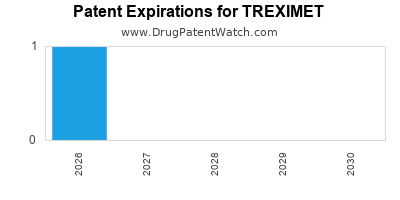
Mid-2020s, subject to applicable adjustments |
Patent scope and expiration must be read against the specific Orange Book listing, patent-term adjustment, pediatric exclusivity, terminal disclaimers, and litigation outcome. A later-expiring patent does not necessarily block all generic products. The key question is whether the generic applicant's proposed formulation or labeling practices infringe the asserted claims.
What formulations are protected by Treximet patents?
The protected technology generally addressed the co-formulation of sumatriptan and naproxen in a single oral dosage form. Relevant formulation issues included:
- Delivery of both active ingredients in one tablet.
- Different release or dissolution characteristics for the two ingredients.
- Stability and manufacturability of the fixed-dose combination.
- Dosing designed to provide acute migraine treatment with reduced need for separate NSAID administration.
- Method-of-use claims covering treatment of migraine and reduction of recurrence.
Formulation patents can create a stronger barrier than a basic composition patent when they require specific release profiles, excipients, particle sizes, or manufacturing steps. Their value depends on whether an ANDA applicant can design around the claims while maintaining pharmaceutical equivalence.
Did Treximet face Paragraph IV challenges?
Yes. Treximet faced the standard generic-entry risks associated with an approved small-molecule product whose principal patents approached expiration. Generic applicants could file ANDAs with Paragraph IV certifications asserting that listed patents were invalid, unenforceable, or not infringed.
The commercial consequences included:
- Patent litigation against ANDA applicants.
- Settlement negotiations governing the earliest launch date.
- Authorized-generic arrangements designed to retain part of the generic margin.
- Payer substitution after FDA approval of therapeutically equivalent products.
- Declining branded prescription volume before complete loss of exclusivity.
The most important risk was not a single patent challenge. It was the cumulative effect of multiple ANDA filings against a product with a finite patient base and limited room for premium pricing.
Which companies challenged or competed against Treximet?
Public generic competition involved major ANDA manufacturers and generic distributors, including companies active in the sumatriptan/naproxen market such as Dr. Reddy's Laboratories and other large generic manufacturers. The exact list of applicants, settlement terms, and launch rights varied by litigation docket and product configuration.
The product also faced indirect competition from manufacturers of generic sumatriptan and naproxen. A physician could prescribe the two ingredients separately, creating a lower-cost substitute even before a fully substitutable generic Treximet product became widely available.
What was Treximet's financial trajectory?
Treximet generated meaningful branded revenue during the GSK period but became a declining specialty-pharmaceutical asset after the 2014 divestiture. Pernix acquired U.S. Treximet rights from GSK in a transaction reported at approximately $250 million, subject to transaction terms and related obligations.[2]
The transaction reflected the product's remaining cash-flow value before full generic erosion. Pernix's strategy depended on extending the commercial life of established prescription products, controlling sales and marketing costs, and managing generic-entry risk.
Treximet revenue exposure by ownership period
| Period |
Principal commercial owner |
Financial interpretation |
| 2008-2013 |
GlaxoSmithKline |
Branded growth and lifecycle commercialization |
| 2014-2018 |
Pernix Therapeutics |
Mature-product cash generation and patent defense |
| 2019 onward |
Successor portfolio owners and rights holders |
Declining value after generic entry and market fragmentation |
Public company filings indicate that Treximet was one of Pernix's key revenue-producing products before the company's financial distress. The asset supported substantial net sales relative to Pernix's overall portfolio, but its value was exposed to prescription declines, customer concentration, rebates, litigation costs, and generic competition.[3]
The financial trajectory can be summarized as follows:
- Revenue increased during the early branded period as awareness and migraine prescribing expanded.
- Revenue remained material after Pernix's acquisition, supporting the purchase price.
- Sales weakened as generic versions and separate-component substitution expanded.
- Gross-to-net deductions increased the gap between list price and realized revenue.
- The product became less attractive as a standalone branded asset and more relevant as part of a portfolio transaction.
- Later owners had fewer opportunities to sustain premium pricing without new clinical differentiation.
No durable revenue-growth thesis remained after generic exposure. The commercial case shifted from expansion to cash-flow harvesting, cost control, and residual brand loyalty.
How did licensing deals affect Treximet's value?
Treximet was developed by Pozen and commercialized through a licensing arrangement with GlaxoSmithKline. Pozen retained economic participation through royalties and milestone structures while GSK provided regulatory, sales, and distribution infrastructure.[4]
The licensing structure affected value in three ways:
- It allowed Pozen to monetize the product without building a large commercial organization.
- It transferred much of the launch and commercialization burden to GSK.
- It created a later transaction asset when GSK divested the product to Pernix.
For a mature drug, license obligations can reduce the value available to the product owner. Royalty payments, supply commitments, transition services, and regulatory responsibilities can materially affect EBITDA after generic entry. Buyers therefore evaluate Treximet on net cash contribution rather than gross prescription revenue.
What is the FDA regulatory status and Orange Book status of Treximet?
Treximet was approved by the FDA under NDA 021926 as an immediate-release oral tablet containing sumatriptan and naproxen sodium.[1] It is a small-molecule product, not a biologic.
The relevant regulatory framework includes:
- 505(b)(1) NDA approval for the branded product.
- ANDA approval for generic products demonstrating pharmaceutical equivalence and bioequivalence.
- Orange Book patent listings submitted by the NDA holder.
- Paragraph IV certifications against listed patents.
- Possible 30-month litigation stays following timely patent litigation.
- Therapeutic-equivalence determinations for approved generic products.
Treximet has no biosimilar pathway. Biosimilar risk is therefore zero in the technical regulatory sense. The relevant erosion mechanism is ANDA-based generic competition.
The Orange Book remains the controlling source for current listed patents, therapeutic-equivalence codes, and marketing status. Historical patent listings should not be treated as evidence that every patent continues to block generic approval.
How strong is the Treximet patent estate?
Treximet's patent estate was moderate during the branded period but weak as a long-term barrier after the core combination patents approached expiration.
Strengths
- The fixed-dose combination created a distinct formulation rather than a simple single-ingredient product.
- Multiple patents provided layered protection.
- Method-of-use and formulation claims increased litigation leverage.
- The product had FDA approval and established commercial use.
Weaknesses
- The active ingredients were both old and widely available.
- Separate administration of sumatriptan and naproxen created an obvious low-cost substitute.
- A generic manufacturer could pursue design-around strategies.
- The product had no biologic complexity or device dependence.
- The principal commercial value was concentrated in the United States.
- Later patents faced a narrower remaining market and limited ability to support high launch prices.
The estate was stronger against an exact-copy fixed-dose product than against substitution by the two separate generic components. Its defensive value declined rapidly once generic manufacturers demonstrated a viable pathway to market.
What generic launch scenarios existed for Treximet?
Three launch scenarios were commercially relevant.
At-risk launch
A generic manufacturer could launch before final resolution of patent litigation after filing a Paragraph IV certification. This would expose the applicant to damages and potential injunctive relief but could accelerate market share capture.
Settlement-based launch
The brand owner and generic applicant could agree to a future launch date, potentially with authorized-generic rights, supply terms, or other commercial provisions. Settlement timing would determine the duration of residual branded exclusivity.
Post-expiration launch
Generic products could enter after expiration or invalidation of blocking patents without material litigation risk. This scenario generally produces the fastest price decline because multiple manufacturers may launch in close succession.
For Treximet, the post-expiration environment was especially challenging because physicians could choose between a generic fixed-dose combination and inexpensive separate-component therapy.
What patent litigation and settlement issues affected Treximet?
Treximet litigation centered on whether generic applicants infringed the listed formulation and combination patents and whether those patents were valid and enforceable. The most important business variables were:
- The number of ANDA filers.
- The earliest permitted generic-launch date.
- Whether the generic applicant obtained 180-day exclusivity.
- Whether the brand owner launched an authorized generic.
- Whether payers shifted patients to separate sumatriptan and naproxen.
- Whether settlements imposed supply or distribution restrictions.
Once a product reaches a late-life stage, litigation may preserve revenue for a limited period but rarely restores the original branded growth profile. A successful patent defense can delay erosion, but the market still discounts the asset as the remaining exclusivity window narrows.
What is the competitive landscape for Treximet today?
Treximet competes in a more crowded acute-migraine market than it did at launch. The main competitive forces are:
- Low-cost generic triptans.
- Generic sumatriptan plus generic or OTC naproxen.
- Newer CGRP-targeting acute therapies.
- Preventive migraine therapies that reduce attack frequency.
- Payer policies favoring step therapy and generic-first treatment.
- Specialty-pharmacy and mail-order substitution.
The fixed-dose format remains commercially useful, but convenience alone is insufficient to preserve a large branded premium once equivalent or near-equivalent alternatives are available.
What manufacturing and intellectual-property barriers remain?
Manufacturing barriers are limited compared with biologics, sterile injectables, or complex drug-device products. The product is an oral tablet using well-established active ingredients. Remaining barriers may include:
- Demonstrating bioequivalence for a two-active-ingredient combination.
- Matching dissolution behavior for each component.
- Establishing stability and batch consistency.
- Securing reliable supply of both active ingredients.
- Meeting FDA manufacturing and quality-system requirements.
- Avoiding valid formulation claims.
These are manageable barriers for established generic manufacturers. They may delay launch or increase development cost, but they do not provide the durable protection associated with complex biologic manufacturing.
What is the investment outlook for Treximet?
Treximet is best analyzed as a mature, generic-exposed pharmaceutical asset rather than a growth product. Its financial value depends on residual branded demand, net pricing, generic share, royalty obligations, sales-force costs, and the cost of maintaining regulatory support.
The upside case is limited to:
- Stable use among loyal branded patients.
- A profitable authorized-generic arrangement.
- Focused promotion in patients who benefit from fixed-dose therapy.
- Efficient supply and distribution.
- Limited generic participation.
The downside case is faster substitution, payer exclusion, additional generic entrants, and declining prescriptions. Newer migraine therapies also cap the product's ability to regain share through repricing or promotion.
Key Takeaways
- Treximet is a fixed-dose sumatriptan/naproxen product approved by the FDA in 2008.
- Its commercial value moved from branded growth under GSK to mature-product cash generation under Pernix and successor owners.
- GSK's 2014 divestiture to Pernix was reported at approximately $250 million.
- The patent estate relied on combination, formulation, and method-of-use claims, with major protection concentrated in the late 2010s and early 2020s.
- Treximet faced Paragraph IV and generic-entry risk; the principal erosion mechanism is ANDA competition, not biosimilar competition.
- Generic sumatriptan plus naproxen is a strong commercial substitute even where a branded fixed-dose tablet retains convenience advantages.
- The product's long-term financial profile is declining revenue, lower pricing power, and residual cash-flow management rather than market expansion.
- Manufacturing barriers are moderate and unlikely to prevent sustained generic competition.
FAQs
Is Treximet still commercially differentiated from generic sumatriptan?
Yes, its main differentiation is the single-tablet combination of sumatriptan and naproxen. That convenience is weaker than a clinical differentiation because patients can take the two generic ingredients separately.
Does Treximet have biosimilar competition?
No. Treximet is a small-molecule drug approved through an NDA, so competition proceeds through the generic-drug ANDA pathway rather than the biosimilar pathway.
What is the strongest remaining Treximet intellectual-property feature?
The strongest historical protection was the combination and formulation architecture requiring sumatriptan and naproxen to be delivered in one approved dosage form. Its commercial strength declined as later patents expired and generic design-around options became available.
Why did Treximet's acquisition value decline after the Pernix transaction?
Generic entry reduced branded prescription volume and pricing power. The asset also faced payer substitution, royalty or transaction obligations, and competition from separate generic sumatriptan and naproxen.
Can a generic manufacturer sell sumatriptan and naproxen separately instead of copying Treximet?
Yes. Separate prescriptions do not require the generic manufacturer to reproduce the Treximet fixed-dose formulation, although the products must be separately approved and prescribed.
References
-
U.S. Food and Drug Administration. (2008). Treximet prescribing information and NDA 021926 approval materials. FDA.
-
GlaxoSmithKline plc. (2014). Annual report 2014. GSK.
-
Pernix Therapeutics Holdings, Inc. (2015-2018). Annual reports and Form 10-K filings. U.S. Securities and Exchange Commission.
-
Pozen, Inc. (2008-2014). Annual reports and licensing disclosures relating to Treximet. U.S. Securities and Exchange Commission.
-
U.S. Food and Drug Administration. (2024). Approved drug products with therapeutic equivalence evaluations, Orange Book. FDA.
-
U.S. Patent and Trademark Office. (2024). Patent Center and patent-term information for U.S. patents associated with Treximet. USPTO.