Last Updated: November 11, 2026

TPOXX Drug Patent Profile

« Back to Dashboard


Which patents cover Tpoxx, and when can generic versions of Tpoxx launch?

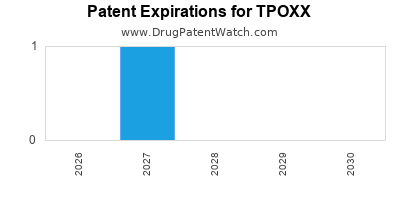
Tpoxx is a drug marketed by Siga Technologies and is included in two NDAs. There are eight patents protecting this drug.

The generic ingredient in TPOXX is tecovirimat. There is one drug master file entry for this compound. One supplier is listed for this compound. Additional details are available on the tecovirimat profile page.

DrugPatentWatch® Generic Entry Outlook for Tpoxx

Tpoxx was eligible for patent challenges on July 13, 2022.

By analyzing the patents and regulatory protections it appears that the earliest date for generic entry will be March 23, 2031. This may change due to patent challenges or generic licensing.

Indicators of Generic Entry

< Available with Subscription >

  Start Trial

AI Deep Research
Questions you can ask:
  • What is the 5 year forecast for TPOXX?
  • What are the global sales for TPOXX?
  • What is Average Wholesale Price for TPOXX?
Summary for TPOXX
US Patents:8
Applicants:1
NDAs:2
Finished Product Suppliers / Packagers: 1
Raw Ingredient (Bulk) Api Vendors: 1
Patent Applications: 136
What excipients (inactive ingredients) are in TPOXX?TPOXX excipients list
DailyMed Link:TPOXX at DailyMed
DrugPatentWatch® Estimated Loss of Exclusivity (LOE) Date for TPOXX
Generic Entry Dates for TPOXX*:
Constraining patent/regulatory exclusivity:
NDA:
Dosage:

CAPSULE;ORAL

Generic Entry Dates for TPOXX*:
Constraining patent/regulatory exclusivity:
NDA:
Dosage:

SOLUTION;INTRAVENOUS

*The generic entry opportunity date is the latter of the last compound-claiming patent and the last regulatory exclusivity protection. Many factors can influence early or later generic entry. This date is provided as a rough estimate of generic entry potential and should not be used as an independent source.

US Patents and Regulatory Information for TPOXX

TPOXX is protected by nine US patents.

Based on analysis by DrugPatentWatch, the earliest date for a generic version of TPOXX is ⤷  Start Trial.

This potential generic entry date is based on patent 12,433,868.

Generics may enter earlier, or later, based on new patent filings, patent extensions, patent invalidation, early generic licensing, generic entry preferences, and other factors.

Applicant Tradename Generic Name Dosage NDA Approval Date TE Type RLD RS Patent No. Patent Expiration Product Substance Delist Req. Exclusivity Expiration
Siga Technologies TPOXX tecovirimat CAPSULE;ORAL 208627-001 Jul 13, 2018 RX Yes Yes 7,737,168 ⤷  Start Trial ⤷  Start Trial
Siga Technologies TPOXX tecovirimat SOLUTION;INTRAVENOUS 214518-001 May 18, 2022 RX Yes Yes 9,907,859 ⤷  Start Trial ⤷  Start Trial
Siga Technologies TPOXX tecovirimat CAPSULE;ORAL 208627-001 Jul 13, 2018 RX Yes Yes 12,433,868 ⤷  Start Trial Y ⤷  Start Trial
Siga Technologies TPOXX tecovirimat SOLUTION;INTRAVENOUS 214518-001 May 18, 2022 RX Yes Yes 10,576,165 ⤷  Start Trial Y ⤷  Start Trial
Siga Technologies TPOXX tecovirimat CAPSULE;ORAL 208627-001 Jul 13, 2018 RX Yes Yes 11,890,270 ⤷  Start Trial ⤷  Start Trial
Siga Technologies TPOXX tecovirimat CAPSULE;ORAL 208627-001 Jul 13, 2018 RX Yes Yes 9,339,466 ⤷  Start Trial Y Y ⤷  Start Trial
>Applicant >Tradename >Generic Name >Dosage >NDA >Approval Date >TE >Type >RLD >RS >Patent No. >Patent Expiration >Product >Substance >Delist Req. >Exclusivity Expiration

Expired US Patents for TPOXX

Applicant Tradename Generic Name Dosage NDA Approval Date Patent No. Patent Expiration
Siga Technologies TPOXX tecovirimat CAPSULE;ORAL 208627-001 Jul 13, 2018 8,124,643 ⤷  Start Trial
Siga Technologies TPOXX tecovirimat SOLUTION;INTRAVENOUS 214518-001 May 18, 2022 8,124,643 ⤷  Start Trial
Siga Technologies TPOXX tecovirimat SOLUTION;INTRAVENOUS 214518-001 May 18, 2022 8,530,509 ⤷  Start Trial
Siga Technologies TPOXX tecovirimat CAPSULE;ORAL 208627-001 Jul 13, 2018 8,802,714 ⤷  Start Trial
Siga Technologies TPOXX tecovirimat CAPSULE;ORAL 208627-001 Jul 13, 2018 8,530,509 ⤷  Start Trial
Siga Technologies TPOXX tecovirimat SOLUTION;INTRAVENOUS 214518-001 May 18, 2022 8,802,714 ⤷  Start Trial
>Applicant >Tradename >Generic Name >Dosage >NDA >Approval Date >Patent No. >Patent Expiration

International Patents for TPOXX

When does loss-of-exclusivity occur for TPOXX?

Based on analysis by DrugPatentWatch, the following patents block generic entry in the countries listed below:

African Regional IP Organization (ARIPO)

Patent: 21
Estimated Expiration: ⤷  Start Trial

Argentina

Patent: 2566
Patent: FORMULACIONES LIQUIDAS DE ST-246 Y METODOS RELACIONADOS, PROCESO
Estimated Expiration: ⤷  Start Trial

Patent: 3435
Estimated Expiration: ⤷  Start Trial

Patent: 2178
Patent: COMPOSICIÓN FARMACÉUTICA LÍQUIDA Y PROCESO PARA PREPARARLA
Estimated Expiration: ⤷  Start Trial

Australia

Patent: 11232551
Estimated Expiration: ⤷  Start Trial

Patent: 11285871
Patent: ST-246 liquid formulations and methods
Estimated Expiration: ⤷  Start Trial

Brazil

Patent: 2012023743
Estimated Expiration: ⤷  Start Trial

Patent: 2013002646
Patent: Formulações farmacêuticas líquidas e métodos e processo de preparo das mesmas e unidade de dosagem das referidas formulações líquidas
Estimated Expiration: ⤷  Start Trial

Canada

Patent: 93533
Estimated Expiration: ⤷  Start Trial

Patent: 07528
Patent: PREPARATIONS LIQUIDES DE ST-246 ET PROCEDES (ST-246 LIQUID FORMULATIONS AND METHODS)
Estimated Expiration: ⤷  Start Trial

Patent: 30671
Estimated Expiration: ⤷  Start Trial

Chile

Patent: 12002621
Estimated Expiration: ⤷  Start Trial

China

Patent: 3068232
Estimated Expiration: ⤷  Start Trial

Patent: 3281898
Patent: St-246 liquid formulations and methods
Estimated Expiration: ⤷  Start Trial

Patent: 5111130
Estimated Expiration: ⤷  Start Trial

Patent: 5111131
Estimated Expiration: ⤷  Start Trial

Patent: 5175311
Estimated Expiration: ⤷  Start Trial

Patent: 6074370
Patent: ST‑246液体配制物以及方法 (ST-246 LIQUID FORMULATIONS AND METHODS)
Estimated Expiration: ⤷  Start Trial

Denmark

Patent: 49871
Estimated Expiration: ⤷  Start Trial

Patent: 00715
Estimated Expiration: ⤷  Start Trial

European Patent Office

Patent: 49871
Estimated Expiration: ⤷  Start Trial

Patent: 00715
Patent: PRÉPARATIONS LIQUIDES DE ST-246 ET PROCÉDÉS (ST-246 LIQUID FORMULATIONS AND METHODS)
Estimated Expiration: ⤷  Start Trial

France

Patent: C1023
Estimated Expiration: ⤷  Start Trial

Israel

Patent: 1991
Estimated Expiration: ⤷  Start Trial

Patent: 4430
Patent: Liquid pharmaceutical formulation comprising st-246 and a beta-cyclodextrin, a process of making the liquid formulation, a unit dosage liquid formulation and a process for preparing a water-soluble solid st-246 pharmaceutical formulation
Estimated Expiration: ⤷  Start Trial

Patent: 8239
Estimated Expiration: ⤷  Start Trial

Japan

Patent: 98196
Estimated Expiration: ⤷  Start Trial

Patent: 18041
Estimated Expiration: ⤷  Start Trial

Patent: 13522371
Estimated Expiration: ⤷  Start Trial

Patent: 13532729
Patent: ST−246液体製剤および方法
Estimated Expiration: ⤷  Start Trial

Patent: 16040323
Patent: ST−246の多形型および調製方法 (POLYMORPHIC FORMS OF ST-246 AND METHODS OF PREPARATION)
Estimated Expiration: ⤷  Start Trial

Patent: 18012735
Patent: ST−246の多形型および調製方法 (POLYMORPHIC FORMS OF ST-246 AND METHODS OF PREPARATION)
Estimated Expiration: ⤷  Start Trial

Mexico

Patent: 7795
Patent: FORMULACIONES LIQUIDAS DE ST-246 Y METODOS. (ST-246 LIQUID FORMULATIONS AND METHODS.)
Estimated Expiration: ⤷  Start Trial

Patent: 1428
Patent: FORMAS POLIMORFICAS ST-246 Y METODOS DE PREPARACION. (POLYMORPHIC FORMS ST-246 AND METHODS OF PREPARATION.)
Estimated Expiration: ⤷  Start Trial

Patent: 8106
Patent: FORMULACIONES LIQUIDAS DE ST-246 Y METODOS. (ST-246 LIQUID FORMULATIONS AND METHODS.)
Estimated Expiration: ⤷  Start Trial

Patent: 12010859
Patent: FORMAS POLIMORFICAS ST-246 Y METODOS DE PREPARACION. (POLYMORPHIC FORMS ST-246 AND METHODS OF PREPARATION.)
Estimated Expiration: ⤷  Start Trial

Patent: 13001389
Patent: FORMULACIONES LIQUIDAS DE ST-246 Y METODOS. (ST-246 LIQUID FORMULATIONS AND METHODS.)
Estimated Expiration: ⤷  Start Trial

New Zealand

Patent: 2578
Patent: Polymorphic forms st-246 and methods of preparation
Estimated Expiration: ⤷  Start Trial

Peru

Patent: 130212
Patent: FORMAS POLIMORFICAS DE ST-246 Y METODOS DE PREPARACION
Estimated Expiration: ⤷  Start Trial

Patent: 170944
Patent: FORMAS POLIMORFICAS DE ST-246 Y METODOS DE PREPARACION
Estimated Expiration: ⤷  Start Trial

Russian Federation

Patent: 78606
Patent: ПОЛИМОРФНЫЕ ФОРМЫ СОЕДИНЕНИЯ ST-246 И СПОСОБЫ ПОЛУЧЕНИЯ (POLYMORPHIC FORMS OF ST-246 COMPOUND AND METHODS FOR PRODUCING)
Estimated Expiration: ⤷  Start Trial

Patent: 12144818
Patent: ПОЛИМОРФНЫЕ ФОРМЫ СОЕДИНЕНИЯ ST-246 И СПОСОБЫ ПОЛУЧЕНИЯ (POLYMORPHIC FORMS OF ST-246 COMPOUND AND METHODS FOR PRODUCING)
Estimated Expiration: ⤷  Start Trial

Patent: 15146899
Patent: ПОЛИМОРФНЫЕ ФОРМЫ СОЕДИНЕНИЯ ST-246 И СПОСОБЫ ПОЛУЧЕНИЯ
Estimated Expiration: ⤷  Start Trial

Singapore

Patent: 201501936P
Patent: POLYMORPHIC FORMS ST-246 AND METHODS OF PREPARATION
Estimated Expiration: ⤷  Start Trial

Patent: 201506031U
Patent: ST-246 LIQUID FORMULATIONS AND METHODS
Estimated Expiration: ⤷  Start Trial

Patent: 202105262Q
Patent: ST-246 LIQUID FORMULATIONS AND METHODS
Estimated Expiration: ⤷  Start Trial

Patent: 4201
Patent: POLYMORPHIC FORMS ST-246 AND METHODS OF PREPARATION
Estimated Expiration: ⤷  Start Trial

Patent: 7243
Patent: ST-246 LIQUID FORMULATIONS AND METHODS
Estimated Expiration: ⤷  Start Trial

South Africa

Patent: 1207141
Patent: POLYMORPHIC FORMS ST-246 AND METHODS OF PREPARATION
Estimated Expiration: ⤷  Start Trial

Patent: 1300930
Patent: ST-246 LIQUID FORMULATIONS AND METHODS
Estimated Expiration: ⤷  Start Trial

South Korea

Patent: 1868117
Estimated Expiration: ⤷  Start Trial

Patent: 130018271
Patent: POLYMORPHIC FORMS ST-246 AND METHODS OF PREPARATION
Estimated Expiration: ⤷  Start Trial

Patent: 130135836
Patent: ST­246 액체 제형 및 방법 (246 ST-246 LIQUID FORMULATIONS AND METHODS)
Estimated Expiration: ⤷  Start Trial

Patent: 150011016
Patent: POLYMORPHIC FORMS ST-246 AND METHODS OF PREPARATION
Estimated Expiration: ⤷  Start Trial

Patent: 150092354
Patent: POLYMORPHIC FORMS ST-246 AND METHODS OF PREPARATION
Estimated Expiration: ⤷  Start Trial

Patent: 160028489
Patent: 다형체 형태 ST―246 및 제조방법 (POLYMORPHIC FORMS ST-246 AND METHODS OF PREPARATION)
Estimated Expiration: ⤷  Start Trial

Patent: 160062208
Patent: 다형체 형태 ST―246 및 제조방법 (POLYMORPHIC FORMS ST-246 AND METHODS OF PREPARATION)
Estimated Expiration: ⤷  Start Trial

Patent: 170102070
Patent: 다형체 형태 ST―246 및 제조방법 (POLYMORPHIC FORMS ST-246 AND METHODS OF PREPARATION)
Estimated Expiration: ⤷  Start Trial

Generics may enter earlier, or later, based on new patent filings, patent extensions, patent invalidation, early generic licensing, generic entry preferences, and other factors.

See the table below for additional patents covering TPOXX around the world.

Country Patent Number Title Estimated Expiration
African Regional IP Organization (ARIPO) 3221 ⤷  Start Trial
Argentina 083435 ⤷  Start Trial
Australia 2011232551 ⤷  Start Trial
Brazil 112012023743 ⤷  Start Trial
Canada 2793533 ⤷  Start Trial
Canada 3030671 ⤷  Start Trial
>Country >Patent Number >Title >Estimated Expiration

Supplementary Protection Certificates for TPOXX

Patent Number Supplementary Protection Certificate SPC Country SPC Expiration SPC Description
1638938 301177 Netherlands ⤷  Start Trial PRODUCT NAME: TECOVIRIMAT OF EEN FARMACEUTISCH AANVAARDBAAR ZOUT DAARVAN; REGISTRATION NO/DATE: EU/1/21/1600/001 20220107
1638938 2022C/521 Belgium ⤷  Start Trial PRODUCT NAME: TECOVIRIMAT OF EEN FARMACEUTISCH AANVAARDBAAR ZOUT HIERVAN; AUTHORISATION NUMBER AND DATE: EU/1/21/1600 20220107
2549871 122022000033 Germany ⤷  Start Trial PREVIOUS APPLICANT: SIGA TECHNOLOGIES, INC., 97333 CORVALLIS, OR, US; PRODUCT NAME: TECOVIRIMAT; AUTHORISATION NO/DATE: EU/1/21/1600 20220106
1638938 122022000032 Germany ⤷  Start Trial PRODUCT NAME: TECOVIRIMAT ODER EIN PHARMAZEUTISCH VERTRAEGLICHES SALZ DAVON; REGISTRATION NO/DATE: EU/1/21/1600 20220106
1638938 2290024-5 Sweden ⤷  Start Trial PRODUCT NAME: TECOVIRIMAT OR A PHARMACEUTICALLY ACCEPTABLE SALT THEREOF; REG. NO/DATE: EU/1/21/1600/001 20220107
1638938 C202230021 Spain ⤷  Start Trial PRODUCT NAME: TECOVIRIMAT O UNA SAL FARMACEUTICAMENTE ACEPTABLE DEL MISMO; NATIONAL AUTHORISATION NUMBER: EU/1/21/1600; DATE OF AUTHORISATION: 20220106; NUMBER OF FIRST AUTHORISATION IN EUROPEAN ECONOMIC AREA (EEA): EU/1/21/1600; DATE OF FIRST AUTHORISATION IN EEA: 20220106
>Patent Number >Supplementary Protection Certificate >SPC Country >SPC Expiration >SPC Description

TPOXX Market Dynamics and Financial Trajectory: Tecovirimat Sales, BARDA Contracts, Patents, and Generic Risk

Last updated: October 3, 2026

TPOXX, the brand name for oral and intravenous tecovirimat, is a government-stockpiled antiviral commercialized by SIGA Technologies. Its revenue profile is driven less by routine prescriptions than by U.S. Strategic National Stockpile procurement, public-health emergencies, and international government purchases. Sales reached approximately $701 million in 2022 after the mpox outbreak triggered large government orders, then declined sharply as emergency procurement normalized. The commercial outlook remains financially attractive but highly volatile, with U.S. government demand, stockpile replenishment, regulatory expansion, and the absence of a practical generic competitor controlling the trajectory.

What is TPOXX and who manufactures it?

TPOXX is an antiviral containing tecovirimat, also known as ST-246. SIGA Technologies developed and commercializes the product. The U.S. government is the principal customer, while the Biomedical Advanced Research and Development Authority, or BARDA, and other government agencies are the dominant procurement channels.

Attribute TPOXX profile
Active ingredient Tecovirimat
Brand name TPOXX
Developer and commercial supplier SIGA Technologies
Dosage forms Oral capsules; intravenous formulation
Initial FDA approval July 2018
Primary FDA indication Treatment of human smallpox disease
Government use Smallpox preparedness and mpox response
Primary customer U.S. government and public-health agencies
Commercial model Stockpiling, replenishment, emergency procurement, and government contracts
Generic or biosimilar exposure No biosimilar pathway; limited near-term generic exposure

The oral product is supplied as 200-milligram capsules. The intravenous formulation was developed for patients who cannot take oral medication or who may have impaired absorption. FDA approved the intravenous formulation in 2022. [1]

TPOXX received its original approval under the Animal Rule, a regulatory pathway that allows approval based on animal efficacy data when human efficacy studies are not feasible or ethical. The approval was based on nonclinical efficacy, pharmacokinetic data, and safety information rather than conventional randomized human efficacy trials in smallpox patients. [1]

What is the FDA regulatory status of TPOXX?

FDA approval covers treatment of human smallpox disease in adults and children. TPOXX is not broadly approved as a standard treatment for mpox, although the product became available for mpox through an expanded-access investigational new drug protocol during the 2022 outbreak. CDC and FDA established mechanisms allowing physicians to access oral tecovirimat for patients with mpox, particularly those with severe disease or elevated risk.

The regulatory position has several commercial consequences:

  1. Smallpox approval supports federal procurement and stockpile maintenance.
  2. Mpox access expands public-health relevance but does not automatically create a conventional reimbursed outpatient market.
  3. Future label expansion could increase demand, but a label expansion alone would not eliminate the product’s dependence on government purchasing.
  4. The intravenous product increases procurement utility for hospitals and emergency-response programs.

In 2022, FDA and CDC expanded operational access to TPOXX during the mpox outbreak. The product remained primarily a government-controlled countermeasure rather than a standard retail antiviral. [2]

How much revenue does TPOXX generate for SIGA?

SIGA’s reported revenue demonstrates the extreme effect of emergency procurement cycles.

Fiscal year SIGA revenue Primary commercial driver Financial interpretation
2021 Approximately $275 million U.S. government TPOXX procurement Elevated stockpile demand
2022 Approximately $701 million Mpox-related and replenishment orders Exceptional emergency-year revenue
2023 Approximately $241 million Lower but continuing government purchases Normalization after the mpox surge

SIGA reported approximately $701 million of revenue in 2022, followed by approximately $241 million in 2023. The decline was caused primarily by the absence of 2022-level emergency procurement, not by loss of product approval or a direct competitive launch. [3,4]

The 2022 revenue figure illustrates TPOXX’s operating leverage. Once manufacturing capacity, regulatory infrastructure, and inventory are established, incremental government orders can produce substantial revenue and cash flow. The same structure creates downside risk when emergency orders are delayed or when stockpile inventories are considered sufficient.

What caused the 2022 TPOXX revenue surge?

The 2022 surge reflected several overlapping events:

  • The global mpox outbreak increased demand for tecovirimat.
  • The U.S. government expanded access through CDC mechanisms.
  • BARDA and other agencies procured additional courses.
  • International governments increased purchases.
  • Existing stockpile requirements supported replenishment beyond immediate clinical use.

The outbreak did not convert TPOXX into a conventional high-volume retail drug. It increased the product’s strategic value and accelerated government purchasing.

What BARDA contracts support TPOXX sales?

BARDA is the central commercial force behind TPOXX in the United States. Its contracts support procurement for the Strategic National Stockpile and allow the government to exercise options when inventory targets, emergency response, or expiration-related replenishment require additional product.

Key contract characteristics include:

Contract feature Effect on TPOXX economics
Multi-year procurement Provides baseline visibility
Option-based purchasing Produces irregular revenue recognition
Stockpile replenishment Creates recurring but unpredictable demand
Emergency clauses Can generate large one-time orders
Government delivery schedules Can shift revenue between fiscal years
Strategic inventory requirements Reduce dependence on routine prescriptions

The U.S. government has purchased millions of TPOXX courses over time. Public disclosures have reported large BARDA procurement commitments, including contracts and options with aggregate potential values in the hundreds of millions of dollars. The headline value of an indefinite-delivery or option-based agreement should not be treated as guaranteed revenue. Actual revenue depends on exercised options, delivery schedules, pricing, and government inventory policy.

When does TPOXX lose exclusivity?

TPOXX’s exclusivity position is more complex than a single patent expiration date. The product benefits from patent protection, regulatory exclusivity, government procurement barriers, manufacturing know-how, and the small size of the commercial market.

The core composition-of-matter patent protection for tecovirimat has been reported as expiring in the early 2020s. Later patents and regulatory barriers may extend practical protection for specific formulations, manufacturing processes, or product configurations. A patent expiration does not automatically produce generic entry. A prospective generic supplier would still need to establish bioequivalence, obtain FDA approval, qualify manufacturing capacity, and secure a market large enough to justify development costs.

Exclusivity barrier Current commercial significance
Core compound patents Reduced after early-2020s expiration period
Formulation and manufacturing patents May affect specific competing products
FDA approval requirements Material for oral and intravenous products
Government procurement qualification High practical barrier
Strategic stockpile contracting Favors established suppliers
Manufacturing capacity Important for emergency-scale supply
Market size outside government Limited
Government ownership and control of stockpile Reduces ordinary pharmacy-channel opportunity

TPOXX does not have biosimilar risk because tecovirimat is a small-molecule drug, not a biologic. The relevant threat is an Abbreviated New Drug Application, or ANDA, generic. As of the latest public commercial information considered here, no generic launch had materially displaced SIGA’s government business.

What patents protect TPOXX?

TPOXX protection has historically included patents covering tecovirimat and related pharmaceutical applications. The most economically important protection was the compound patent, followed by patents potentially covering formulation, dosage, and manufacturing elements.

The commercial value of these patents is uneven:

  • The compound patent provided the strongest early exclusivity.
  • Formulation patents may protect the oral capsule or intravenous presentation.
  • Method-of-use patents may cover treatment of orthopoxvirus infections or specific patient populations.
  • Manufacturing patents can raise the cost of entry but are harder to enforce if competitors use different processes.
  • Government procurement and supply-chain qualification may be more important than residual patent life.

TPOXX patent analysis should distinguish between formal expiration and practical market entry. A generic company would face a low-volume commercial market outside a government contract, and the government could use procurement rules, domestic supply requirements, or emergency authorities to shape the competitive field.

Are there Paragraph IV challenges to TPOXX?

No major publicly reported Paragraph IV litigation has displaced SIGA’s U.S. government business. A Paragraph IV challenger would need to contest listed patents through an ANDA certification and could trigger patent litigation under the Hatch-Waxman Act.

The commercial incentive is limited because:

  1. Retail demand is small.
  2. Government procurement dominates sales.
  3. A generic entrant would need access to federal contracts.
  4. Stockpile orders are irregular.
  5. Manufacturing and quality requirements are stringent.
  6. The government may prefer a proven supplier during a public-health emergency.

The absence of a prominent Paragraph IV challenge does not mean patent protection is indefinite. It indicates that the expected value of generic entry has been constrained by market structure, contracting, and manufacturing economics.

What formulations are protected by TPOXX?

TPOXX has two major dosage forms:

Oral capsules

The oral formulation is the main stockpiled product and the principal source of revenue. It is suitable for large-scale distribution and outpatient administration. Oral supply is central to both smallpox preparedness and mpox response.

Intravenous formulation

The intravenous product was approved to address patients unable to take oral medication or with clinical conditions that may impair oral absorption. Its market is smaller, but it increases TPOXX’s utility in hospitals and high-acuity public-health settings.

The intravenous product adds manufacturing complexity and may create separate competitive and patent questions. It also broadens the government’s ability to use TPOXX across different clinical scenarios without relying entirely on oral capsules.

How strong is the TPOXX patent estate?

The TPOXX estate is commercially strong but not solely because of patent duration. Its strongest elements are:

  • Established FDA approval.
  • Large government purchasing history.
  • Stockpile integration.
  • Existing manufacturing and quality systems.
  • Emergency-use infrastructure.
  • Clinical familiarity among public-health agencies.
  • High regulatory and operational barriers for a new supplier.

Its weaker elements are:

  • Dependence on one dominant customer.
  • Limited routine retail demand.
  • Reduced value of early compound patents after expiration.
  • Potential for government-led procurement competition.
  • Revenue concentration in a small number of contracts.

The estate is therefore stronger as a government-countermeasure platform than as a conventional branded pharmaceutical franchise.

Which companies are challenging TPOXX?

No commercial competitor has established a comparable U.S. market position for smallpox treatment. Potential competitive pressure comes from three groups:

  1. Generic manufacturers that could pursue tecovirimat after relevant patent barriers weaken.
  2. Developers of alternative orthopoxvirus antivirals.
  3. Government-funded programs developing next-generation medical countermeasures.

Brincidofovir, marketed as Tembexa by Chimerix and later acquired by Emergent BioSolutions, is the most relevant approved alternative for smallpox preparedness. It has a different mechanism, dosing profile, and commercial position. Tembexa does not directly compete with TPOXX in all patients, but it gives government buyers an alternative countermeasure and may influence stockpile allocation. [5]

How does TPOXX compare with Tembexa?

Factor TPOXX Tembexa
Active ingredient Tecovirimat Brincidofovir
Developer/commercial owner SIGA Technologies Emergent BioSolutions
FDA smallpox status Approved Approved
Primary market Government stockpile Government stockpile
Formulation profile Oral capsules and IV Oral tablets and oral suspension
Commercial demand Strongly affected by mpox and BARDA orders More dependent on preparedness procurement
Competitive role Leading tecovirimat countermeasure Alternative smallpox antiviral
Biosimilar risk None None
Generic risk Potential future ANDA competition Potential future ANDA competition

TPOXX has had the stronger recent revenue profile because of mpox-related demand and large procurement activity. Tembexa remains strategically relevant as a second approved option for federal preparedness.

What litigation and settlement agreements affect TPOXX?

The most important historical legal dispute involving SIGA concerned its corporate and licensing conflict with PharmAthene. The Delaware litigation produced a major legal decision and damages award related to an alleged agreement concerning SIGA’s smallpox antiviral program. The dispute affected the corporate and licensing history of tecovirimat but did not prevent TPOXX from reaching FDA approval or becoming a government-stockpiled product. [6]

No widely reported patent settlement has created a scheduled generic launch for TPOXX. The practical litigation risk is more likely to arise from:

  • Future ANDA filings.
  • Contract disputes with government agencies.
  • Manufacturing or supply claims.
  • Patent challenges involving formulations or processes.
  • Licensing disputes affecting international distribution.

What generic launch risks exist for TPOXX?

A generic launch would likely occur in stages rather than through an immediate broad retail rollout.

Scenario 1: No near-term generic launch

SIGA continues supplying the U.S. stockpile under government contracts. Revenue remains volatile but supported by replenishment and emergency purchases.

Scenario 2: Limited government-qualified generic

A generic manufacturer obtains FDA approval but captures only a portion of government procurement. Price pressure is moderate because supply reliability and emergency readiness remain important.

Scenario 3: Competitive federal procurement

The government qualifies multiple suppliers and uses competitive bidding. SIGA retains volume but experiences lower prices and reduced margins.

Scenario 4: Emergency demand surge

A new smallpox or mpox event causes the government to prioritize speed and established inventory. SIGA’s incumbent position becomes more valuable, even if patent protection has weakened.

The highest financial risk is not necessarily a conventional generic launch. It is a reduction in federal procurement, delayed contract options, or a government decision that existing inventory is adequate.

What is the international market for TPOXX?

International demand is concentrated in governments, public-health agencies, and emergency preparedness programs. Countries with established biodefense or pandemic-response budgets are the most likely buyers.

International expansion has three constraints:

  • Smallpox is eradicated, so routine clinical demand is negligible.
  • Mpox incidence is episodic and geographically uneven.
  • Government purchasing cycles are lengthy and budget-dependent.

International contracts can diversify SIGA’s customer base, but they do not transform TPOXX into a conventional global commercial drug. The business remains tied to public procurement and strategic inventory.

What is the revenue outlook for TPOXX?

The likely financial trajectory is a high-margin, low-visibility government-countermeasure model.

Revenue driver Near-term effect Long-term effect
U.S. stockpile replenishment Large episodic orders Recurring baseline demand
Mpox outbreaks Sudden demand acceleration Higher strategic relevance
Expiration of stored courses Supports replacement purchases Creates periodic revenue peaks
Generic entry Potential price and volume pressure Depends on federal qualification
International procurement Diversifies customer base Remains irregular
TPOXX IV adoption Adds smaller hospital channel Improves clinical utility
Alternative antivirals Adds procurement competition May limit pricing power

SIGA’s 2022 revenue peak should not be extrapolated as a normal annual run rate. The 2023 decline demonstrates the reset risk. The more defensible valuation framework is based on contracted backlog, exercised options, government inventory requirements, gross margin, and cash generation rather than headline outbreak-year sales.

What is the commercial investment case for TPOXX?

The investment case rests on five factors:

  1. TPOXX has an approved indication and an established government customer.
  2. The product is embedded in U.S. smallpox preparedness.
  3. Emergency procurement can produce substantial cash flow.
  4. Generic competition has not yet become a material commercial force.
  5. The company has a specialized position in medical countermeasures.

The principal risks are equally clear:

  • Revenue concentration in U.S. government contracts.
  • Large year-to-year sales variation.
  • Dependence on public-health events and inventory policy.
  • Potential generic or alternative-product competition.
  • Limited ordinary commercial demand.
  • Contract timing and option-exercise risk.

Key Takeaways

  • TPOXX is a government-countermeasure business, not a conventional retail antiviral.
  • SIGA’s revenue reached approximately $701 million in 2022 and fell to approximately $241 million in 2023 as emergency procurement normalized.
  • BARDA and Strategic National Stockpile purchases are the main revenue drivers.
  • The oral capsule is the core commercial product; the intravenous formulation expands hospital and emergency utility.
  • TPOXX has no biosimilar risk, but future ANDA generic competition remains possible.
  • No major publicly reported Paragraph IV challenge has produced a scheduled generic launch.
  • Patent protection is only one part of TPOXX’s competitive position. Government contracts, manufacturing qualification, stockpile integration, and emergency readiness are more important practical barriers.
  • Tembexa is the most relevant approved alternative smallpox antiviral.
  • The largest financial risk is a decline or delay in government procurement, not routine retail substitution.
  • The appropriate financial model uses contract awards, stockpile replacement cycles, and scenario-based government demand rather than a steady annual sales assumption.

FAQs About TPOXX Market and Exclusivity

Is TPOXX a profitable drug for SIGA Technologies?

Yes. TPOXX has generated substantial revenue and strong operating leverage, especially during government procurement surges. Profitability is volatile because orders are episodic.

Does TPOXX have a normal pharmacy market?

No. Its primary market is government stockpiling and emergency public-health distribution. Routine retail prescriptions represent a limited portion of the commercial opportunity.

Can a generic company sell tecovirimat in the United States?

Potentially. A generic manufacturer would need FDA approval, satisfy applicable patent requirements, establish manufacturing capacity, and compete for government procurement contracts.

Is TPOXX approved for mpox?

TPOXX is FDA-approved for treatment of human smallpox. During the mpox outbreak, access was provided through CDC and FDA expanded-access mechanisms rather than a broad conventional mpox label approval.

What drug competes most directly with TPOXX?

Tembexa, or brincidofovir, is the most relevant approved alternative for smallpox preparedness. It has a different active ingredient and formulation profile and competes mainly in government stockpiling.

References

  1. U.S. Food and Drug Administration. (2018). FDA approves the first drug with an indication for treatment of smallpox.
  2. Centers for Disease Control and Prevention. (2022). Tecovirimat use under expanded access investigational new drug protocol for mpox.
  3. SIGA Technologies, Inc. (2023). Annual report on Form 10-K for the fiscal year ended December 31, 2022.
  4. SIGA Technologies, Inc. (2024). Annual report on Form 10-K for the fiscal year ended December 31, 2023.
  5. U.S. Food and Drug Administration. (2021). FDA approves brincidofovir for treatment of human smallpox disease.
  6. Supreme Court of Delaware. (2015). SIGA Technologies, Inc. v. PharmAthene, Inc., 67 A.3d 330.

More… ↓

⤷  Start Trial

Make Better Decisions: Try a trial or see plans & pricing

Drugs may be covered by multiple patents or regulatory protections. All trademarks and applicant names are the property of their respective owners or licensors. Although great care is taken in the proper and correct provision of this service, thinkBiotech LLC does not accept any responsibility for possible consequences of errors or omissions in the provided data. The data presented herein is for information purposes only. There is no warranty that the data contained herein is error free. We do not provide individual investment advice. This service is not registered with any financial regulatory agency. The information we publish is educational only and based on our opinions plus our models. By using DrugPatentWatch you acknowledge that we do not provide personalized recommendations or advice. thinkBiotech performs no independent verification of facts as provided by public sources nor are attempts made to provide legal or investing advice. Any reliance on data provided herein is done solely at the discretion of the user. Users of this service are advised to seek professional advice and independent confirmation before considering acting on any of the provided information. thinkBiotech LLC reserves the right to amend, extend or withdraw any part or all of the offered service without notice.