Last updated: September 7, 2026
Torsemide is a mature, low-cost loop diuretic with broad generic availability and no material U.S. exclusivity barrier. Its commercial trajectory is volume-driven rather than innovation-driven. Demand is tied to heart failure, hypertension, chronic kidney disease, and edema, while pricing remains constrained by generic competition. The principal competitive threat is furosemide, not a new torsemide entrant.
What is the current market position of torsemide?
Torsemide is an oral and injectable loop diuretic used to treat edema associated with heart failure, renal disease, and hepatic disease. Oral tablets are available in multiple strengths, commonly 5 mg, 10 mg, 20 mg, and 100 mg. Generic torsemide is marketed by multiple manufacturers in the United States and other regulated markets.
The market has four defining characteristics:
- The active ingredient is off-patent.
- Generic supply is broad.
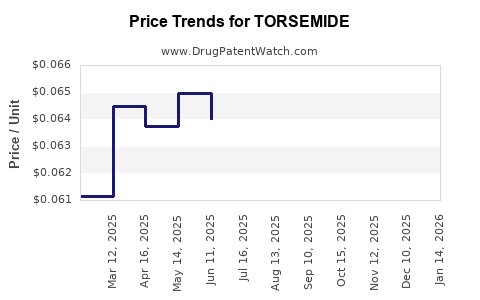
- Unit prices are low.
- Clinical demand is recurring but not strongly differentiated.
Torsemide competes primarily with furosemide, bumetanide, and ethacrynic acid. Furosemide retains the largest clinical and commercial footprint because of long-standing physician familiarity, very low cost, extensive hospital use, and availability in oral and injectable forms.
Torsemide has a more predictable oral absorption profile than furosemide. That attribute supports use in patients with heart failure or gut edema, but it has not eliminated furosemide's market dominance.
How large is the torsemide market?
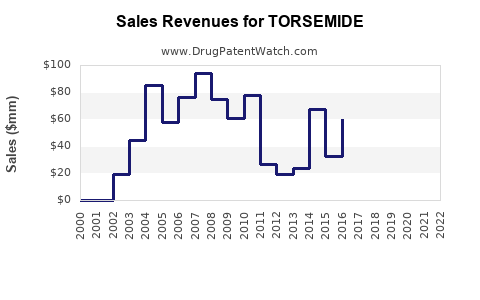
No major public company reports torsemide revenue as a separate product line. Generic manufacturers generally disclose revenue by business segment, geography, or therapeutic portfolio rather than by active pharmaceutical ingredient. A precise global torsemide revenue figure therefore cannot be derived from public filings.
The commercial market is best assessed through prescription volume, product availability, reimbursement, and manufacturer participation rather than branded sales.
| Market factor |
Torsemide impact |
| Prescription demand |
Stable to moderately growing with heart failure and chronic kidney disease prevalence |
| Pricing |
Low because of multiple generic suppliers |
| Brand contribution |
Limited |
| Hospital demand |
Supported by injectable and oral use, but furosemide remains dominant |
| Retail demand |
Primarily generic tablets |
| Innovation premium |
Minimal |
| Switching risk |
Low where patients are clinically stable |
| Reimbursement risk |
High for manufacturers with undifferentiated products |
| Revenue visibility |
Low at the individual-drug level |
Demand can expand with growth in heart failure diagnoses, aging populations, chronic kidney disease, and outpatient management of fluid overload. That growth does not necessarily translate into higher torsemide revenue because generic price erosion can offset volume gains.
What is the financial trajectory for torsemide?
Torsemide's financial trajectory is mature and deflationary.
The likely pattern is:
- Long-term prescription stability or modest volume growth.
- Continued erosion in average selling price.
- Low branded contribution.
- Periodic supply-driven price increases if manufacturers exit.
- Limited ability to sustain premium pricing without a differentiated formulation or delivery system.
For generic manufacturers, torsemide is generally a portfolio product rather than a major revenue engine. Its value comes from manufacturing scale, established regulatory approvals, hospital contracts, and inclusion in broader cardiovascular or renal portfolios.
For distributors and pharmacies, margins depend on supplier concentration and contract terms. A shortage or manufacturing disruption can temporarily increase prices, but the effect is usually short-lived once alternative suppliers restore supply.
For branded-product companies, a torsemide strategy requires differentiation. Possible approaches include:
- Extended-release dosing.
- Fixed-dose combinations.
- Specialty packaging or adherence programs.
- Hospital-to-home transition products.
- Formulations designed for patients with impaired gastrointestinal absorption.
- Digital dosing support linked to weight and fluid monitoring.
Without such differentiation, a torsemide product faces a low ceiling on revenue because immediate-release generics are widely available.
When did torsemide lose market exclusivity?
Torsemide lost meaningful U.S. market exclusivity decades ago. The original U.S. product, Demadex, received FDA approval in the early 1990s. The active ingredient and original oral product are no longer protected by effective market exclusivity.
The original composition and product patents associated with torsemide expired before the current generic market developed. Any historical patent protection would have been subject to the pre-1995 U.S. patent-term framework, terminal disclaimers, and applicable patent-term adjustments.
| Regulatory event |
Approximate timing |
| Original torsemide development and patenting |
1970s-1980s |
| Original U.S. product approval |
1993 |
| Generic entry period |
Late 1990s and subsequent years |
| Current U.S. exclusivity position |
No meaningful branded exclusivity |
| Current commercial model |
Multi-source generic competition |
What patents protect torsemide?
No commercially significant active U.S. patent estate is generally associated with the basic torsemide molecule or conventional immediate-release tablets.
Historical torsemide patents include early compound and pharmaceutical-use filings, including U.S. Patent No. 4,285,956, which is associated with torsemide-related diuretic compounds. Such early patents expired long ago and do not provide a current barrier to generic manufacture.
What formulation patents cover torsemide?
The principal commercial product is an immediate-release tablet. Generic manufacturers can generally produce standard torsemide tablets without licensing a current branded patent estate.
Potential protection could arise from later patents covering:
- Modified-release formulations.
- Fixed-dose combinations.
- Specific excipient systems.
- Abuse-resistant or orally disintegrating dosage forms.
- Injectable compositions.
- Narrow method-of-use claims.
- Patient-selection or dosing protocols.
Those claims would need to be evaluated separately from the expired composition patents. A formulation patent would not automatically block standard generic torsemide tablets unless the generic product infringed the specific formulation claims.
What method-of-use patents cover torsemide?
Torsemide's core uses, including treatment of edema associated with heart failure, renal disease, and hepatic disease, are longstanding indications. Broad method-of-use protection for those uses is not a meaningful current barrier.
A later patent could attempt to claim a narrow patient population, dosing schedule, combination therapy, or biomarker-defined use. Such claims would generally face validity, written-description, enablement, obviousness, and infringement challenges. They would also have limited commercial value if physicians use generic torsemide for the same underlying indication.
What is the Orange Book status of torsemide?
The FDA Orange Book contains approved torsemide products and therapeutic-equivalence information for relevant generic products. Demadex was the original branded reference product. Multiple abbreviated new drug applications have supported generic competition.
The commercial importance of Orange Book listings is limited because the original product is mature and no prominent unexpired patent listing controls generic entry.
| Orange Book issue |
Torsemide position |
| Reference product |
Demadex |
| Dosage forms |
Tablets and injection, depending on product |
| Generic pathway |
ANDA approval with therapeutic-equivalence evaluation |
| Active branded patent barrier |
Not commercially significant |
| NCE exclusivity |
Expired |
| Paragraph IV importance |
Low for the historical product |
| Substitution environment |
Generic substitution is central to the market |
FDA Orange Book records should be checked for the specific strength, dosage form, and reference-listed drug because approval and listing status can differ across products.
Have companies filed Paragraph IV challenges against torsemide?
Paragraph IV litigation is not a major current feature of the torsemide market. The core product is too old and too genericized for the original compound to support a conventional branded-defense strategy.
Paragraph IV activity could arise if a company obtains a later patent covering a new torsemide formulation or a narrow method of use. In that scenario, a generic applicant could certify that the patent is invalid, unenforceable, or not infringed. The resulting litigation would concern the later patent, not the basic torsemide molecule.
The absence of meaningful current Paragraph IV activity reduces launch uncertainty for conventional generic torsemide. It also means that commercial risk is more likely to arise from manufacturing, supply, reimbursement, or regulatory compliance than from patent litigation.
What generic entry risks exist for torsemide?
Generic entry risk is already embedded in the product's market structure. New entrants can intensify price competition, reduce incumbent volume, and weaken hospital and pharmacy contract economics.
The main risks are:
Price erosion
Each additional approved supplier can reduce average selling prices. The effect is strongest for commonly used tablet strengths and products with low manufacturing complexity.
Manufacturing concentration
Older generic products can experience temporary shortages when a small number of manufacturers supply most demand. This can produce short-term pricing power, but it does not create durable exclusivity.
FDA compliance
Warning letters, Form 483 observations, recalls, and manufacturing suspensions can remove supply from the market. For an established generic, regulatory compliance may be more commercially important than patent protection.
Procurement pressure
Hospitals and group purchasing organizations can negotiate aggressively because torsemide has therapeutic substitutes and multiple suppliers.
Therapeutic substitution
Physicians may use furosemide or bumetanide based on clinical response, formulary rules, inpatient protocols, and cost. This limits torsemide's ability to capture all growth in the loop-diuretic market.
How does torsemide compare with furosemide and bumetanide?
| Attribute |
Torsemide |
Furosemide |
Bumetanide |
| Market maturity |
Mature generic |
Mature generic |
Mature generic |
| Typical commercial position |
Secondary loop diuretic |
Market leader |
Smaller specialty alternative |
| Oral absorption |
More predictable than furosemide |
Variable |
Generally reliable |
| Price |
Low |
Very low |
Often higher per dose |
| Hospital use |
Established |
Dominant |
Selective |
| Differentiation |
Pharmacokinetic profile |
Broad familiarity and low cost |
High potency and alternative dosing |
| Patent barrier |
None of practical significance |
None of practical significance |
None of practical significance |
| Revenue opportunity |
Portfolio and formulation-based |
Scale-based |
Niche and specialty-based |
Torsemide's strongest commercial argument is pharmacokinetic consistency. Its weakest commercial attribute is the absence of a proprietary barrier that can convert that clinical distinction into durable pricing power.
What FDA regulatory status does torsemide have?
Torsemide is an FDA-approved small-molecule drug available through both new drug application and abbreviated new drug application pathways. It is not a biologic and does not create biosimilar substitution issues.
Is there biosimilar risk for torsemide?
No. Torsemide is a conventional small molecule, not a biologic. The relevant competitive threats are generic ANDA approvals, therapeutic substitution, authorized generic competition, and new formulations.
Regulatory risk centers on:
- Product quality.
- Bioequivalence.
- Stability.
- Manufacturing controls.
- Labeling accuracy.
- Drug shortages.
- Recall exposure.
Which companies are challenging torsemide's market?
The competitive field includes generic manufacturers, contract manufacturers, wholesalers, and the suppliers of competing loop diuretics. The market is fragmented and product-specific. Company participation can change as manufacturers discontinue low-margin products or shift production capacity.
The principal competitive groups are:
- Generic pharmaceutical manufacturers selling immediate-release tablets.
- Hospital suppliers distributing injectable torsemide.
- Manufacturers of furosemide and bumetanide.
- Developers of extended-release or combination products.
- Specialty companies targeting outpatient heart-failure management.
No single company has a durable patent-controlled position in standard torsemide tablets.
What licensing deals and partnerships affect torsemide?
Publicly visible licensing economics for conventional torsemide are limited. The molecule is old, generic, and widely available. Commercial partnerships are more likely to involve:
- Contract manufacturing.
- Authorized distribution.
- Private-label supply.
- Hospital purchasing agreements.
- Combination-product development.
- Reformulation licensing.
A licensing transaction involving torsemide would derive most of its value from formulation, channel access, manufacturing capacity, or a broader cardiovascular portfolio. The active ingredient itself would contribute little exclusivity value.
What litigation and settlement agreements affect torsemide?
There is no prominent ongoing U.S. patent litigation involving the basic torsemide product that materially restricts generic access. No major branded settlement agreement is generally associated with current conventional torsemide tablets.
Potential litigation exposure remains in three areas:
- Product liability claims involving electrolyte abnormalities, dehydration, hypotension, or renal effects.
- Manufacturing and quality disputes.
- Later-generation formulation patents.
These risks are distinct from market-exclusivity litigation and are unlikely to support a sustained price premium for standard torsemide.
What geographic markets offer the strongest opportunity?
Torsemide's opportunity is strongest where heart failure prevalence is high, generic reimbursement is established, and supply reliability is valued.
| Geography |
Commercial outlook |
| United States |
Large generic market; low pricing; strong regulatory and supply-chain competition |
| Europe |
Mature generic use; national reimbursement and tendering pressure |
| Japan |
Established cardiovascular market; local regulatory and pricing controls |
| China |
Large potential volume; intense generic competition and centralized procurement |
| India |
Strong manufacturing base; high price competition and export opportunity |
| Latin America |
Variable access; branded-generic and distributor models remain relevant |
Geographic expansion can increase volume but generally does not create strong margins unless the supplier has a cost advantage, local registration portfolio, or reliable government-contract access.
How strong is the torsemide patent estate?
The patent estate for standard torsemide is weak from a current commercial perspective.
| Patent-estate factor |
Assessment |
| Basic molecule |
Expired |
| Original indication claims |
Expired or commercially ineffective |
| Immediate-release tablets |
No meaningful active barrier |
| Later formulations |
Potentially protectable, product-specific |
| Manufacturing process |
Possible narrow protection, limited blocking value |
| Method of use |
Narrow claims may exist, but broad use is unprotected |
| Biosimilar protection |
Not applicable |
| Generic launch risk |
High for standard products |
The product's remaining defensibility depends on execution rather than ownership of the molecule. A company seeking value from torsemide would need to build around manufacturing cost, supply reliability, formulation differentiation, or clinical-service integration.
What is the outlook for torsemide revenue?
The base-case outlook is stable volume with low or declining unit economics. Revenue growth is possible if heart-failure and chronic kidney disease treatment expands, but generic price competition will capture much of that growth.
A realistic commercial forecast has three scenarios:
| Scenario |
Volume |
Price |
Revenue effect |
| Base case |
Stable to modest growth |
Continued erosion |
Flat to modest decline |
| Supply disruption |
Temporary increase |
Short-term increase |
Volatile, not durable |
| Differentiated formulation |
Incremental growth |
Premium pricing |
Potentially meaningful for the reformulated product |
The greatest upside does not come from standard torsemide tablets. It comes from a clinically differentiated formulation supported by enforceable patents, FDA approval, reimbursement access, and evidence of improved adherence or outcomes.
Key Takeaways
- Torsemide is a mature, off-patent loop diuretic with broad generic competition.
- The original U.S. product, Demadex, has no meaningful current exclusivity barrier.
- Standard torsemide tablets are unlikely to support high-margin branded economics.
- Revenue is driven by prescription volume, manufacturing scale, and supply reliability.
- Furosemide remains the principal competitive benchmark.
- Paragraph IV and settlement risk are low for conventional torsemide.
- Biosimilar competition is irrelevant because torsemide is a small molecule.
- Reformulations, fixed-dose combinations, and specialty delivery systems offer the main route to differentiated value.
- Generic price erosion, procurement pressure, and manufacturing compliance are the primary commercial risks.
- The financial trajectory is stable to declining for undifferentiated products, with selective upside for protected reformulations.
FAQs
Is torsemide a profitable generic drug?
Torsemide can contribute profit as part of a broad generic portfolio, but standard tablets generally have limited standalone profitability because of low prices and multiple suppliers.
Does torsemide have an active U.S. patent?
The basic torsemide molecule and conventional immediate-release products are not protected by a commercially meaningful active U.S. patent estate.
Can a company launch a generic torsemide product?
A company can pursue an ANDA for an eligible torsemide dosage form, subject to FDA requirements, product-specific exclusivity, bioequivalence, manufacturing compliance, and Orange Book analysis.
Is torsemide more valuable than furosemide commercially?
No. Torsemide may have clinical advantages in selected patients, but furosemide has greater market scale, broader institutional use, and lower cost.
Could an extended-release torsemide product command a premium?
Yes, but only if the product demonstrates clinically relevant value, obtains enforceable formulation protection, secures reimbursement, and avoids direct substitution with low-cost immediate-release tablets.
References
-
U.S. Food and Drug Administration. (2024). Approved drug products with therapeutic equivalence evaluations. FDA.
-
U.S. Food and Drug Administration. (2024). Drugs@FDA: Torsemide and Demadex product records. FDA.
-
U.S. Food and Drug Administration. (2024). Prescribing information for torsemide tablets. FDA.
-
U.S. Patent and Trademark Office. (1981). U.S. Patent No. 4,285,956: Torsemide-related diuretic compounds. USPTO.
-
U.S. National Library of Medicine. (2024). DailyMed: Torsemide prescribing information. National Library of Medicine.
-
American Heart Association. (2024). Heart disease and stroke statistics update. American Heart Association.
-
Centers for Medicare & Medicaid Services. (2024). Medicare Part D drug spending dashboard. CMS.