Last updated: August 20, 2026
Terconazole is a mature, prescription vaginal antifungal with limited commercial growth and no material originator franchise. Its market is driven by generic prescriptions for vulvovaginal candidiasis, competition from low-cost OTC azoles, and substitution with oral fluconazole. Public companies do not generally report terconazole revenue separately, so the product’s financial trajectory is best assessed through market structure, generic availability, pricing pressure, regulatory status, and prescription demand rather than standalone sales figures.
What is terconazole and how is it used?
Terconazole is a triazole antifungal marketed for the local treatment of vulvovaginal candidiasis. FDA-approved dosage forms include vaginal cream and vaginal suppositories, generally administered over three or seven days depending on strength and formulation.
| Product type |
Common strength |
Typical course |
Market status |
| Vaginal cream |
0.4% |
Seven days |
Generic prescription product |
| Vaginal cream |
0.8% |
Three days |
Generic prescription product |
| Vaginal suppository |
80 mg |
Three days |
Generic prescription product |
Terconazole inhibits fungal cytochrome P450-dependent sterol synthesis, reducing ergosterol formation in susceptible Candida species. Its therapeutic positioning is local vaginal treatment rather than systemic antifungal therapy.
FDA labeling identifies vulvovaginal candidiasis as the approved indication. The product is not approved for systemic fungal infections or for treatment of bacterial vaginosis. Diagnosis matters because symptoms can overlap with bacterial vaginosis, sexually transmitted infections, dermatologic disorders, and recurrent or complicated candidiasis. (U.S. Food and Drug Administration, n.d.-a)
How large is the terconazole market?
No authoritative public source reports a current global market size for terconazole alone. Commercial data providers typically aggregate it within prescription vaginal antifungals or broader women’s health categories.
The addressable market is structurally limited because terconazole competes with:
- Oral fluconazole, a common prescription alternative.
- OTC vaginal miconazole and clotrimazole.
- Other local azole products.
- Non-drug treatment choices in recurrent or uncomplicated cases.
- Diagnostic and treatment changes for non-albicans Candida infections.
Terconazole remains relevant when prescribers prefer a topical prescription azole, when an oral product is unsuitable, or when a patient has previously responded to the product. Its three-day and seven-day regimens allow differentiation from single-dose oral fluconazole and shorter OTC regimens, but the differentiation is limited.
The market is therefore a mature, low-growth segment. Volume is tied primarily to the incidence of diagnosed vaginal candidiasis and prescription habits, while revenue depends heavily on generic pricing and payer reimbursement.
What is the financial trajectory for terconazole?
Terconazole has the financial profile of a mature multisource generic rather than a branded growth product.
| Financial driver |
Expected effect on terconazole |
| Originator patent expiry |
Eliminated meaningful brand exclusivity |
| Multiple ANDA suppliers |
Increased price competition |
| OTC alternatives |
Limits prescription volume and pricing |
| Low manufacturing complexity |
Supports supplier entry |
| Small market size |
Limits premium pricing |
| Payer substitution |
Favors the lowest-cost approved product |
| Short treatment duration |
Restricts annual revenue per patient |
Public pharmaceutical companies generally do not disclose terconazole sales as a separate line item. Revenue is usually grouped into broader generic pharmaceuticals, women’s health, or established products. The absence of product-level reporting indicates that terconazole is not a material standalone contributor to the financial statements of major suppliers.
The commercial trajectory is likely characterized by:
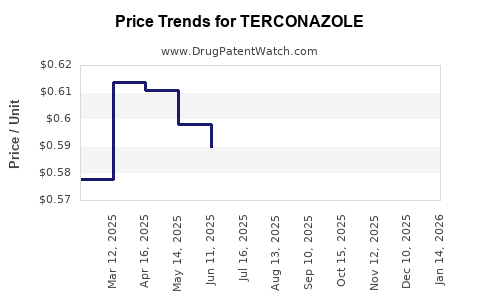
- Declining or flat nominal revenue per unit because of generic price erosion.
- Stable prescription demand in a narrow therapeutic category.
- Periodic revenue volatility from supply interruptions, wholesaler inventory, and contract changes.
- Limited opportunity for substantial price increases without a shortage or differentiated formulation.
- Low probability of major investment in clinical development.
For a generic manufacturer, terconazole can still provide incremental portfolio revenue because development and regulatory costs are lower than for a new chemical entity. The product is more valuable as part of a broad women’s health or topical-generic portfolio than as a standalone strategic asset.
When did terconazole lose exclusivity?
Terconazole’s core small-molecule and dosage-form exclusivity expired many years ago. The product was approved in the 1980s, placing it well outside the period of new chemical entity exclusivity and standard patent protection associated with a recently launched branded drug.
The commercial sequence was:
| Period |
Market event |
| 1980s |
Initial FDA approval of prescription terconazole products |
| 1990s and 2000s |
Expansion of generic and alternative vaginal antifungal competition |
| Later years |
Transition from branded Terazol economics to multisource generic pricing |
| Current market |
Mature generic prescription segment with OTC substitution |
The branded Terazol franchise no longer has the commercial characteristics of an active exclusivity asset. Any remaining brand sales are limited relative to generic volume and are not generally disclosed as a separate revenue stream.
What is the Orange Book status of terconazole?
Terconazole is listed in FDA drug-product databases in multiple prescription dosage forms and strengths. The active commercial market is primarily supplied through abbreviated new drug applications rather than a protected new-drug application franchise.
The Orange Book implications are straightforward:
- Terconazole is an old, multisource small molecule.
- No current new chemical entity exclusivity protects the active ingredient.
- Generic applicants can rely on the established FDA safety and efficacy record through the ANDA pathway.
- Product-specific patents, if listed for a particular approved product, do not create a broad barrier across all terconazole products.
- No active Orange Book exclusivity is known to support a branded monopoly for the core cream and suppository products. (U.S. Food and Drug Administration, 2024)
The principal regulatory barrier is therefore product quality and approval, not fundamental patent exclusion.
Which companies compete in terconazole?
Competition comes from generic manufacturers, private-label suppliers, contract manufacturers, and distributors. Terconazole products have historically been associated with large generic companies and specialty suppliers, including Teva Pharmaceuticals and other FDA-approved manufacturers listed in product labeling and drug databases.
The competitive field is fragmented because the product is available in multiple dosage forms and strengths. A supplier may compete in one strength while another company controls a separate channel, customer contract, or private-label presentation.
The most important competitive variables are:
- FDA approval status.
- Consistent API and finished-dose supply.
- Wholesaler and pharmacy distribution.
- Contract pricing.
- Reimbursement status.
- Ability to supply cream and suppository formats.
- Manufacturing cost and quality compliance.
- Capacity to absorb low-margin orders.
Market share can change without a change in clinical demand when a manufacturer exits, loses a contract, receives a warning letter, or experiences a manufacturing disruption.
What formulations are protected by terconazole patents?
The commercially relevant formulations are vaginal cream and vaginal suppositories. Their technical protection is largely historical. Current commercial differentiation is based on dosage form, strength, excipients, packaging, applicator design, and manufacturing quality rather than a broad active-ingredient patent.
Potential formulation-level barriers include:
- Cream viscosity and drug uniformity.
- Suppository melting or dissolution performance.
- Stability through labeled shelf life.
- Applicator compatibility.
- Microbiological quality.
- Container-closure performance.
- Bioequivalence and in vitro release characteristics.
These characteristics can create regulatory development work, but they are not equivalent to a durable patent moat. A generic applicant generally must demonstrate pharmaceutical equivalence and bioequivalence or satisfy the applicable FDA requirements for the dosage form. The technical burden is manageable for an established topical product and does not normally support premium pricing.
Are there Paragraph IV challenges or terconazole patent lawsuits?
Terconazole has not been associated with a major current Paragraph IV litigation campaign comparable to those involving high-value branded drugs. The reason is economic: the core product is old, generic competition is established, and the revenue available to support prolonged patent litigation is limited.
For a legacy product, litigation risk is more likely to arise from:
- Manufacturing quality disputes.
- ANDA approval or labeling issues.
- Contract termination.
- Product liability claims.
- Supply disruption.
- Alleged trade-secret or manufacturing-process misuse.
These risks differ from a branded patent challenge. There is no evident current litigation structure that would materially delay generic terconazole entry across the market.
What is the FDA regulatory status of terconazole?
Terconazole remains an FDA-approved prescription treatment for vulvovaginal candidiasis. Generic products must comply with FDA requirements for identity, strength, quality, purity, labeling, manufacturing, and application approval.
Regulatory considerations include:
- Prescription-only status.
- Established safety and efficacy record.
- Multiple approved dosage forms.
- Labeling directed to vaginal candidiasis.
- Pregnancy-related labeling and administration precautions.
- Product-specific manufacturing and quality obligations.
The regulatory environment is stable but not risk-free. Topical and vaginal products can face quality problems involving microbial contamination, potency, content uniformity, packaging, and applicator performance. These issues can cause recalls or temporary shortages even when clinical demand is unchanged.
How does terconazole compare with fluconazole and OTC azoles?
| Attribute |
Terconazole |
Oral fluconazole |
OTC miconazole or clotrimazole |
| Route |
Vaginal |
Oral |
Vaginal |
| Prescription status |
Prescription |
Prescription |
OTC in the United States |
| Main use |
Vulvovaginal candidiasis |
Vulvovaginal and systemic fungal infections |
Uncomplicated vaginal candidiasis |
| Treatment duration |
Three or seven days |
Often single dose for uncomplicated cases |
One, three, or seven days |
| Systemic exposure |
Limited relative to oral therapy |
Systemic |
Limited |
| Pricing power |
Low because of generics |
Low to moderate depending on product |
Low |
| Competitive threat |
High |
High |
High |
| Patent strength |
Mature, weak |
Mature for the active ingredient |
Mature, weak |
Terconazole’s main commercial advantage is local prescription treatment with established clinical familiarity. Its main disadvantage is that it faces competition from both a convenient oral prescription product and inexpensive OTC products.
What generic launch scenarios exist for terconazole?
The market is already generic, so future launches would likely be incremental rather than transformational.
Additional generic entry
New ANDA approvals could reduce prices further, particularly if a supplier offers the same strength and dosage form as incumbent products. The effect would be greatest in pharmacy benefit channels that use lowest-net-cost contracting.
Manufacturer exit
A supplier exit could temporarily improve pricing for remaining manufacturers if inventory is tight. Any improvement would likely be limited and reversible because the product is technically established and other manufacturers can enter or expand supply.
Private-label expansion
Retailers, wholesalers, or specialty distributors could use private-label arrangements to capture margin without investing in a new clinical brand. This would increase channel competition but would not materially expand the overall market.
Product shortage
A quality event or API disruption could cause temporary supply constraints. The financial effect would depend on duration, inventory levels, and the number of alternative suppliers. Shortages can create short-term volume gains for available manufacturers but do not establish durable pricing power.
What manufacturing and intellectual-property barriers affect terconazole?
Manufacturing is a greater practical barrier than intellectual property. Terconazole requires reliable formulation, filling, packaging, and quality-control processes. The product’s age reduces clinical and patent risk, but topical manufacturing remains subject to FDA inspection and current good manufacturing practice requirements.
Key barriers include:
- Qualified API supply.
- Consistent cream rheology.
- Suppository thermal and physical stability.
- Microbial control.
- Finished-product testing.
- Reliable applicator and packaging suppliers.
- Compliance with FDA facility standards.
- Commercial-scale production economics.
These barriers can limit the number of reliable suppliers, but they do not prevent generic competition. The market’s low unit value makes operational efficiency more important than proprietary science.
What is the geographic coverage of terconazole?
The United States is the most commercially visible market because FDA-approved terconazole products are established in the U.S. prescription channel. International availability varies by country, with differences in:
- Brand names.
- Prescription and OTC classification.
- Approved strengths.
- Treatment guidelines.
- Reimbursement.
- Local generic registrations.
- Distribution arrangements.
A company with U.S. approval does not automatically have market access in Europe, Canada, Latin America, or Asia. International growth would require country-specific registrations and distribution economics, but the product’s mature status limits the strategic value of pursuing broad new geographic expansion unless bundled with a larger women’s health portfolio.
What licensing deals affect terconazole?
No major recent licensing transaction is publicly associated with terconazole as a standalone asset. Commercial arrangements are more likely to involve:
- Contract manufacturing.
- Private-label supply.
- Generic portfolio acquisitions.
- Distribution agreements.
- Product transfers between established generic companies.
The absence of major licensing activity reflects the product’s limited revenue ceiling and lack of meaningful exclusivity. Any transaction involving terconazole would likely value it as part of a package of mature generic products rather than as an independently strategic asset.
How strong is the terconazole patent estate?
Terconazole has a weak current patent estate. The core active ingredient and conventional dosage forms are mature, genericized, and commercially available from multiple suppliers.
| Patent-estate factor |
Assessment |
| Active-ingredient protection |
Expired or commercially irrelevant |
| New chemical entity exclusivity |
Expired |
| Core formulation protection |
Weak or expired |
| Method-of-use protection |
Limited commercial significance |
| Regulatory exclusivity |
No meaningful current monopoly |
| Generic entry barrier |
Moderate operationally, low legally |
| Litigation value |
Low |
The main residual protection would have to come from a genuinely differentiated formulation, delivery system, or manufacturing process. No such platform has established a significant market-wide barrier for conventional terconazole products.
What revenue exposure does terconazole create for manufacturers?
Terconazole creates low individual-product revenue exposure but can contribute to portfolio stability. For large generic companies, a product-level disruption is unlikely to affect consolidated revenue materially. For a smaller specialty manufacturer or contract supplier, the impact can be greater if terconazole represents a meaningful share of its women’s health portfolio.
Exposure is highest where a company has:
- One approved supplier.
- A concentrated customer base.
- Limited alternative products.
- Fixed manufacturing costs.
- Dependence on a single API source.
- Low inventory coverage.
Exposure is lower for companies with multiple dosage forms, diversified customers, and broad generic portfolios.
Key Takeaways
- Terconazole is a mature prescription vaginal antifungal with established generic competition.
- Its main products are 0.4% and 0.8% vaginal creams and 80 mg vaginal suppositories.
- No meaningful current branded exclusivity supports a monopoly or premium pricing.
- Public companies do not generally report terconazole revenue separately.
- Financial performance is driven by generic price competition, supply reliability, reimbursement, and prescription volume.
- Fluconazole and OTC miconazole or clotrimazole are the principal commercial substitutes.
- Current market risk is operational and regulatory rather than patent-driven.
- There is no prominent current Paragraph IV litigation campaign associated with conventional terconazole products.
- Manufacturing quality, API sourcing, and distribution contracts are more important than intellectual-property barriers.
- Terconazole is more valuable as part of a diversified generic or women’s health portfolio than as a standalone growth asset.
FAQs About Terconazole Commercial and Patent Economics
Is terconazole still a branded drug?
Terconazole is primarily a generic prescription drug. Terazol branding may remain recognized, but the commercial market is dominated by generic equivalents and does not have the economics of a protected branded product.
Can terconazole become an OTC product?
An OTC switch would require FDA review of labeling, consumer self-selection, safety, and use conditions. No broad OTC conversion is established for terconazole in the United States. Miconazole and clotrimazole already provide OTC alternatives.
Does terconazole have biosimilar competition?
No. Terconazole is a small-molecule drug, not a biologic. Competition occurs through generic ANDAs rather than biosimilar applications.
Is terconazole more profitable as a cream or suppository?
Profitability depends on manufacturing cost, contract pricing, competition, and supply availability. Cream and suppository products have different production and packaging requirements, so neither dosage form has a universal margin advantage.
Could a new terconazole formulation create meaningful commercial value?
A new formulation could create value if it materially improves adherence, dosing convenience, tolerability, or treatment outcomes and obtains enforceable intellectual-property or regulatory protection. A conventional reformulation without clinical or commercial differentiation would face rapid generic substitution.
References
-
U.S. Food and Drug Administration. (2024). Approved drug products with therapeutic equivalence evaluations: The Orange Book. https://www.fda.gov/drugs/drug-approvals-and-databases/orange-book
-
U.S. Food and Drug Administration. (n.d.-a). Terconazole vaginal cream and vaginal suppository prescribing information. Drugs@FDA. https://www.accessdata.fda.gov/scripts/cder/daf/
-
U.S. National Library of Medicine. (n.d.). Terconazole vaginal cream and suppository drug labels. DailyMed. https://dailymed.nlm.nih.gov/dailymed/
-
U.S. Food and Drug Administration. (n.d.-b). Abbreviated new drug application approvals and generic drug information. https://www.fda.gov/drugs/generic-drugs
-
U.S. Food and Drug Administration. (n.d.-c). Drug shortages. https://www.accessdata.fda.gov/scripts/drugshortages/