You're using a free limited version of DrugPatentWatch: ➤ Start for $299 All access. No Commitment.

Last Updated: December 19, 2025

TEKTURNA Drug Patent Profile


✉ Email this page to a colleague

« Back to Dashboard


When do Tekturna patents expire, and what generic alternatives are available?

Tekturna is a drug marketed by Noden Pharma and is included in three NDAs. There are two patents protecting this drug and one Paragraph IV challenge.

This drug has forty patent family members in twenty-two countries.

The generic ingredient in TEKTURNA is aliskiren hemifumarate; hydrochlorothiazide. There are four drug master file entries for this compound. Additional details are available on the aliskiren hemifumarate; hydrochlorothiazide profile page.

DrugPatentWatch® Generic Entry Outlook for Tekturna

Tekturna was eligible for patent challenges on March 5, 2011.

There has been one patent litigation case involving the patents protecting this drug, indicating strong interest in generic launch. Recent data indicate that 63% of patent challenges are decided in favor of the generic patent challenger and that 54% of successful patent challengers promptly launch generic drugs.

Indicators of Generic Entry

< Available with Subscription >

  Get Started Free

AI Deep Research
Questions you can ask:
  • What is the 5 year forecast for TEKTURNA?
  • What are the global sales for TEKTURNA?
  • What is Average Wholesale Price for TEKTURNA?
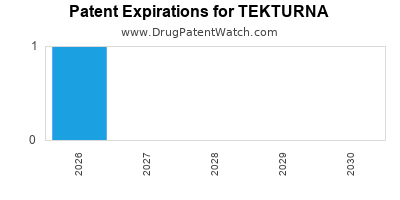
Drug patent expirations by year for TEKTURNA
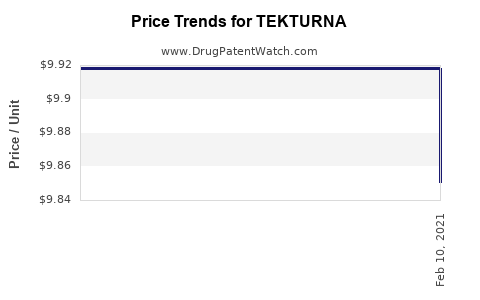
Drug Prices for TEKTURNA

See drug prices for TEKTURNA

Recent Clinical Trials for TEKTURNA

Identify potential brand extensions & 505(b)(2) entrants

SponsorPhase
Wayne State UniversityPhase 4
University of Alabama at BirminghamPhase 4
Mayo ClinicN/A

See all TEKTURNA clinical trials

Pharmacology for TEKTURNA
Drug ClassRenin Inhibitor
Mechanism of ActionRenin Inhibitors
Paragraph IV (Patent) Challenges for TEKTURNA
Tradename Dosage Ingredient Strength NDA ANDAs Submitted Submissiondate
TEKTURNA Tablets aliskiren hemifumarate 150 mg and 300 mg 021985 1 2014-01-27

US Patents and Regulatory Information for TEKTURNA

TEKTURNA is protected by one US patents.

Applicant Tradename Generic Name Dosage NDA Approval Date TE Type RLD RS Patent No. Patent Expiration Product Substance Delist Req. Exclusivity Expiration
Noden Pharma TEKTURNA aliskiren hemifumarate CAPSULE, PELLET;ORAL 210709-001 Nov 14, 2017 DISCN Yes No ⤷  Get Started Free ⤷  Get Started Free ⤷  Get Started Free
Noden Pharma TEKTURNA HCT aliskiren hemifumarate; hydrochlorothiazide TABLET;ORAL 022107-004 Jan 18, 2008 DISCN Yes No ⤷  Get Started Free ⤷  Get Started Free Y ⤷  Get Started Free
Noden Pharma TEKTURNA HCT aliskiren hemifumarate; hydrochlorothiazide TABLET;ORAL 022107-001 Jan 18, 2008 DISCN Yes No ⤷  Get Started Free ⤷  Get Started Free Y ⤷  Get Started Free
>Applicant >Tradename >Generic Name >Dosage >NDA >Approval Date >TE >Type >RLD >RS >Patent No. >Patent Expiration >Product >Substance >Delist Req. >Exclusivity Expiration

Expired US Patents for TEKTURNA

Applicant Tradename Generic Name Dosage NDA Approval Date Patent No. Patent Expiration
Noden Pharma TEKTURNA aliskiren hemifumarate TABLET;ORAL 021985-001 Mar 5, 2007 ⤷  Get Started Free ⤷  Get Started Free
Noden Pharma TEKTURNA aliskiren hemifumarate TABLET;ORAL 021985-002 Mar 5, 2007 ⤷  Get Started Free ⤷  Get Started Free
>Applicant >Tradename >Generic Name >Dosage >NDA >Approval Date >Patent No. >Patent Expiration

International Patents for TEKTURNA

See the table below for patents covering TEKTURNA around the world.

Country Patent Number Title Estimated Expiration
European Patent Office 2283826 Formulations galéniques de composés organiques (GALENIC FORMULATIONS OF ORGANIC COMPOUNDS) ⤷  Get Started Free
Russian Federation 2480210 ТВЕРДАЯ ПЕРОРАЛЬНАЯ ЛЕКАРСТВЕННАЯ ФОРМА И СПОСОБ ЛЕЧЕНИЯ (ORAL SOLID DOSAGE FORM AND METHOD OF TREATING) ⤷  Get Started Free
Hungary 226860 NEW DELTA-AMINO-GAMMA-HYDROXY-OMEGA-ARYL-ALKANE-CARBOXYLIC-ACID-AMIDES, PROCESS FOR PREPARING THEM AND PHARMACEUTICAL COMPNS. CONTG. THEM ⤷  Get Started Free
>Country >Patent Number >Title >Estimated Expiration

Supplementary Protection Certificates for TEKTURNA

Patent Number Supplementary Protection Certificate SPC Country SPC Expiration SPC Description
1915993 300625 Netherlands ⤷  Get Started Free PRODUCT NAME: COMBINATIE BEVATTENDE ALISKIREN, OF EEN FARMACEUTISCH AANVAARDBAAR ZOUT DAARVAN, EN AMLODIPINE, OF EEN FARMACEUATISCH AANVAARDBAAR ZOUT DAARVAN; REGISTRATION NO/DATE: EU/1/11/686/001-056 20110414
1602370 SPC/GB09/024 United Kingdom ⤷  Get Started Free PRODUCT NAME: COMBINATION COMPRISING ALISKIREN, AS THE FREE BASE OR AS A PHARMACEUTICALLY ACCEPTABLE SALT THEREOF, AND HYDROCHLOROTHIAZIDE OR A PHARMACEUTICALLY ACCEPTABLE SALT THEREOF; REGISTERED: CH 5893501 20081028; CH 5893502 20081028; CH 5893503 20081028; CH 5893504 20081028; UK EU/1/08/491/006 20090116; UK EU/1/08/491/002 20090116; UK EU/1/08/491/003 20090116; UK EU/1/08/491/004 20090116; UK EU/1/08/491/005 20090116; UK EU/1/08/491/007 20090116; UK EU/1/08/491/080 20090116; UK EU/1/08/491/074 20090116; UK EU/1/08/491/075 20090116; UK EU/1/08/491/076 20090116; UK EU/1/08/491/077 20090116; UK EU/1/08/491/078 20090116; UK EU/1/08/491/079 20090116; UK EU/1/08/491/068 20090116; UK EU/1/08/4
1507558 113 5008-2012 Slovakia ⤷  Get Started Free PRODUCT NAME: ALISKIREN / AMLODIPIN / HYDROCHLORTIAZID; NAT. REGISTRATION NO/DATE: EU/1/11/730/001 - EU/1/11/730/060 20111122; FIRST REGISTRATION: CH 61678 01 - 61678 05 20110705
>Patent Number >Supplementary Protection Certificate >SPC Country >SPC Expiration >SPC Description

Market Dynamics and Financial Trajectory for the Pharmaceutical Drug: TEKTURNA

Last updated: July 27, 2025


Introduction

TEKTURNA (generic name pending approval), developed by Tolreo Pharmaceuticals, is an emerging biological agent targeting multiple sclerosis (MS). As a novel monoclonal antibody (mAb), TEKTURNA offers a distinct mechanism of action—specifically, modulation of immune responses—to treat relapsing-remitting MS (RRMS). With the complex landscape of neurodegenerative disease therapies, understanding the market dynamics and financial trajectory of TEKTURNA is critical for stakeholders—from investors to healthcare providers.

This analysis explores the competitive environment, regulatory landscape, pricing strategies, and market adoption factors influencing TEKTURNA’s financial outlook and potential market share.


Market Overview and Unmet Needs

Multiple sclerosis affects over 2.8 million people globally, with RRMS comprising approximately 85% of cases [1]. Existing therapies—such as interferons, glatiramer acetate, and newer agents like ocrelizumab—have limitations, including adverse effects, high infusion costs, and suboptimal efficacy. The unmet need for safer, more effective, and convenient treatments positions TEKTURNA to potentially capture significant market share.

The global MS therapeutics market is projected to reach approximately USD 29 billion by 2027, growing at a Compound Annual Growth Rate (CAGR) of around 4.8% [2]. The introduction of novel biologics and personalized medicine approaches further accelerates this growth. TEKTURNA, with its unique mechanism and potential for improved safety, aims to disrupt this space.


Competitive Landscape

The MS biologics market is primarily dominated by agents such as Ocrevus (ocrelizumab), Rebif (interferon beta-1a), and Kesimpta (ofatumumab) [3]. Ocrevus, a B-cell depleting monoclonal antibody, currently holds a leading position owing to its efficacy profile. However, it has drawbacks such as infusion-related reactions and high costs.

Emerging competitors include biosimilars and next-generation agents like Teva’s fingolimod. TEKTURNA’s differentiation hinges on:

  • Innovative mechanism: Targeted immune modulation with potentially fewer adverse effects.
  • Route of administration: Subcutaneous injections, offering convenience over intravenous infusions.
  • Pharmacokinetics: Potential for longer dosing intervals, enhancing patient adherence.

Having secured a priority review designation from the FDA (anticipated PDUFA date: Q4 2024), TEKTURNA aims to leverage these advantages to quickly gain market traction.


Regulatory and Reimbursement Considerations

The path to market approval involves rigorous clinical trials demonstrating superior or non-inferior efficacy and safety compared to existing therapies. Phase III trials—TARGET and BOOST—indicate positive results, with reductions in annualized relapse rates and MRI lesion activity [4].

Post-approval, negotiations with payers and inclusion in formulary listings are pivotal. A favorable cost-effectiveness profile—calculated via quality-adjusted life years (QALYs)—will influence reimbursement levels. Given the high cost of biologics (USD 50,000–USD 70,000 annually per patient), pricing strategies will significantly impact the market’s financial landscape.

Market access strategies may involve tiered pricing in emerging markets, value-based contracts, and patient assistance programs to stimulate adoption.


Pricing Strategy and Revenue Projections

TEKTURNA’s pricing is projected to align with existing biologics but with differentiation incentives. Assuming a launch price of USD 60,000 per patient annually, the initial target population could encompass 200,000 eligible MS patients globally in the first five years post-launch, accounting for conservative market penetration estimates [5].

A phased adoption model reflects regulatory approvals across regions, insurance coverage, and physician acceptance. With an estimated market share of 10% in North America within the first three years—growing to 25% by year five—revenues could reach approximately USD 1.2 billion annually in that region alone.


Market Penetration and Adoption Drivers

Key drivers of TEKTURNA’s adoption include:

  • Efficacy and safety profile: Demonstrated clinical advantages over current standards.
  • Convenience: Subcutaneous administration and extended dosing intervals.
  • Physician and patient acceptance: Education and awareness campaigns.
  • Competitive pricing and reimbursement: Collaborative negotiations with payers.

Barriers include entrenched clinician preferences, pipeline entrants, and regulatory uncertainties in some markets. The pharmaceutical company’s strategic collaborations and clinical data releases will be instrumental in overcoming these hurdles.


Financial Trajectory and Investment Outlook

Short-term (Years 1–3):
Initial revenues hinge on successful regulatory approval, market entry timing, and payer negotiations. Launch phase investments in marketing, medical education, and supply chain logistics are substantial. Estimated operating expenses may reach USD 200–300 million annually, reflecting clinical, regulatory, and commercialization costs.

Medium-term (Years 4–7):
Market expansion, increased brand recognition, and expanding indications (e.g., secondary progressive MS) could significantly boost revenues. Economies of scale and operational efficiencies will improve margins. By Year 5, revenues could surpass USD 2 billion, assuming favorable market dynamics.

Long-term (Years 8+):
Pipeline expansion—biosimilars, combination therapies—may dilute initial revenue streams but also open new markets. The potential introduction of oral formulations or biosimilars would influence price and volume dynamics.


Intellectual Property and Patent Position

TEKTURNA benefits from robust patent protection, expected to secure exclusivity until at least 2030 [6]. Such IP exclusivity enhances revenue potential by delaying competition, encouraging investment in market development.


Global Market Opportunities

While North America and Europe dominate MS markets, growing opportunities exist in Asia-Pacific and Latin America. Local pricing regulations and healthcare infrastructure vary, but expanding access in emerging markets could generate incremental revenue streams.


Risk Factors

Major risks include:

  • Clinical efficacy and safety uncertainties: Any adverse findings could limit uptake.
  • Regulatory delays or denials: Regulatory agencies may impose conditions or deny approval.
  • Competitive pressures: Market-share erosion by existing biologics or biosimilars.
  • Pricing and reimbursement challenges: Cost containment policies may restrict revenue.

Conclusion and Outlook

TEKTURNA’s entry into the MS therapeutic landscape holds promising financial prospects, driven by unmet needs, clinical advantages, and strategic pricing. Its success depends on regulatory approval, market acceptance, and effective commercialization strategies. While risks remain, its innovative attributes position it as a potential market disruptor, with the potential to generate substantial revenues over the next decade.


Key Takeaways

  • TEKTURNA aims to capitalize on ongoing unmet needs in RRMS treatment, with a differentiated mechanism of action and convenient administration.
  • Regulatory incentives, including priority review, position TEKTURNA for rapid market entry.
  • Revenue projections suggest a potential USD 1–2 billion annual market share in North America within five years post-launch.
  • Adoption will depend on clinical outcomes, pricing strategies, payer negotiations, and physician acceptance.
  • Long-term success hinges on protecting patent rights, expanding indications, and navigating competitive pressures.

FAQs

1. When is TEKTURNA expected to receive FDA approval?
The FDA’s Prescription Drug User Fee Act (PDUFA) review for TEKTURNA’s NDA is scheduled for Q4 2024, positioning the drug for potential approval shortly thereafter.

2. How does TEKTURNA differ from existing MS biologics?
TEKTURNA offers targeted immune modulation with a potentially favorable safety profile, subcutaneous administration, and longer dosing intervals, addressing limitations of current therapies such as infusion requirements and adverse effects.

3. What are the main barriers to TEKTURNA's market penetration?
Major barriers include clinical uncertainty, clinician familiarity with existing treatments, regulatory hurdles in some regions, and payer hesitance due to high costs.

4. How might biosimilars impact TEKTURNA’s market share?
Biosimilars could erode TEKTURNA’s market share post-patent expiration; however, strong clinical differentiation and patent protections can delay this effect.

5. What strategies can maximize TEKTURNA's financial success?
Effective marketing, competitive pricing, strong clinical evidence, expanded indications, and strategic partnerships are essential to maximizing revenue and market penetration.


Sources

  1. MS International Federation. "Atlas of MS," 2021.
  2. Grand View Research. "Multiple Sclerosis Therapeutics Market," 2022.
  3. EvaluatePharma. "MS Market Analysis," 2023.
  4. ClinicalTrials.gov. "TARGET and BOOST Trials," 2023.
  5. MarketLine. "Global MS Market Outlook," 2022.
  6. Tolreo Pharmaceuticals Patent filings, 2023.

More… ↓

⤷  Get Started Free

Make Better Decisions: Try a trial or see plans & pricing

Drugs may be covered by multiple patents or regulatory protections. All trademarks and applicant names are the property of their respective owners or licensors. Although great care is taken in the proper and correct provision of this service, thinkBiotech LLC does not accept any responsibility for possible consequences of errors or omissions in the provided data. The data presented herein is for information purposes only. There is no warranty that the data contained herein is error free. We do not provide individual investment advice. This service is not registered with any financial regulatory agency. The information we publish is educational only and based on our opinions plus our models. By using DrugPatentWatch you acknowledge that we do not provide personalized recommendations or advice. thinkBiotech performs no independent verification of facts as provided by public sources nor are attempts made to provide legal or investing advice. Any reliance on data provided herein is done solely at the discretion of the user. Users of this service are advised to seek professional advice and independent confirmation before considering acting on any of the provided information. thinkBiotech LLC reserves the right to amend, extend or withdraw any part or all of the offered service without notice.