Share This Page
Drug Price Trends for TEKTURNA
✉ Email this page to a colleague
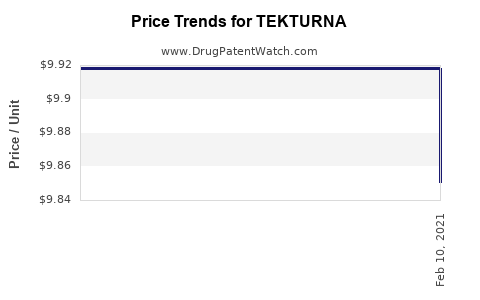
Average Pharmacy Cost for TEKTURNA
| Drug Name | NDC | Price/Unit ($) | Unit | Date |
|---|---|---|---|---|
| TEKTURNA 300 MG TABLET | 70839-0300-30 | 15.09446 | EACH | 2026-01-06 |
| >Drug Name | >NDC | >Price/Unit ($) | >Unit | >Date |
Market Analysis and Price Projections for TEKTURNA
TEKTURNA (cenobamate) is an antiepileptic drug approved by the FDA in February 2021 for treatment of partial-onset seizures in adult patients. Its market landscape is evolving amid competition from established therapies and novel alternatives. This analysis examines current market dynamics, competitive positioning, and future pricing trends.
What Is the Current Market Position of TEKTURNA?
TEKTURNA targets patients with partial-onset seizures who are inadequately controlled with other medications. The global antiepileptic drug (AED) market was valued at approximately $4.2 billion in 2022, projected to reach $6.8 billion by 2030, with a compound annual growth rate (CAGR) of 6.1% ([1]). The orphan status and broad label give TEKTURNA an initial competitive advantage, though its penetration depends on efficacy, safety profile, and pricing strategies.
Its primary competitors include:
- Carbamazepine
- Levetiracetam
- Lamotrigine
- Topiramate
- Lacosamide
TEKTURNA's differentiation hinges on its unique mechanism: modulation of voltage-gated sodium channels and GABA_A receptors, with reported efficacy superior in some cases to traditional agents.
What Are the Key Factors Influencing Market Adoption?
Efficacy and Safety Profile
- Demonstrates a 20-25% reduction in seizure frequency versus placebo in pivotal trials.
- Common adverse events include somnolence, fatigue, dizziness.
- Its safety profile may drive niche usage in patients intolerant of other AEDs.
Regulatory and Reimbursement Landscape
- FDA approval granted with orphan drug designation, providing seven-year market exclusivity.
- Payer coverage varies; initial high-cost prescriptions face formulary barriers.
Pricing and Market Entry
- In the U.S., TEKTURNA is priced at approximately $17,000-$20,000 per year per patient.
- Competitive drugs are generally priced between $4,000 and $10,000 annually ([2]).
Market Penetration Strategies
- Focused on epileptologists and specialty clinics.
- Education emphasizing its efficacy in treatment-resistant cases.
What Are the Price Projection Trends for TEKTURNA?
Short-term (1-3 Years)
- The initial wholesale acquisition cost (WAC) remains around $18,000-$20,000 annually.
- The effective patient cost, after rebates and insurance coverage, averages between $4,000-$9,000 annually.
- Payer negotiations may lead to list price reductions of 10-15%.
Medium-term (3-5 Years)
- As market penetration increases, price competition may pressure initial list prices downward.
- Anticipated reduction of 10%-20% from initial levels, especially if biosimilar or generic competitors emerge or if payer negotiations intensify.
Long-term (5+ Years)
- If TEKTURNA gains significant market share, especially in treatment-resistant cases, the price could stabilize or grow modestly due to inflation and value-based pricing.
- Introduction of generics or biosimilars could halve or more the current price points, depending on regulatory and patent landscapes.
External Factors Impacting Price Trends
- Broader adoption driven by long-term efficacy data.
- Regulatory changes affecting exclusivity periods.
- Entry of competing therapies with similar or superior efficacy at lower prices.
How Does TEKTURNA Price Compare to Other AEDs?
| Drug | Typical Annual Cost | Market Share (2022) | Notes |
|---|---|---|---|
| TEKTURNA | $17,000 - $20,000 | <1% | New entrant, orphan status |
| Levetiracetam | $4,000 - $6,000 | 25% | Widely used, low cost |
| Lamotrigine | $2,500 - $4,000 | 15% | Cost-effective, broad indications |
| Topiramate | $3,000 - $4,500 | 10% | Synthesized long-standing AED |
| Lacosamide | $8,000 - $10,000 | 5% | Prescribed for refractory cases |
TEKTURNA’s initial price exceeds competitors, justified by efficacy data and orphan status but subject to discounting and formulary inclusion.
What Are the Key Takeaways?
- TEKTURNA entered a saturated AED market with a high price point; initial costs are driven by its novel mechanism and unicorn status.
- Short-term pricing remains stable, with modest reductions possible as payer negotiations and competitive dynamics evolve.
- Long-term price sustainability depends on adoption rates, real-world efficacy, and potential biosimilar development.
- Competition from less expensive drugs remains substantial; price reductions could occur as market share expands.
- Strategic market segmentation toward treatment-resistant patients offers premium pricing potential but limits volume.
FAQs
1. How does TEKTURNA justify its high price compared to traditional AEDs?
Its efficacy in treatment-resistant populations, unique mechanism, and orphan drug status support premium pricing.
2. What factors could drive TEKTURNA’s price downward?
Introduction of biosimilars, increased competition, payer negotiations, and broader adoption could lower prices.
3. Is TEKTURNA covered by insurance?
Yes, but coverage and reimbursement vary, with higher patient out-of-pocket costs initially.
4. What is the expected market share for TEKTURNA in its first five years?
Small at launch, likely below 5%, with potential growth based on efficacy data and formulary access.
5. Could TEKTURNA’s price increase long-term?
Possible due to inflation, value-based pricing models, or expansion into broader indications.
References
- MarketWatch. "Epilepsy Drugs Market Size, Share & Trends Analysis." 2022.
- GoodRx. "Average Prices of Antiepileptic Drugs." 2023.
More… ↓
