Last updated: August 16, 2026
Tecfidera, Biogen’s oral dimethyl fumarate treatment for relapsing forms of multiple sclerosis, has moved from blockbuster growth to post-exclusivity erosion. U.S. generic entry began in 2020 after a key patent was invalidated, while competition from Vumerity, Aubagio generics, Ocrevus, Kesimpta, and Briumvi has reduced Tecfidera’s strategic value. Global Tecfidera revenue fell from approximately $4.4 billion in 2019 to about $1.2 billion in 2023, according to Biogen filings.[1-4]
What is Tecfidera and how does it generate revenue?
Tecfidera is an oral delayed-release formulation of dimethyl fumarate. The FDA approved it in March 2013 for adults with relapsing forms of multiple sclerosis, including relapsing-remitting multiple sclerosis, active secondary progressive disease, and clinically isolated syndrome.[5]
The product’s commercial advantages were:
- Oral administration rather than injection or infusion.
- Early positioning as a high-volume first-line disease-modifying therapy.
- A relatively simple small-molecule manufacturing process.
- Broad prescriber familiarity within the multiple sclerosis market.
Tecfidera competes with injectable therapies, oral agents, and infusion products. Its commercial profile weakened after generic dimethyl fumarate became available in the United States and after Biogen introduced Vumerity, another fumarate product intended to improve gastrointestinal tolerability.
How much revenue has Tecfidera generated?
Tecfidera reached peak annual revenue before generic competition and then entered a sustained decline.
| Fiscal year |
Approximate Tecfidera revenue |
Commercial position |
| 2018 |
$3.9 billion |
Major growth product |
| 2019 |
$4.4 billion |
Peak revenue period |
| 2020 |
$3.0 billion |
Generic litigation and launch year |
| 2021 |
$2.0 billion |
Accelerated U.S. erosion |
| 2022 |
$1.5 billion |
Mature post-exclusivity product |
| 2023 |
$1.2 billion |
Continued generic and branded competition |
Sources: Biogen annual reports and Form 10-K filings.[1-4]
The revenue decline was concentrated in the United States, where generic substitution created price and volume pressure. International erosion developed more gradually because regulatory approvals, national reimbursement systems, and generic launch timing differed by country.
Why did Tecfidera revenue decline so quickly?
Three factors drove the decline:
- Generic dimethyl fumarate entry. Generic products competed directly with the same active ingredient and dosage form.
- Loss of U.S. patent protection. The main Tecfidera formulation patent was invalidated in litigation.
- Therapeutic substitution. Neurologists increasingly used alternatives such as Ocrevus, Kesimpta, Vumerity, and newer high-efficacy therapies.
Biogen also faced a strategic tradeoff. Vumerity could retain some fumarate patients within Biogen’s portfolio, but it could not fully replace Tecfidera revenue because Vumerity entered a market with multiple branded and generic alternatives.
When did Tecfidera lose U.S. exclusivity?
Tecfidera’s U.S. market exclusivity ended in practice in 2020. The key patent dispute concerned U.S. Patent No. 8,399,514, which covered a delayed-release dimethyl fumarate composition and was listed in the FDA Orange Book.[6]
The U.S. District Court for the District of Delaware ruled in 2020 that the patent was invalid for obviousness. The Federal Circuit affirmed the decision, allowing generic entry before the patent’s nominal expiration date.[7-8]
The principal patent timeline was:
| Event |
Date |
| Tecfidera FDA approval |
March 27, 2013 |
| U.S. Patent No. 8,399,514 issuance |
March 12, 2013 |
| Key patent litigation decision |
2020 |
| Generic dimethyl fumarate U.S. launches |
2020 |
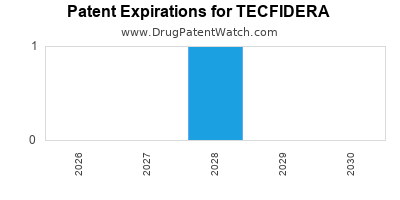
| Nominal expiration of the challenged patent |
2028, subject to legal and regulatory adjustments |
The effective commercial protection ended years before the nominal patent expiration because invalidation removed the enforceable barrier to generic marketing.
What patents protect Tecfidera?
Tecfidera’s principal U.S. patent estate centered on the delayed-release oral formulation rather than a highly complex active pharmaceutical ingredient.
| Patent |
General subject matter |
Commercial relevance |
| U.S. Patent No. 7,619,001 |
Dimethyl fumarate and related pharmaceutical compositions |
Earlier composition and formulation protection |
| U.S. Patent No. 8,399,514 |
Delayed-release dimethyl fumarate formulation |
Main Orange Book patent challenged by generics |
| Related continuation and foreign patents |
Formulation, dosing, and pharmaceutical use claims |
Variable jurisdictional protection |
The ’514 patent became the central barrier because it covered the commercially important delayed-release product. The court’s obviousness ruling materially reduced the value of related formulation claims in the United States.[7]
What formulation patents protect Tecfidera?
Tecfidera’s formulation claims generally addressed delayed release, oral dosage forms, and treatment using dimethyl fumarate. These claims were commercially important because the branded product was not marketed as an immediate-release capsule.
The formulation strategy also created a regulatory pathway for generic competitors. Generic manufacturers could seek approval through an abbreviated new drug application by demonstrating pharmaceutical equivalence and bioequivalence to Tecfidera, subject to patent certification and litigation risk.
Which companies challenged Tecfidera patents?
The principal generic challengers included Mylan, Biocon, Zydus Pharmaceuticals, and other abbreviated new drug application sponsors. Their Paragraph IV certifications asserted that the listed Tecfidera patent was invalid, unenforceable, or would not be infringed by the proposed generic products.[7]
Biogen filed patent litigation to preserve its U.S. exclusivity. The resulting Delaware case established the commercial outcome: the principal listed patent was invalid, and generic entry followed.
What was the Paragraph IV litigation outcome?
The litigation produced an adverse result for Biogen. The court held the ’514 patent invalid for obviousness, and the Federal Circuit affirmed. That outcome was more consequential than a conventional settlement because it removed the key enforceable patent barrier and enabled market entry by multiple generic manufacturers.[7-8]
The case also illustrates the risk of relying on a formulation patent with broad commercial importance but limited technical complexity. Once the patent failed the obviousness test, the entire U.S. branded franchise became vulnerable.
What is the Orange Book status of Tecfidera?
Tecfidera was listed in the FDA Orange Book with patents covering its approved delayed-release formulation. The most important listed patent was U.S. Patent No. 8,399,514.[6]
After invalidation, the patent no longer provided an effective exclusionary right against approved generic dimethyl fumarate products. Orange Book listing alone did not preserve market exclusivity because a listed patent must remain enforceable and withstand Paragraph IV litigation.
Tecfidera’s regulatory position differs from that of a biologic. It is a small-molecule drug approved under a conventional new drug application, so competitors enter through the ANDA pathway rather than through the biosimilar pathway.
Does Tecfidera face biosimilar risk?
No. Tecfidera does not face biosimilar risk because dimethyl fumarate is a small-molecule drug. The relevant competitive threat is generic substitution.
The distinction affects:
- Approval standards.
- Interchangeability rules.
- Patent litigation mechanics.
- Pricing erosion.
- Manufacturing requirements.
Generic dimethyl fumarate manufacturers can rely on the reference product’s safety and efficacy findings while demonstrating bioequivalence. That generally produces faster and more severe price pressure than many biologic products experience after biosimilar entry.
How does Tecfidera compare with Vumerity?
Vumerity is Biogen’s diroximel fumarate product, approved in 2019 for relapsing forms of multiple sclerosis. It was developed to provide a fumarate option with potentially improved gastrointestinal tolerability compared with Tecfidera.[9]
| Factor |
Tecfidera |
Vumerity |
| Active ingredient |
Dimethyl fumarate |
Diroximel fumarate |
| FDA approval |
2013 |
2019 |
| Dosage form |
Delayed-release capsule |
Delayed-release capsule |
| U.S. generic exposure |
High |
Lower than Tecfidera during the earlier period |
| Strategic role |
Mature, post-exclusivity product |
Lifecycle-management product |
| Main risk |
Generic price erosion |
Reimbursement and competitor pressure |
Vumerity helped Biogen shift some patients from Tecfidera into a newer branded fumarate. It did not eliminate the economic impact of low-cost generic dimethyl fumarate.
What competitors are affecting Tecfidera demand?
Tecfidera competes across several segments of the multiple sclerosis market.
Oral competitors
Aubagio, Gilenya, Mayzent, and Mavenclad compete with Tecfidera as oral disease-modifying therapies. Aubagio became subject to generic competition after loss of exclusivity, increasing pressure across the oral segment.
High-efficacy therapies
Ocrevus, Kesimpta, and Briumvi compete for patients and treatment decisions where physicians prioritize high efficacy. These therapies are particularly relevant in newly diagnosed patients with high disease activity and in treatment-escalation strategies.
Biogen’s internal portfolio
Biogen’s own products create both portfolio protection and cannibalization risk. Vumerity can retain patients within Biogen, while Tysabri and other therapies address different disease-severity and administration preferences.
What manufacturing and intellectual-property barriers remain?
Manufacturing barriers are moderate. Dimethyl fumarate is a known small molecule and does not require the specialized cell-culture, viral-clearance, or cold-chain infrastructure associated with biologics.
The principal barriers are:
- Pharmaceutical-grade active ingredient supply.
- Delayed-release capsule manufacturing.
- Stability and impurity control.
- Bioequivalence testing.
- Regulatory filing and patent certification.
- Commercial scale and payer access.
These barriers can delay smaller entrants but do not create a durable moat comparable to a complex biologic manufacturing process.
What generic launch risks exist for Tecfidera?
The main generic launch risk is sustained price compression rather than a single launch event. Multiple approved or marketed generic products can create rapid pharmacy substitution and payer-driven formulary displacement.
Generic competition affects Biogen through:
- Lower net price.
- Reduced prescription volume.
- Loss of preferred formulary position.
- Greater rebate pressure on remaining branded sales.
- Lower return on promotional and medical-affairs spending.
The risk is highest in the United States, where pharmacy substitution is more direct. International exposure depends on local reimbursement and substitution rules.
What licensing deals affect Tecfidera?
Tecfidera’s commercial history is primarily associated with Biogen’s internal development and commercialization rather than a major external licensing transaction. Biogen obtained the product through its acquisition of Fumapharm, which had developed fumarate-based multiple sclerosis therapies. Biogen completed the acquisition in 2006.[10]
The transaction gave Biogen control over fumarate intellectual property and development programs that ultimately supported Tecfidera. No later licensing agreement has restored the product’s lost U.S. exclusivity.
What is the future financial trajectory for Tecfidera?
Tecfidera is likely to remain a declining mature product rather than return to blockbuster growth. Revenue can persist through:
- Brand loyalty among established patients.
- International markets with slower generic penetration.
- Patients who prefer an oral therapy.
- Supply or reimbursement differences that limit generic substitution.
- Biogen’s ability to retain some fumarate demand through Vumerity.
The main downside is continued substitution by lower-priced generics and newer high-efficacy therapies. Tecfidera’s remaining value is more consistent with cash generation from a mature brand than with a growth asset.
Key Takeaways
- Tecfidera was approved by the FDA in 2013 and reached peak annual revenue of roughly $4.4 billion in 2019.
- Generic dimethyl fumarate entered the U.S. market in 2020.
- U.S. Patent No. 8,399,514, the key delayed-release formulation patent, was invalidated for obviousness.
- Tecfidera’s effective U.S. exclusivity ended well before the patent’s nominal 2028 expiration.
- The product faces generic, branded oral, and high-efficacy biologic competition.
- Tecfidera has generic risk, not biosimilar risk.
- Vumerity is Biogen’s principal lifecycle-management product in the fumarate class.
- Revenue has fallen to approximately $1.2 billion by 2023 and is expected to continue declining as generic penetration expands.
Frequently Asked Questions
Is Tecfidera still patent protected?
Tecfidera’s key U.S. formulation patent was invalidated in litigation, so it no longer provides an effective commercial barrier against generic dimethyl fumarate.
When did generic Tecfidera become available?
Generic dimethyl fumarate became available in the United States in 2020 after the principal patent litigation concluded.
Is generic dimethyl fumarate therapeutically equivalent to Tecfidera?
FDA-approved generic dimethyl fumarate products must meet applicable pharmaceutical equivalence and bioequivalence requirements for the reference product. Individual product labeling and substitution status depend on FDA approval details.
What drug replaced Tecfidera in Biogen’s portfolio?
Vumerity is the closest Biogen product in terms of fumarate class and intended patient population. Tysabri and other Biogen products address different treatment segments.
Can Tecfidera revenue recover after generic entry?
A material recovery is unlikely. Residual revenue can continue in markets with slower generic adoption, but U.S. price and volume erosion limits the product’s recovery potential.
References
- Biogen Inc. (2020). 2020 annual report. https://investors.biogen.com/financial-information/annual-reports
- Biogen Inc. (2021). 2021 annual report. https://investors.biogen.com/financial-information/annual-reports
- Biogen Inc. (2022). 2022 annual report. https://investors.biogen.com/financial-information/annual-reports
- Biogen Inc. (2023). 2023 annual report. https://investors.biogen.com/financial-information/annual-reports
- U.S. Food and Drug Administration. (2013). FDA approves new multiple sclerosis treatment Tecfidera. https://www.fda.gov
- U.S. Food and Drug Administration. (n.d.). Orange Book: Approved drug products with therapeutic equivalence evaluations. https://www.accessdata.fda.gov/scripts/cder/ob/
- Biogen International GmbH v. Mylan Pharmaceuticals Inc., 18-cv-00156, 2020 WL 3317106 (D. Del. June 18, 2020).
- Biogen International GmbH v. Mylan Pharmaceuticals Inc., 18-1163, 2021 WL 1259560 (Fed. Cir. Apr. 6, 2021).
- U.S. Food and Drug Administration. (2019). FDA approves Vumerity for relapsing forms of multiple sclerosis. https://www.fda.gov
- Biogen Idec. (2006). Biogen Idec completes acquisition of Fumapharm. https://investors.biogen.com