TAVALISSE Drug Patent Profile
✉ Email this page to a colleague
When do Tavalisse patents expire, and when can generic versions of Tavalisse launch?
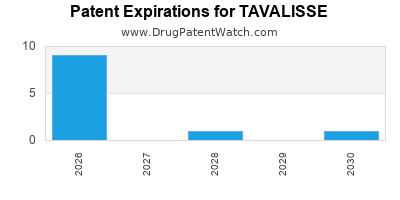
Tavalisse is a drug marketed by Rigel Pharms and is included in one NDA. There are fourteen patents protecting this drug and one Paragraph IV challenge.
The generic ingredient in TAVALISSE is fostamatinib disodium. There is one drug master file entry for this compound. One supplier is listed for this compound. Additional details are available on the fostamatinib disodium profile page.
DrugPatentWatch® Litigation and Generic Entry Outlook for Tavalisse
A generic version of TAVALISSE was approved as fostamatinib disodium by ANNORA PHARMA on June 17th, 2026.
AI Deep Research
Questions you can ask:
- What is the 5 year forecast for TAVALISSE?
- What are the global sales for TAVALISSE?
- What is Average Wholesale Price for TAVALISSE?
Summary for TAVALISSE
| US Patents: | 14 |
| Applicants: | 1 |
| NDAs: | 1 |
| Finished Product Suppliers / Packagers: | 1 |
| Raw Ingredient (Bulk) Api Vendors: | 165 |
| Clinical Trials: | 3 |
| Patent Applications: | 2,567 |
| Drug Prices: | Drug price information for TAVALISSE |
| Patent Litigation and PTAB cases: | See patent lawsuits and PTAB cases for TAVALISSE |
| What excipients (inactive ingredients) are in TAVALISSE? | TAVALISSE excipients list |
| DailyMed Link: | TAVALISSE at DailyMed |

Recent Clinical Trials for TAVALISSE
Identify potential brand extensions & 505(b)(2) entrants
| Sponsor | Phase |
|---|---|
| Holdsworth House Medical Practice | Phase 2 |
| Washington University School of Medicine | Phase 2 |
| Rigel Pharmaceuticals | Phase 2 |
Paragraph IV (Patent) Challenges for TAVALISSE
| Tradename | Dosage | Ingredient | Strength | NDA | ANDAs Submitted | Submissiondate |
|---|---|---|---|---|---|---|
| TAVALISSE | Tablets | fostamatinib disodium | 100 mg and 150 mg | 209299 | 1 | 2022-04-18 |
US Patents and Regulatory Information for TAVALISSE
TAVALISSE is protected by fourteen US patents.
| Applicant | Tradename | Generic Name | Dosage | NDA | Approval Date | TE | Type | RLD | RS | Patent No. | Patent Expiration | Product | Substance | Delist Req. | Exclusivity Expiration |
|---|---|---|---|---|---|---|---|---|---|---|---|---|---|---|---|
| Rigel Pharms | TAVALISSE | fostamatinib disodium | TABLET;ORAL | 209299-002 | Apr 17, 2018 | AB | RX | Yes | Yes | ⤷ Start Trial | ⤷ Start Trial | Y | ⤷ Start Trial | ||
| Rigel Pharms | TAVALISSE | fostamatinib disodium | TABLET;ORAL | 209299-001 | Apr 17, 2018 | AB | RX | Yes | No | ⤷ Start Trial | ⤷ Start Trial | ⤷ Start Trial | |||
| Rigel Pharms | TAVALISSE | fostamatinib disodium | TABLET;ORAL | 209299-002 | Apr 17, 2018 | AB | RX | Yes | Yes | ⤷ Start Trial | ⤷ Start Trial | Y | ⤷ Start Trial | ||
| Rigel Pharms | TAVALISSE | fostamatinib disodium | TABLET;ORAL | 209299-002 | Apr 17, 2018 | AB | RX | Yes | Yes | ⤷ Start Trial | ⤷ Start Trial | Y | ⤷ Start Trial | ||
| Rigel Pharms | TAVALISSE | fostamatinib disodium | TABLET;ORAL | 209299-001 | Apr 17, 2018 | AB | RX | Yes | No | ⤷ Start Trial | ⤷ Start Trial | Y | ⤷ Start Trial | ||
| Rigel Pharms | TAVALISSE | fostamatinib disodium | TABLET;ORAL | 209299-001 | Apr 17, 2018 | AB | RX | Yes | No | ⤷ Start Trial | ⤷ Start Trial | Y | ⤷ Start Trial | ||
| Rigel Pharms | TAVALISSE | fostamatinib disodium | TABLET;ORAL | 209299-001 | Apr 17, 2018 | AB | RX | Yes | No | ⤷ Start Trial | ⤷ Start Trial | Y | ⤷ Start Trial | ||
| >Applicant | >Tradename | >Generic Name | >Dosage | >NDA | >Approval Date | >TE | >Type | >RLD | >RS | >Patent No. | >Patent Expiration | >Product | >Substance | >Delist Req. | >Exclusivity Expiration |
Expired US Patents for TAVALISSE
| Applicant | Tradename | Generic Name | Dosage | NDA | Approval Date | Patent No. | Patent Expiration |
|---|---|---|---|---|---|---|---|
| Rigel Pharms | TAVALISSE | fostamatinib disodium | TABLET;ORAL | 209299-002 | Apr 17, 2018 | ⤷ Start Trial | ⤷ Start Trial |
| Rigel Pharms | TAVALISSE | fostamatinib disodium | TABLET;ORAL | 209299-001 | Apr 17, 2018 | ⤷ Start Trial | ⤷ Start Trial |
| Rigel Pharms | TAVALISSE | fostamatinib disodium | TABLET;ORAL | 209299-002 | Apr 17, 2018 | ⤷ Start Trial | ⤷ Start Trial |
| Rigel Pharms | TAVALISSE | fostamatinib disodium | TABLET;ORAL | 209299-001 | Apr 17, 2018 | ⤷ Start Trial | ⤷ Start Trial |
| Rigel Pharms | TAVALISSE | fostamatinib disodium | TABLET;ORAL | 209299-002 | Apr 17, 2018 | ⤷ Start Trial | ⤷ Start Trial |
| Rigel Pharms | TAVALISSE | fostamatinib disodium | TABLET;ORAL | 209299-002 | Apr 17, 2018 | ⤷ Start Trial | ⤷ Start Trial |
| Rigel Pharms | TAVALISSE | fostamatinib disodium | TABLET;ORAL | 209299-001 | Apr 17, 2018 | ⤷ Start Trial | ⤷ Start Trial |
| >Applicant | >Tradename | >Generic Name | >Dosage | >NDA | >Approval Date | >Patent No. | >Patent Expiration |
International Patents for TAVALISSE
When does loss-of-exclusivity occur for TAVALISSE?
Based on analysis by DrugPatentWatch, the following patents block generic entry in the countries listed below:
Argentina
Patent: 7371
Patent: FORMULACIONES DE (TRIMETOXIFENILAMINO)PIRIMIDINILO, METODOS
Estimated Expiration: ⤷ Start Trial
Australia
Patent: 12288632
Patent: New (trimethoxyphenylamino)pyrimidinyl formulations
Estimated Expiration: ⤷ Start Trial
Brazil
Patent: 2014001999
Patent: composição farmacêutica, forma de dosagem unitária, formulação de granulação a úmido, formulação de compactação por roletes, formulação de compressão direta, e, método para a preparação de uma composição farmacêutica
Estimated Expiration: ⤷ Start Trial
Canada
Patent: 43138
Patent: NOUVELLES FORMULATIONS DE (TRIMETHOXYPHENYLAMINO)PYRIMIDINYLE (NEW (TRIMETHOXYPHENYLAMINO)PYRIMIDINYL FORMULATIONS)
Estimated Expiration: ⤷ Start Trial
China
Patent: 3826610
Estimated Expiration: ⤷ Start Trial
Croatia
Patent: 0190186
Estimated Expiration: ⤷ Start Trial
Cyprus
Patent: 22596
Estimated Expiration: ⤷ Start Trial
Denmark
Patent: 36487
Estimated Expiration: ⤷ Start Trial
Eurasian Patent Organization
Patent: 8432
Patent: НОВЫЕ СОСТАВЫ НА ОСНОВЕ (ТРИМЕТОКСИФЕНИЛАМИНО)ПИРИМИДИНИЛОВ (NEW (TRIMETHOXYPHENYLAMINO)PYRIMIDINYL FORMULATIONS)
Estimated Expiration: ⤷ Start Trial
Patent: 1490363
Patent: НОВЫЕ СОСТАВЫ НА ОСНОВЕ (ТРИМЕТОКСИФЕНИЛАМИНО)ПИРИМИДИНИЛОВ (NEW (TRIMETHOXYPHENYLAMINO)PYRIMIDINYL FORMULATIONS)
Estimated Expiration: ⤷ Start Trial
European Patent Office
Patent: 36487
Patent: NOUVELLES FORMULATIONS DE (TRIMÉTHOXYPHÉNYLAMINO)PYRIMIDINYLE (NEW (TRIMETHOXYPHENYLAMINO)PYRIMIDINYL FORMULATIONS)
Estimated Expiration: ⤷ Start Trial
Finland
Patent: 36487
Estimated Expiration: ⤷ Start Trial
Hong Kong
Patent: 98741
Patent: 新的 三甲氧基苯氨基 嘧啶基配製品 (NEW (TRIMETHOXYPHENYLAMINO)PYRIMIDINYL FORMULATIONS ())
Estimated Expiration: ⤷ Start Trial
Hungary
Patent: 42611
Estimated Expiration: ⤷ Start Trial
Japan
Patent: 19116
Estimated Expiration: ⤷ Start Trial
Patent: 14521630
Patent: (トリメトキシフェニルアミノ)ピリミジニル製剤
Estimated Expiration: ⤷ Start Trial
Lithuania
Patent: 36487
Estimated Expiration: ⤷ Start Trial
Mexico
Patent: 9685
Patent: FORMULACIONES DE (TRIMETOXIFENILAMINO) PIRIMIDILINO NUEVAS. (NEW (TRIMETHOXYPHENYLAMINO)PYRIMIDINYL FORMULATIONS.)
Estimated Expiration: ⤷ Start Trial
Patent: 14001065
Patent: FORMULACIONES DE (TRIMETOXIFENILAMINO) PIRIMIDILINO NUEVAS. (NEW (TRIMETHOXYPHENYLAMINO)PYRIMIDINYL FORMULATIONS.)
Estimated Expiration: ⤷ Start Trial
Poland
Patent: 36487
Estimated Expiration: ⤷ Start Trial
Portugal
Patent: 36487
Estimated Expiration: ⤷ Start Trial
San Marino
Patent: 01900071
Estimated Expiration: ⤷ Start Trial
Serbia
Patent: 433
Patent: NOVE FORMULACIJE (TRIMETOKSIFENILAMINO)PIRIMIDINILA (NEW (TRIMETHOXYPHENYLAMINO)PYRIMIDINYL FORMULATIONS)
Estimated Expiration: ⤷ Start Trial
Slovenia
Patent: 36487
Estimated Expiration: ⤷ Start Trial
South Korea
Patent: 2024120
Estimated Expiration: ⤷ Start Trial
Patent: 2090440
Estimated Expiration: ⤷ Start Trial
Patent: 140058576
Patent: 신규한 피리미디닐 제형 (NEW (TRIMETHOXYPHENYLAMINO)PYRIMIDINYL FORMULATIONS)
Estimated Expiration: ⤷ Start Trial
Patent: 190109576
Patent: 신규한 피리미디닐 제형 (NEW TRIMETHOXYPHENYLAMINOPYRIMIDINYL FORMULATIONS)
Estimated Expiration: ⤷ Start Trial
Spain
Patent: 10423
Estimated Expiration: ⤷ Start Trial
Taiwan
Patent: 1311251
Patent: New (trimethoxyphenylamino) pyrimidinyl formulations
Estimated Expiration: ⤷ Start Trial
Turkey
Patent: 1901792
Estimated Expiration: ⤷ Start Trial
Uruguay
Patent: 223
Patent: FORMULACIONES DE (TRIMETOXIFENILAMINO)PIRIMIDINILO NUEVAS
Estimated Expiration: ⤷ Start Trial
Generics may enter earlier, or later, based on new patent filings, patent extensions, patent invalidation, early generic licensing, generic entry preferences, and other factors.
See the table below for additional patents covering TAVALISSE around the world.
| Country | Patent Number | Title | Estimated Expiration |
|---|---|---|---|
| Austria | E451381 | ⤷ Start Trial | |
| Australia | 2006206458 | Prodrugs of 2,4-pyrimidinediamine compounds and their uses | ⤷ Start Trial |
| Brazil | PI0606318 | composto, composição, e, uso de um composto | ⤷ Start Trial |
| Canada | 2591948 | PROMEDICAMENTS DE COMPOSES DE 2,4-PYRIMIDINEDIAMINE ET LEURSUTILISATIONS (PRODRUGS OF 2,4-PYRIMIDINEDIAMINE COMPOUNDS AND THEIR USES) | ⤷ Start Trial |
| China | 101115761 | Prodrugs of 2,4-pyrimidinediamine compounds and their uses | ⤷ Start Trial |
| Cyprus | 1109888 | ⤷ Start Trial | |
| Germany | 602006010979 | ⤷ Start Trial | |
| >Country | >Patent Number | >Title | >Estimated Expiration |
Supplementary Protection Certificates for TAVALISSE
| Patent Number | Supplementary Protection Certificate | SPC Country | SPC Expiration | SPC Description |
|---|---|---|---|---|
| 1856135 | 301039 | Netherlands | ⤷ Start Trial | PRODUCT NAME: FOSTAMATINIB OF EEN FARMACEUTISCH AANVAARDBAAR ZOUT VAN FOSTAMATINIB, OF EEN HYDRAAT, SOLVAAT OF N-OXIDE VAN FOSTAMATINIB OF HET FARMACEUTISCH AANVAARDBARE ZOUT VAN FOSTAMATINIB, IN HET BIJZONDER DINATRIUMFOSTAMATINIB EVENTUEEL IN DE VORM VAN EEN HYDRAAT; REGISTRATION NO/DATE: EU/1/19/1405 20200113 |
| 1856135 | CA 2020 00018 | Denmark | ⤷ Start Trial | PRODUCT NAME: FOSTAMATINIB OR A PHARMACEUTICALLY ACCEPTABLE SALT OF FOSTAMATINIB, OR A HYDRATE, SOLVATE OR N-OXIDE OF FOSTAMATINIB OR THE PHARMACEUTICALLY ACCEPTABLE SALT OF FOSTAMATINIB, ESPECIALLY FOSTAMATINIB DISODIUM, OPTIONALLY IN FORM OF A HYDRATE; REG. NO/DATE: EU/1/19/1405 20200113 |
| 1856135 | LUC00153 | Luxembourg | ⤷ Start Trial | PRODUCT NAME: FOSTAMATINIB OU UN SEL PHARMACEUTIQUEMENT ACCEPTABLE DE FOSTAMATINIB, OU UN HYDRATE, SOLVATE OU N-OXYDE DE FOSTAMATINIB OU LE SEL PHARMACEUTIQUEMENT ACCEPTABLE DE FOSTAMATINIB, EN PARTICULIER FOSTAMATINIB DISODIUM, EVENTUELLEMENT SOUS FORME D'HYDRATE; AUTHORISATION NUMBER AND DATE: EU/1/19/1405 20200113 |
| 1856135 | 122020000021 | Germany | ⤷ Start Trial | PRODUCT NAME: FOSTAMATINIB ODER EIN PHARMAZEUTISCH VERTRAEGLICHES SALZ, HYDRAT UND/ODER SOLVAT DAVON, INSBESONDERE DINATRIUM-FOSTAMATINIB-HEXAHYDRAT; REGISTRATION NO/DATE: EU/1/19/1405 20200109 |
| 1856135 | PA2020507 | Lithuania | ⤷ Start Trial | PRODUCT NAME: FOSTAMATINIBO DINATRIO HEKSAHIDRATAS; REGISTRATION NO/DATE: EU/1/19/1405 20200109 |
| 1856135 | 132020000000046 | Italy | ⤷ Start Trial | PRODUCT NAME: FOSTAMATINIB O SUO SALE FARMACEUTICAMENTE ACCETTABILE O IDRATO, SOLVATO O N-OSSIDO DI FOSTAMATINIB O DI SUO SALE FARMACEUTICAMENTE ACCETTABILE, IN PARTICOLARE FOSTAMATINIB DISODICO, FACOLTATIVAMENTE NELLA SUA FORMA IDRATA(TAVLESSE - FOSTAMATINIB); AUTHORISATION NUMBER(S) AND DATE(S): EU/1/19/1405, 20200113 |
| 1856135 | 2020C/511 | Belgium | ⤷ Start Trial | PRODUCT NAME: TAVLESSE - FOSTAMATINIB; AUTHORISATION NUMBER AND DATE: EU/1/19/1405 20200113 |
| >Patent Number | >Supplementary Protection Certificate | >SPC Country | >SPC Expiration | >SPC Description |
Tavalisse (fostamatinib) Market Dynamics and Financial Trajectory: Pricing, Uptake, Segment Exposure, and Exclusivity-Driven Risk
More… ↓
DrugChatter Q&A for TAVALISSE
Make Better Decisions: Try a trial or see plans & pricing
Drugs may be covered by multiple patents or regulatory protections. All trademarks and applicant names are the property of their respective owners or licensors. Although great care is taken in the proper and correct provision of this service, thinkBiotech LLC does not accept any responsibility for possible consequences of errors or omissions in the provided data. The data presented herein is for information purposes only. There is no warranty that the data contained herein is error free. We do not provide individual investment advice. This service is not registered with any financial regulatory agency. The information we publish is educational only and based on our opinions plus our models. By using DrugPatentWatch you acknowledge that we do not provide personalized recommendations or advice. thinkBiotech performs no independent verification of facts as provided by public sources nor are attempts made to provide legal or investing advice. Any reliance on data provided herein is done solely at the discretion of the user. Users of this service are advised to seek professional advice and independent confirmation before considering acting on any of the provided information. thinkBiotech LLC reserves the right to amend, extend or withdraw any part or all of the offered service without notice.
ISSN: 2162-2639

Privacy and Cookies
Terms & Conditions
Site Map
DrugPatentWatch Alternatives
LOE / Major Patent Expirations 2026 - 2027
NCE-1 Patent Challenge Dates 2026 - 2027
Friedman, Yali. "DrugPatentWatch" DrugPatentWatch, thinkBiotech, 2026, www.DrugPatentWatch.com.
See Primary Research Papers Citing DrugPatentWatch