Rigel Pharms Company Profile
✉ Email this page to a colleague
What is the competitive landscape for RIGEL PHARMS
RIGEL PHARMS has four approved drugs.
There are thirty-eight US patents protecting RIGEL PHARMS drugs.
Summary for Rigel Pharms
| US Patents: | 38 |
| Tradenames: | 4 |
| Ingredients: | 4 |
| NDAs: | 4 |
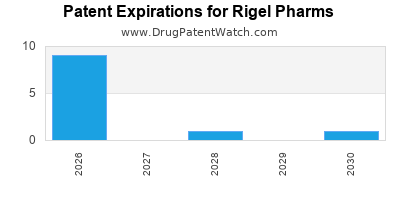
Drugs and US Patents for Rigel Pharms
| Applicant | Tradename | Generic Name | Dosage | NDA | Approval Date | TE | Type | RLD | RS | Patent No. | Patent Expiration | Product | Substance | Delist Req. | Exclusivity Expiration |
|---|---|---|---|---|---|---|---|---|---|---|---|---|---|---|---|
| Rigel Pharms | TAVALISSE | fostamatinib disodium | TABLET;ORAL | 209299-001 | Apr 17, 2018 | AB | RX | Yes | No | 9,283,238 | ⤷ Start Trial | ⤷ Start Trial | |||
| Rigel Pharms | TAVALISSE | fostamatinib disodium | TABLET;ORAL | 209299-001 | Apr 17, 2018 | AB | RX | Yes | No | 9,266,912 | ⤷ Start Trial | ⤷ Start Trial | |||
| Rigel Pharms | TAVALISSE | fostamatinib disodium | TABLET;ORAL | 209299-002 | Apr 17, 2018 | AB | RX | Yes | Yes | 8,211,889 | ⤷ Start Trial | Y | ⤷ Start Trial | ||
| Rigel Pharms | VEPPANU | vepdegestrant | TABLET;ORAL | 219835-001 | May 1, 2026 | RX | Yes | No | ⤷ Start Trial | ⤷ Start Trial | |||||
| Rigel Pharms | REZLIDHIA | olutasidenib | CAPSULE;ORAL | 215814-001 | Dec 1, 2022 | RX | Yes | Yes | 11,376,246 | ⤷ Start Trial | ⤷ Start Trial | ||||
| Rigel Pharms | TAVALISSE | fostamatinib disodium | TABLET;ORAL | 209299-001 | Apr 17, 2018 | AB | RX | Yes | No | 7,989,448 | ⤷ Start Trial | Y | ⤷ Start Trial | ||
| Rigel Pharms | REZLIDHIA | olutasidenib | CAPSULE;ORAL | 215814-001 | Dec 1, 2022 | RX | Yes | Yes | 12,275,715 | ⤷ Start Trial | Y | Y | ⤷ Start Trial | ||
| >Applicant | >Tradename | >Generic Name | >Dosage | >NDA | >Approval Date | >TE | >Type | >RLD | >RS | >Patent No. | >Patent Expiration | >Product | >Substance | >Delist Req. | >Exclusivity Expiration |
Expired US Patents for Rigel Pharms
| Applicant | Tradename | Generic Name | Dosage | NDA | Approval Date | Patent No. | Patent Expiration |
|---|---|---|---|---|---|---|---|
| Rigel Pharms | TAVALISSE | fostamatinib disodium | TABLET;ORAL | 209299-002 | Apr 17, 2018 | 8,211,889 | ⤷ Start Trial |
| Rigel Pharms | TAVALISSE | fostamatinib disodium | TABLET;ORAL | 209299-002 | Apr 17, 2018 | 7,538,108 | ⤷ Start Trial |
| Rigel Pharms | TAVALISSE | fostamatinib disodium | TABLET;ORAL | 209299-001 | Apr 17, 2018 | 9,737,554 | ⤷ Start Trial |
| Rigel Pharms | TAVALISSE | fostamatinib disodium | TABLET;ORAL | 209299-001 | Apr 17, 2018 | 8,445,485 | ⤷ Start Trial |
| Rigel Pharms | TAVALISSE | fostamatinib disodium | TABLET;ORAL | 209299-002 | Apr 17, 2018 | 7,989,448 | ⤷ Start Trial |
| Rigel Pharms | TAVALISSE | fostamatinib disodium | TABLET;ORAL | 209299-001 | Apr 17, 2018 | 7,538,108 | ⤷ Start Trial |
| Rigel Pharms | TAVALISSE | fostamatinib disodium | TABLET;ORAL | 209299-002 | Apr 17, 2018 | 8,445,485 | ⤷ Start Trial |
| >Applicant | >Tradename | >Generic Name | >Dosage | >NDA | >Approval Date | >Patent No. | >Patent Expiration |
International Patents for Rigel Pharms Drugs
| Country | Patent Number | Estimated Expiration |
|---|---|---|
| Portugal | 3447050 | ⤷ Start Trial |
| Lithuania | 3720442 | ⤷ Start Trial |
| Japan | 2017528489 | ⤷ Start Trial |
| Cyprus | 1122865 | ⤷ Start Trial |
| Japan | 6648115 | ⤷ Start Trial |
| Croatia | P20231681 | ⤷ Start Trial |
| Croatia | P20200666 | ⤷ Start Trial |
| >Country | >Patent Number | >Estimated Expiration |
Supplementary Protection Certificates for Rigel Pharms Drugs
| Patent Number | Supplementary Protection Certificate | SPC Country | SPC Expiration | SPC Description |
|---|---|---|---|---|
| 1856135 | C20200009 00319 | Estonia | ⤷ Start Trial | PRODUCT NAME: FOSTAMATINIIB;REG NO/DATE: EU/1/19/1405 13.01.2020 |
| 1856135 | 2020C/511 | Belgium | ⤷ Start Trial | PRODUCT NAME: TAVLESSE - FOSTAMATINIB; AUTHORISATION NUMBER AND DATE: EU/1/19/1405 20200113 |
| 1856135 | CR 2020 00018 | Denmark | ⤷ Start Trial | PRODUCT NAME: FOSTAMATINIB OR A PHARMACEUTICALLY ACCEPTABLE SALT OF FOSTAMATINIB, OR A HYDRATE, SOLVATE OR N-OXIDE OF FOSTAMATINIB OR THE PHARMACEUTICALLY ACCEPTABLE SALT OF FOSTAMATINIB, ESPECIALLY FOSTAMATINIB DISODIUM, OPTIONALLY IN FORM OF A HYDRATE; REG. NO/DATE: EU/1/19/1405 20200113 |
| 1856135 | CA 2020 00018 | Denmark | ⤷ Start Trial | PRODUCT NAME: FOSTAMATINIB OR A PHARMACEUTICALLY ACCEPTABLE SALT OF FOSTAMATINIB, OR A HYDRATE, SOLVATE OR N-OXIDE OF FOSTAMATINIB OR THE PHARMACEUTICALLY ACCEPTABLE SALT OF FOSTAMATINIB, ESPECIALLY FOSTAMATINIB DISODIUM, OPTIONALLY IN FORM OF A HYDRATE; REG. NO/DATE: EU/1/19/1405 20200113 |
| 3371171 | 122024000021 | Germany | ⤷ Start Trial | PRODUCT NAME: PRALSETINIB UND PHARMAZEUTISCH AKZEPTABLE SALZE DAVON; REGISTRATION NO/DATE: EU/1/21/1555 20211118 |
| 1856135 | 20C1019 | France | ⤷ Start Trial | PRODUCT NAME: FOSTAMATINIB ET/OU SES SELS PHARMACEUTIQUEMENT ACCEPTABLES OU HYDRATE OU SOLVATE DU FOSTAMATINIB, EN PARTICULIER UN SEL DISODIQUE DE FOSTAMATINIB TEL QUE LE FOSTAMATINIB DISODIQUE HEXAHYDRATE; NAT. REGISTRATION NO/DATE: EU/1/19/1405 20200109; FIRST REGISTRATION: NL - EU/1/19/1405 20200109 |
| 1856135 | 122020000021 | Germany | ⤷ Start Trial | PRODUCT NAME: FOSTAMATINIB ODER EIN PHARMAZEUTISCH VERTRAEGLICHES SALZ, HYDRAT UND/ODER SOLVAT DAVON, INSBESONDERE DINATRIUM-FOSTAMATINIB-HEXAHYDRAT; REGISTRATION NO/DATE: EU/1/19/1405 20200109 |
| >Patent Number | >Supplementary Protection Certificate | >SPC Country | >SPC Expiration | >SPC Description |
Similar Applicant Names
Applicants may be listed under multiple names.
Here is a list of applicants with similar names.
Here is a list of applicants with similar names.
