Last updated: July 23, 2026
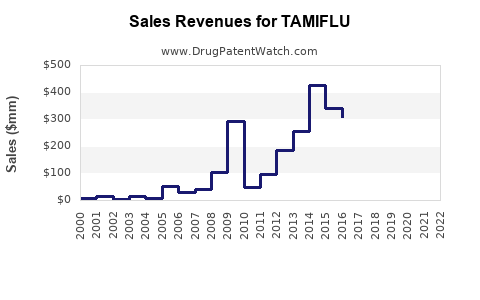
Is Tamiflu still a blockbuster? What do sales, revenue mix, and demand cycles look like?
Tamiflu is no longer a peak-season influenza blockbuster in steady-state terms, but it remains a durable, episodic demand product tied to influenza incidence, public-health stockpiling, and outbreak-driven procurement. Commercial performance has been structurally affected by (1) stockpiling cycles, (2) payer and formulary restrictions, (3) guideline positioning versus alternatives, and (4) generic erosion risk that has capped pricing power in many markets over time.
What has driven Tamiflu demand historically?
Demand has clustered into three buckets:
- Seasonal treatment: symptomatic influenza treated early.
- Post-exposure prophylaxis: household and institutional exposure use.
- Government procurement: emergency and seasonal stockpiles.
The commercial pattern has been less “continuous demand” than “in-season and outbreak-dependent pull,” so quarters with higher influenza activity show stronger order intake while off-season periods underperform.
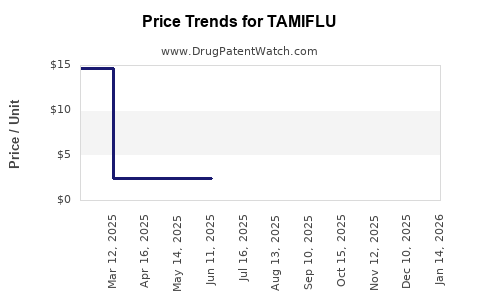
How has pricing and access changed?
Tamiflu pricing dynamics have been shaped by:
- Generic substitution in treatment where available.
- Contracting and tender structure for hospitals and governments that compress unit pricing.
- Formulary competitiveness as payers weigh clinical evidence and safety/tolerability.
What does the competitive set include beyond oseltamivir?
- Other neuraminidase inhibitors (notably zanamivir historically, with market impact limited by delivery and availability).
- Influenza antivirals with different administration routes and payer preferences.
- Supportive-care and vaccination-driven prevention that can reduce the treatable population.
What is the financial trajectory for Tamiflu by company, and how have revenues shifted over time?
Tamiflu’s revenue trajectory has followed two dominant phases: pre-loss-of-exclusivity strength and post-generic pressure normalization.
What companies commercialized Tamiflu and how did responsibilities split?
- Roche/Genentech is the historical innovator commercial anchor outside the original Japanese partner structure.
- Gilead historically held and later divested commercialization rights in some territories (transaction history changed over time).
- Manufacturing and distribution have included global supply-chain scaling, then later rationalization tied to volume decline and competitive entry.
What lines typically show up in financial reporting?
For companies that still break out influenza antivirals, investors generally track:
- Prescription volumes by season.
- Government sales through tender orders.
- Net sales impacted by rebates, discounts, and channel inventory movements.
How did financial outcomes change after generic entry risk became real?
Once generics became market-accessible in key geographies, Tamiflu’s revenue growth could not stay on a price-per-course basis. The profit pool shifted toward:
- Public procurement contracts where supply qualification and tender frameworks favor legacy products.
- Brand-protected segments (sometimes where generics face substitution limits in early outbreak procurement).
- Distribution depth and supplier relationships that keep inventory moving during peak demand windows.
What market dynamics affect Tamiflu sales in influenza outbreaks, pandemics, and non-pandemic seasons?
Tamiflu sales are highly sensitive to outbreak severity and epidemiology.
How do influenza incidence and timing translate into orders?
- Early-season spikes in influenza activity drive faster physician uptake.
- Late-season surges often reduce full-season totals if treatment windows narrow.
- Government procurement tends to lag epidemiology cycles and follows procurement planning and budget calendars.
What role does stockpiling play in year-to-year volatility?
Public-health stockpiles can both:
- Boost sales when inventories are replenished.
- Depress sales when inventories remain sufficient, pushing demand into “maintenance procurement” rather than “new fill.”
How do new viral strains and clinical guidance change uptake?
Guidelines and resistance concerns can shift clinician preferences and payer approvals. In practice, neuraminidase inhibitor use remains guideline-consistent for many influenza presentations, but competitive placement changes depending on evidence, safety perceptions, and availability.
What patents protect Tamiflu (oseltamivir), and when do they expire?
Tamiflu patent protection is the principal economic factor behind brand pricing and market exclusivity. Oseltamivir’s core compound and process patents have had staggered expirations across jurisdictions, with additional layers possible for:
- polymorphs and solid-state forms,
- intermediates,
- manufacturing processes,
- specific formulations and dosing regimens,
- method-of-use claims.
Where does patent expiration risk show up commercially?
Patent expiration does not only affect market entry. It affects:
- Tender behavior (switching supplier qualification).
- Bid pricing (generics push down tender margins).
- Pharmacy channel substitution (brand versus generic interchangeability depending on national rules).
When does Tamiflu lose exclusivity? What are the key exclusivity clocks to model?
Exclusivity in practice is a composite of:
- Patent term expiry for compound/process/formulation claims.
- Regulatory exclusivity (where applicable, especially early in product history).
- Market exclusivity de facto from supply chain readiness and contract structures.
How should exclusivity be mapped to expected generic timing?
A realistic generic risk model should include:
- Patent expiry dates by jurisdiction.
- Expected Paragraph IV litigation windows when applicable.
- Manufacturing and regulatory approval lead times for generics.
- Government tender cycle duration for public-sector switching.
What generic entry risks exist for Tamiflu in the US, and how do Paragraph IV challenges play out?
Generic entry for oseltamivir has already occurred in many markets historically, but for forward-looking planning, the key legal mechanism remains the US system:
- ANDA approvals against listed patents.
- Paragraph IV certifications for patent challenges.
- Potential 30-month stay when a qualifying Paragraph IV notice leads to litigation.
What does the litigation landscape typically determine?
- Whether a generic launch is delayed beyond patent expiry.
- Whether settlement drives an agreed launch date and distribution restrictions.
- Whether the innovator retains leverage through additional “late-stage” patent listings.
What is the Orange Book status of Tamiflu (oseltamivir)? Which patents are listed for each dosage form?
Tamiflu’s Orange Book coverage depends on the specific drug product and dosage form (capsules vs powder for oral suspension), and on what patents remain in force and are listed for those NDA products at a given time.
How does Orange Book listing map to real-world switching?
- Patents with broad claim coverage (active ingredient, solid-state form, composition, process) can reduce generic substitution.
- Narrow formulation or method-of-use patents can still matter through litigation leverage but may have less market impact if practical design-arounds exist.
What formulations are protected for Tamiflu: capsules, oral suspension, and manufacturing method patents?
Tamiflu availability includes:
- Oral capsules.
- Powder for oral suspension.
Formulation-related protection usually targets:
- Specific solid-state characteristics and stability.
- Bioavailability-relevant formulation parameters.
- Manufacturing processes that control particle size, impurities, or stability.
How do formulation patents impact generic design-around?
Design-around often needs:
- alternate excipients,
- alternate manufacturing steps,
- alternate solid-state forms (when allowed),
- proof of comparable bioavailability and stability.
Where design-around is difficult, brand share can persist longer.
How strong is the patent estate for oseltamivir (Tamiflu) across jurisdictions?
Patent strength is best evaluated by:
- number of active patents remaining,
- claim scope breadth (compound/process vs minor formulation improvements),
- remaining claim term weighted by filing dates,
- historical litigation outcomes and settlement patterns.
From a market perspective, once core compound exclusivity ends, the remaining estate often provides diminishing returns unless it blocks key generic pathways.
How does Tamiflu compare with competing influenza antivirals in market access and utilization?
Neuraminidase inhibitors vs alternative classes
- Neuraminidase inhibitors have remained central in many guideline algorithms historically.
- Utilization differences hinge on dosing convenience, route of administration, clinician familiarity, and payer restriction.
What has mattered for commercial performance
- Supply reliability and tender qualification.
- Seasonal prescribing patterns.
- Institutional formularies.
Which companies challenge Tamiflu patents or market oseltamivir generics, and what matters for licensing leverage?
Market dynamics depend on:
- the number of ANDA filers and their launch readiness,
- whether litigation results in design-around acceptability,
- whether settlements cap generic entry or allow early launch with carve-outs.
In licensing negotiations, the key issue is whether the innovator still has enforceable patents in major territories and whether generics face practical formulation/process barriers.
What patent litigation affects Tamiflu, and what settlement patterns drive launch timing?
In systems where ANDA challengers file Paragraph IV certifications, settlement agreements often:
- establish an agreed launch date,
- define carve-outs for specific strengths or dosage forms,
- require supply terms during the interim period,
- sometimes involve payment or non-monetary commitments.
These settlements shape the slope of revenue decline post-expiry more than the nominal patent date alone.
What FDA pathway and regulatory milestones matter for Tamiflu’s generics and biosimilar-adjacent risk?
Tamiflu is a small-molecule drug product, so biosimilar risk is not the relevant analogue. The key regulatory pathway for competition is the generic ANDA route.
What changes after ANDA approvals?
Once generics are approved and on the market:
- pricing pressure typically accelerates,
- procurement contracts shift,
- physician and pharmacy substitution becomes more common.
What commercial metrics should investors track for Tamiflu going forward?
High-signal metrics:
- quarterly prescription demand proxies during peak influenza seasons,
- government tender wins and replenishment schedules,
- average net price after rebates/contracting,
- inventory position and distribution channel loading during outbreaks,
- generic penetration by geography and dosage form.
Key Takeaways
- Tamiflu’s market dynamics are driven by influenza incidence cycles and public-sector stockpiling, producing volatility rather than steady growth.
- The financial trajectory has shifted from brand pricing strength to normalization under generic pressure after core exclusivity ended in key markets.
- Patent estate effects persist mainly through Orange Book-listed composition/process/formulation patents that influence generic design-around and tender substitution behavior.
- Forward-looking commercial risk is less about “biosimilar” pathways and more about generic ANDA entry timing, litigation/settlement-driven launch dates, and territory-specific tender qualification.
FAQs
1) Why do Tamiflu sales spike in certain quarters even without new product launches?
Seasonal influenza incidence and public-health replenishment cycles drive order timing, shifting sales peaks across quarters.
2) Does Tamiflu face biosimilar competition?
No. Tamiflu is a small-molecule product, so competition comes from generic ANDAs, not biosimilars.
3) Which factor usually causes the biggest revenue decline for branded Tamiflu after exclusivity?
Generic entry that triggers channel substitution and tender re-bids tends to compress net pricing quickly.
4) How do government stockpiles affect Tamiflu unit demand?
Stockpile levels can defer or accelerate replenishment procurement, making year-to-year demand less predictable.
5) Are formulation changes a common strategy for generic oseltamivir launches?
Generic manufacturers often rely on composition and manufacturing design-around plus bioequivalence, with formulation-related patents shaping the ease of entry.
References
- FDA. Orange Book: Approved Drug Products with Therapeutic Equivalence Evaluations (oseltamivir). U.S. Food and Drug Administration. https://www.accessdata.fda.gov/scripts/cder/daf/ (accessed 2026-07-23)
- FDA. ANDA (Abbreviated New Drug Application) basics and regulatory framework. U.S. Food and Drug Administration. https://www.fda.gov/drugs/ (accessed 2026-07-23)