Last Updated: September 24, 2026

TAFINLAR Drug Patent Profile


✉ Email this page to a colleague

« Back to Dashboard


Which patents cover Tafinlar, and what generic alternatives are available?

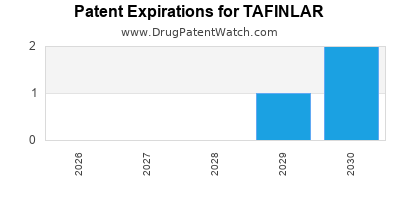
Tafinlar is a drug marketed by Novartis and is included in two NDAs. There are seven patents protecting this drug and one Paragraph IV challenge.

The generic ingredient in TAFINLAR is dabrafenib mesylate. There is one drug master file entry for this compound. One supplier is listed for this compound. Additional details are available on the dabrafenib mesylate profile page.

DrugPatentWatch® Generic Entry Outlook for Tafinlar

Tafinlar was eligible for patent challenges on May 29, 2017.

By analyzing the patents and regulatory protections it appears that the earliest date for generic entry will be March 16, 2030. This may change due to patent challenges or generic licensing.

There have been two patent litigation cases involving the patents protecting this drug, indicating strong interest in generic launch. Recent data indicate that 63% of patent challenges are decided in favor of the generic patent challenger and that 54% of successful patent challengers promptly launch generic drugs.

Indicators of Generic Entry

< Available with Subscription >

  Start Trial

AI Deep Research
Questions you can ask:
  • What is the 5 year forecast for TAFINLAR?
  • What are the global sales for TAFINLAR?
  • What is Average Wholesale Price for TAFINLAR?
DrugPatentWatch® Estimated Loss of Exclusivity (LOE) Date for TAFINLAR
Generic Entry Dates for TAFINLAR*:
Constraining patent/regulatory exclusivity:

TREATMENT OF PEDIATRIC PATIENTS 1 YEAR OF AGE AND OLDER WITH LOW-GRADE GLIOMA (LGG) WITH A BRAF V600E MUTATION WHO REQUIRE SYSTEMIC THERAPY

NDA:
Dosage:

CAPSULE;ORAL

Generic Entry Dates for TAFINLAR*:
Constraining patent/regulatory exclusivity:
NDA:
Dosage:

TABLET, FOR SUSPENSION;ORAL

*The generic entry opportunity date is the latter of the last compound-claiming patent and the last regulatory exclusivity protection. Many factors can influence early or later generic entry. This date is provided as a rough estimate of generic entry potential and should not be used as an independent source.

Recent Clinical Trials for TAFINLAR

Identify potential brand extensions & 505(b)(2) entrants

SponsorPhase
Eva Marie Erfurth, MD, PhDPhase 2
Eastern HealthPhase 2
Sir Charles Gairdner HospitalPhase 2

See all TAFINLAR clinical trials

Paragraph IV (Patent) Challenges for TAFINLAR
Tradename Dosage Ingredient Strength NDA ANDAs Submitted Submissiondate
TAFINLAR Capsules dabrafenib mesylate 50 mg and 75 mg 202806 1 2025-11-13

US Patents and Regulatory Information for TAFINLAR

TAFINLAR is protected by seven US patents and five FDA Regulatory Exclusivities.

Based on analysis by DrugPatentWatch, the earliest date for a generic version of TAFINLAR is ⤷  Start Trial.

This potential generic entry date is based on TREATMENT OF PEDIATRIC PATIENTS 1 YEAR OF AGE AND OLDER WITH LOW-GRADE GLIOMA (LGG) WITH A BRAF V600E MUTATION WHO REQUIRE SYSTEMIC THERAPY.

Generics may enter earlier, or later, based on new patent filings, patent extensions, patent invalidation, early generic licensing, generic entry preferences, and other factors.

Applicant Tradename Generic Name Dosage NDA Approval Date TE Type RLD RS Patent No. Patent Expiration Product Substance Delist Req. Exclusivity Expiration
Novartis TAFINLAR dabrafenib mesylate TABLET, FOR SUSPENSION;ORAL 217514-001 Mar 16, 2023 RX Yes Yes ⤷  Start Trial ⤷  Start Trial ⤷  Start Trial
Novartis TAFINLAR dabrafenib mesylate CAPSULE;ORAL 202806-001 May 29, 2013 RX Yes No 7,994,185*PED ⤷  Start Trial Y ⤷  Start Trial
Novartis TAFINLAR dabrafenib mesylate CAPSULE;ORAL 202806-002 May 29, 2013 RX Yes Yes ⤷  Start Trial ⤷  Start Trial ⤷  Start Trial
Novartis TAFINLAR dabrafenib mesylate TABLET, FOR SUSPENSION;ORAL 217514-001 Mar 16, 2023 RX Yes Yes 7,994,185*PED ⤷  Start Trial Y ⤷  Start Trial
Novartis TAFINLAR dabrafenib mesylate CAPSULE;ORAL 202806-001 May 29, 2013 RX Yes No ⤷  Start Trial ⤷  Start Trial ⤷  Start Trial
>Applicant >Tradename >Generic Name >Dosage >NDA >Approval Date >TE >Type >RLD >RS >Patent No. >Patent Expiration >Product >Substance >Delist Req. >Exclusivity Expiration

International Patents for TAFINLAR

When does loss-of-exclusivity occur for TAFINLAR?

Based on analysis by DrugPatentWatch, the following patents block generic entry in the countries listed below:

Australia

Patent: 10306653
Estimated Expiration: ⤷  Start Trial

Patent: 18297656
Estimated Expiration: ⤷  Start Trial

Patent: 21221451
Estimated Expiration: ⤷  Start Trial

Patent: 23266278
Estimated Expiration: ⤷  Start Trial

Patent: 25242246
Estimated Expiration: ⤷  Start Trial

Brazil

Patent: 2012008854
Estimated Expiration: ⤷  Start Trial

Canada

Patent: 75803
Estimated Expiration: ⤷  Start Trial

Patent: 68936
Estimated Expiration: ⤷  Start Trial

Chile

Patent: 12000964
Estimated Expiration: ⤷  Start Trial

China

Patent: 2655753
Estimated Expiration: ⤷  Start Trial

Patent: 0831582
Estimated Expiration: ⤷  Start Trial

Colombia

Patent: 31498
Estimated Expiration: ⤷  Start Trial

Costa Rica

Patent: 120155
Estimated Expiration: ⤷  Start Trial

Croatia

Patent: 0191617
Estimated Expiration: ⤷  Start Trial

Patent: 0221304
Estimated Expiration: ⤷  Start Trial

Patent: 0260236
Estimated Expiration: ⤷  Start Trial

Cyprus

Patent: 22013
Estimated Expiration: ⤷  Start Trial

Patent: 25664
Estimated Expiration: ⤷  Start Trial

Patent: 27091
Estimated Expiration: ⤷  Start Trial

Denmark

Patent: 88033
Estimated Expiration: ⤷  Start Trial

Patent: 60498
Estimated Expiration: ⤷  Start Trial

Patent: 59217
Estimated Expiration: ⤷  Start Trial

Patent: 97376
Estimated Expiration: ⤷  Start Trial

Dominican Republic

Patent: 012000091
Estimated Expiration: ⤷  Start Trial

Eurasian Patent Organization

Patent: 0589
Estimated Expiration: ⤷  Start Trial

Patent: 1290149
Estimated Expiration: ⤷  Start Trial

European Patent Office

Patent: 88033
Estimated Expiration: ⤷  Start Trial

Patent: 60498
Estimated Expiration: ⤷  Start Trial

Patent: 48744
Estimated Expiration: ⤷  Start Trial

Patent: 59217
Estimated Expiration: ⤷  Start Trial

Patent: 97376
Estimated Expiration: ⤷  Start Trial

Patent: 06770
Estimated Expiration: ⤷  Start Trial

Finland

Patent: 59217
Estimated Expiration: ⤷  Start Trial

Patent: 97376
Estimated Expiration: ⤷  Start Trial

Hungary

Patent: 46139
Estimated Expiration: ⤷  Start Trial

Patent: 60206
Estimated Expiration: ⤷  Start Trial

Patent: 67723
Estimated Expiration: ⤷  Start Trial

Israel

Patent: 9073
Estimated Expiration: ⤷  Start Trial

Patent: 1513
Estimated Expiration: ⤷  Start Trial

Japan

Patent: 18929
Estimated Expiration: ⤷  Start Trial

Patent: 13508294
Estimated Expiration: ⤷  Start Trial

Patent: 19529343
Estimated Expiration: ⤷  Start Trial

Lithuania

Patent: 88033
Estimated Expiration: ⤷  Start Trial

Patent: 60498
Estimated Expiration: ⤷  Start Trial

Patent: 59217
Estimated Expiration: ⤷  Start Trial

Patent: 97376
Estimated Expiration: ⤷  Start Trial

Malaysia

Patent: 4759
Estimated Expiration: ⤷  Start Trial

Mexico

Patent: 12004413
Estimated Expiration: ⤷  Start Trial

Montenegro

Patent: 497
Estimated Expiration: ⤷  Start Trial

Morocco

Patent: 746
Estimated Expiration: ⤷  Start Trial

New Zealand

Patent: 8913
Estimated Expiration: ⤷  Start Trial

Peru

Patent: 121093
Estimated Expiration: ⤷  Start Trial

Philippines

Patent: 012500742
Estimated Expiration: ⤷  Start Trial

Poland

Patent: 88033
Estimated Expiration: ⤷  Start Trial

Patent: 60498
Estimated Expiration: ⤷  Start Trial

Patent: 59217
Estimated Expiration: ⤷  Start Trial

Patent: 97376
Estimated Expiration: ⤷  Start Trial

Portugal

Patent: 88033
Estimated Expiration: ⤷  Start Trial

Patent: 60498
Estimated Expiration: ⤷  Start Trial

Patent: 59217
Estimated Expiration: ⤷  Start Trial

Patent: 97376
Estimated Expiration: ⤷  Start Trial

Russian Federation

Patent: 20104742
Estimated Expiration: ⤷  Start Trial

Serbia

Patent: 181
Estimated Expiration: ⤷  Start Trial

Patent: 702
Estimated Expiration: ⤷  Start Trial

Patent: 800
Estimated Expiration: ⤷  Start Trial

Patent: 767
Estimated Expiration: ⤷  Start Trial

Slovenia

Patent: 88033
Estimated Expiration: ⤷  Start Trial

Patent: 59217
Estimated Expiration: ⤷  Start Trial

Patent: 97376
Estimated Expiration: ⤷  Start Trial

South Africa

Patent: 1202612
Estimated Expiration: ⤷  Start Trial

South Korea

Patent: 1729116
Estimated Expiration: ⤷  Start Trial

Patent: 120104547
Estimated Expiration: ⤷  Start Trial

Patent: 200024890
Estimated Expiration: ⤷  Start Trial

Patent: 250026366
Estimated Expiration: ⤷  Start Trial

Spain

Patent: 45479
Estimated Expiration: ⤷  Start Trial

Patent: 30157
Estimated Expiration: ⤷  Start Trial

Patent: 86037
Estimated Expiration: ⤷  Start Trial

Patent: 63926
Estimated Expiration: ⤷  Start Trial

Ukraine

Patent: 5064
Estimated Expiration: ⤷  Start Trial

Generics may enter earlier, or later, based on new patent filings, patent extensions, patent invalidation, early generic licensing, generic entry preferences, and other factors.

See the table below for additional patents covering TAFINLAR around the world.

Country Patent Number Title Estimated Expiration
Australia 2013313050 ⤷  Start Trial
Australia 2016244279 ⤷  Start Trial
Brazil 112015004578 ⤷  Start Trial
Canada 2882437 ⤷  Start Trial
China 104582706 ⤷  Start Trial
>Country >Patent Number >Title >Estimated Expiration

Supplementary Protection Certificates for TAFINLAR

Patent Number Supplementary Protection Certificate SPC Country SPC Expiration SPC Description
1761528 C300701 Netherlands ⤷  Start Trial PRODUCT NAME: TRAMETINIB, DESGEWENST IN DE VORM VAN EEN FRAMACEUTISCH AANVAARDBAAR ZOUT, HYDRAAT OF SOLVAAT DAARVAN; REGISTRATION NO/DATE: EU/1/14/931/01-06 20140702
1761528 PA2014039 Lithuania ⤷  Start Trial PRODUCT NAME: TRAMETINIBUM; REGISTRATION NO/DATE: EU/1/14/931/01-06 20140630
1761528 CA 2014 00055 Denmark ⤷  Start Trial PRODUCT NAME: TRAMETINIB, EVENTUELT I FORM AF ET FARMACEUTISK ACCEPTABELT SALT, HYDRAT ELLER SOLVAT DERAF, HERUNDER TRAMETINIBDIMETHYLSULFOXID; REG. NO/DATE: EU/1/14/931/01-06 20140630
1761528 14C0083 France ⤷  Start Trial PRODUCT NAME: TRAMETINIB,EVENTUELLEMENT SOUS LA FORME D'UN SEL,HYDRATE OU SOLVATE PHARMACEUTIQUEMENT ACCEPTABLE DE CELUI-CI; REGISTRATION NO/DATE: EU/1/14/931 20140630
1761528 C20140036 00120 Estonia ⤷  Start Trial CHANGE OF OWNER'S ADDRESS
>Patent Number >Supplementary Protection Certificate >SPC Country >SPC Expiration >SPC Description

Tafinlar Market Dynamics and Financial Trajectory: Dabrafenib Sales, Competition, Exclusivity and Growth Outlook

Last updated: August 17, 2026

Tafinlar, Novartis’ dabrafenib, is a commercially established BRAF-targeted therapy whose financial performance depends primarily on its combination with Mekinist, trametinib. The Tafinlar-Mekinist franchise generates approximately $2 billion in annual sales, supported by expanded use across melanoma, non-small-cell lung cancer, anaplastic thyroid cancer, solid tumors and pediatric low-grade glioma. Growth has shifted from initial metastatic melanoma uptake toward adjuvant melanoma, lung cancer and tumor-agnostic indications.

The franchise remains strategically valuable, but its long-term trajectory faces pressure from immunotherapy, competing BRAF/MEK combinations, treatment sequencing changes and eventual generic entry. Tafinlar is a small molecule, so biosimilar risk does not apply. The principal commercial risk is generic competition after relevant U.S. patent and regulatory exclusivities expire.

What is Tafinlar and how does it generate revenue?

Tafinlar is the brand name for dabrafenib, an oral selective inhibitor of BRAF kinase. It is approved mainly in combination with Mekinist, or trametinib, a MEK inhibitor. The combination suppresses signaling through the MAPK pathway in tumors containing activating BRAF V600 mutations.

Novartis generally reports Tafinlar and Mekinist as a combined franchise rather than disclosing separate product revenue. This accounting convention makes the combination’s sales the most reliable measure of Tafinlar’s commercial performance.

Metric Position
Active ingredient Dabrafenib
Primary partner Mekinist, trametinib
Developer and marketer Novartis
U.S. approval May 29, 2013
Therapeutic class BRAF kinase inhibitor
Administration Oral capsules or tablets, depending on formulation
Core biomarker BRAF V600E or V600K, with indication-specific requirements
Commercial reporting Combined Tafinlar-Mekinist franchise
Biosimilar exposure None
Generic exposure Expected after applicable small-molecule exclusivity and patent barriers expire

Tafinlar’s value is linked to companion use with Mekinist. The products are not economically independent in the most important approved settings, including BRAF-mutated melanoma, metastatic non-small-cell lung cancer and several newer indications.

What FDA-approved indications support Tafinlar sales?

The FDA has approved Tafinlar in combination with Mekinist for several BRAF V600-driven cancers.

Melanoma

The combination is approved for:

  • Unresectable or metastatic melanoma with BRAF V600E or V600K mutations.
  • Adjuvant treatment of patients with BRAF V600E or V600K mutation-positive melanoma with lymph-node involvement after complete resection.

The adjuvant indication expanded the addressable market beyond patients with active metastatic disease. It also changed the revenue profile by creating treatment demand earlier in the disease course.

Non-small-cell lung cancer

Tafinlar plus Mekinist is approved for metastatic non-small-cell lung cancer with BRAF V600E mutation. The indication addresses a small molecularly defined population, but it gives Novartis a targeted-therapy position in a large commercial cancer category.

Anaplastic thyroid cancer

The combination is approved for locally advanced or metastatic anaplastic thyroid cancer with BRAF V600E mutation and no satisfactory locoregional treatment options. The population is small, but the disease has high unmet need and limited treatment alternatives.

Tumor-agnostic solid tumors

In 2022, the FDA granted accelerated approval for Tafinlar plus Mekinist in unresectable or metastatic solid tumors with BRAF V600E mutation that have progressed after prior treatment and lack satisfactory alternative options. This approval was significant commercially because it permitted use across tumor types rather than within a single organ-specific indication (FDA, 2022).

Pediatric low-grade glioma

In 2023, the FDA approved the combination for pediatric patients aged 1 year or older with low-grade glioma harboring a BRAF V600E mutation who require systemic therapy. The pediatric approval added a new population and strengthened the franchise’s position in precision oncology (FDA, 2023).

How have Tafinlar and Mekinist sales changed over time?

Novartis does not report standalone Tafinlar sales. Its annual reports group Tafinlar and Mekinist together. The franchise has maintained roughly $2 billion in annual sales in recent years.

Fiscal year Tafinlar-Mekinist reported sales Commercial interpretation
2019 Approximately $1.8 billion Mature melanoma franchise with expansion into lung cancer
2020 Approximately $1.9 billion Resilient demand despite pandemic-related treatment disruption
2021 Approximately $1.9 billion Growth supported by broader biomarker testing and lung cancer use
2022 Approximately $2.0 billion Tumor-agnostic approval added market reach
2023 Approximately $2.0 billion Portfolio maturity offset by new indications and geographic expansion

Source: Novartis annual reports and reported Innovative Medicines sales categories (Novartis, 2020, 2021, 2022, 2023).

The financial pattern is one of durable scale rather than rapid growth. Initial melanoma adoption produced the largest expansion. Later gains came from the adjuvant melanoma indication, BRAF-mutated lung cancer, thyroid cancer and pediatric use.

Novartis’ reporting structure creates two limitations for investors. First, Tafinlar’s product-level gross margin and revenue contribution cannot be isolated from Mekinist. Second, the company does not generally disclose revenue by indication, preventing precise attribution of growth to melanoma, lung cancer or tumor-agnostic use.

What market forces are driving Tafinlar demand?

Molecular testing

Tafinlar demand depends on identification of BRAF V600 mutations. Increased use of next-generation sequencing and broader molecular testing expands the number of eligible patients, particularly in non-small-cell lung cancer and rare solid tumors.

Treatment sequencing

In metastatic melanoma, targeted BRAF/MEK therapy competes with immune checkpoint inhibitors. Clinicians may choose immunotherapy first for patients with durable-response potential, reserving Tafinlar-Mekinist for patients requiring rapid tumor shrinkage or for later-line treatment.

The adjuvant melanoma setting creates a separate sequencing decision. Physicians weigh targeted therapy against anti-PD-1 treatment, with selection influenced by mutation status, recurrence risk, toxicity considerations and patient preference.

Combination dependence

Tafinlar is commercially tied to Mekinist. A safety issue, supply disruption or pricing change affecting either product can affect the franchise. The combination also has a more complex adverse-event profile than many single-agent oncology products, including pyrexia, rash, cardiomyopathy, ocular toxicity and hepatotoxicity.

Label expansion

The tumor-agnostic and pediatric approvals increase the number of treatment settings, but they do not automatically create large revenue pools. BRAF V600E mutations are uncommon outside selected melanoma, lung, thyroid and brain tumor populations.

How does Tafinlar compare with competing BRAF therapies?

Tafinlar-Mekinist competes against other BRAF/MEK combinations and against immunotherapy.

Franchise BRAF agent MEK agent Primary competitive position
Tafinlar-Mekinist Dabrafenib Trametinib Broad label, established safety and efficacy history
Braftovi-Mektovi Encorafenib Binimetinib Strong melanoma presence and differentiated tolerability perceptions
Zelboraf-Cotellic Vemurafenib Cobimetinib Earlier-generation franchise with reduced strategic momentum
BRAF inhibitor monotherapy Various None Generally less favored where combination therapy is appropriate
Checkpoint inhibitors None None Major competitor in melanoma and some lung cancer treatment sequences

Braftovi-Mektovi is the most direct branded competitor in BRAF-mutated melanoma. Its commercial position benefits from clinical differentiation and use in combination strategies. Zelboraf-Cotellic has a longer commercial history but less momentum than the two leading BRAF/MEK combinations.

Tafinlar-Mekinist retains advantages from broad regulatory coverage and established physician familiarity. Its competitive disadvantage is that BRAF/MEK therapy is limited to biomarker-positive patients and may be displaced by immunotherapy in treatment sequences where long-term disease control is prioritized.

What patents protect Tafinlar and when does it lose exclusivity?

Tafinlar is a small-molecule product protected by compound, formulation, manufacturing and method-of-use intellectual property. The original U.S. new chemical entity exclusivity period began with the 2013 approval and generally lasted five years, subject to applicable pediatric extensions and patent-term adjustments.

The key commercial issue is not the original five-year exclusivity period. It is the remaining enforceable patent estate and the timing of an approved generic dabrafenib product.

Patent categories

Tafinlar-related protection can include:

  • Dabrafenib compound patents.
  • Salt, polymorph and crystalline-form patents.
  • Capsule and tablet formulation patents.
  • Combination-use patents covering dabrafenib with trametinib.
  • Method-of-treatment patents for BRAF-mutated cancers.
  • Pediatric and tumor-specific method patents.
  • Manufacturing and process patents.

Patent term varies by patent family and jurisdiction. U.S. patent-term adjustment, patent-term extension and pediatric exclusivity can alter the effective barrier to generic launch. Orange Book-listed patents are the operative reference for U.S. Abbreviated New Drug Application litigation and Paragraph IV analysis (FDA, n.d.-a).

Orange Book status

Tafinlar is an FDA-approved small-molecule product subject to the Hatch-Waxman framework. A prospective generic applicant can file an ANDA with a Paragraph IV certification against listed patents. A Paragraph IV notice could trigger patent litigation and, if filed within the statutory period, a 30-month stay of FDA approval under applicable conditions.

The absence of a disclosed Paragraph IV challenge in Novartis’ recent annual-report litigation summaries indicates that no major public challenge had become a material reported event through the cited reporting period. It does not eliminate the possibility of a later ANDA filing.

Exclusivity risk

The most important future event is the first credible generic dabrafenib filing, not simply the nominal expiration of one patent. Generic entry can be delayed by:

  • Multiple Orange Book-listed patents.
  • Patent litigation and a 30-month stay.
  • Formulation differences.
  • Combination-use patents.
  • Regulatory requirements for demonstrating bioequivalence.
  • Commercial difficulty of launching both dabrafenib and trametinib products together.

The franchise is more defensible than a single-product oral therapy because the clinical standard is often the combination. That protection is commercial rather than absolute. A generic dabrafenib could enter independently, although physicians and payers may favor a coordinated generic combination.

Which companies are challenging Tafinlar’s market position?

The principal branded competitors are Pfizer’s Braftovi-Mektovi franchise, Roche’s Zelboraf-Cotellic franchise and immune checkpoint inhibitor manufacturers.

Competitive pressure also comes from:

  • Merck’s Keytruda in melanoma, lung cancer and other tumors.
  • Bristol Myers Squibb’s Opdivo and Yervoy in melanoma and lung cancer.
  • Regeneron and Sanofi’s Libtayo in selected lung cancer settings.
  • Diagnostic companies that influence BRAF mutation testing and treatment selection.
  • Future generic manufacturers of dabrafenib and trametinib.

No biosimilar company can directly challenge Tafinlar because dabrafenib is a chemically synthesized small molecule. The relevant future competitors are ANDA filers and branded targeted-therapy developers.

What patent litigation and settlement risks affect Tafinlar?

Publicly disclosed material litigation involving Tafinlar has been limited relative to major biologic franchises. The principal future litigation pathway is an ANDA Paragraph IV dispute.

Potential litigation could involve:

  1. The dabrafenib compound.
  2. Dabrafenib dosage forms.
  3. Dabrafenib-trametinib combination treatment.
  4. Specific cancer indications.
  5. Pediatric or tumor-agnostic uses.
  6. Manufacturing processes.

A settlement could include a licensed generic launch date, an authorized generic arrangement, or restrictions on the scope of the generic label. Settlement economics would depend on the strength of the asserted patent claims and the expected timing of regulatory approval.

The absence of a reported settlement does not indicate that the estate is litigation-proof. It indicates that public generic-entry activity had not yet become a major disclosed financial event in the cited Novartis filings.

What generic launch scenarios exist for Tafinlar?

Scenario 1: Delayed generic entry

A generic applicant files a Paragraph IV challenge, Novartis litigates, and launch is delayed until settlement or court resolution. This scenario preserves branded revenue for several additional years but can create sharp price erosion once entry occurs.

Scenario 2: Single-product generic entry

Dabrafenib becomes available before a generic trametinib equivalent. Physicians may use the products separately, but the clinical and economic impact would be less than a complete generic replacement of the combination.

Scenario 3: Coordinated combination erosion

Generic dabrafenib and trametinib become available within a similar period. This is the highest-risk scenario because payers can shift patients to lower-cost combination treatment rapidly.

Scenario 4: Limited erosion from indication complexity

Generic entry occurs, but uptake is slower because of biomarker testing, specialist prescribing, safety monitoring and the need to coordinate two products. This would reduce the speed of revenue decline but would not eliminate long-term price pressure.

How strong is the Tafinlar patent estate?

Tafinlar’s estate is commercially meaningful but has structural limitations.

Strength Assessment
Compound protection Usually the strongest barrier, but duration is finite
Combination protection Supports the Tafinlar-Mekinist regimen
Formulation protection Can complicate generic design-around strategies
Method-of-use protection Useful for selected indications, but narrower than compound claims
Biomarker requirement Adds regulatory and commercial complexity
Product dependence Tafinlar’s value is linked to Mekinist availability
Biological differentiation Limited against other BRAF/MEK combinations
Biosimilar barrier Not relevant
Generic substitution risk Material after patent barriers fall

The estate’s strength is greater when compound and combination patents overlap in time. Its weakness is that generic manufacturers may avoid narrower method-of-use claims through label carving or other regulatory strategies.

What is the FDA regulatory status of Tafinlar?

Tafinlar has full FDA approval in several indications and accelerated approval for the tumor-agnostic solid-tumor indication. The product’s regulatory profile is supported by companion diagnostic and biomarker testing requirements in relevant settings.

Key FDA milestones include:

Date Milestone
May 29, 2013 Initial FDA approval for unresectable or metastatic BRAF V600E melanoma
2014 Combination approval with Mekinist for BRAF-mutated melanoma
2017 Approval for adjuvant treatment of BRAF-mutated melanoma after resection
2018 Approval for BRAF V600E metastatic non-small-cell lung cancer
2018 Approval for BRAF V600E anaplastic thyroid cancer
2022 Accelerated approval for BRAF V600E solid tumors
2023 Approval for pediatric BRAF V600E low-grade glioma

The tumor-agnostic approval carries the regulatory obligations associated with accelerated approval, including confirmatory evidence requirements. The product’s mature regulatory history reduces approval risk for label expansions but does not guarantee continued reimbursement or broad use.

What revenue exposure does Novartis have to Tafinlar?

Tafinlar-Mekinist contributes approximately $2 billion annually to Novartis’ Innovative Medicines portfolio. That makes it a meaningful franchise but not one of the company’s largest products. The company’s broader revenue base includes Entresto, Cosentyx, Kesimpta, Kisqali and other high-growth medicines.

The financial exposure has three dimensions:

  • Direct revenue exposure from Tafinlar-Mekinist sales.
  • Margin exposure from eventual price erosion.
  • Portfolio exposure because oncology sales are increasingly concentrated in products with long-term growth potential.

A gradual decline would be manageable at the group level. A rapid combination-generic launch could create a visible oncology revenue gap, particularly if new indications fail to offset melanoma maturity.

What is the outlook for Tafinlar’s financial trajectory?

The most likely near-term trajectory is stable-to-modestly declining revenue rather than high growth. New indications and continued use in BRAF-mutated lung cancer and melanoma can offset declining growth in the original metastatic melanoma market.

The medium-term outlook depends on four variables:

  1. The effective date of generic dabrafenib entry.
  2. Whether generic trametinib becomes available at the same time.
  3. The rate of adoption in pediatric glioma and rare tumor settings.
  4. Competitive prescribing against Braftovi-Mektovi and immunotherapy.

Tafinlar is likely to remain a cash-generating oncology franchise while its patent estate limits generic competition. Its growth ceiling is constrained by the low prevalence of BRAF V600 mutations and the availability of alternative therapies. Its downside is concentrated around the eventual loss of exclusivity and the possibility of coordinated generic erosion.

Key Takeaways

  • Tafinlar is dabrafenib, an oral BRAF inhibitor marketed primarily with Mekinist.
  • Novartis reports the products together, with franchise sales of about $2 billion annually.
  • Revenue has matured after strong initial growth in metastatic melanoma.
  • Adjuvant melanoma, lung cancer, thyroid cancer, tumor-agnostic solid tumors and pediatric glioma broaden the commercial base.
  • The leading branded competitor is Braftovi-Mektovi, while immunotherapy creates major treatment-sequencing pressure.
  • Tafinlar has no biosimilar risk because it is a small molecule.
  • Generic risk will arise through ANDA filings, Paragraph IV challenges and eventual patent expiry.
  • Combination dependence on Mekinist can delay or complicate generic substitution, but it cannot prevent long-term erosion.
  • The franchise outlook is stable in the near term and increasingly exposed to patent-cliff timing over the medium term.

FAQs About Tafinlar Market Dynamics

Is Tafinlar still a commercially important drug?

Yes. The Tafinlar-Mekinist franchise generates approximately $2 billion in annual sales for Novartis and remains a major targeted-oncology product.

Does Novartis report Tafinlar sales separately from Mekinist?

No. Novartis generally reports combined Tafinlar-Mekinist revenue, so standalone dabrafenib sales cannot be reliably calculated from public company filings.

Is there a generic version of Tafinlar?

Tafinlar is subject to the U.S. generic-drug framework, but the timing of commercial generic availability depends on remaining patents, FDA approval and any Paragraph IV litigation. No biosimilar pathway applies.

What is the main clinical competitor to Tafinlar?

Braftovi-Mektovi, containing encorafenib and binimetinib, is the closest branded BRAF/MEK competitor. Keytruda, Opdivo and other immunotherapies compete in treatment sequencing, particularly in melanoma and lung cancer.

Which Tafinlar indication has the greatest growth potential?

The largest incremental opportunities are in adjuvant melanoma, BRAF V600E non-small-cell lung cancer and broader biomarker-defined use. Pediatric glioma and tumor-agnostic solid tumors add strategic reach but represent smaller patient populations.

References

Food and Drug Administration. (2022). FDA grants accelerated approval to dabrafenib with trametinib for unresectable or metastatic solid tumors with BRAF V600E mutation. U.S. Department of Health and Human Services.

Food and Drug Administration. (2023). FDA approves dabrafenib with trametinib for pediatric low-grade glioma with BRAF V600E mutation. U.S. Department of Health and Human Services.

Food and Drug Administration. (n.d.-a). Orange Book: Approved drug products with therapeutic equivalence evaluations. U.S. Department of Health and Human Services.

Novartis AG. (2020). Annual report 2020. Basel, Switzerland: Author.

Novartis AG. (2021). Annual report 2021. Basel, Switzerland: Author.

Novartis AG. (2022). Annual report 2022. Basel, Switzerland: Author.

Novartis AG. (2023). Annual report 2023. Basel, Switzerland: Author.

U.S. Food and Drug Administration. (2024). Tafinlar prescribing information. U.S. Department of Health and Human Services.

More… ↓

⤷  Start Trial

DrugChatter Q&A for TAFINLAR

Make Better Decisions: Try a trial or see plans & pricing

Drugs may be covered by multiple patents or regulatory protections. All trademarks and applicant names are the property of their respective owners or licensors. Although great care is taken in the proper and correct provision of this service, thinkBiotech LLC does not accept any responsibility for possible consequences of errors or omissions in the provided data. The data presented herein is for information purposes only. There is no warranty that the data contained herein is error free. We do not provide individual investment advice. This service is not registered with any financial regulatory agency. The information we publish is educational only and based on our opinions plus our models. By using DrugPatentWatch you acknowledge that we do not provide personalized recommendations or advice. thinkBiotech performs no independent verification of facts as provided by public sources nor are attempts made to provide legal or investing advice. Any reliance on data provided herein is done solely at the discretion of the user. Users of this service are advised to seek professional advice and independent confirmation before considering acting on any of the provided information. thinkBiotech LLC reserves the right to amend, extend or withdraw any part or all of the offered service without notice.