Last Updated: September 24, 2026

TABRECTA Drug Patent Profile


✉ Email this page to a colleague

« Back to Dashboard


Which patents cover Tabrecta, and when can generic versions of Tabrecta launch?

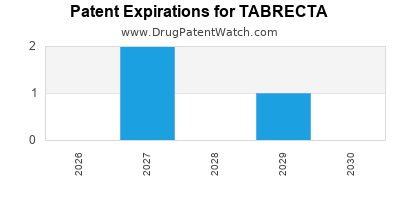
Tabrecta is a drug marketed by Novartis Pharm and is included in one NDA. There are seven patents protecting this drug and one Paragraph IV challenge.

The generic ingredient in TABRECTA is capmatinib hydrochloride. There is one drug master file entry for this compound. One supplier is listed for this compound. Additional details are available on the capmatinib hydrochloride profile page.

DrugPatentWatch® Generic Entry Outlook for Tabrecta

Tabrecta was eligible for patent challenges on May 6, 2024.

By analyzing the patents and regulatory protections it appears that the earliest date for generic entry will be July 22, 2035. This may change due to patent challenges or generic licensing.

There is one Paragraph IV patent challenge for this drug. This may lead to patent invalidation or a license for generic production.

Indicators of Generic Entry

< Available with Subscription >

  Start Trial

AI Deep Research
Questions you can ask:
  • What is the 5 year forecast for TABRECTA?
  • What are the global sales for TABRECTA?
  • What is Average Wholesale Price for TABRECTA?
Summary for TABRECTA
DrugPatentWatch® Estimated Loss of Exclusivity (LOE) Date for TABRECTA
Generic Entry Date for TABRECTA*:
Constraining patent/regulatory exclusivity:
NDA:
Dosage:

TABLET;ORAL

*The generic entry opportunity date is the latter of the last compound-claiming patent and the last regulatory exclusivity protection. Many factors can influence early or later generic entry. This date is provided as a rough estimate of generic entry potential and should not be used as an independent source.

Recent Clinical Trials for TABRECTA

Identify potential brand extensions & 505(b)(2) entrants

SponsorPhase
Timothy BurnsPhase 2
NovartisPhase 2

See all TABRECTA clinical trials

Paragraph IV (Patent) Challenges for TABRECTA
Tradename Dosage Ingredient Strength NDA ANDAs Submitted Submissiondate
TABRECTA Tablets capmatinib hydrochloride 150 mg and 200 mg 213591 1 2024-05-06

US Patents and Regulatory Information for TABRECTA

TABRECTA is protected by seven US patents and one FDA Regulatory Exclusivity.

Based on analysis by DrugPatentWatch, the earliest date for a generic version of TABRECTA is ⤷  Start Trial.

This potential generic entry date is based on patent 10,596,178.

Generics may enter earlier, or later, based on new patent filings, patent extensions, patent invalidation, early generic licensing, generic entry preferences, and other factors.

Applicant Tradename Generic Name Dosage NDA Approval Date TE Type RLD RS Patent No. Patent Expiration Product Substance Delist Req. Exclusivity Expiration
Novartis Pharm TABRECTA capmatinib hydrochloride TABLET;ORAL 213591-001 May 6, 2020 RX Yes No 12,084,449 ⤷  Start Trial ⤷  Start Trial
Novartis Pharm TABRECTA capmatinib hydrochloride TABLET;ORAL 213591-001 May 6, 2020 RX Yes No 12,208,101 ⤷  Start Trial Y ⤷  Start Trial
Novartis Pharm TABRECTA capmatinib hydrochloride TABLET;ORAL 213591-001 May 6, 2020 RX Yes No 10,596,178 ⤷  Start Trial Y ⤷  Start Trial
Novartis Pharm TABRECTA capmatinib hydrochloride TABLET;ORAL 213591-002 May 6, 2020 RX Yes Yes 7,767,675 ⤷  Start Trial Y Y ⤷  Start Trial
Novartis Pharm TABRECTA capmatinib hydrochloride TABLET;ORAL 213591-001 May 6, 2020 RX Yes No ⤷  Start Trial ⤷  Start Trial ⤷  Start Trial
Novartis Pharm TABRECTA capmatinib hydrochloride TABLET;ORAL 213591-002 May 6, 2020 RX Yes Yes ⤷  Start Trial ⤷  Start Trial ⤷  Start Trial
Novartis Pharm TABRECTA capmatinib hydrochloride TABLET;ORAL 213591-002 May 6, 2020 RX Yes Yes 8,461,330 ⤷  Start Trial Y Y ⤷  Start Trial
>Applicant >Tradename >Generic Name >Dosage >NDA >Approval Date >TE >Type >RLD >RS >Patent No. >Patent Expiration >Product >Substance >Delist Req. >Exclusivity Expiration

International Patents for TABRECTA

When does loss-of-exclusivity occur for TABRECTA?

Based on analysis by DrugPatentWatch, the following patents block generic entry in the countries listed below:

Argentina

Patent: 1286
Estimated Expiration: ⤷  Start Trial

Australia

Patent: 15293539
Estimated Expiration: ⤷  Start Trial

Patent: 18207947
Estimated Expiration: ⤷  Start Trial

Patent: 20200912
Estimated Expiration: ⤷  Start Trial

Patent: 21202500
Estimated Expiration: ⤷  Start Trial

Brazil

Patent: 2017000953
Estimated Expiration: ⤷  Start Trial

Canada

Patent: 54840
Estimated Expiration: ⤷  Start Trial

Chile

Patent: 17000180
Estimated Expiration: ⤷  Start Trial

China

Patent: 6714784
Estimated Expiration: ⤷  Start Trial

Patent: 5364061
Estimated Expiration: ⤷  Start Trial

Colombia

Patent: 17000586
Estimated Expiration: ⤷  Start Trial

Denmark

Patent: 72209
Estimated Expiration: ⤷  Start Trial

Ecuador

Patent: 17011672
Estimated Expiration: ⤷  Start Trial

Eurasian Patent Organization

Patent: 9220
Estimated Expiration: ⤷  Start Trial

Patent: 1790259
Estimated Expiration: ⤷  Start Trial

Patent: 2191301
Estimated Expiration: ⤷  Start Trial

European Patent Office

Patent: 72209
Estimated Expiration: ⤷  Start Trial

Patent: 48376
Estimated Expiration: ⤷  Start Trial

France

Patent: C1058
Estimated Expiration: ⤷  Start Trial

Guatemala

Patent: 1700007
Estimated Expiration: ⤷  Start Trial

Hungary

Patent: 53346
Estimated Expiration: ⤷  Start Trial

Patent: 200054
Estimated Expiration: ⤷  Start Trial

Israel

Patent: 0166
Estimated Expiration: ⤷  Start Trial

Japan

Patent: 70946
Estimated Expiration: ⤷  Start Trial

Patent: 02587
Estimated Expiration: ⤷  Start Trial

Patent: 17521469
Estimated Expiration: ⤷  Start Trial

Patent: 20114852
Estimated Expiration: ⤷  Start Trial

Patent: 22046659
Estimated Expiration: ⤷  Start Trial

Jordan

Patent: 18
Estimated Expiration: ⤷  Start Trial

Malaysia

Patent: 7276
Estimated Expiration: ⤷  Start Trial

Mexico

Patent: 9279
Estimated Expiration: ⤷  Start Trial

Patent: 17001177
Estimated Expiration: ⤷  Start Trial

Patent: 21000595
Estimated Expiration: ⤷  Start Trial

Netherlands

Patent: 1208
Estimated Expiration: ⤷  Start Trial

New Zealand

Patent: 8089
Estimated Expiration: ⤷  Start Trial

Norway

Patent: 22058
Estimated Expiration: ⤷  Start Trial

Peru

Patent: 170523
Estimated Expiration: ⤷  Start Trial

Philippines

Patent: 017500121
Estimated Expiration: ⤷  Start Trial

Poland

Patent: 72209
Estimated Expiration: ⤷  Start Trial

Portugal

Patent: 72209
Estimated Expiration: ⤷  Start Trial

Singapore

Patent: 201900648S
Estimated Expiration: ⤷  Start Trial

Patent: 201700147S
Estimated Expiration: ⤷  Start Trial

Slovenia

Patent: 72209
Estimated Expiration: ⤷  Start Trial

South Korea

Patent: 2581121
Estimated Expiration: ⤷  Start Trial

Patent: 170039211
Estimated Expiration: ⤷  Start Trial

Patent: 230136693
Estimated Expiration: ⤷  Start Trial

Spain

Patent: 57523
Estimated Expiration: ⤷  Start Trial

Taiwan

Patent: 1613595
Estimated Expiration: ⤷  Start Trial

Patent: 2200148
Estimated Expiration: ⤷  Start Trial

Patent: 24993
Estimated Expiration: ⤷  Start Trial

Generics may enter earlier, or later, based on new patent filings, patent extensions, patent invalidation, early generic licensing, generic entry preferences, and other factors.

See the table below for additional patents covering TABRECTA around the world.

Country Patent Number Title Estimated Expiration
Argentina 101286 ⤷  Start Trial
Australia 2015293539 ⤷  Start Trial
Australia 2018207947 ⤷  Start Trial
Australia 2020200912 ⤷  Start Trial
Australia 2021202500 ⤷  Start Trial
Brazil 112017000953 ⤷  Start Trial
Canada 2954840 ⤷  Start Trial
>Country >Patent Number >Title >Estimated Expiration

Supplementary Protection Certificates for TABRECTA

Patent Number Supplementary Protection Certificate SPC Country SPC Expiration SPC Description
2099447 C02099447/01 Switzerland ⤷  Start Trial PRODUCT NAME: CAPMATINIB; REGISTRATION NO/DATE: SWISSMEDIC-ZULASSUNG 67648 26.04.2021
2099447 CA 2022 00053 Denmark ⤷  Start Trial PRODUCT NAME: CAPMATINIB ELLER ET FARMACEUTISK ACCEPTABELT SALT DERAF; REG. NO/DATE: EU/1/22/1650 20220621
2099447 301209 Netherlands ⤷  Start Trial PRODUCT NAME: CAPMATINIB OF EEN FARMACEUTISCH AANVAARDBAAR ZOUT DAARVAN; REGISTRATION NO/DATE: EU/1/22/1650 20220621
2099447 PA2022527 Lithuania ⤷  Start Trial PRODUCT NAME: KAPMATINIBAS ARBA JO FARMACINIU POZIURIU PRIIMTINA DRUSKA; REGISTRATION NO/DATE: EU/1/22/1650 20220620
3172209 301208 Netherlands ⤷  Start Trial PRODUCT NAME: CAPMATINIB OF EEN FARMACEUTISCH AANVAARDBAAR ZOUT DAARVAN; REGISTRATION NO/DATE: EU/1/22/1650 20220621
3172209 CA 2022 00056 Denmark ⤷  Start Trial PRODUCT NAME: CAPMATINIB ELER ET FARMACEUTISK ACCEPTABLET SALT DERAF; REG. NO/DATE: EU/1/22/1650 20220621
3172209 2022C/558 Belgium ⤷  Start Trial PRODUCT NAME: CAPMATINIB OF EEN FARMACEUTISCH AANVAARDBAAR ZOUT ERVAN; AUTHORISATION NUMBER AND DATE: EU/1/22/1650 20220621
>Patent Number >Supplementary Protection Certificate >SPC Country >SPC Expiration >SPC Description

Tabrecta Market Dynamics, Financial Trajectory, Patent Protection, and Generic Entry Risk

Last updated: August 13, 2026

Tabrecta, Novartis’ capmatinib, is a targeted therapy for adults with metastatic non-small cell lung cancer whose tumors have MET exon 14 skipping alterations. Its commercial opportunity is constrained by the small biomarker-defined population, molecular testing requirements, competition from Tepmetko and other MET-directed therapies, and limited clinical use outside the approved indication. Novartis’ reported Tabrecta sales increased from an early launch base, but the product remains a small contributor to the company’s pharmaceutical revenue.

What is Tabrecta and which patients does it treat?

Tabrecta is an oral, selective MET inhibitor. The FDA approved it in May 2020 under the accelerated approval pathway for adults with metastatic NSCLC harboring MET exon 14 skipping alterations, based on overall response rate and duration of response in the GEOMETRY mono-1 study.[1]

The labeled population is defined by both disease stage and biomarker status:

Attribute Tabrecta
Active ingredient Capmatinib
Manufacturer Novartis Pharmaceuticals
Drug class Selective MET tyrosine kinase inhibitor
Dosage form 150 mg and 200 mg tablets
Standard dose 400 mg orally twice daily
FDA indication Metastatic NSCLC with MET exon 14 skipping alteration
Diagnostic requirement FDA-approved or cleared companion diagnostic testing
Initial FDA approval May 6, 2020
Regulatory pathway Accelerated approval
Principal trial GEOMETRY mono-1
Competing branded therapy Tepmetko, tepotinib, Merck KGaA/Eisai

MET exon 14 skipping alterations occur in approximately 3% to 4% of NSCLC cases, although prevalence varies by testing method, histology, age, and smoking history.[2] The addressable population is therefore much smaller than the broader EGFR-, ALK-, or KRAS-defined NSCLC markets.

How has Tabrecta revenue changed since launch?

Tabrecta sales grew after launch but remained modest relative to Novartis’ largest oncology products. Novartis reported approximately $29 million in sales in 2021, $44 million in 2022, and $67 million in 2023.[3-5]

Year Reported Tabrecta sales Approximate year-over-year change Commercial interpretation
2020 Early launch contribution Not meaningful Initial U.S. launch during the COVID-19 period
2021 $29 million Growth from launch base Early biomarker adoption and market access development
2022 $44 million Approximately 50% Increased testing and treatment uptake
2023 $67 million Approximately 50% Continued growth, but from a narrow patient population

The revenue trajectory shows product adoption rather than blockbuster-scale commercialization. The main drivers were:

  1. Increased identification of MET exon 14 skipping alterations through next-generation sequencing.
  2. Broader use of tissue and liquid biopsy testing in metastatic NSCLC.
  3. Physician familiarity with MET-directed treatment.
  4. Expansion of first-line treatment use in patients with a confirmed alteration.
  5. Novartis’ established oncology infrastructure.

The principal constraints were the low prevalence of the alteration, competition from Tepmetko, tolerability issues, and the limited duration of treatment in patients with advanced disease.

What is Tabrecta’s market size and commercial ceiling?

Tabrecta addresses a biomarker-defined segment rather than the entire NSCLC market. The commercial ceiling depends on four variables:

  • The number of patients diagnosed with metastatic nonsquamous and squamous NSCLC.
  • The share receiving comprehensive genomic profiling.
  • The frequency of MET exon 14 skipping alterations.
  • The proportion receiving targeted therapy rather than immunotherapy, chemotherapy, or another sequence of treatment.

The U.S. market is the most important commercial geography because of higher testing penetration, specialist oncology access, and reimbursement for molecular diagnostics. Europe and Japan contribute additional demand, but testing rates, treatment guidelines, and reimbursement differ by country.

The market is also concentrated among older patients. MET exon 14 skipping NSCLC is associated with an older patient population than several other oncogenic driver subsets. This can limit treatment duration and reduce the number of patients able to tolerate oral targeted therapy.

Tabrecta is unlikely to approach the scale of broad NSCLC products such as Keytruda, Tagrisso, or Alecensa unless the MET franchise expands into additional indications or earlier lines of treatment.

How does Tabrecta compare with Tepmetko?

Tepmetko is the most direct branded competitor. Both products target MET exon 14 skipping NSCLC and are oral MET inhibitors.

Category Tabrecta Tepmetko
Active ingredient Capmatinib Tepotinib
Originator Novartis Merck KGaA, with regional commercialization arrangements
FDA approval 2020 2021
Target MET MET
Key biomarker MET exon 14 skipping alteration MET exon 14 skipping alteration
Administration Twice daily Once daily
Commercial positioning Strong early clinical evidence in MET exon 14 disease Differentiation through once-daily dosing and VISION trial data
Principal competition Tepmetko, chemotherapy, immunotherapy, clinical trials Tabrecta and other MET-directed development programs

Clinical differentiation is limited because both products are used in the same narrow molecular population. Dosing convenience favors Tepmetko, while Tabrecta benefits from earlier market entry and Novartis’ oncology commercial platform.

Treatment selection can depend on prior therapy, comorbidities, hepatic function, edema risk, drug interactions, physician familiarity, and payer policy. Neither product has a market position comparable to the leading EGFR or ALK inhibitors.

What is the FDA regulatory status of Tabrecta?

The FDA granted accelerated approval based on a response rate of approximately 68% in treatment-naive patients and 41% in previously treated patients in GEOMETRY mono-1.[1] Median duration of response was approximately 12.6 months in treatment-naive patients and 9.7 months in previously treated patients.

The pivotal regulatory issue was the requirement for confirmatory evidence. Accelerated approval allows the FDA to approve a product based on a surrogate endpoint that is reasonably likely to predict clinical benefit. The sponsor must then complete postmarketing work that confirms benefit.

Novartis has continued to evaluate capmatinib in earlier-line and combination settings. The commercial importance of those studies is high because first-line use can increase treatment duration and patient volume. A failure to establish broader clinical utility would leave Tabrecta dependent on a small, biomarker-selected metastatic population.

When does Tabrecta lose exclusivity?

Tabrecta’s exclusivity profile has several components:

  • FDA five-year new chemical entity exclusivity from the 2020 approval date.
  • Orphan drug exclusivity may apply only if the approved indication received orphan designation and the statutory conditions are satisfied.
  • U.S. patent protection covering capmatinib, pharmaceutical compositions, and methods of use.
  • Regulatory exclusivity and patent rights in markets outside the United States.

The first five-year NCE exclusivity period expired in 2025. Patent expiry remains more important for generic entry.

The relevant patent estate is expected to include protection for the capmatinib molecule, pharmaceutical compositions, and use in MET-driven cancer. The effective U.S. loss-of-exclusivity date depends on the Orange Book-listed patents, patent term adjustment, patent term extension, pediatric exclusivity, and the outcome of any Paragraph IV litigation.

A precise launch date cannot be inferred from the FDA approval date alone. Generic applicants can file an ANDA with a Paragraph IV certification before patent expiry and may launch at risk if litigation does not produce an injunction or settlement restriction.

What patents protect Tabrecta?

Tabrecta protection is based primarily on small-molecule and method-of-use patents rather than biologic manufacturing rights.

Composition-of-matter protection

The strongest patent category generally covers capmatinib or a related compound series. Composition-of-matter claims are more difficult for a generic applicant to design around because an ANDA must contain the same active ingredient.

Formulation and pharmaceutical-composition protection

Additional claims may cover:

  • Tablet compositions.
  • Specific excipient combinations.
  • Solid-state forms.
  • Dosage strengths.
  • Stability characteristics.
  • Manufacturing processes for the active pharmaceutical ingredient or finished dosage form.

Formulation patents are generally less commercially decisive than composition-of-matter patents. An ANDA applicant may avoid some formulation claims by using a different excipient system or manufacturing process, although it must still demonstrate pharmaceutical equivalence.

Method-of-use patents

Method claims may cover treatment of MET exon 14 skipping NSCLC or other MET-dependent cancers. Their value depends on the scope of the claims and whether the FDA label includes the patented use.

Use patents can create litigation risk even when the active-ingredient patent is approaching expiry. Generic companies may attempt a section viii statement that omits the patented indication, provided the remaining label is commercially viable and the prescribing information does not induce infringement.

What is the Orange Book status of Tabrecta?

Tabrecta is an FDA-approved small-molecule prescription drug and is eligible for Orange Book patent listings. The Orange Book is the central reference for approved product patents and exclusivity, but listed patents do not guarantee that all claims will survive litigation or that generic entry will be blocked until the listed expiration date.[6]

The main Orange Book-related risks are:

  • Paragraph IV challenges to listed patents.
  • Declaratory judgment litigation.
  • Patent-term calculations.
  • Carve-outs for method-of-use claims.
  • At-risk generic launches.
  • Settlement agreements that delay entry without extending the practical life of every patent claim.

The branded product has no biosimilar pathway. Generic competition would proceed through the ANDA pathway, not through a 351(k) biosimilar application.

Which companies are challenging Tabrecta patents?

Publicly disclosed Paragraph IV activity and litigation should be tracked through FDA patent certifications, district court dockets, and the Orange Book. The commercial threat is likely to come from large generic manufacturers, including companies with established oncology ANDA capabilities, rather than from biosimilar developers.

A Paragraph IV challenge would create a 45-day period for the patent holder to file suit. If litigation is filed within that period, FDA approval may be subject to a 30-month stay, subject to court decisions and statutory exceptions.

The practical launch scenarios are:

Scenario Likely commercial effect
No Paragraph IV filing Generic entry near the final enforceable patent expiry
Paragraph IV settlement Entry date determined by the agreement, often before the latest patent expiry
Novartis wins litigation Entry delayed until patent expiry or a negotiated license
Generic wins litigation Potential at-risk launch before patent expiry
Label carve-out Competition may initially exclude a patented use
Multiple ANDA approvals Rapid price erosion after the first generic

How strong is the Tabrecta patent estate?

The estate is commercially meaningful but narrower than the patent positions of products with multiple indications, formulations, delivery systems, and combination regimens.

Strengths include:

  • A small-molecule composition-of-matter position.
  • A defined biomarker-linked indication.
  • FDA approval and clinical evidence supporting the labeled use.
  • Potential method-of-use and formulation layers.
  • The difficulty of substituting a different active ingredient in an ANDA.

Weaknesses include:

  • A narrow patient population.
  • Limited formulation differentiation.
  • The absence of biologic manufacturing barriers.
  • Potential use-label carve-outs.
  • The ability of generic companies to challenge patents before expiry.
  • Competitive substitution by Tepmetko and future MET inhibitors.

The estate’s value is therefore tied to the remaining patent term and the commercial persistence of capmatinib, not only to the number of listed patents.

What generic entry risks exist for Tabrecta?

Generic entry would likely produce a sharp price decline because oral oncology products are readily substituted when payer and pharmacy systems support generic dispensing. The first approved generic could capture substantial share quickly, particularly if Novartis has no authorized generic or favorable formulary position.

Entry risk is moderated by:

  • The narrow MET exon 14 population.
  • Lower expected generic revenue relative to high-volume oncology products.
  • Potential complexity around bioequivalence for multiple strengths.
  • Restricted distribution or specialty-pharmacy practices, if applicable.
  • Physician preference for an established branded product in a precision-oncology setting.

Entry risk is increased by:

  • A relatively simple oral tablet dosage form.
  • The absence of biosimilar-style manufacturing complexity.
  • A single, well-defined active ingredient.
  • Payer pressure on branded oncology spending.
  • The availability of molecular testing that identifies eligible patients.

What patent litigation and settlement issues affect Tabrecta?

Patent litigation risk will center on whether generic applicants can invalidate or avoid capmatinib composition, formulation, or method-of-use claims. Any settlement would need review under the FTC’s pharmaceutical patent-settlement framework and would have direct implications for the commercial launch date.

A settlement could include:

  • A licensed generic entry date.
  • Authorized-generic rights.
  • Restrictions on launch before a specified date.
  • No-challenge provisions.
  • Supply or distribution terms.
  • Allocation of risks relating to method-of-use claims.

No settlement should be treated as equivalent to a patent victory. The economic effect depends on the entry date, the number of generic licensees, and whether an authorized generic is launched.

What licensing deals support Tabrecta commercialization?

Tabrecta was developed by Incyte and later acquired by Novartis through an asset transaction. Novartis controls the global commercial franchise and has used its oncology infrastructure to develop and market capmatinib.[7]

The product does not depend on a broad external licensing network comparable to some partnered oncology drugs. Regional commercialization, distribution, and diagnostic relationships still matter because access requires identification of MET exon 14 skipping alterations.

What is the competitive outlook for MET-targeted NSCLC?

The market will remain competitive despite its small size. Key pressures include:

  • Tepmetko in the same approved biomarker population.
  • Combination trials involving MET inhibitors and immunotherapy.
  • Next-generation MET inhibitors designed to address resistance.
  • Broader liquid-biopsy adoption.
  • Clinical trials for MET amplification and MET overexpression.
  • Increasing use of comprehensive genomic profiling at diagnosis.

The largest potential growth lever is movement into first-line treatment and earlier disease settings. The largest downside risk is failure to demonstrate incremental value over existing targeted therapy or standard treatment sequences.

Key Takeaways

  • Tabrecta is capmatinib, an oral MET inhibitor approved for metastatic NSCLC with MET exon 14 skipping alterations.
  • Novartis sales increased from approximately $29 million in 2021 to $67 million in 2023.
  • The commercial market is limited by the 3% to 4% prevalence of MET exon 14 alterations in NSCLC.
  • Tepmetko is the principal direct branded competitor.
  • FDA NCE exclusivity ended in 2025; patent expiry and Paragraph IV litigation now control the generic-entry analysis.
  • Tabrecta is a small-molecule drug, so biosimilar risk does not apply.
  • Composition-of-matter patents are likely the most important protection, with formulation and method-of-use patents providing additional layers.
  • Generic entry would likely cause substantial price erosion, although the absolute revenue opportunity is limited by the narrow patient population.
  • First-line expansion, testing penetration, and treatment duration are the central variables for future revenue growth.
  • The product is commercially viable as a targeted niche therapy but has limited blockbuster potential without label expansion.

FAQs

Is Tabrecta a chemotherapy drug?

No. Tabrecta is an oral targeted therapy that inhibits MET signaling. It is used for NSCLC with a specific MET exon 14 skipping alteration.

Does Tabrecta require a companion diagnostic?

Yes. Patients must be identified through an FDA-approved or cleared test capable of detecting MET exon 14 skipping alterations.

Is there a generic version of Tabrecta?

No widely available generic version was identified in the cited regulatory and company materials. Future generic entry depends on ANDA filings, Orange Book patents, Paragraph IV litigation, and settlement terms.

Can Tabrecta be used for MET amplification?

The FDA-approved indication is for metastatic NSCLC with MET exon 14 skipping alterations. MET amplification alone is not the same biomarker and does not establish use under the approved label.

Does Tabrecta have biosimilar competition?

No. Capmatinib is a synthetic small molecule, so competition would arise through abbreviated new drug applications for generics rather than biosimilar applications.

References

  1. U.S. Food and Drug Administration. (2020). FDA approves capmatinib for metastatic non-small cell lung cancer.
  2. National Cancer Institute. (2023). MET exon 14 skipping alterations in non-small cell lung cancer.
  3. Novartis. (2022). Annual report 2021.
  4. Novartis. (2023). Annual report 2022.
  5. Novartis. (2024). Annual report 2023.
  6. U.S. Food and Drug Administration. (2024). Approved drug products with therapeutic equivalence evaluations: Orange Book.
  7. Novartis. (2020). Novartis receives FDA approval for Tabrecta, the first and only therapy specifically designed for metastatic NSCLC with MET exon 14 skipping alterations.

More… ↓

⤷  Start Trial

Make Better Decisions: Try a trial or see plans & pricing

Drugs may be covered by multiple patents or regulatory protections. All trademarks and applicant names are the property of their respective owners or licensors. Although great care is taken in the proper and correct provision of this service, thinkBiotech LLC does not accept any responsibility for possible consequences of errors or omissions in the provided data. The data presented herein is for information purposes only. There is no warranty that the data contained herein is error free. We do not provide individual investment advice. This service is not registered with any financial regulatory agency. The information we publish is educational only and based on our opinions plus our models. By using DrugPatentWatch you acknowledge that we do not provide personalized recommendations or advice. thinkBiotech performs no independent verification of facts as provided by public sources nor are attempts made to provide legal or investing advice. Any reliance on data provided herein is done solely at the discretion of the user. Users of this service are advised to seek professional advice and independent confirmation before considering acting on any of the provided information. thinkBiotech LLC reserves the right to amend, extend or withdraw any part or all of the offered service without notice.