You're using a free limited version of DrugPatentWatch: Upgrade for Complete Access

Last Updated: December 19, 2025

SYNRIBO Drug Patent Profile


✉ Email this page to a colleague

« Back to Dashboard


When do Synribo patents expire, and when can generic versions of Synribo launch?

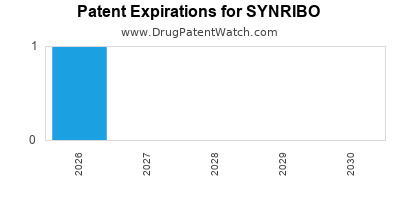
Synribo is a drug marketed by Teva Pharms Intl and is included in one NDA. There is one patent protecting this drug and one Paragraph IV challenge.

This drug has twenty-one patent family members in twelve countries.

The generic ingredient in SYNRIBO is omacetaxine mepesuccinate. There are two drug master file entries for this compound. Additional details are available on the omacetaxine mepesuccinate profile page.

DrugPatentWatch® Generic Entry Outlook for Synribo

Synribo was eligible for patent challenges on October 26, 2016.

By analyzing the patents and regulatory protections it appears that the earliest date for generic entry will be October 26, 2026. This may change due to patent challenges or generic licensing.

There is one Paragraph IV patent challenge for this drug. This may lead to patent invalidation or a license for generic production.

Indicators of Generic Entry

< Available with Subscription >

  Get Started Free

AI Deep Research
Questions you can ask:
  • What is the 5 year forecast for SYNRIBO?
  • What are the global sales for SYNRIBO?
  • What is Average Wholesale Price for SYNRIBO?
Summary for SYNRIBO
International Patents:21
US Patents:1
Applicants:1
NDAs:1
Raw Ingredient (Bulk) Api Vendors: 57
Clinical Trials: 7
Patent Applications: 3,173
Drug Prices: Drug price information for SYNRIBO
What excipients (inactive ingredients) are in SYNRIBO?SYNRIBO excipients list
DailyMed Link:SYNRIBO at DailyMed
Drug patent expirations by year for SYNRIBO
Drug Prices for SYNRIBO

See drug prices for SYNRIBO

DrugPatentWatch® Estimated Loss of Exclusivity (LOE) Date for SYNRIBO
Generic Entry Date for SYNRIBO*:
Constraining patent/regulatory exclusivity:
NDA:
Dosage:
POWDER;SUBCUTANEOUS

*The generic entry opportunity date is the latter of the last compound-claiming patent and the last regulatory exclusivity protection. Many factors can influence early or later generic entry. This date is provided as a rough estimate of generic entry potential and should not be used as an independent source.

Recent Clinical Trials for SYNRIBO

Identify potential brand extensions & 505(b)(2) entrants

SponsorPhase
M.D. Anderson Cancer CenterPhase 1/Phase 2
Teva Pharmaceutical Industries, Ltd.Phase 1/Phase 2
University of FloridaPhase 1/Phase 2

See all SYNRIBO clinical trials

Paragraph IV (Patent) Challenges for SYNRIBO
Tradename Dosage Ingredient Strength NDA ANDAs Submitted Submissiondate
SYNRIBO for Injection omacetaxine mepesuccinate 3.5 mg/vial 203585 1 2016-10-26

US Patents and Regulatory Information for SYNRIBO

SYNRIBO is protected by one US patents.

Based on analysis by DrugPatentWatch, the earliest date for a generic version of SYNRIBO is ⤷  Get Started Free.

This potential generic entry date is based on patent 6,987,103.

Generics may enter earlier, or later, based on new patent filings, patent extensions, patent invalidation, early generic licensing, generic entry preferences, and other factors.

Applicant Tradename Generic Name Dosage NDA Approval Date TE Type RLD RS Patent No. Patent Expiration Product Substance Delist Req. Exclusivity Expiration
Teva Pharms Intl SYNRIBO omacetaxine mepesuccinate POWDER;SUBCUTANEOUS 203585-001 Oct 26, 2012 DISCN Yes No 6,987,103 ⤷  Get Started Free ⤷  Get Started Free
>Applicant >Tradename >Generic Name >Dosage >NDA >Approval Date >TE >Type >RLD >RS >Patent No. >Patent Expiration >Product >Substance >Delist Req. >Exclusivity Expiration

Expired US Patents for SYNRIBO

Applicant Tradename Generic Name Dosage NDA Approval Date Patent No. Patent Expiration
Teva Pharms Intl SYNRIBO omacetaxine mepesuccinate POWDER;SUBCUTANEOUS 203585-001 Oct 26, 2012 7,842,687 ⤷  Get Started Free
Teva Pharms Intl SYNRIBO omacetaxine mepesuccinate POWDER;SUBCUTANEOUS 203585-001 Oct 26, 2012 RE45128 ⤷  Get Started Free
>Applicant >Tradename >Generic Name >Dosage >NDA >Approval Date >Patent No. >Patent Expiration

International Patents for SYNRIBO

See the table below for patents covering SYNRIBO around the world.

Country Patent Number Title Estimated Expiration
Germany 69923768 ⤷  Get Started Free
Canada 2459822 TRAITEMENT DE LA LEUCEMIE MYELOIDE CHRONIQUE, RESISTANTE OU INTOLERANTE AU STI571, IMPLIQUANT L'HOMOHARRINGTONINE SEUL OU EN COMBINAISON AVEC D'AUTRES AGENTS (TREATMENT OF CHRONIC MYELOGENOUS LEUKEMIA, RESISTANT OR INTOLERANT TO STI571, INVOLVING HOMOHARRINGTONINE ALONE OR COMBINED WITH OTHER AGENTS) ⤷  Get Started Free
Canada 2324895 ⤷  Get Started Free
>Country >Patent Number >Title >Estimated Expiration

Market Dynamics and Financial Trajectory for the Pharmaceutical Drug: Synribo

Last updated: July 27, 2025


Introduction

Synribo (omacetaxine mepesuccinate) is an FDA-approved chemotherapy agent developed by Teva Pharmaceutical Industries, primarily indicated for the treatment of chronic or accelerated phase chronic myeloid leukemia (CML) in patients resistant or intolerant to at least two tyrosine kinase inhibitors (TKIs). Since its approval, Synribo's commercial trajectory has been shaped by evolving market dynamics, competitive landscape, regulatory influences, and clinical developments, all contributing to its financial outlook.


Market Context and Therapeutic Landscape

The CML market has undergone transformative shifts with the advent of targeted kinase inhibitors. First-generation drugs like imatinib revolutionized treatment, extending median survival significantly. However, resistance and intolerance issues led to second-generation TKIs (dasatinib, nilotinib) and third-generation agents (ponatinib), creating a highly competitive environment [1].

Synribo occupies a niche for treatment-resistant CML cases, specifically in patients who cannot tolerate or develop resistance to TKIs. Its unique mechanism—protein synthesis inhibition via epigenetic modulation—differentiates it from TKIs, positioning it as a second- or third-line therapy. Nevertheless, the limited scope of its approved indication constrains its market penetration.


Market Dynamics

1. Competitive Landscape

Despite advances, resistance to TKIs remains a clinical challenge, creating demand for alternative therapies like Synribo. However, its market share is limited due to the following:

  • Emergence of Novel Agents: Newer therapies, including asciminib (a STAMP inhibitor) and combination regimens, are expanding options for resistant CML patients. These agents could potentially border or replace Synribo in certain cases, impacting its long-term market share [2].

  • Orphan Drug Status: Synribo's FDA approval as an orphan drug provides benefits such as market exclusivity for seven years, albeit limited scope. The exclusivity period's expiration may introduce generic competition or biosimilar entries, affecting revenues.

  • Clinical Guidelines and Adoption: Treatment guidelines increasingly favor TKIs and their combinations. Use of Synribo remains confined to niche patient populations, limiting extensive adoption.

2. Regulatory and Pricing Environment

Pricing for Synribo remains premium due to its targeted indication and mode of action. Regulatory frameworks emphasizing cost-effectiveness and value-based pricing could exert downward pressures.

Additionally, value-based assessments by payers constrain reimbursement premiums. In markets with cost-containment policies (e.g., Europe, the US), reimbursement dynamics are critical for sales stability.

3. Clinical Development and Label Expansion

Efforts to extend Synribo’s indication to broader or earlier-stage disease could positively influence demand. However, ongoing clinical trials and outcomes data are essential for such expansion. To date, limited new data have surfaced, constraining growth prospects.

4. Manufacturing, Supply Chain, and Market Penetration

Manufacturing complexities and supply chain stability influence availability and pricing. Given the concentrated nature of its indication, market penetration remains modest outside specialized centers, especially given competition from more accessible oral TKIs.


Financial Trajectory Analysis

1. Current Revenue Performance

Synribo’s sales, historically modest due to its niche application and competition, have been stable but limited. For FY 2022, Teva reported Synribo revenues in the mid-hundreds of millions USD, reflecting steady, if restrained, demand. The drug’s revenue is sensitive to factors like pricing strategies, treatment guidelines, and market acceptance.

2. Impact of Patent and Exclusivity Periods

Synribo benefits from patent protections and orphan drug status, with exclusivity potentially lasting until 2027. The patent cliff nearing expiration could open markets to biosimilars or generics, pressuring prices and reducing revenues unless supplemented by indications or market expansion.

3. R&D and Clinical Pipeline Investment

Teva continues investing in clinical research to support label expansion or combination strategies involving Synribo. These initiatives, if successful, could redefine its financial trajectory, either positively through expanded markets or negatively if clinical trials fail to meet endpoints.

4. Market Growth and Future Projections

Considering the limited expansion potential and ongoing resistance issues, forecasts estimate modest CAGR growth (around 2-3%) over the next five years. Market saturation and increasing competition from emerging therapies could suppress growth further.

5. Strategic Opportunities and Risks

Opportunities include:

  • Label expansion: Trials exploring Synribo for other hematologic malignancies or earlier-stage CML could broaden its market.
  • Combination therapies: Demonstrating synergistic effects with TKIs might reposition Synribo as part of first-line regimens.

Risks involve:

  • Market erosion due to generic competition post-patent expiry.
  • Clinical setbacks in ongoing trials.
  • Price pressures from payers demanding value-based pricing.

Regulatory and Market Trends Shaping the Future

Regulatory bodies focus increasingly on innovative, targeted therapies with clear value propositions. The trend toward personalized medicine aligns with Synribo’s niche profile but also requires demonstrating improved clinical outcomes to justify premium pricing.

Global market access remains key, with potential growth in emerging markets where the burden of resistant CML is rising, and access to costly TKIs is limited. However, price sensitivity and regulatory hurdles in these regions could temper expansion.


Conclusion

Synribo's market dynamics are characterized by limited but stable demand driven by treatment-resistant CML cases. Its financial trajectory hinges on patent life, clinical developments, and evolving treatment paradigms. While current revenues are modest, strategic positioning—via clinical trial success and potential indication expansion—could enhance its market footprint. Nonetheless, competitive pressures, alternative therapies, and regulatory trends pose ongoing challenges to sustained growth.


Key Takeaways

  • Niche Positioning: Synribo remains a critical treatment for resistant CML but faces limited growth due to competition and treatment paradigm shifts.
  • Patent and Market Exclusivity: Patent expiration and upcoming biosimilar entries threaten revenue stability, emphasizing the importance of market expansion initiatives.
  • Clinical Development: Successful trials for indication expansion or combination therapies could significantly alter Synribo’s financial outlook.
  • Pricing and Reimbursement: Value-based pricing strategies are essential to maintain profitability amid price regulation and payer pressures.
  • Market Expansion Opportunities: Growing CML burden in emerging markets presents a strategic avenue, albeit intertwined with regulatory challenges.

FAQs

1. What are Synribo’s primary competitors in the CML treatment landscape?
Synribo's main competitors are newer TKIs such as ponatinib, asciminib, and combination strategies involving established TKIs, which have broader indications and easier oral administration.

2. Can Synribo be used as a first-line therapy for CML?
Currently, no. Synribo is approved specifically for resistant or intolerant cases in the advanced phases of CML, limiting its use to second- or third-line settings.

3. What impact will patent expiration have on Synribo’s revenues?
Patent and exclusivity periods are set to expire around 2027, risking generic entry and significant revenue erosion unless the company expands its indications or develops new formulations.

4. Are there ongoing clinical trials to expand Synribo’s use?
Yes, Teva and collaborators are exploring combination therapies and potential new indications, but conclusive results are pending and may influence future market potential.

5. How might regional market differences affect Synribo’s sales?
In regions with high treatment-resistant CML prevalence and limited access to TKIs, Synribo could see increased adoption. Conversely, stringent pricing controls or competing therapies in developed markets could suppress sales growth.


References

[1] Baccarani et al., "European LeukemiaNet Recommendations for the Management of Chronic Myeloid Leukemia," Blood, 2013.
[2] Hughes et al., "Emerging Therapies for Resistant CML," J Hematol Oncol, 2022.

More… ↓

⤷  Get Started Free

Make Better Decisions: Try a trial or see plans & pricing

Drugs may be covered by multiple patents or regulatory protections. All trademarks and applicant names are the property of their respective owners or licensors. Although great care is taken in the proper and correct provision of this service, thinkBiotech LLC does not accept any responsibility for possible consequences of errors or omissions in the provided data. The data presented herein is for information purposes only. There is no warranty that the data contained herein is error free. We do not provide individual investment advice. This service is not registered with any financial regulatory agency. The information we publish is educational only and based on our opinions plus our models. By using DrugPatentWatch you acknowledge that we do not provide personalized recommendations or advice. thinkBiotech performs no independent verification of facts as provided by public sources nor are attempts made to provide legal or investing advice. Any reliance on data provided herein is done solely at the discretion of the user. Users of this service are advised to seek professional advice and independent confirmation before considering acting on any of the provided information. thinkBiotech LLC reserves the right to amend, extend or withdraw any part or all of the offered service without notice.