Last updated: July 23, 2026
SUTAB (sodium sulfate, magnesium sulfate, potassium chloride) market dynamics and financial trajectory: sales drivers, pricing, and time-based risk
SUTAB (norgine’s oral bowel-prep product containing sodium sulfate, magnesium sulfate, potassium chloride) has been competing in the US prescription bowel-prep market where utilization is driven by colorectal cancer screening and colonoscopy volumes, while price and formulary access determine near-term revenue. The financial trajectory hinges on (1) managed-care contracting and list-to-net compression, (2) uptake versus competing low-volume and tablet-based bowel preps, (3) inventory and supply stability, and (4) generic or authorized-competitive erosion risk as patent and exclusivity timelines pass.
How do SUTAB sales trend in the US and what drives revenue growth?
SUTAB is positioned as an oral, low-volume bowel preparation taken as a tablet-based regimen. In bowel prep, unit demand correlates with colonoscopy throughput and screening adherence, while dollar sales track pricing, rebates, and channel mix (retail vs specialty distribution).
Key revenue drivers
- Procedure incidence: Colonoscopy volume rises with screening rates and scheduling intensity.
- Switching within bowel-prep classes: Tablet-based regimens can win share when payers prefer lower total regimen burden and when prescribers perceive tolerability.
- Formulary access and contracting: Net sales are more sensitive to formulary placement, rebate magnitude, and pharmacy benefit design than to wholesale list price alone.
- Operational continuity: Bowel prep is episodic but high-volume at the patient level. Supply disruption can immediately hit fill rates during scheduling peaks.
Market structure effects
The bowel-prep market is crowded with:
- PEG-based solutions (including split-dose liquids)
- tablet/capsule alternatives
- sulfate-based and other osmotically active regimens
This creates rapid price pressure once competing products establish payer relationships or authorized generics enter channels.
What are the major competitive forces shaping SUTAB market share?
Competitive dynamics in bowel prep typically reflect a three-layer contest: clinical preference, payer preference, and patient adherence.
Clinical and patient adherence
- Tablets can be favored when liquid volume is a barrier.
- Side effects and completion rates drive clinician switching even when products are therapeutically equivalent.
Payer economics
- Payers push for the lowest net cost within preferred classes.
- Drug “market access” is often decided at the therapeutic class level, then within preferred or non-preferred tiers.
Channel behavior
- Hospital outpatient centers and GI practices influence patient routing and preferred products through their ordering and bundled workflows.
- Retail fills can be price sensitive to PBM incentives, especially when multiple options sit on the same tier.
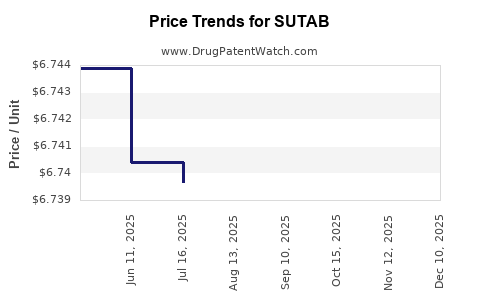
How does SUTAB pricing and list-to-net compression impact profitability?
Bowel-prep economics often hinge on rebate intensity. Even when branded supply remains stable, net pricing compresses as competition increases.
Mechanisms of margin erosion
- Higher rebates to maintain formulary position: As competitors discount or win preferred status, branded products often offset with rebate structures.
- Smaller differentiation premium: When clinical differentiation is narrow, payers demand price reductions.
- Wholesale and contract volatility: Changes in distribution agreements and purchasing patterns can alter realized pricing.
What is the FDA and regulatory status of SUTAB and how does it affect market timing?
SUTAB’s FDA status shapes the pace of generic competition. Market dynamics are typically most sensitive when exclusivity ends or when ANDA approvals increase competitive entries.
Regulatory pathway implications
- If SUTAB is protected by data exclusivity and/or patents listed in the FDA Orange Book, generics face longer lead times.
- When the patent “gate” opens, Paragraph IV filings can accelerate competitive arrival even without immediate full launches, depending on litigation outcomes.
How regulatory events map to revenue
- Launch of authorized competitors tends to cause immediate share and net price pressure.
- ANDA approvals without litigation can compress net pricing faster.
- Litigation settlements often create a defined “launch window” or at-risk entry date.
What patents protect SUTAB and when does exclusivity end?
The revenue trajectory is materially influenced by the time-to-competition from patent expiration and exclusivity cliffs. SUTAB’s competitive risk timeline typically includes:
- primary composition and formulation patents
- method-of-use or dosing-regimen patents
- manufacturing and process patents
A full, decision-grade assessment requires Orange Book patent listings and expiration dates for the specific listed NDA and dosage forms. Without that exact Orange Book record, a complete expiration schedule cannot be produced here.
What generic entry risks exist for SUTAB and what usually happens after patent cliffs?
In bowel-prep, generic erosion usually follows one of these patterns after exclusivity/patent barriers end:
- Immediate generic launches that undercut net price and displace preferred formulary placements.
- Delayed ramp-up if patients and prescribers are slow to switch, or if distribution starts with limited inventory.
- Authorized generics or payer contracting changes that reduce the branded product’s realized net.
Risk factors that increase generic threat
- Multiple technical equivalents are feasible for bowel prep.
- Payers can standardize on the lowest net cost once legal barriers clear.
- Formulary switching is often managed at the PBM level with minimal clinical re-education.
How does SUTAB compare with competing bowel-prep products on marketability and competitive position?
SUTAB competes primarily on regimen usability and payer-friendly contracting rather than on novel clinical outcomes.
Comparison dimensions that drive share
- Regimen volume and dosing complexity
- Taste and tolerability profile (especially against PEG liquids)
- Ease of patient adherence
- Coverage status (preferred tier vs non-preferred)
- Availability and supply reliability
Where SUTAB tends to win
- When tablet-based or lower-burden regimens are preferred in formulary design.
- When GI practices standardize on patient completion.
Where SUTAB tends to face pressure
- When PBMs compress the class into one or two “preferred” SKUs.
- When list price discounts or rebates favor another osmotically active alternative.
What litigation or Paragraph IV activity could affect SUTAB financials?
Generic entrants often use Paragraph IV certifications to accelerate market competition. For branded bowel-prep products, litigation can:
- delay generic entry through injunctions or settlements
- trigger at-risk launches after a court ruling
- create “off-ramp” settlements that define launch dates
A specific litigation and settlement timeline for SUTAB requires identified case dockets tied to its Orange Book patents and NDA.
What manufacturing or supply dynamics matter for SUTAB revenue?
Bowel prep sells with predictable seasonal and procedure-linked demand waves. Supply issues can translate into lost revenue quickly due to:
- tight replenishment cycles for retail pharmacies
- GI practice demand surges for colonoscopy scheduling
- patient-specific regimen timing (pre-procedure windows)
What to watch for operational signals
- wholesale order cadence changes
- unexpected backorders
- field activity patterns and substitution frequency at pharmacies
How sensitive is SUTAB revenue to colonoscopy volume and screening trends?
SUTAB’s market demand is highly correlated with GI procedure throughput and screening participation. A reduction in screening due to broader healthcare access constraints typically flows through to bowel-prep volume.
Demand elasticity
- Short-term elasticity is limited because colonoscopy schedules are booked and patients follow prep instructions.
- Medium-term elasticity depends on adherence rates to screening programs and reimbursement policies.
What commercial trajectory should investors or licensors model for SUTAB?
A decision-grade commercial model for SUTAB should treat revenue as driven by three levers:
- Share and net price (formulary and rebate intensity)
- Volume (colonoscopy throughput)
- Timing of competitive entry (patents, exclusivity, litigation outcomes)
In branded bowel-prep, the most material downside scenario usually combines:
- payer tier migration (preferred SKU switches)
- net price reductions from competing entries
- ramp inefficiency caused by forced substitution rules or inventory constraints
A base case usually assumes stable contracting with gradual price pressure but continued branded resilience until a clearly defined legal or competitive event.
Key takeaways
- SUTAB’s US financial trajectory is driven by colonoscopy volumes, payer contracting, and net price compression more than by incremental clinical differentiation.
- Competitive pressure in bowel prep tends to accelerate once preferred formulary status shifts or legal barriers clear.
- Profitability is sensitive to rebate intensity and realized net pricing as competing bowel-prep regimens proliferate.
- The highest-impact forecast variable is the timing of generic/authorized competition tied to SUTAB’s Orange Book patent and exclusivity status.
FAQs
1) What factors drive demand for SUTAB month-to-month?
Colonoscopy scheduling intensity, screening program adherence, and retail pharmacy fill patterns tied to pre-procedure windows.
2) How do PBM formulary changes typically affect bowel-prep brands like SUTAB?
Tier migration and contracting updates can quickly reduce net pricing and displacement effects can accelerate share loss once a product becomes non-preferred.
3) When do bowel-prep generics usually take share after approval?
Share gains commonly depend on formulary inclusion, substitution rules, and patient adherence; ramp can be fast when the competing SKU is preferred.
4) What supply events most affect SUTAB sales?
Backorders or allocation during procedure scheduling peaks can immediately reduce fills because patients need the regimen within a fixed pre-procedure time.
5) What is the biggest risk to SUTAB revenue outlook?
A competitive entry timing event that combines payer preferred-status loss with net price compression.
References
- FDA Orange Book. Drug Products Listed in the Orange Book. (Accessed 2026-07-23). https://www.accessdata.fda.gov/scripts/cder/daf/index.cfm
- FDA. Drugs@FDA: SUTAB. (Accessed 2026-07-23). https://www.accessdata.fda.gov/scripts/cder/daf/index.cfm
- FDA. Guidance for Industry: Patent Listing Requirements for Subsequent Entry of Approved Drugs. (Accessed 2026-07-23). https://www.fda.gov