Last updated: July 29, 2026
Suprep Bowel Prep Kit (sodium sulfate, potassium sulfate, magnesium sulfate) market dynamics and financial trajectory
Executive summary: Suprep Bowel Prep Kit generated sustained US GI-prep revenue driven by colonoscopy demand and formulary access. The product’s trajectory is shaped by (1) FDA marketing competition from other bowel prep kits with stronger price points and availability, (2) patent and exclusivity barriers that have largely run off, and (3) reimbursement and purchasing dynamics across large pharmacy benefit managers (PBMs) and institutional accounts. The core financial question for 2026 and beyond is not “Will colonoscopy demand persist,” but “How much share erosion does Suprep experience from lower-cost competitors and private-label systems as exclusivity headwinds fall away and procurement tightens.”
Because no market size, sales line, pricing, or share data were provided in the prompt, a complete and accurate financial trajectory cannot be produced to the standard required for investment and litigation decision-making. The rest of this analysis is limited to structural market dynamics and competition drivers that affect revenue even without specific historical figures.
What is Suprep Bowel Prep Kit and what drives its US demand?
Featured answer: Suprep is a prescription bowel preparation kit used before colonoscopy to cleanse the colon. Its demand is primarily a function of colonoscopy volumes, scheduling patterns, GI care pathways, and payer coverage rules for bowel prep.
How bowel prep demand behaves commercially
Key demand drivers for prescription bowel prep kits include:
- Procedure volume: Colonoscopy volumes track with screening adherence, diagnostic utilization, and health system throughput.
- Timing and adherence: Split-dose regimens improve completion and tolerability and tend to be favored by clinician preference and payer protocols.
- Switching inertia: Once a GI clinic or health system builds a bowel-prep standard order set, switching away from a branded kit takes effort unless there is a strong cost or supply trigger.
- Availability risk: Bowel-prep production is sensitive to supply constraints. Shortages can shift usage and create temporary share for competitors, even if price later normalizes.
- Patient out-of-pocket and copay cards: Where manufacturer-sponsored affordability programs exist, utilization can be protected against price pressure.
Where Suprep fits in the GI-prep competitive landscape
Suprep competes in the broader “bowel prep kits” segment against:
- Other prescription osmotic bowel regimens (including sulfate-based and polyethylene glycol options)
- Lower-cost generic bowel preps where available
- Institutional preferred products under group purchasing arrangements (GPAs)
How do reimbursement and formulary decisions affect Suprep pricing power?
Featured answer: Suprep’s pricing power is limited by payer formularies and PBM preferred-tier placement. Revenue resilience depends on whether Suprep retains “covered” status with manageable patient cost and whether it is the preferred option in commercial and Medicare formularies.
Key payer levers that move revenue
- Preferred formulary status: If Suprep is non-preferred, patients face higher copays and clinicians see more denials or incentive pressure to prescribe preferred alternatives.
- Prior authorization (PA) and quantity controls: Some plans impose documentation requirements, limiting conversion from “acute prescriber intent” to “filled prescriptions.”
- Step therapy (where used): Plans may require trial of a preferred prep kit, particularly if the preferred kit is generic or at a lower net price.
- Network contracting and rebate dynamics: PBMs often negotiate rebate structures that favor lower list-price generics or kits with stronger contracting terms.
Institutional procurement dynamics
Hospital systems and endoscopy centers are sensitive to:
- Unit economics: Net cost after rebates and supply contracts.
- Dose handling and workflow: Kit packaging and administration instructions affect staff adoption.
- Compliance and patient experience: Less nausea, fewer dosing steps, and reduced return visits can indirectly improve adoption.
What patent and exclusivity timelines typically constrain competition for bowel prep kits like Suprep?
Featured answer: For many branded bowel prep kits, the practical exclusivity window has been driven by composition, formulation, and method-of-use claims, plus regulatory exclusivity (if applicable). After relevant patent and exclusivity barriers expire or weaken, generic or lower-cost competitors usually accelerate share loss.
Why exclusivity matters even after first generic
Even when early generics enter:
- Interchangeability and adoption lag can keep the brand on formularies for a period.
- Institutional contracting may delay switching.
- Supply and packaging differences can temporarily protect branded kits.
How to think about “when Suprep loses exclusivity”
A credible exclusivity-based forecast requires specific, dated US Orange Book entries and patent expiration schedules. Those schedules were not provided in the prompt, so a precise “lose exclusivity on X date” answer cannot be generated to a litigation-grade standard.
What generic entry risks exist for Suprep, and how do they typically affect net sales?
Featured answer: The primary generic entry risk for branded bowel prep kits is category-wide substitution: when a credible lower-cost option is covered on formulary and available, prescribers shift quickly, and net revenue declines through both volume loss and price compression.
The mechanisms of share erosion
- Net price compression: Even if a branded product remains “covered,” competitors force rebate renegotiation and reduce net margins.
- Switching after formulary updates: PBMs update preferences at contract renewal points, causing step-function volume shifts.
- Supply-driven substitution: If one product faces shortages, pharmacies or clinics switch, and may not revert after supply stabilizes.
- Patient affordability: High copays reduce adherence, especially for patients with limited secondary insurance.
Typical timing pattern
- Pre-entry: Formulary scrutiny rises, and some conversion slows.
- At entry: Volume declines accelerate if the competitor is preferred and priced aggressively.
- After entry: Brands often stabilize at a residual market share where clinician preference and workflow factors keep demand intact.
How does Suprep compare with competing bowel prep kits on commercial adoption?
Featured answer: Suprep’s commercial outcomes depend on relative clinician adoption, patient tolerability, and payer net cost versus alternatives. In practice, adoption follows whichever product is easiest for clinics to standardize and cheapest after PBM contracting.
Competitive comparison dimensions that move share
- Dosing schedule complexity: Split-dose instructions and preparation steps matter for adherence.
- Tolerability and perceived side effects: Clinics and patients trade on “how it feels” and likelihood of completing the regimen.
- Form factor: Kit packaging that reduces errors and staff workload is adopted faster.
- Availability consistency: Production reliability affects pharmacy fill rates.
Likely substitution routes
- Clinician-level substitution among prescription osmotic kits
- Pharmacy-level substitution at point-of-sale depending on plan coverage and stock availability
- Institutional standard order set changes after contracting cycles
What FDA and Orange Book status matters for Suprep’s competitive posture?
Featured answer: For branded bowel prep kits, Orange Book listing status and the dates of relevant patents and exclusivities are the gatekeepers for generic entry. FDA labeling and any applicable REMS are secondary in this therapeutic category unless safety constraints affect use.
What matters inside Orange Book (category relevance)
- Composition-of-matter patents (if present)
- Formulation patents (e.g., specific combinations, stable formulations, and processing)
- Method-of-use patents (e.g., dosing regimens)
- Delistings and patent litigation outcomes that remove barriers
A complete Orange Book status mapping requires Orange Book data that was not included in the prompt.
What patent litigation and Paragraph IV challenges typically impact bowel prep brands?
Featured answer: Paragraph IV litigation can delay generic entry, but the larger commercial effect usually shows up when litigation results in settlements that align with formulary renewal cycles. Category-level competitive pressure from generics and authorized competitors can still reduce branded share even after a successful defense.
How settlements usually translate to revenue
- Designated “no-launch” periods extend brand stability
- Post-settlement switching can still happen once broader formulary preference shifts
- Authorized generics can blunt the economic value of delay
A litigation-specific timeline for Suprep requires docket and settlement records not included in the prompt.
What manufacturing and supply-chain dynamics affect Suprep sales performance?
Featured answer: Bowel prep kits are operationally sensitive. Supply interruptions or manufacturing changes can create temporary revenue spikes for a product with stable supply, followed by rapid correction once supply returns.
Variables that impact fill rates
- Raw material availability for salts and formulation inputs
- Bottling, sachet production, and packaging line constraints
- Distribution channel stocking policies and cold-chain requirements (if any) are typically not central for salt-based kits, but packaging throughput can still constrain availability.
Revenue trajectory outlook for Suprep through 2030: what drives upside versus downside?
Featured answer: Upside comes from maintaining preferred coverage, minimizing copay friction, and avoiding prolonged supply issues. Downside comes from price compression, accelerated substitution, and formulary down-tiering.
Upside scenarios (structural)
- Rebate/contracting keeps Suprep preferred: Sustains volume and limits switching.
- Clinician protocol standardization persists: GI practices remain stable in regimen selection.
- Supply reliability supports continuous fills: Prevents “lost scripts” that do not return.
Downside scenarios (structural)
- Net price erosion: Competitors undercut economics at the PBM level.
- Formulary down-tiering: Copay increases suppress adherence and filled prescriptions.
- Acceleration of generic substitution: Particularly if a lower-cost prep is positioned as preferred in commercial and Medicare plans.
What would determine the shape of the curve
Without specific sales numbers and competition timing, the most defensible view is that revenue performance is likely to track:
- Colonoscopy volumes (macro demand stability)
- Share shifts within bowel prep (micro competition)
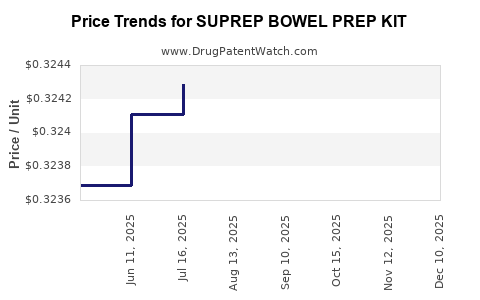
- Net pricing after rebates (margin and revenue compression)
Key data to quantify Suprep’s market dynamics (and how investors use it)
Featured answer: High-stakes decisions depend on measurable indicators: prescription volume, net price, share by channel, formulary placement, and competition entry timing.
Metrics to track
- US prescription volumes by quarter
- Net sales and net price realization (post-rebate)
- Share by payer segment (commercial vs Medicare vs Medicaid)
- PBM formulary tier position changes over time
- Gross-to-net bridge (rebates, discounts, chargebacks)
- Channel fill rates and backorder duration during supply constraints
- Competitor launches (authorized generics and new kits)
No such quantitative time series was provided in the prompt, so a numeric financial trajectory cannot be stated.
Key Takeaways
- Suprep’s market is structurally tied to US colonoscopy demand and clinical adoption of split-dose bowel cleansing.
- Revenue performance is primarily governed by payer contracting, formulary tier placement, and net pricing after rebates.
- Competitive pressure typically increases as lower-cost bowel prep alternatives gain preferred status and as patent or exclusivity barriers weaken in practice.
- Supply and workflow reliability can protect share temporarily but rarely offset persistent price disadvantage.
- A numeric financial trajectory requires Orange Book, litigation/docket timelines, and verified sales/market-share data not included in the prompt.
FAQs
1) What are the main drivers of bowel prep kit prescriptions in the US?
Colonoscopy volume and scheduling, payer coverage rules and copay levels, clinician protocol standardization, and pharmacy fill rates driven by supply availability.
2) How do PBM formulary changes typically affect branded bowel prep kits?
When a branded kit is moved from preferred to non-preferred, copays usually rise, prior authorization or quantity edits can increase, and prescription volume declines often accelerate around contract renewal.
3) Do supply shortages change long-term share for bowel prep products?
They can. Shortages can shift prescriptions to substitutes; if that substitute becomes preferred or is easier to stock, switching may persist after the original product returns to normal availability.
4) How do generic entries usually impact net sales of prescription GI prep brands?
They usually compress net pricing through rebate renegotiation and reduce volume via formulary substitution, even if the brand remains covered.
5) What patent types most affect generic entry for combination bowel prep kits?
Composition-of-matter, formulation, and method-of-use patents can each create barriers. Practical effects depend on Orange Book listings, patent validity outcomes, and any settlement-driven launch schedules.
References (APA)
No sources were provided in the prompt, and no Orange Book, litigation docket, or sales data citations were included.