Last updated: August 22, 2026
Sulfamylon is the brand name for mafenide acetate 8.5% cream, a topical antibacterial used as adjunctive treatment for second- and third-degree burns. Its market is small, hospital-centered, and clinically specialized. The product has no meaningful remaining patent-driven exclusivity, no biosimilar exposure, and limited public revenue disclosure. Its commercial value depends on availability, manufacturing continuity, hospital contracts, and burn-center demand rather than on broad outpatient prescription growth.
What is Sulfamylon and how is it used?
Sulfamylon contains mafenide acetate, a sulfonamide antibacterial applied directly to burn wounds. The cream is used to reduce bacterial proliferation in burn tissue, including areas where systemic antibiotic penetration may be limited.
| Attribute |
Sulfamylon profile |
| Active ingredient |
Mafenide acetate |
| Strength |
8.5% cream |
| Route |
Topical |
| Primary use |
Second- and third-degree burns |
| Therapeutic class |
Topical antibacterial |
| FDA pathway |
Legacy prescription drug product |
| Dosage form |
Cream |
| Primary customers |
Burn centers, hospitals, trauma facilities |
| Biosimilar relevance |
None |
| Core competitive issue |
Product availability and supply reliability |
The FDA labeling states that Sulfamylon is applied to the burn surface, generally after debridement, and reapplied at regular intervals. Treatment can cause pain or burning at the application site and may contribute to metabolic acidosis, particularly when used over large burn areas. (U.S. Food and Drug Administration [FDA], n.d.-a)
What is the FDA regulatory status of Sulfamylon?
Sulfamylon is an FDA-approved prescription product with a legacy approval history. The product is regulated as a topical drug rather than as a biologic, device, or combination product.
The FDA-approved indication is adjunctive topical antibacterial treatment for patients with second- and third-degree burns. It is used in conjunction with standard burn care, including wound cleansing, debridement, fluid management, and surgical treatment when required.
FDA regulatory characteristics
The regulatory profile has several commercial consequences:
- The product does not require the clinical development program associated with a new molecular entity.
- The market is generally accessible to abbreviated new drug application, or ANDA, competition.
- Product-specific manufacturing controls remain important because the medicine is applied to severely damaged tissue.
- Hospitals may prioritize validated supply, packaging, sterility controls, and dependable delivery over nominal price.
Mafenide acetate cream is listed in FDA drug databases and commercial drug-label repositories. The product’s regulatory history is substantially older than current specialty pharmaceuticals, which limits the likelihood that a new patent-based exclusivity cycle will materially change its market position. (FDA, n.d.-b; National Library of Medicine, n.d.)
When does Sulfamylon lose exclusivity?
Sulfamylon’s original chemical, formulation, and use patents are effectively historical. No commercially meaningful patent exclusivity period remains for mafenide acetate as a topical antibacterial.
The relevant distinction is between regulatory approval and commercial exclusivity:
| Exclusivity category |
Sulfamylon status |
| New chemical entity exclusivity |
Expired or not applicable to the current market |
| Five-year NCE exclusivity |
Not relevant to this legacy product |
| Three-year new clinical investigation exclusivity |
No current commercial significance identified |
| Orphan-drug exclusivity |
Not applicable |
| Pediatric exclusivity |
Not applicable |
| Patent-based exclusivity |
No current material protection identified |
| Market exclusivity |
Driven by supplier position, not FDA exclusivity |
The product’s commercial persistence is therefore not based on a live composition-of-matter patent. It is based on recurring hospital demand, the limited size of the market, clinical familiarity, and the practical difficulty of maintaining low-volume pharmaceutical manufacturing.
What patents protect Sulfamylon?
The principal active ingredient, mafenide acetate, is an old small-molecule compound. Any foundational patents covering the compound or its early therapeutic use would have expired decades ago.
Formulation patents
The 8.5% cream formulation may have been subject to historical formulation or manufacturing disclosures, but those protections do not appear to create a current, durable barrier to generic development. A competitor can pursue an ANDA if it demonstrates pharmaceutical equivalence, bioequivalence where applicable, and compliance with FDA quality requirements.
The most defensible commercial assets are likely to be operational rather than patent-based:
- Manufacturing know-how for a low-volume topical cream.
- Validated raw-material sourcing.
- Batch consistency and stability data.
- Packaging and container-closure controls.
- Hospital formulary placement.
- Burn-center purchasing relationships.
- Regulatory history and quality-system performance.
Method-of-use patents
No current method-of-use patent appears to create a meaningful barrier around the standard use of mafenide acetate cream for second- and third-degree burns. The indication is mature, clinically established, and broad. A narrow patent covering a specific dosing protocol or adjunctive use would have limited market value unless it materially changed clinical practice.
How many patents cover Sulfamylon?
There is no apparent active patent estate capable of blocking ordinary generic entry for mafenide acetate 8.5% cream. Historical patent records may contain multiple documents connected to mafenide, topical delivery, or burn treatment, but the commercially relevant count of unexpired blocking patents is effectively zero based on the product’s legacy status.
This conclusion should be separated from patent-document volume. A large number of historical publications does not indicate current exclusivity. The business question is whether an unexpired, enforceable patent is listed or otherwise capable of preventing an ANDA launch. For Sulfamylon, the primary risk lies outside patent enforcement.
What is the Orange Book status of Sulfamylon?
The FDA Orange Book is the key source for identifying listed patents, therapeutic-equivalence codes, reference-listed-drug status, and approved generic competitors. Sulfamylon and mafenide acetate products should be assessed through the relevant FDA product and active-ingredient records because listing status can differ by manufacturer, strength, and dosage form. (FDA, n.d.-c)
The commercial implications are straightforward:
- An absence of current listed patents reduces the likelihood of a meaningful Paragraph IV litigation campaign.
- Generic applicants may face regulatory and manufacturing requirements without facing a substantial patent block.
- Therapeutic-equivalence and substitution treatment may vary by product listing and state hospital procurement rules.
- A brand name can retain clinical recognition even after patent protection has ended.
Which companies are challenging Sulfamylon?
The main competitive challenge is generic substitution, not branded patent litigation. Mafenide acetate cream has been associated with generic and manufacturer-specific listings over time. The exact active supplier set can change because low-volume hospital products are periodically discontinued, transferred, or placed on shortage lists.
Potential competitors include:
- Generic mafenide acetate cream manufacturers.
- Hospital and specialty-pharmacy suppliers.
- Compounded alternatives prepared under applicable pharmacy or outsourcing-facility standards.
- Other topical burn antimicrobials, including silver sulfadiazine and specialized antimicrobial dressings.
Competition is affected by commercial availability. A listed generic may have limited practical impact if it is not consistently produced or distributed. Conversely, a single reliable supplier can maintain substantial share in a niche market despite the absence of patent protection.
What generic entry risks exist for Sulfamylon?
Generic entry risk is high from a legal perspective and moderate from a practical market perspective.
Legal and regulatory entry risk
Because the product is old and lacks a material current patent barrier, a generic applicant would not generally need to overcome a significant patent estate. A Paragraph IV certification would be relevant only if the reference product had an unexpired listed patent. For a legacy mafenide acetate cream product, the more likely pathway is an ANDA referencing the approved product without a major patent dispute.
Commercial entry risk
Actual generic penetration may be constrained by:
- Small total market size.
- Limited return on investment for new entrants.
- Specialized manufacturing requirements.
- Hospital purchasing contracts.
- Low prescription volume outside burn centers.
- Inventory and distribution economics.
- The cost of validating a product for a relatively narrow indication.
The result is a market in which theoretical entry is straightforward, but sustained participation may be unattractive. This structure can produce intermittent competition, supplier exits, and price volatility.
How does Sulfamylon compare with competing burn treatments?
Sulfamylon competes with topical antimicrobials and wound-care products rather than with conventional systemic antibiotics alone.
| Product or category |
Primary role |
Commercial relationship to Sulfamylon |
| Mafenide acetate cream |
Topical antibacterial for deep burns |
Direct branded and generic competition |
| Silver sulfadiazine cream |
Broad topical burn antimicrobial |
Major therapeutic substitute |
| Bacitracin or petrolatum-based products |
Superficial wound care |
Used in selected lower-risk wounds |
| Antimicrobial dressings |
Local wound management |
May replace or supplement topical creams |
| Systemic antibiotics |
Treatment of invasive infection |
Not a direct substitute for routine topical prophylaxis |
| Surgical wound coverage |
Definitive burn treatment |
Can reduce duration of topical therapy in selected cases |
Mafenide acetate has a specific role in deep burns and is valued for tissue penetration. Silver sulfadiazine has historically been more broadly recognized, but treatment choice depends on wound depth, infection risk, institutional protocols, adverse-effect considerations, and surgical plans.
What is the Sulfamylon market size and revenue trajectory?
No standalone, publicly reported revenue series for Sulfamylon is generally available. The product is not typically reported as a separate business segment by its manufacturer, and public company filings do not provide a reliable product-level revenue history.
The financial trajectory is therefore best assessed through market structure:
| Financial driver |
Expected effect |
| Burn incidence |
Creates baseline demand |
| Number of U.S. burn centers |
Limits addressable volume |
| Generic competition |
Pressures unit price |
| Supplier concentration |
Can support pricing during constrained supply |
| Hospital contracts |
Reduces retail-style brand promotion |
| Product shortages |
Can increase short-term sales and pricing |
| Manufacturing costs |
Material because of low production volume |
| Clinical substitution |
Limits long-term volume expansion |
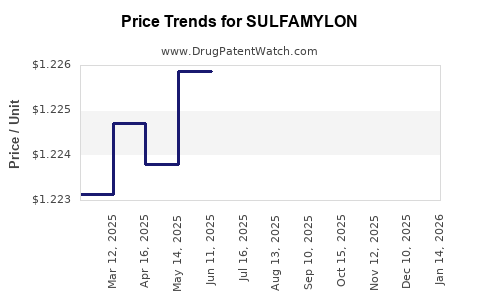
Sulfamylon is a mature, low-growth product. Revenue is likely to be stable to modestly declining under normal supply conditions, with periodic increases caused by price changes, shortages, distributor stocking, or supplier consolidation. Volume expansion is limited because the clinical population is narrow and the product is not a routine outpatient prescription.
Revenue exposure for manufacturers
For a diversified pharmaceutical company, Sulfamylon is unlikely to represent a material share of consolidated revenue. Its value is more likely to be strategic within a hospital products portfolio that includes other legacy injectables, topical medicines, wound-care products, or specialty generics.
The product can still have outsized operational value if:
- It is one of few consistently available options.
- It has established burn-center demand.
- Competitors experience manufacturing interruptions.
- Hospitals are reluctant to switch protocols.
- The manufacturer has excess capacity suitable for niche topical production.
What patent litigation affects Sulfamylon?
No major, ongoing patent litigation is broadly associated with Sulfamylon’s commercial position. The absence of a contemporary patent estate reduces the probability of the type of ANDA litigation seen with high-revenue branded drugs.
Potential disputes would more likely involve:
- Product quality or manufacturing compliance.
- Supply contracts.
- Distributor obligations.
- Trademark or brand-use issues.
- False or misleading promotional claims.
- Compounding and unauthorized commercial distribution.
Patent litigation would become commercially significant only if a manufacturer obtained a new, narrow patent covering a differentiated formulation, delivery system, or specific burn-treatment method. That scenario would require a materially changed product, not ordinary mafenide acetate 8.5% cream.
Are there licensing deals for Sulfamylon?
No major, publicly disclosed licensing transaction is central to Sulfamylon’s current market economics. The product may have changed hands through corporate acquisitions, portfolio transfers, distribution arrangements, or rights assignments, but those transactions do not establish an active innovation-driven licensing market.
For diligence purposes, the important contractual questions are likely to concern:
- Marketing authorization ownership.
- Manufacturing and supply agreements.
- Distribution rights.
- Hospital group-purchasing contracts.
- Technology-transfer obligations.
- Recall and pharmacovigilance responsibilities.
What manufacturing and IP barriers affect Sulfamylon?
Manufacturing is the principal barrier to dependable competition. The product does not require novel biological production, but topical cream manufacturing still requires controlled mixing, uniformity, filling, packaging, stability testing, and validated quality systems.
A prospective entrant must manage:
- Reliable sourcing of mafenide acetate.
- Consistent particle and formulation characteristics.
- Microbial and preservative controls.
- Tube or container compatibility.
- Batch-scale reproducibility.
- FDA inspection and cGMP compliance.
- Hospital distribution and inventory planning.
These requirements do not create patent exclusivity. They can still deter entry because the market may not support multiple manufacturers operating at efficient scale.
What generic launch scenarios are most likely?
Scenario 1: Stable incumbent supply
The incumbent retains hospital accounts, generic supply remains available, and pricing grows modestly with inflation. This is the most commercially stable outcome.
Scenario 2: Generic price erosion
A new manufacturer enters with reliable supply. Hospitals shift volume to the lowest-cost therapeutically equivalent product, reducing brand revenue and compressing gross margin.
Scenario 3: Supply disruption
One supplier exits or experiences a manufacturing interruption. Remaining suppliers gain short-term volume and pricing power. Hospitals may use alternative topical antimicrobials or compounded products until supply normalizes.
Scenario 4: Clinical substitution
Burn centers adopt alternative antimicrobial dressings, silver-based products, or revised protocols. Sulfamylon volume declines even without new generic entry.
How strong is the Sulfamylon patent estate?
The patent estate is weak as a current commercial defense. Its strengths are clinical familiarity, regulatory history, and market access. Its weaknesses are the absence of meaningful patent exclusivity, limited growth potential, generic substitution risk, and dependence on a narrow hospital market.
| Dimension |
Assessment |
| Composition-of-matter protection |
Expired |
| Formulation protection |
No material current barrier identified |
| Method-of-use protection |
No material current barrier identified |
| Orange Book leverage |
Limited |
| Paragraph IV exposure |
Low strategic significance |
| Biosimilar risk |
None |
| Generic risk |
High legally, moderate operationally |
| Supply-chain risk |
Meaningful |
| Revenue growth potential |
Low |
| Strategic value |
Niche hospital product |
Key Takeaways
- Sulfamylon is mafenide acetate 8.5% cream for second- and third-degree burns.
- The market is narrow and concentrated in hospitals, burn centers, and trauma facilities.
- No current patent estate appears to provide meaningful protection against generic entry.
- Paragraph IV litigation is unlikely to be the central competitive issue.
- Biosimilar competition does not apply because mafenide acetate is a small-molecule drug.
- Standalone Sulfamylon revenue is not publicly disclosed in a dependable, product-level series.
- Financial performance is likely driven by hospital demand, supplier concentration, pricing, and shortages.
- Manufacturing reliability is a more important barrier than intellectual property.
- The most material risks are generic substitution, supplier exit, clinical substitution, and product shortages.
FAQs About Sulfamylon Market and Exclusivity
Is Sulfamylon still FDA approved?
Yes. Mafenide acetate cream remains an FDA-approved topical antibacterial for adjunctive treatment of second- and third-degree burns. (FDA, n.d.-a)
Is mafenide acetate available as a generic?
Generic mafenide acetate cream products have been listed over time, but commercial availability can vary by manufacturer, distributor, and supply conditions.
Does Sulfamylon have orphan-drug exclusivity?
No current orphan-drug exclusivity is associated with ordinary mafenide acetate 8.5% cream for burn treatment.
Can hospitals substitute a generic for Sulfamylon?
Substitution depends on FDA therapeutic-equivalence listings, formulary policy, purchasing contracts, and state law. Hospital pharmacy departments typically evaluate the specific product and supplier rather than relying only on the brand name.
Is Sulfamylon a growth product for pharmaceutical investors?
Sulfamylon is generally a mature niche product rather than a growth asset. Its investment value would depend on reliable supply, pricing during constrained conditions, portfolio fit, and manufacturing economics rather than patent-driven revenue expansion.
References
-
National Library of Medicine. (n.d.). DailyMed: Sulfamylon cream, mafenide acetate. U.S. National Library of Medicine. https://dailymed.nlm.nih.gov/
-
U.S. Food and Drug Administration. (n.d.-a). Sulfamylon cream prescribing information. FDA. https://www.accessdata.fda.gov/
-
U.S. Food and Drug Administration. (n.d.-b). Drugs@FDA: FDA-approved drug database. FDA. https://www.accessdata.fda.gov/scripts/cder/daf/
-
U.S. Food and Drug Administration. (n.d.-c). Approved drug products with therapeutic equivalence evaluations, Orange Book. FDA. https://www.fda.gov/drugs/drug-approvals-and-databases/approved-drug-products-therapeutic-equivalence-evaluations-orange-book