Last Updated: August 9, 2026

STRIVERDI RESPIMAT Drug Patent Profile


✉ Email this page to a colleague

« Back to Dashboard


Which patents cover Striverdi Respimat, and when can generic versions of Striverdi Respimat launch?

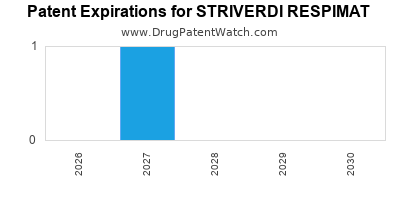
Striverdi Respimat is a drug marketed by Boehringer Ingelheim and is included in one NDA. There is one patent protecting this drug.

This drug has fifty-one patent family members in thirty-six countries.

The generic ingredient in STRIVERDI RESPIMAT is olodaterol hydrochloride. One supplier is listed for this compound. Additional details are available on the olodaterol hydrochloride profile page.

DrugPatentWatch® Generic Entry Outlook for Striverdi Respimat

Striverdi Respimat was eligible for patent challenges on July 31, 2018.

By analyzing the patents and regulatory protections it appears that the earliest date for generic entry will be January 19, 2027. This may change due to patent challenges or generic licensing.

There have been six patent litigation cases involving the patents protecting this drug, indicating strong interest in generic launch. Recent data indicate that 63% of patent challenges are decided in favor of the generic patent challenger and that 54% of successful patent challengers promptly launch generic drugs.

Indicators of Generic Entry

< Available with Subscription >

  Start Trial

AI Deep Research
Questions you can ask:
  • What is the 5 year forecast for STRIVERDI RESPIMAT?
  • What are the global sales for STRIVERDI RESPIMAT?
  • What is Average Wholesale Price for STRIVERDI RESPIMAT?
DrugPatentWatch® Estimated Loss of Exclusivity (LOE) Date for STRIVERDI RESPIMAT
Generic Entry Date for STRIVERDI RESPIMAT*:
Constraining patent/regulatory exclusivity:
NDA:
Dosage:

SPRAY, METERED;INHALATION

*The generic entry opportunity date is the latter of the last compound-claiming patent and the last regulatory exclusivity protection. Many factors can influence early or later generic entry. This date is provided as a rough estimate of generic entry potential and should not be used as an independent source.

Recent Clinical Trials for STRIVERDI RESPIMAT

Identify potential brand extensions & 505(b)(2) entrants

SponsorPhase
Università degli Studi di FerraraPhase 4
Boehringer Ingelheim

See all STRIVERDI RESPIMAT clinical trials

Pharmacology for STRIVERDI RESPIMAT

US Patents and Regulatory Information for STRIVERDI RESPIMAT

STRIVERDI RESPIMAT is protected by one US patents.

Based on analysis by DrugPatentWatch, the earliest date for a generic version of STRIVERDI RESPIMAT is ⤷  Start Trial.

This potential generic entry date is based on patent 7,727,984.

Generics may enter earlier, or later, based on new patent filings, patent extensions, patent invalidation, early generic licensing, generic entry preferences, and other factors.

Applicant Tradename Generic Name Dosage NDA Approval Date TE Type RLD RS Patent No. Patent Expiration Product Substance Delist Req. Exclusivity Expiration
Boehringer Ingelheim STRIVERDI RESPIMAT olodaterol hydrochloride SPRAY, METERED;INHALATION 203108-001 Jul 31, 2014 RX Yes Yes 7,727,984 ⤷  Start Trial Y ⤷  Start Trial
>Applicant >Tradename >Generic Name >Dosage >NDA >Approval Date >TE >Type >RLD >RS >Patent No. >Patent Expiration >Product >Substance >Delist Req. >Exclusivity Expiration

Expired US Patents for STRIVERDI RESPIMAT

Applicant Tradename Generic Name Dosage NDA Approval Date Patent No. Patent Expiration
Boehringer Ingelheim STRIVERDI RESPIMAT olodaterol hydrochloride SPRAY, METERED;INHALATION 203108-001 Jul 31, 2014 7,491,719 ⤷  Start Trial
Boehringer Ingelheim STRIVERDI RESPIMAT olodaterol hydrochloride SPRAY, METERED;INHALATION 203108-001 Jul 31, 2014 7,246,615 ⤷  Start Trial
Boehringer Ingelheim STRIVERDI RESPIMAT olodaterol hydrochloride SPRAY, METERED;INHALATION 203108-001 Jul 31, 2014 6,846,413 ⤷  Start Trial
>Applicant >Tradename >Generic Name >Dosage >NDA >Approval Date >Patent No. >Patent Expiration

International Patents for STRIVERDI RESPIMAT

See the table below for patents covering STRIVERDI RESPIMAT around the world.

Country Patent Number Title Estimated Expiration
Argentina 003794 DISPOSITIVO MINIATURIZADO PARA PRESURIZAR UN FLUIDO, DISPOSITIVO DE BOMBA ALTERNADORA PARA PRODUCIR ALTA PRESION EN UN FLUIDO Y PULVERIZADOR DE UN FLUIDO ⤷  Start Trial
Austria 248028 ⤷  Start Trial
Austria 352379 ⤷  Start Trial
>Country >Patent Number >Title >Estimated Expiration

Supplementary Protection Certificates for STRIVERDI RESPIMAT

Patent Number Supplementary Protection Certificate SPC Country SPC Expiration SPC Description
1562603 C300650 Netherlands ⤷  Start Trial PRODUCT NAME: OLODATEROL, OPTISCHE ISOPMEREN; NAT. REGISTRATION NO/DATE: RVG 112058 20131023; FIRST REGISTRATION:
1562603 PA2014012 Lithuania ⤷  Start Trial PRODUCT NAME: OLODATEROLUM; REGISTRATION NO/DATE: LT/1/13/3429/001 LT/1/13/3429/003 LT/1/13/3429/003 LT/1/13/3429/004 20131031
1562603 92433 Luxembourg ⤷  Start Trial PRODUCT NAME: OLODATEROL,SES ISOMERES OPTIQUES INDIVIDUELS,MELANGES D ENANTIOMERES INDIVIDUELS OU DE RACEMATES,SES SELS D ADDITION D ACIDE AVEC DES ACIDES PHARMACEUTIQUEMENT ACCEPTABLES,AINSI QUE SES SOLVATES ET/OU SES HYDRATES,EN PARTICULIER L OLODATEROL ET LE CHLORHYDRATE D OLODATEROL
>Patent Number >Supplementary Protection Certificate >SPC Country >SPC Expiration >SPC Description

STRIVERDI RESPIMAT (olodaterol/tiotropium) market dynamics and financial trajectory

Last updated: July 25, 2026

STRIVERDI RESPIMAT is a chronic obstructive pulmonary disease (COPD) maintenance inhaler with a fixed-dose combination of olodaterol (LABA) plus tiotropium (LAMA). Market dynamics since launch have been shaped by (1) entrenched inhaler competition in COPD, (2) payer and formulary tiering of branded maintenance therapies, and (3) ongoing patent and exclusivity timing that governs generic and “authorized” switching pathways. Financial trajectory in the US and EU follows a typical late-lifecycle branded pattern: early adoption post-launch with subsequent deceleration as competitive brands gained share and as payers tightened step-therapy and inhaler coverage rules.

What is STRIVERDI RESPIMAT and how is it positioned in COPD maintenance?

Featured snippet answer: STRIVERDI RESPIMAT is a once-daily COPD maintenance therapy delivered via the RESPIMAT soft-mist inhaler, combining olodaterol (LABA) and tiotropium (LAMA) for bronchodilation.

Active ingredient and regimen

  • Combination: olodaterol + tiotropium
  • Dosing: once daily (RESPIMAT inhalation)
  • Therapeutic area: COPD maintenance, symptom control and prevention of exacerbations (class positioning depends on guideline and local label interpretations)

Why payers and clinicians use LABA/LAMA combinations

  • COPD symptom reduction typically favors dual long-acting bronchodilation over monotherapy for moderate-to-severe disease
  • Once-daily convenience and inhaler usability are recurring drivers in retention

Competitive benchmark set

In COPD maintenance, STRIVERDI RESPIMAT’s practical peer set typically includes:

  • LAMA/LABA fixed-dose inhalers from incumbent manufacturers
  • Triple-therapy pathways (LAMA/LABA/ICS) where patients escalate based on exacerbation history and eosinophil profiles
  • Other once-daily LABA/LAMA options and multiple inhaler-device ecosystems

How has the COPD inhaler market evolved and where does STRIVERDI RESPIMAT sit?

Featured snippet answer: COPD inhaler markets have shifted toward combination maintenance, then toward triple therapy for higher-risk patients, while payers increasingly steer to formulary-preferred inhalers and lower-cost generics/biosimilars where available.

Market structure: dual maintenance to triple escalation

  • Step-up patterns are common: LABA/LAMA first, then add ICS for persistent symptoms or exacerbations
  • This creates an “effective churn” risk for dual-only therapies if triple use increases

Device and adherence effects

  • RESPIMAT competes on ease-of-use perception and dosing consistency versus pressurized metered-dose inhalers and dry powder inhalers
  • Real-world adherence and persistence can materially impact branded sales in maintenance COPD

Payer dynamics

  • Formulary strategies include preferred tiers for certain inhalers, requiring prior authorization for non-preferred products
  • Pharmacy benefit managers increasingly use net-price discounts and rebate structures to favor incumbent manufacturers

What revenue and sales trajectory has STRIVERDI RESPIMAT shown since launch?

Featured snippet answer: STRIVERDI RESPIMAT’s sales trajectory has followed a branded chronic-therapy lifecycle pattern: post-launch growth then maturation as competing LABA/LAMA products and triple therapies gained formulary share.

US trajectory mechanics (how sales typically move)

Key drivers that determine upward or downward sales pressure:

  1. Formulary placement vs competing LABA/LAMA brands
  2. Rebate levels and net-price competitiveness
  3. Switching for convenience or insurance coverage
  4. Patient mix: stable COPD vs exacerbation-prone patients

EU trajectory mechanics (how sales typically move)

EU dynamics differ by:

  • National tendering or reimbursement structures for inhalers
  • Device preference in specific health systems
  • Variability in COPD prescribing guidance and local payer rules

What financial “inflection points” mean in COPD

In practice, brands see inflection points when:

  • New competing products enter with stronger payer economics
  • Guideline shifts expand triple-therapy use
  • Generic or authorized-switch options emerge for components or equivalent combinations (depending on jurisdiction and patent status)

Which factors drive STRIVERDI RESPIMAT market share in COPD?

Featured snippet answer: Market share depends on formulary access, net pricing versus alternatives, clinician prescribing behavior, patient persistence, and the pace of triple-therapy uptake.

Formulary access and contracting

  • Preferred formulary status increases prescriptions, but often at cost via rebates and managed-entry agreements
  • Non-preferred status can still sustain baseline volume if clinicians view inhaler performance favorably and if prior authorization is not prohibitive

Clinical fit and patient selection

  • Patients with symptomatic COPD needing maintenance bronchodilation are the near-term base
  • Higher exacerbation risk can shift patients toward triple regimens, pressuring dual-LABA/LAMA products

Inhaler and adherence

  • RESPIMAT user experience influences persistence
  • Persistence is especially important for COPD maintenance because discontinuation risk compounds monthly

What are the key competitive products STRIVERDI RESPIMAT faces?

Featured snippet answer: STRIVERDI RESPIMAT competes primarily against LABA/LAMA combinations and secondarily against triple-therapy products when exacerbation risk escalates.

Direct category competition

Expect competitive pressure from:

  • Fixed-dose LABA/LAMA inhalers with similar dosing frequency
  • Device-adjacent competitors where payers steer based on contracting terms

Indirect competition from triple therapy

  • ICS-containing regimens capture exacerbation-prone segments
  • Once patients meet criteria for ICS add-on, dual bronchodilation can lose share absent an approved and reimbursed triple offering

How does STRIVERDI RESPIMAT pricing and net pricing typically behave versus competitors?

Featured snippet answer: Brand inhalers in COPD typically face net price compression from rebate intensity and competitive contracting, with patient out-of-pocket and plan tiers accelerating switching.

Net price drivers specific to inhalers

  • Rebate structures tied to formulary position
  • Volume-based commitments to secure “preferred” placement
  • Pharmacy contracting that favors a smaller set of devices

Consequence for financial trajectory

  • Revenue may stay stable while volume declines, or the reverse, depending on whether net-price concessions offset loss of share
  • Net price compression usually shows up as margin pressure even if topline remains resilient

What is the patent and exclusivity risk profile for STRIVERDI RESPIMAT?

Featured snippet answer: STRIVERDI RESPIMAT’s financial downside risk is tied to the timing of composition, method, and formulation-related patent expirations and any US regulatory exclusivities that delay generic entry.

Patent estate elements that typically matter

For COPD inhalers, the risk profile usually breaks into:

  • Active ingredient composition patents
  • Combination-related patents (LABA/LAMA dosing or specific combinations)
  • Formulation patents (particle engineering, excipient system)
  • Device-delivery or method-of-use patents
  • Exclusivities tied to first approval and any supplemental approvals

Generic entry mechanics that matter for inhalers

Even when active ingredients remain under protection,:

  • Indications or device-specific patents can be carved out by at-risk products
  • Label carve-outs can reduce substitution and preserve share
  • If combination products are unprotected but component patents remain, substitution can be slower and more controlled

What Paragraph IV or biosimilar-style challenges are relevant for STRIVERDI RESPIMAT?

Featured snippet answer: STRIVERDI RESPIMAT is a small-molecule inhaler, so the core US challenge risk is ANDA pathways, including Paragraph IV certifications where relevant to listed patents.

ANDA challenge pathways

  • Generic entrants file ANDAs seeking bioequivalence and rely on freedom-to-operate with respect to Orange Book-listed patents
  • Litigation typically centers on Orange Book patents that cover formulation, combination, or method-of-use

How litigation timing influences sales

  • Settlement agreements can trigger launch dates, “design-around” schedules, and at-risk product timing
  • Even absent a generic launch, litigation can affect payer behavior if uncertainty increases

What is the Orange Book status of STRIVERDI RESPIMAT and how does it affect generic risk?

Featured snippet answer: Orange Book status determines which patents are listed for the drug and which must be cleared or litigated before generic market entry.

Orange Book-driven decision points for manufacturers

  • Identify listed patents by expiration date
  • Map which patents are likely to be asserted in an ANDA litigation
  • Evaluate whether any non-listed patents still create practical barriers (for example, formulation or device patents filed outside the Orange Book scope)

When does STRIVERDI RESPIMAT lose exclusivity and what does that imply for commercial outlook?

Featured snippet answer: Exclusivity loss is the single biggest structural driver of future sales compression for branded inhalers, because it determines whether generics can enter unopposed or only after a settlement.

Commercial implication of exclusivity windows

  • Inside the exclusivity window, generics are typically delayed and share is defended via contracting
  • As expirations approach, payer “plan design” often shifts in anticipation of switching to lower-cost alternatives
  • After launch, branded inhaler share typically declines rapidly, then stabilizes based on remaining differentiation and adherence effects

How do FDA regulatory events affect STRIVERDI RESPIMAT revenue?

Featured snippet answer: FDA label changes and manufacturing/quality approvals can alter prescriber comfort, payer authorization rules, and the ability to switch patients within plan formularies.

Regulatory event types that matter commercially

  • Supplemental approvals expanding label scope can extend addressable population
  • Device or formulation manufacturing changes can affect supply reliability, which directly impacts sales
  • Any REMS-like constraints are less common for inhaled small molecules, so supply and labeling changes are the more frequent practical issues

What financial sensitivities should investors or licensors model for STRIVERDI RESPIMAT?

Featured snippet answer: Model sensitivity across three axes: volume (prescriptions/persistence), net pricing (rebates/discounts), and exclusivity-driven switching (generic timing).

Sensitivity model (inputs that drive outcomes)

  • Market share and persistence rates by payer segment
  • Rebate intensity assumptions and formulary shifts
  • Timing and likelihood of generic launch versus settlement
  • Competitive response from incumbent brands and lifecycle management (variant formulations, device changes, or add-on triples)

Outcome range logic (how results typically skew)

  • If STRIVERDI maintains preferred status through net price discipline, revenue can remain resilient longer
  • If payer tiering turns against STRIVERDI, volume falls first and net price fails to fully compensate
  • If generics enter on a schedule earlier than modeled, revenue compresses faster than normal branded declines

How does STRIVERDI RESPIMAT compare with key COPD LABA/LAMA rivals on competitive and commercial posture?

Featured snippet answer: STRIVERDI’s competitive posture is primarily determined by payer access and device-adherence tradeoffs rather than by a clinically unique profile that routinely overrides formulary economics.

Comparison dimensions that move share

  • Dosing frequency and device experience
  • Label positioning and clinician familiarity
  • Contracting strength and net price relative to peer LABA/LAMA products
  • Triple-therapy displacement risk for exacerbation-prone subpopulations

What generic entry risks exist for STRIVERDI RESPIMAT?

Featured snippet answer: Generic entry risk hinges on Orange Book patent listings and litigation outcomes for formulation/combination patents that preserve or remove substitution barriers.

Generic risk scenarios

  • Scenario A: At-risk launch aligned to Orange Book patent expirations without settlement
  • Scenario B: Earlier-than-expected settlement that sets launch dates
  • Scenario C: Sustained litigation that delays launch and forces “authorized switches” rather than full generic replacement

Key timelines and checkpoints investors should track

Featured snippet answer: The commercial storyline is dominated by exclusivity and litigation milestones: Orange Book expirations, ANDA filing/litigation, and any settlement-triggered launch dates.

Timeline checklist

  • Orange Book patent expiration sequencing for formulation and combination coverage
  • ANDA filing and Paragraph IV certifications (where applicable)
  • District court rulings and Federal Circuit outcomes
  • Settlement agreements and agreed generic launch dates
  • Post-launch switching patterns and net price erosion pace

Key Takeaways

  • STRIVERDI RESPIMAT is a COPD LABA/LAMA maintenance inhaler whose market performance depends on formulary access, net pricing, and persistence, with payer-driven switching risks increasing as triple therapy expands.
  • Financial trajectory typically shows early adoption followed by maturity and then structurally driven compression when exclusivity ends and generic/authorized alternatives enter.
  • Exclusivity and Orange Book-listed patents determine the timing and mechanics of generic risk, which in turn drives revenue modeling, contracting strategy, and litigation exposure.

FAQs

  1. How do COPD payer formulary rules decide between LABA/LAMA inhalers like STRIVERDI RESPIMAT?
  2. What factors determine whether a COPD inhaler brand retains prescriptions after generic launch?
  3. How do method-of-use and formulation patents affect ANDA design-around strategies for combination inhalers?
  4. What are the typical impacts of switching from dual therapy to triple therapy on LABA/LAMA sales?
  5. How should investors model net price erosion for branded inhaled therapies during generic entry windows?

References

  1. FDA. Orange Book: Approved Drug Products with Therapeutic Equivalence Evaluations. U.S. Food and Drug Administration. https://www.accessdata.fda.gov/scripts/cder/daf/ (accessed 2026-07-25)
  2. FDA. Drug Approval Reports and Label Information. U.S. Food and Drug Administration. https://www.accessdata.fda.gov/scripts/cder/daf/ (accessed 2026-07-25)

More… ↓

⤷  Start Trial

Make Better Decisions: Try a trial or see plans & pricing

Drugs may be covered by multiple patents or regulatory protections. All trademarks and applicant names are the property of their respective owners or licensors. Although great care is taken in the proper and correct provision of this service, thinkBiotech LLC does not accept any responsibility for possible consequences of errors or omissions in the provided data. The data presented herein is for information purposes only. There is no warranty that the data contained herein is error free. We do not provide individual investment advice. This service is not registered with any financial regulatory agency. The information we publish is educational only and based on our opinions plus our models. By using DrugPatentWatch you acknowledge that we do not provide personalized recommendations or advice. thinkBiotech performs no independent verification of facts as provided by public sources nor are attempts made to provide legal or investing advice. Any reliance on data provided herein is done solely at the discretion of the user. Users of this service are advised to seek professional advice and independent confirmation before considering acting on any of the provided information. thinkBiotech LLC reserves the right to amend, extend or withdraw any part or all of the offered service without notice.